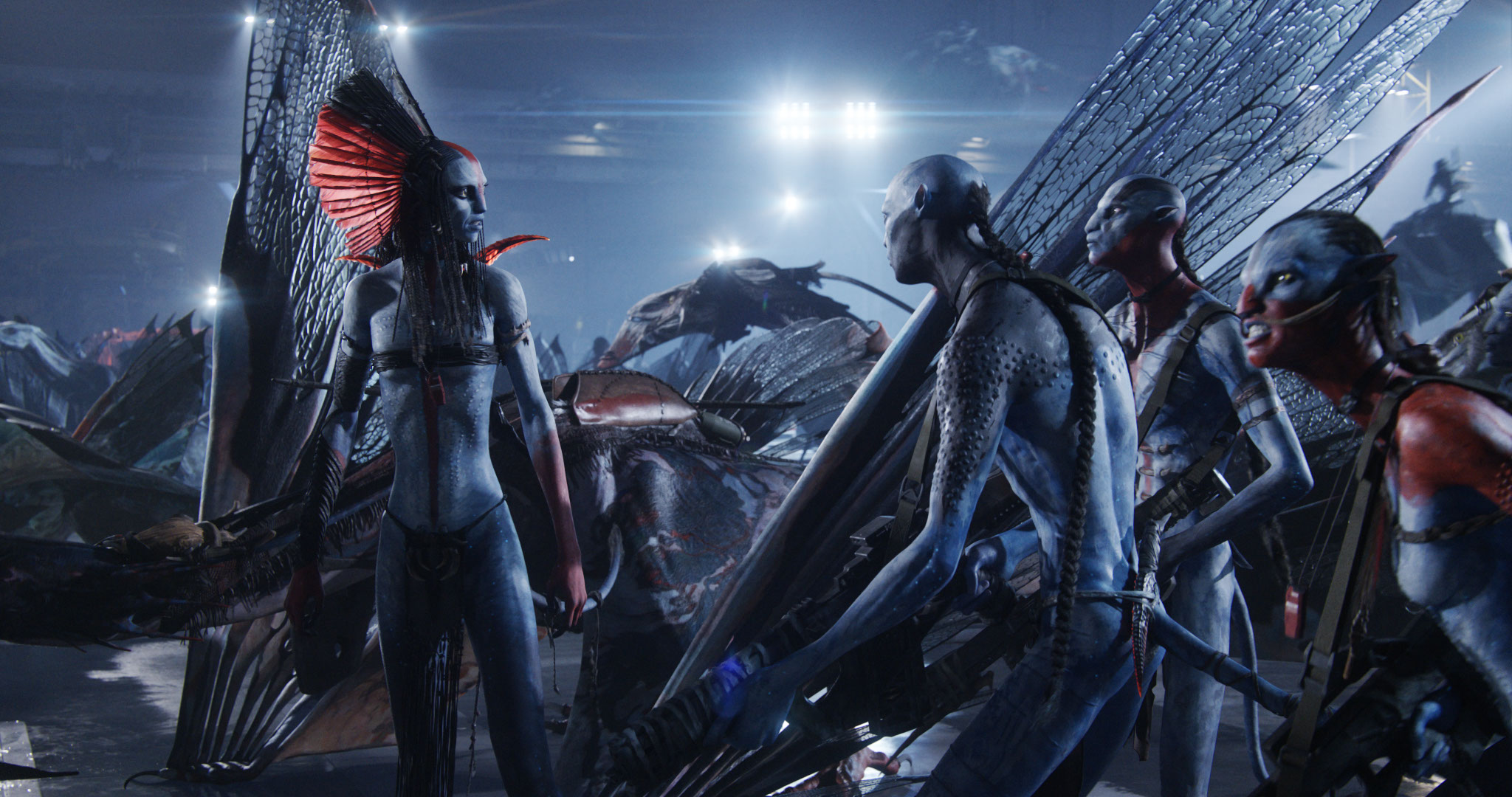
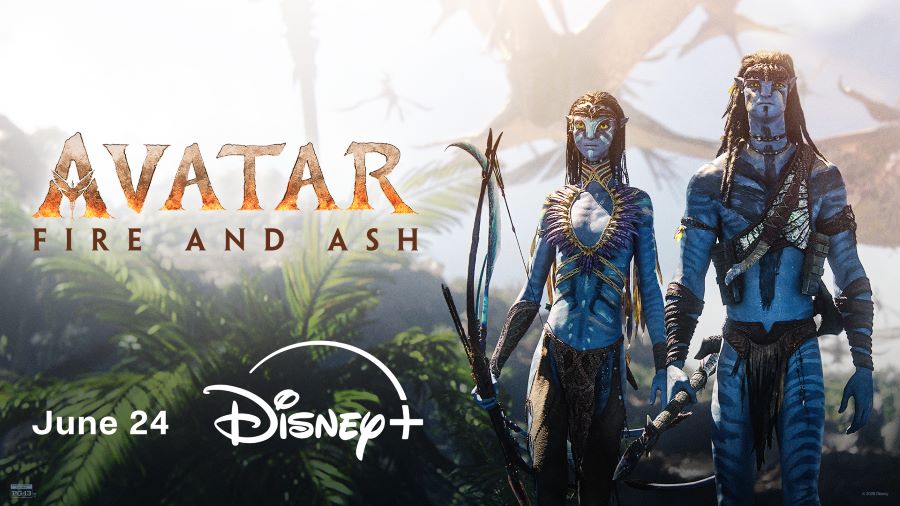
Disney+ Media Relations has officially announced that James Cameron’s Oscar®-winning global blockbuster, Avatar: Fire and Ash, will stream exclusively on Disney+ starting June 24.
The third film in the phenomenally successful Avatar franchise was a major theatrical event upon its December 2025 release. It grossed a worldwide total of $1.48 billion and earned an Academy Award® for Best Visual Effects. The film was praised by critics and fans alike for its grand spectacle, thrilling action, and “spectacular visual effects, dazzling new environments, and stunning new creatures“.
The movie dominated the domestic box office for five consecutive weeks. However, its theatrical staying power did not match its predecessors, as it fell out of the top five in only its seventh weekend of release, a record pace compared to the original Avatar (12th weekend) and The Way of Water (11th weekend). Despite this, it was reported to be holding stronger than its 2022 predecessor in the early weeks of its run.
The film will join the existing Avatar Collection on Disney+, which includes the first two installments in the series and the documentary Fire And Water: Making The Avatar Films.
Synopsis and Creative Team
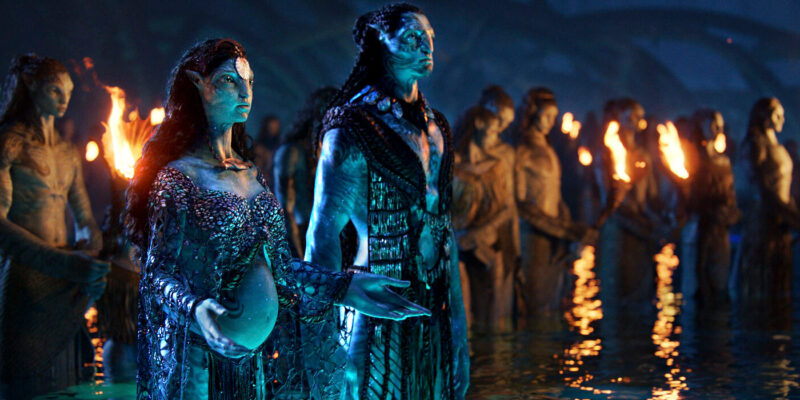
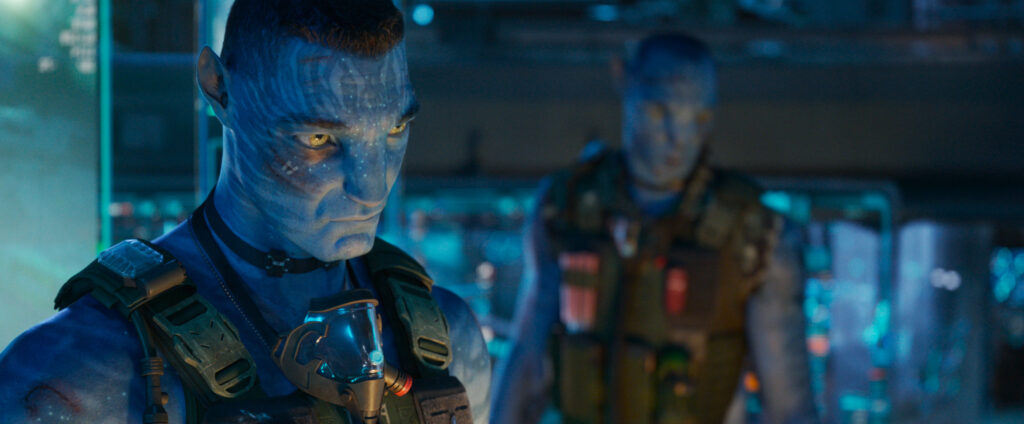
Avatar: Fire and Ash returns audiences to Pandora with Marine turned Na’vi leader Jake Sully (Sam Worthington), Na’vi warrior Neytiri (Zoe Saldaña), and the Sully family. After living amongst the Metkayina Clan in Pandora’s picturesque reefs, and still recovering from a family member’s death at the hands of the RDA, the Sullys attempt to protect another loved one. Aiding them are the peaceful Tlalim Clan, also known as the Wind Traders, who sail the skies. However, their journey is cut short when they are attacked by members of the Mangkwan Clan, or the Ash People, who blame the deity Eywa for the volcanic devastation of their home.
The Oscar®-winning film was directed by James Cameron and features a screenplay by Cameron, Rick Jaffa, and Amanda Silver. The story was crafted by Cameron, Jaffa, Silver, Josh Friedman, and Shane Salerno. The all-star cast features Sam Worthington, Zoe Saldaña, Sigourney Weaver, Stephen Lang, Kate Winslet, Cliff Curtis, Oona Chaplin, Jack Champion, and Britain Dalton, among others.
Since acquiring 20th Century Studios from Fox in 2019, Disney has had its hands full managing legacy IPs. We’ve seen the studio struggle to find its footing with some franchises, but if there is one golden rule in Hollywood that has remained undefeated for nearly 40 years, it is this: Never. Bet. Against. James. Cameron.
For over a decade, the internet echo chamber loved to shout that Avatar had “no cultural impact.” Nobody cared about the Na’vi. Nobody cared about Dances with Space Wolves. And then The Way of Water dropped, silenced the haters, and casually grossed $2.3 billion. Now, as we stare down the barrel of the third installment, Avatar: Fire and Ash, it’s clear that Cameron isn’t just making movies; he’s crafting a generational mythology. Before dissecting whether or not Cameron managed to catch lightning in a bottle for a third time, a look back is required.
In 2009, James Cameron decided to change cinema forever, and he succeeded.
Avatar introduced Jake Sully, a paraplegic Marine who took his brother’s spot in the Avatar Program. The mission was simple: infiltrate the Omaticaya clan, gain their trust, and convince them to move so the RDA could mine their Unobtainium. But Cameron doesn’t do simple.
The Turn: Jake fell hard for Neytiri and the spiritual depth of the Na’vi. He realized that while Earth was dying, Pandora was living–and worth dying for.
The Big Bad: Colonel Miles Quaritch. The guy drank coffee while piloting a mech and wanted nothing more than to burn Hometree to the ground.
The Climax: Jake went full native, tamed the Toruk to become Toruk Makto, and united the clans to send the Sky People packing. He transferred his consciousness permanently into his Avatar body, leaving his human life behind.
A visual masterpiece, Avatar set the stage for Cameron’s incredibly ambitious plans.
Avatar: The Way of Water (2022): The Resurgence
Fast forward 13 years. The “no cultural impact” crowd was loud, but Cameron was louder.
Jake and Neytiri had been busy raising a squad: Neteyam (the dutiful oldest), Lo’ak (the rebellious second son), Tuk (the adorable youngest), and Kiri (Grace Augustine’s mysterious daughter with a God-tier connection to Eywa). They even took in Spider, a human kid who–in one of the franchise’s best twists–is Quaritch’s son.
And speaking of Quaritch, the RDA brought him back as a Recombinant Avatar. He’s blue, he’s angry, and he’s hunting Jake.
The Shift: Realizing his presence put the forest in danger, Jake resigned as leader. The family fled to the Metkayina, the reef people. This was a bold move by Cameron, taking the Sullys and the audience out of the familiar forest and forcing both to learn the way of water.
The Heartbreak: The RDA wasn’t just hunting Jake; they were hunting Tulkun (sentient space whales) for Amrita, the new immortality serum. In the final, brutal confrontation, Cameron delivered a gut punch that grounded the spectacle in real, raw loss when Neteyam was killed.
The Lesson: Jake realized that running is a fool’s game. “This is our fortress.” The Sullys are done hiding.
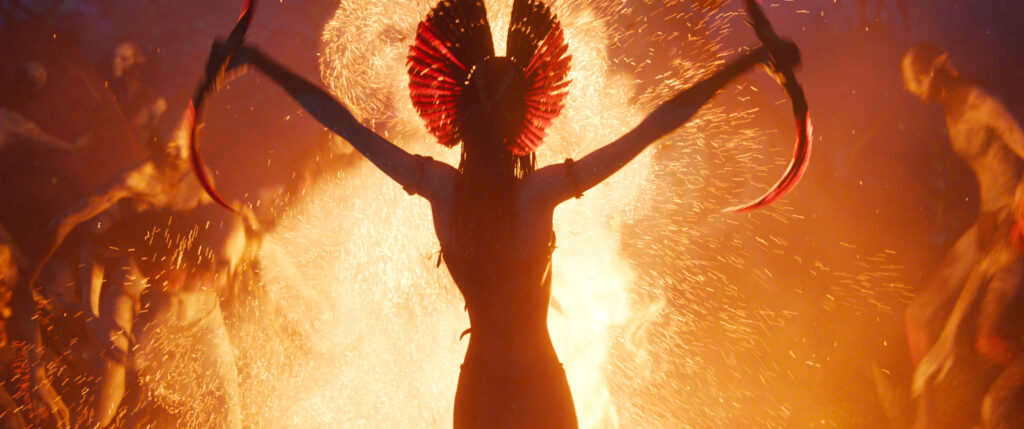
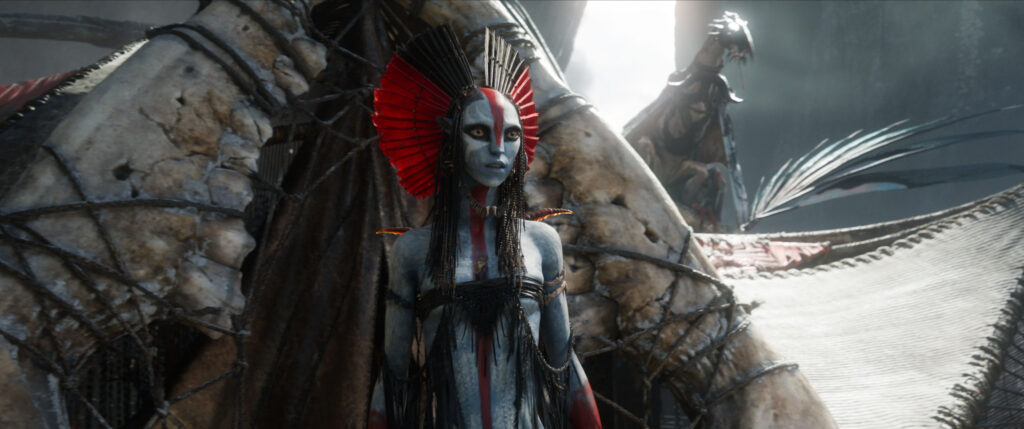
We’ve seen the forest, and we’ve seen the ocean; now, Cameron is dragging us into the fire. If Avatar: The Way of Water was about protection, Avatar: Fire and Ash is about aggression. And aggression is a central and organizing theme of the third installment in the franchise. Avatar: Fire and Ash introduces the Mangkwan clan– the Ash People–a volcanic tribe who have suffered greatly. Unlike the forest and reef clans who live in harmony with Eywa, the Ash People have been twisted by their suffering to become vengeful and aggressive, a far cry from the Metkayina. Radicalized by their suffering, the Mangkwan and their leader, the Nightsister-coded Varang, hold a deconstructivist mirror up to the prior installments in the franchise, proving that not all Na’vi are inherently good and allowing for the exploration of how experience can shape morality.
Heading into Avatar: Fire and Ash, the heroes and villains of Pandora find themselves much changed from their original selves and those changes and the chaos that has accompanied them drive the film’s first two acts.
Mourning a son, Jake and Neytiri find themselves challenged by grief and rage, with each of them handling things differently but, unfortunately, separately. Having been saved by Spider, Quartich is still out there, carrying a heavy grudge. As awful as Quaritch is, he’s really nothing more than Jake’s nemesis, whereas the RDA–now establishing a permanent footprint in Bridgehead–has begun colonizing the planet and doing what humans do worst. And, of course, the wildcard in the mix is Kiri, with her inexplicable connection to Pandora’s super organism/goddess, Eywa, still serving as a potential game changer.
To speak bluntly, Avatar: Fire and Ash does not spin the most compelling or surprising yarn, often repeating beats from Avatar: The Way of Water. The plot, while not poorly conceived will neither surprise nor disappoint; however, it’s predictable nature at no point detracts from the enjoyment of the film. In my screening, I found myself less-than-engrossed in the story for only one ten-minute stretch of the 190+ minute movie and that’s because, as you might expect, Cameron‘s inclination to prioritize spectacle is on grand display. Ancient Tulkun that dwarf what we’ve seen before, battles over sky and sea that captivate and hold stakes and set pieces worthy of the Dolby experience Cameron intends audiences to have all make Avatar: Fire and Ash exactly the type of film that demands to be seen in a theater.
It’s not all eye candy, though. For its lack of a truly surprising plot, the third installment in the franchise does allow for its main characters to grow. With war upon them, the Sullys must choose whether to be consumed by their grief or repair the rift that remains from the death of Neteyam. It is to this end that the Mangkwan serve as a wonderfully conceived foil for everything the audience has come to understand about the Na’vi and the Sullys. In the case of Neytiri, Oona Chaplin‘s Varang is less of a dark shadow of who she is and more of a projection of who she may become if she allows her own personal fire to burn what she still has to ash.
While Cameron has plans for another pair of films in the franchise, there’s no guarantee those will come to fruition. If that becomes the case and Avatar is ultimately a trilogy, Fire and Ash ensures that Cameron will have accomplished everything he set out to do. Not only has he continued to push the boundaries of technology in film, he’s created a series of parables that have spread his message of conservation, family dynamics and the universal desire to belong. If there’s one point among those that Fire and Ash makes most salient, it’s the final one and it does so in a way that’s reverential to the entire trilogy while also serving as the perfect conclusion to the Avatar story if it does not continue. Its a beautiful and fitting end cap to what’s been a beautiful and fitting examination of our time.
Sixteen years ago, James Cameron introduced audiences to the world of Pandora in Avatar. Three years ago, Avatar: The Way of Water expanded the mythology of Pandora’s interconnected biosphere while once again stretching the boundaries of filmmaking. In just a few weeks, the next installment in the franchise, Avatar: Fire and Ash, hits theaters, introducing new villains while keeping the focus on the Sully family.
The film screened for critics ahead of its December 19th release and following the lifting of the social media embargo, reactions to the film have arrived online. As always, it’s worth noting that these types of reactions don’t always line up with full-length reviews from critics; however, they can provide a glimpse of what to expect. In this case, one thing seems clear: Cameron has crafted another stunning visual masterpiece.
I am a full-blown 3D hater. Have always felt it was just a gimmick to take cash. That said, I can't imagine seeing #AvatarFireandAsh any other way. Cameron's use of 3D technology (saw it at a Dolby theater) is incredible and truly adds to the experience. pic.twitter.com/Ih4HVnIlGp
For 3 hours and 15 minutes, I was transported to Pandora! Avatar: Fire and Ash is more than a movie,it’s an experience. James Cameron pushes the boundaries of filmmaking, but the performances are the real stars. Spider is the heart of the film, and Quaritch gets great one-liners! pic.twitter.com/zCHSmTzR7Q
Avatar: Fire and Ash is stunning. A true triumph. James Cameron has crafted a beautiful movie that is among the most satisfying of the year. Across the board, it’s got everything you’d want out of a spectacle at the movie theater. #Avatarpic.twitter.com/x6CqGBF2kJ
#AvatarFireAndAsh: 3 films in, James Cameron still has the sauce, making the epic spectacular feel emotionally impactful. A glorious saga. Bold, brilliant & awesome in every way, this is what movie theaters were built for. Payakan is still my fave, but Varang is the MVP. pic.twitter.com/zs1BjCTYmZ
#AvatarFireAndAsh is the CINEMATIC EVENT of the year you need to see to believe. James Cameron has delivered a MASSIVE VISUAL MASTERPIECE where every frame combusts with creativity and the best VFX ever put to screen. Pandora has never felt more real or emotionally resonant. pic.twitter.com/XfZlQFlUkb
#Avatar FIRE AND ASH is a knockout. An epic that delivers on an enormous scale, with the characters & worldbuilding paying off surprising dividends. It's a delight to see a film be this big while still being a narratively & visually bold work of science-fiction. The best one yet. pic.twitter.com/2bu9DGrg9r
AVATAR: FIRE AND ASH is truly a marvelous cinematic experience. James Cameron goes all out with bigger sequences, more action, and some of the most stunning shots I've ever seen in my life. Oona Chaplins VARANG steals it. This truly was a ride I didn't want to end. #Avatarpic.twitter.com/HjfUvWbHgN
Cameron has spent an enormous amount of time, effort and money on pushing VFX to their limits to create an immersive experience for the audience. In this case, according to Cameron, that involves seeing the film in theaters with 3D Dolby Vision and Atmos, as was the case with the previous film.
The previous two films scored 81% and 76% Fresh scores on Rotten Tomatoes, respectively, and while Fire and Ash does retread familiar franchise territory to some extent, it’s likely to accrue a similar score while also blowing up the box office.
Cookie Consent
We use cookies to improve your experience on our site. By using our site, you consent to cookies.
This website uses cookies
Websites store cookies to enhance functionality and personalise your experience. You can manage your preferences, but blocking some cookies may impact site performance and services.
Essential cookies enable basic functions and are necessary for the proper function of the website.
Name
Description
Duration
Cookie Preferences
This cookie is used to store the user's cookie consent preferences.
30 days
These cookies are needed for adding comments on this website.
Name
Description
Duration
comment_author_email
Used to track the user across multiple sessions.
Session
comment_author_url
Used to track the user across multiple sessions.
Session
comment_author
Used to track the user across multiple sessions.
Session
Statistics cookies collect information anonymously. This information helps us understand how visitors use our website.
Google Analytics is a powerful tool that tracks and analyzes website traffic for informed marketing decisions.
Contains information related to marketing campaigns of the user. These are shared with Google AdWords / Google Ads when the Google Ads and Google Analytics accounts are linked together.
90 days
__utma
ID used to identify users and sessions
2 years after last activity
__utmt
Used to monitor number of Google Analytics server requests
10 minutes
__utmb
Used to distinguish new sessions and visits. This cookie is set when the GA.js javascript library is loaded and there is no existing __utmb cookie. The cookie is updated every time data is sent to the Google Analytics server.
30 minutes after last activity
__utmc
Used only with old Urchin versions of Google Analytics and not with GA.js. Was used to distinguish between new sessions and visits at the end of a session.
End of session (browser)
__utmz
Contains information about the traffic source or campaign that directed user to the website. The cookie is set when the GA.js javascript is loaded and updated when data is sent to the Google Anaytics server
6 months after last activity
__utmv
Contains custom information set by the web developer via the _setCustomVar method in Google Analytics. This cookie is updated every time new data is sent to the Google Analytics server.
2 years after last activity
__utmx
Used to determine whether a user is included in an A / B or Multivariate test.
18 months
_ga
ID used to identify users
2 years
_gali
Used by Google Analytics to determine which links on a page are being clicked
30 seconds
_ga_
ID used to identify users
2 years
_gid
ID used to identify users for 24 hours after last activity
24 hours
_gat
Used to monitor number of Google Analytics server requests when using Google Tag Manager
1 minute
Marketing cookies are used to follow visitors to websites. The intention is to show ads that are relevant and engaging to the individual user.
Pinterest Tag is a web analytics service that tracks and reports website traffic.