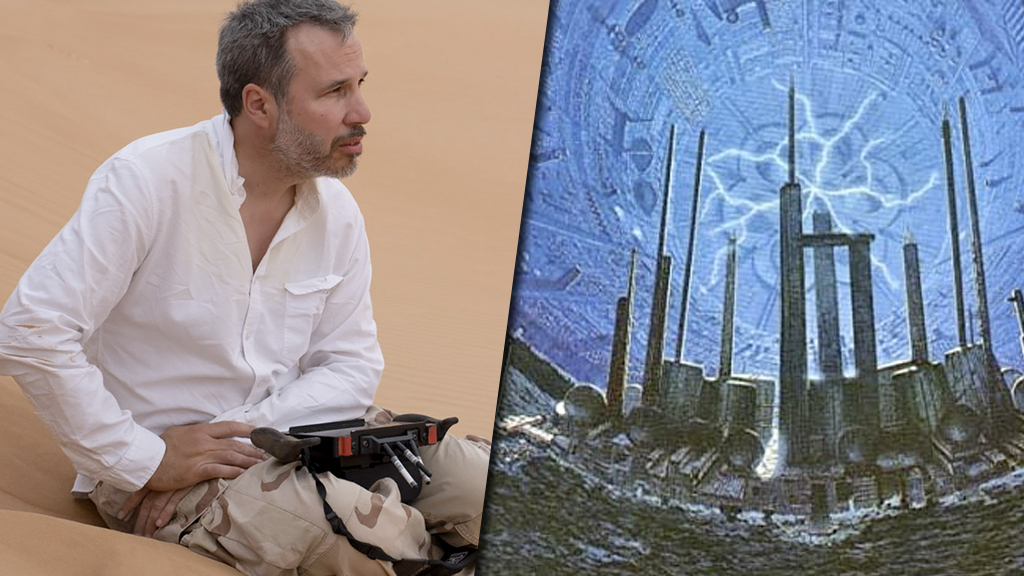
Dune‘s success has caused a resurgence of ambitious sci-fi in mainstream cinema. In addition to the announcement of a sequel to Villeneuve‘s new franchise, we now received word that Warner Bros. has plans to adapt Hyperion, another genre classic. Today, The Hollywood Reporter reported thatthe director will tackle the adaptation of another sci-fi novel, this time by Arthur C. Clarke, the mastermind behind 2001: A Space Odyssey, titled Rendezvous with Rama.
The story of Rendezvous with Rama follows a group of human space explorers that are tasked with intercepting an alien starship that is hurtling through the solar system. It is believed that the missions will lead to mankind’s first contact with alien intelligence.
The film will be produced for Alcon Entertainment Studios and Morgan Freeman will be one of the producers. At the moment, Villeneuve has plenty of projects he’s actively working on. In addition to the film adaptation of Clarke‘s book, he has the mentioned sequel to Dune (and a potential third installment), the Dune: Sisterhood series, the HBO limited series The Son with Jake Gyllenhaal, and the long-announced Cleopatra, where Angeline Jolie at one point was involved.
Just a month ago, Kevin Feige announced that he was working with Scarlett Johansson on an untitled project for Marvel Studios. She is moving on to a new role s producer after her first solo outing in Black Widow. There has been a lot of speculation as to what project this might be about, such as a film inspired by the comic series A-Force or a spin-off to Black Widow movie. In a recent interview with Collider, Johansson shared her motivations for being a producer for multiple films as well as working for Marvel.
I have worked for 30 years, which is insane when I say it out loud, but I think I just understand the efficiency of how productions run and how you thin the fat on a production and make things well oiled.
Scarlett Johansson
With that much experience, it seems like a natural move to tackle a project as a producer, and it seems that the freedom Marvel Studios offers is exactly the kind of thing
As far as Marvel goes, it’s like working with family there. Marvel has some of the best IP ever and you can really dream big there and nothing’s ever off the table and you kind of throw all these blue sky ideas around and see what sticks. It’s like a creative playground that’s just like a dream. Again, I have that shorthand with my fellow creatives there that comes from being in the world for 10 years with those guys.
Scarlett Johansson
Sadly, she still doesn’t give away what project she is working on, but she certainly seems excited about tackling the new project. Of course, it seems very likely that she’s tackling a film next, but there is a chance a Disney+ series is also involved in some capacity. Some Marvel Studios actors have been moving into producing or even directing roles and it’ll be interesting to see who else might join her.
Spider-Man: Far From Home is the final movie in our retrospective, as well as the last Spider-Man movie released in theaters (for now). 2019 was a special time for Marvel fans. After the massive event that was Avengers: Endgame, Spider-Man was meant to bring audiences into a period of rest between phases, as well as reframe what we can expect from the franchise’s future. However, the film’s most important task was to bring Peter out of Iron Man’s shadow and set him on his path.
Spider-Man: Far From Home, which takes place a few months after the events of Avengers: Endgame, tells the story of Peter Parker and his closest friends going on a well-deserved vacation to Europe. Peter’s idyll is interrupted when Nick Fury comes to him asking for help as mysterious multiversal beasts are ravaging the continent. At least, that’s what the movie wants you to believe.
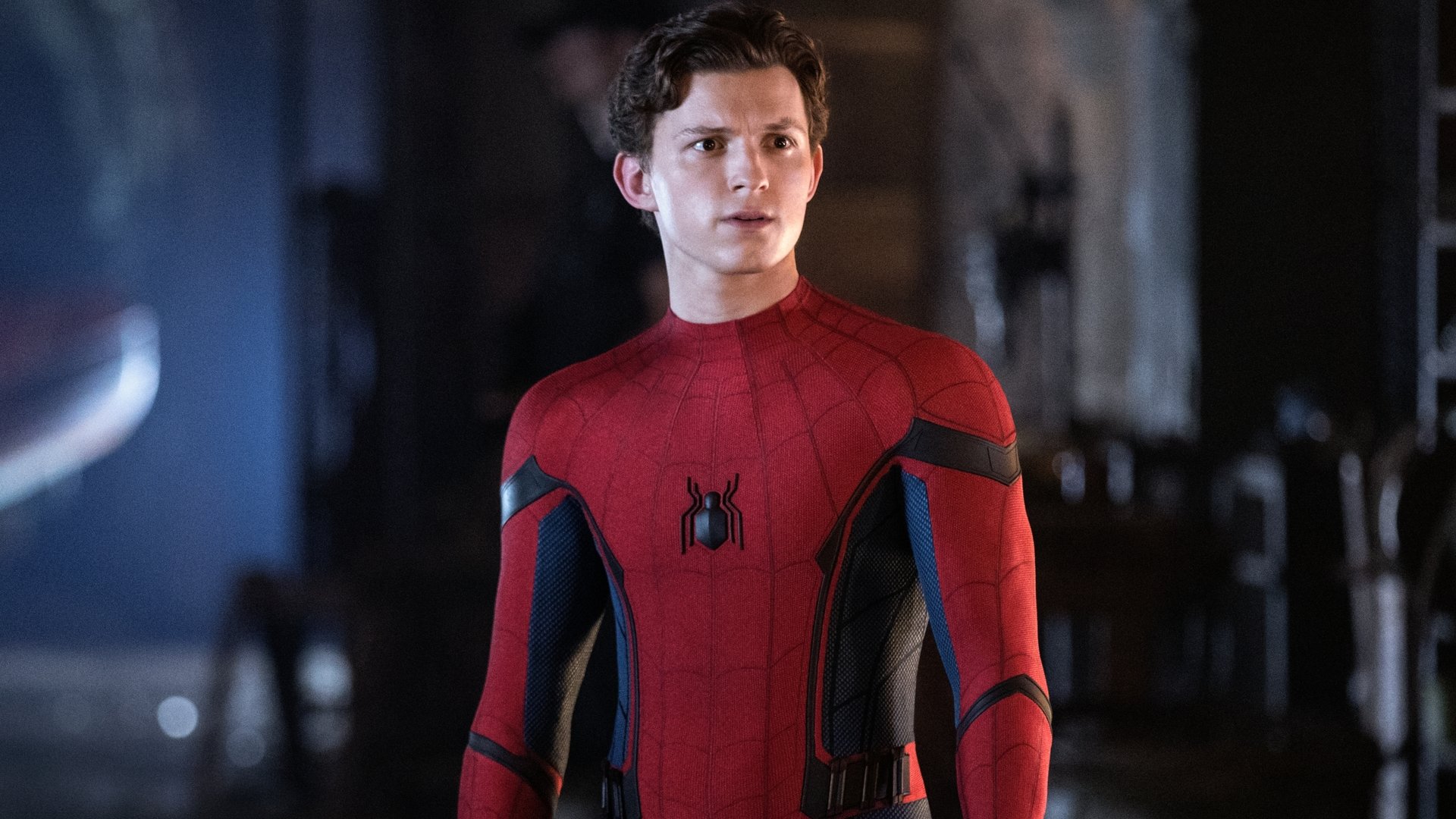
In the film, Peter Parker(Tom Holland) undergoes a very significant character development in the context of the entire universe, which is somewhat like a reversal of his storyline from Homecoming. After his cosmic journey, Peter wants to rest, he does not want to be put in the role of the successor of Iron Man whose death still haunts him. The public sees him as Stark’s successor, but the teenager prefers to forget about that and focus on declaring his love for MJ (Zendaya). This escapist motivation of Peter’s is very believable and, with the tragic events of his previous two films in mind, we root for him to realize his current plans.
What I loved most about the film was just all the holiday moments of Peter and his friends. I was also captivated by the childlike naivety and awkwardness of his relationship with MJ, which has a lot of heart and charm. Yet, Ned (Jacob Batalon) didn’t leave a great impression on me because of the fact he doesn’t have much to do in this film. The filmmakers gave him a romance with Betty (Anguire Rice), which ends as suddenly as it beings, and nothing comes from that eventually. Flash Thompson (Tony Revolori) is also worth mentioning, as his character has a nice little arc across the two Spider-Man movies. He’s in the background, but Watts outlines his sad life through some visual means. The ending of Far From Home certainly brought a lot of confusion and moral conflict into his life.
This escape, or rather conflict with being the successor to Iron Man has its narrative center in the extremely advanced E.D.I.T.H. technology. It allows the bearer to access a satellite and hundreds of drones. This plotline is by far my biggest problem with the film, which posthumously puts Stark in the rather reckless role of a mentor who took a carefully considered approach to Parker’s superheroic growth. Giving a teenager access to arguably one of the most advanced technologies of mass destruction is too much for me, and I have a hard time accepting this plot.
On the other side, we have Jake Gyllenhaal as Quentin Beck a.ka. Mysterio is a former Stark Industries employee responsible for creatingB.A.R.F., the technology that was first introduced in Captain America: Civil War. I’m a huge fan of revisiting this tech, as I’ve always liked it when the MCU taps into themes that were teased or underdeveloped somewhere in a previous film. Gyllenhaal, of course, is very convincing in his role. He’s a bit goofy and over-expressive, but I think that makes this character interesting and memorable. On paper, this is another bad Stark’s villain, only this time we have a collective of Stark’s ex-employees.
What’s worth noting is thatFar From Home is a very metatextual film and there are quite a few allusions in the story to the very shape of the MCU, our relationship with the universe, and the image of VFX artists. This auto thematicapproach is something original and interesting within the MCU. The closing film of the Infinity Saga was perfect to address this kind of issue. We are put in the role of students who are going on a well-deserved vacation after years of intensely following the development of the universe, and the production is meant to put us in a sort of lethargy between phases.
The film communicates more than once that it is time to move on and to cut off certain attachments that still weigh on us, such as our relationship with Stark, which is well emphasized by Peter’s plot. On that note, the final scene with the swinging between Manhattan buildings is my favorite sequence in the film. It symbolizes a new era in Peter’s life, the MCU, and sets us, viewers, up for new and equally exciting adventures.
It also manifests itself in terms of special effects and the role of VFX artists in the filmmaking community. The storyline of Beck and his crew present how VFX artists are devalued in film discourse and how their immense contribution to history is often forgotten. This is a very interesting theme, considering how this actually plays out and the intensity with which people can trivialize aspects of special effects. Leaving that aside, the effects in Far From Home are on a really high level and the Mysterio illusion sequences or the third act are in my opinion the top of the MCU when it comes to visuals.
Spider-Man: Far From Home is a movie that perfectly fits into the post-Endgame reality, bringing Peter and us into a new era in the universe while giving us a lot of breathing room and a more relaxed atmosphere. I have a few gripes with this film, but Peter’s journey and the meta-narrative are interesting and engaging enough for me to like the film as well as its message. We’ll see how the sequel builds upon it.
Hawkeye’s two-episode premiere introduced us to a couple of new characters in the Marvel Cinematic universe. In addition to Kate Bishop and Jack Duquesne, we have been introduced to the hilariously adorable Tracksuit Mafia, which consists of Eastern Europeans who call everyone “bro” a lot. One of its most prominent members wasTomas played by Piotr Adamczyk. In an exclusive interview, he shared some insight into what it was like being on set, especially when Marvel Studios president Kevin Feige visited.
He was on the set. It was very special for us. He talked to everyone, so I had a chance to talk to him, and I was also surprised that for him this mafia, tracksuit mafia, is an important element. He even told us that it was a very significant element of the story.
Piotr Adamczyk
It highlights one of the reasons for Marvel Studios’ success is that Kevin Feige and the rest of the producers are comic geeks and care about properly adapting certain comic book elements. The Tracksuit Mafia was an iconic part of the comic My Life as a Weapon, and it’s no surprise that Feige‘s meticulous attention to this aspect is being taken to reflect them well in the series. Yet, Adamczyk highlights that it was a very different experience on set:
We didn’t feel like that at that time, because we were mainly the group that was waiting to be needed, maybe they would use us. We were often on the set but not always working. Working on the set, especially of such a big, big-budget production, is waiting, especially if you’re not Jeremy Renner. But yes, it was an exceptional conversation, very uplifting. This is also a man who, with such a huge presence, is always in a hat, in sneakers, this is just a regular guy you can talk to casually.
Piotr Adamczyk
As Adamczyk highlights, a lot of working on these kinds of projects is waiting. Actors are around for specific scenes and with the Tracksuit Mafia’s presence throughout the story, they might have to wait around quite a bit. So, it’s great to see how approachable Feige is for cast members of any kind to chat with him. There’s a lot of care put into these projects by the various teams involved with the production.
It looks like another actor has joined HBO’s The Last of Us.
A new listing on IMDb suggests that actor Brendan Fletcher has joined the series’ cast as Robert, one of the first antagonists to cross Joel and Tress’ path in the game. Robert is an arms dealer and one of the first antagonists in the game who owed guns to Joel and Tess but ended up selling them to the Fireflies.
Filming on HBO’s The Last of Us is currently underway in Calgary, Alberta. Production has been ongoing since July, with reports suggesting it won’t wrap until June 2022. The series is being produced by Naughty Dog Studios, the studio behind the hugely successful video games. The Last of Us stars Pedro Pascal as Joel who is tasked with helping to escort Bella Ramsey‘s Ellie out of the quarantine zone in a post-apocalyptic United States.
Fletcher is perhaps best known for the Rampage series, Arrow and his performance in Iñárritu’s The Revenant.
While a release date has not yet been announced, The Last of Us may hit HBO Max late in 2022. Of course, with a rich world to bring to life – one that includes a fair share of zombies – it’s possible the series could see a 2023 release. For now, fans can get excited knowing The Last of Us is one step closer to coming to life.
It didn’t take long after the release of Dune that we got the confirmation for a sequel. As the film only covered around half of the original novel, the lack of an announcement had some on edge if director Denis Villeneuve will truly be able to bring his vision to life. Luckily, now that we have the confirmation, it opens up new questions, such as who we might expect in the sequel if he might make some changes to the source material. In a recent interview with Empire, the director confirmed that Feyd-Rautha Harkonnen – the heir to the throne of House Harkonnen will appear in Dune: Part Two:
Definitely. That’s a choice that I personally brought on. There was enough characters that were introduced in this first part, and it will be more elegant to keep Feyd for Part Two. It will be definitely a very, very important character in the second part.
Denis Villeneuve
Feyd-Rautha Harkonnen is a brother of Beast Rabann and the nephew of Baron Harkonnen. He is a young man, who is just a year older than Paul and is preparing to become the Baron’s successor. Not just that, he’s also part of the genetic plan mentioned by Gaius Helen Mohiam in the film.
They’ll now have a chance to explore the parallels between Feyd and Paul, who grew up in very different circumstances and have quite a few things in common. It’ll be interesting to see how Villeneuve brings this character to life and how close he’ll stick to the books.
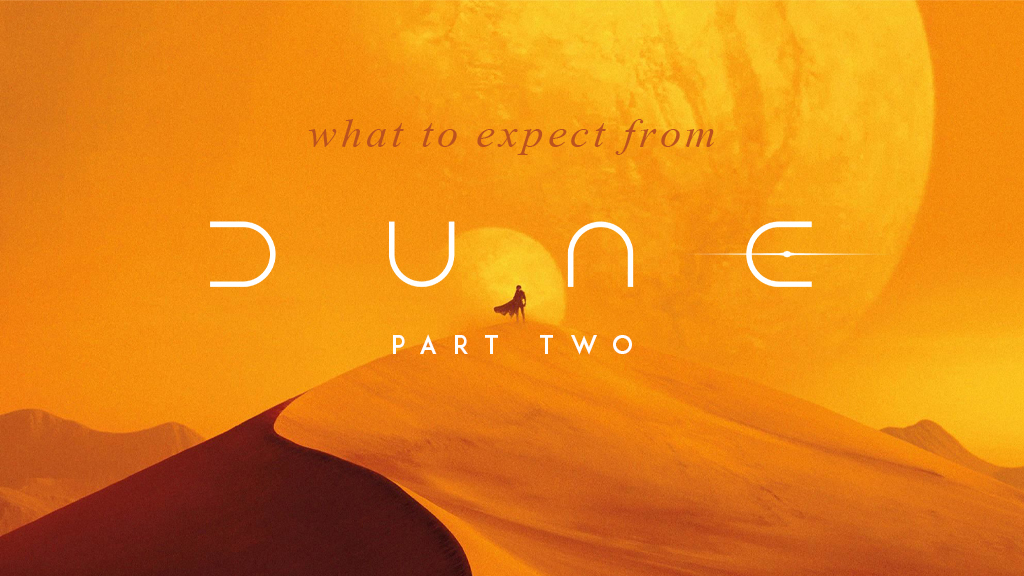
Dune was only a prelude to a grander and much more complex story in the world created by Frank Herbert. As the film only adapted approximately two-thirds of the first book, many fans were hoping for a sequel to be confirmed sooner rather than later. Especially because of many unfinished plot lines left by director Denis Villeneuve and Chani’s words at the end of the film – “This is only the beginning.” With the second part of Dune officially announced, let’s look ahead to three things we can expect in the sequel.
New Faces
Dune: Part Two will introduce several new characters who will play significant roles in the story. Without a doubt, the biggest addition will be Feyd-Rautha Harkonnen – the brother of Beast Rabann and nephew of Baron Harkonnen. Feyd is a young man, just a year older than Paul, who is being prepared to be the Baron’s successor and who is also part of the genetic plan mentioned by Gaius Helen Mohiam. The filmmakers will have an opportunity to highlight the parallels between Feyd and Paul, who grew up in very different circumstances and have quite a few things in common.
Another character will be, of course, be Emperor Shadam IV who was mentioned a couple of times in Dune: Part One. The sequence on Selusa Secundus itself gave us a bit of a taste of what kind of character the Emperor might be. He’s not another Palpatine, but a slightly more nuanced character who got caught up in the Bene Gesserit and had a lot of doubts about his actions.
Speaking of the Emperor, we have to mention his eldest daughter – Princess Irulan being a Bene Gesserit, who is a very important character in Paul’s story. She is a chronicler, and it’s her words that open the story of Dune. The sequel should also introduce Hasimir and Margot Fenring in the film. Hasimir is the Emperor’s best friend who has been sent to Giedi Prime to look into Feyd-Rautha as well as confront Baron’s plans. Out of the other major characters, we’ll also get to see Alia Atreides – Paul’s sister, whom he saw in one of his visions.
Paul and Chani’s Journey
In one of his interviews for the Italian magazineIl Venerdì di Repubblica, Villeneuve mentioned that Chani, played by Zendaya, would be the protagonist of the story inPart Two. This statement outraged many people, but there’s a reason why Chani will be so important in the second part. As Paul moves further and further away from humanity and dives deeper and deeper into his (anti)messianic figure for the Fremen, Chani will be the person who will be his anchor in the present. Through her, Paul will stay in touch with humanity and Chani will act as a beacon of light.
The first part made us step into the shoes of Paul Atreides, and together we began to discover Arrakis and his inner nature. However, Paul’s journey is not a typical Cambellian pattern of the protagonist’s journey. Herbert broke out of that pattern, and Paul is a certain deconstruction of that trope. In the first film, we saw Paul’s potential future, leading to a bloody holy war in his name. Paul himself will want to escape this, but the further into the woods he gets, the more he solidifies that he has fallen into a messiah trap where fanatics have blindly followed his words. It was already evident in Part One how the Fremen had ingrained the fable of Lisan al-Gaib into their culture, which Paul incidentally used to survive. What will be important in this context is the perspective of those around Paul, who will face a persona that is nothing like his father.
Fremen’s society
The sight of a Fremen riding a sandworm in the final scene inDune certainly sparked the imagination of many viewers as to what might await us next. We’ve only been given a glimpse of Fremen culture, and the second part will only expand that corner of the world. Together with Paul, we will delve into the huge Fremen sietches which can accommodate thousands of people. We will learn about their beliefs and customs, and the second film should open with an extremely psychedelic scene involving the water of life. We should also be introduced to the Fremen’s ecological plan to terraform Arrakis into a green paradise, which is an extremely important theme throughout the series. Villeneuve has shown that he can emphasize the monumentalism and scale of the world, and the second part has much more to offer.
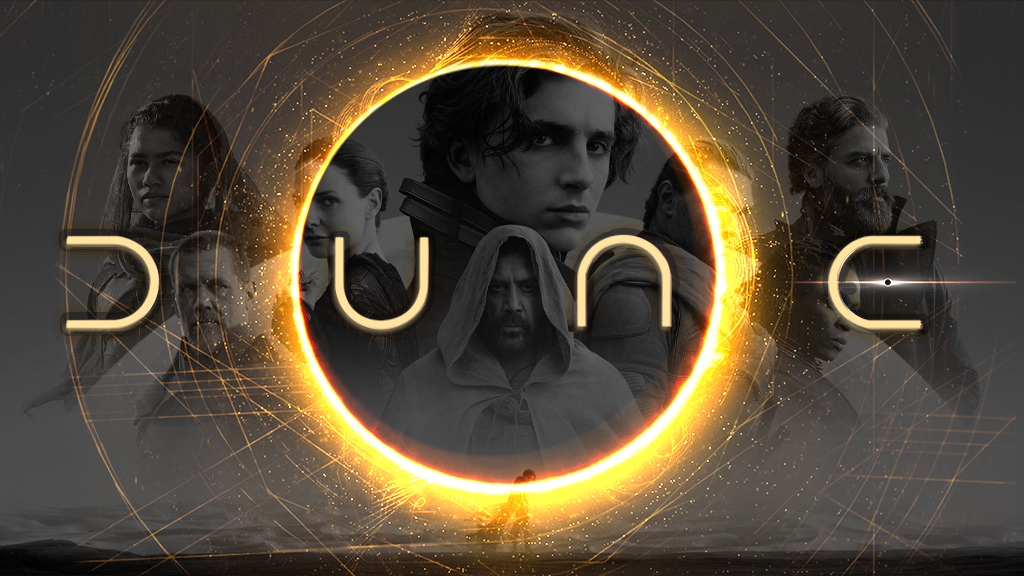
Dune was without a doubt my most anticipated movie ever. After years of waiting, I had the chance to finally see the movie (twice!) and I can confidently say that Dune is another brilliant film in Villeneuve‘s career. Is it the best? I think not. But it’s certainly the most personal in terms of form as well as themes. It is the kind of film that will go down as one of the most unique blockbusters of this century, one that has brought a lot of fresh air into the landscape of mainstream cinema.
Dune is a coming-of-age story of a young man named Paul Atreides who is frightened of leaving Caladan – his home planet full of water and a variety of life. House Atreides is supposed to go Arrakis, also known as Dune, which is a desert planet with a rough ecosystem. However, Dune is full of spice called melange, a psychoactive chemical that is the main natural resource in the entire Empire. Melange enables interstellar travels and without it, the economy of the empire would collapse. As soon as Paul enters the Arrakis’ environment imbued with spice, his powers awaken.
Denis Villeneuve has created a work that is enthralling in its immersion and scale. The editing makes the film feel like a dream, which resonates with Paul’s storyline and the film’s narrative. From the very beginning, we step into the shoes of Paul Atreides who is faced with strange dreams, and from a certain point, he loses his footing and stops fighting both his nature and the environment of Arrakis.
Dune delivers a solid story about adapting our bodies and subconsciousness to a new environment, showing the power of nature over our petty human issues. Paul, being the (false) messiah, is faced with the sandworm Shai-Hulud, a sacred and religious manifestation of the power of nature. From the beginning of the movie, it’s clear that Paul’s journey isn’t a pleasant one but a sad one and at the very end of the film, I felt the emptiness and imprisonment that Paul suffered.
Dune’s source material is very dense and comprehensive, as it deconstructs the journey of a white hero while providing readers with a treatise on many sociopolitical issues. The filmmakers had a tough task to fit all of this neatly into the film’s narrative without losing focus on the main plot. I had a lot of concerns about this but as a fan of the book, I am really satisfied with how skillfully they were able to adapt 2/3 of the book’s material.
While Villeneuve’s vision has an emphasis on the sacred and metaphysical parts of Dune, he doesn’t lose sight of the sociopolitical issues. From the very opening scene, the movie criticizes colonialism and the exploitation of the planet’s natural resources by the Empire’s great houses. It is a theme that is consistently built upon by Villeneuve, including Fremen’s tribalist lifestyle and their relationship with the otherworldly people. Moreover, Paul’s journey fits symbolically into the ecological thesis of the Dune universe and provides a good foundation for the sequel.
As the movie adapts 2/3 of the book, some conscious flaws in the production are hard to judge after one movie. I have to state that my biggest disappointment and simultaneously the movie’s biggest flaw is the pacing. After the director’s work and the characterization of Dune itself, I had expected the picture to be calmly paced, in a style similar to Blade Runner 2049.
But the movie is spectacle after spectacle with little room to breathe in between. The beginning of the second act, where the heroes find themselves on Arrakis, suffers the most as it never takes time to deepen the relationships of the characters. At this point, I felt that the movie was just ticking off some of the scenes from the book that only bring us closer to the midpoint of the story, robbing any weight from the build to the story’s pivotal moment.
Denis Villeneuve is a genuinely talented filmmaker and presents the story gracefully but either the film should have paced better or should have been 10 minutes longer. Many relationships would have benefited from it. One of those characters that suffered from the pace is Doctor Yueh. I don’t want to reveal too much, but his character and his tragedy were completely swept under the rug.
Villeneuve makes the most out of his canvas, using sound and design to tell stories, and building the atmosphere with Greig Fraser‘s cinematography. The entire film evokes a sense of historic real-world scale because of many vast panoramic shots, which takes us back to the first films of the Canadian filmmaker from Quebec. Arrakis, the culture, ecology, and religion of this planet are treated with non-fictional aesthetics. On the other hand, the more intimate, personal character moments are shot in a slightly more static tone. Many wide frames show us the scale and size of this universe and it never feels empty. It feels alive, breathing, and lived-in. Villeneuve and Fraser brilliantly draw the contrast between the humid and wet Kaladan and the sultry and hot Arrakis. Every frame is treated with reverence and care.
As for the music, Hans Zimmer has probably delivered the best soundtrack of his career. The soundtrack is extremely diverse and feels a lot of electronics, oriental music, or strong vocals. The soundtrack in itself is a distinct character in the story.
However, the most important element, which was supposed to highlight the internal state of the characters, is of course the acting. Overall, I would rate it as really good and I wouldn’t be able to point out a bad performance. I would say that some of the performances are simply unsatisfying due to lack of screen time or script problems, like Josh Brolin as Gurney Halleck or Chen Chang as Doctor Wellington Yueh, among others.
The rest of the cast brings stellar performances The absolute MVP of the film is Rebbeca Ferguson as Lady Jessica. She is outstanding and brilliant in this role, providing a wealth of emotion and character simply with the most nuanced of expressions. She is genius in the fluidity of her mannerisms and switching between being a mother, Bene Gesserit, a concubine of a duke, or a warrior. Her interpretation of Lady Jessica perfectly corresponds with my idea of this character who from the beginning of the film plays chess with everyone.
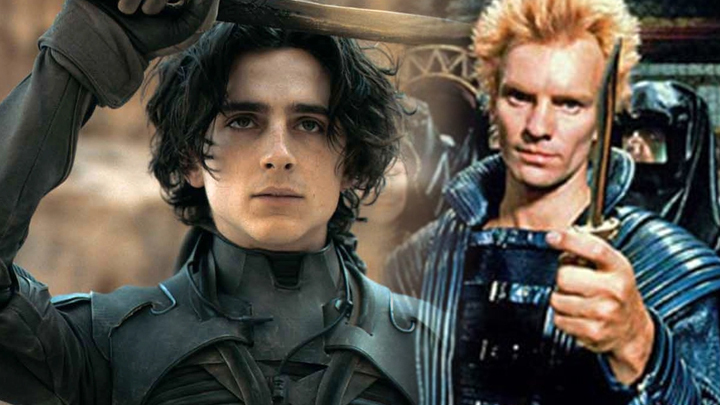
Timothée Chamalet as Paul Atreides is also great, and I could say he was born for this role. As in the case of Jessica, his performance matched my idea of the character. Timothée smuggles in a lot of nuances and also smoothly transitions from this scared boy to a person who has to face the fatalism of his existence.
Dune is an event-like film and an experience that has stuck with me. I feel as if I have entered someone’s dream and seen images that have been in the mind of the creator for decades. It’s not a film without flaws, and I think it may turn a lot of viewers from it. In my opinion, it’s a film that breaks out of the blockbuster mold and tells a story through a visual and aural experience. This is a film that must be seen in a cinema, preferably in IMAX. This is the kind of movie that breathes and lives its own life, introducing us to this alien world with grace and a touch of style.
Dune is an incredibly diverse and culturally rich story. Frank Herbert introduced us to many interesting cultures, factions, and places, which influenced the entire broad thematic spectrum of Dune. Despite this, Herbert was not famous for his elaborate descriptions of places, landscapes, or costumes. Instead, he focused on a varied narrative that presented the viewer with different perspectives and heavily delves into characters’ psychology.
The lack of a consistent stylistic vision of the world presented by Herbert made this subject open to several artists. When we take a look at the film adaptations of Herbert’s work, we can see that each of them approached the visual aspect of this world in a different way. You can see this most clearly in Alejandro Jodorowsky‘s unfinished version ofDune, and Villeneuve’s film. Jodorowsky intended to go for a visual extravaganza, collaborating with famed artist Mobius. Mobius’ concept art later inspired many artists with its creativity, psychedelic and fantasy.
Villeneuve, on the other hand, focuses on the rawness and brutality of Herbert’s world. He doesn’t hide the inspiration he draws from the colors of John Schoenherr‘s works that appear on the illustrated edition ofDune. Even Herbert himself once pointed out that this vision is the closest to what he had imagined.
However, there is another artist who has influenced Denis Villeneuve’s vision in a much greater way: Wojtek Siudmak.
The Works of Wojtek Siudmak are beautiful and powerful hypnotism. Once encountered, they remain rooted in our memory like intimate revelations about ourselves. It seems as if the artist’s raw material originated from our own unconscious. His vision captivates the viewers with their profundity. Though nobody has yet managed to crack open the door to the future, Wojtek Siudmak already anticipates it and watches, with his curious eyes, eternal beings floating in a world where time and space are no longer constrained by the fundamental laws of nature.
Denis Villeneuve, The Worlds Of Wojtek Siudmak, Rebis, 2021
Wojtek Siudmak has been creating interstellar hyper-realistic illustrations related to Dune for many years. The most famous works of his are from the Polish edition published by Rebis, which have become a unique project worldwide. His works have become an inspiration for many artists like Federico Fellini, Jean-Jacques Annaud and George Lucas, who mentioned that “there’s a powerful tranquility in Wojtek Siudmak’s creations, and endless to explore and invent”.
artist: Wojciech Siudmak
Exploring the world of Dunethrough the perspective of Siudmak’s images is an amazing experience on its own. The world he envisions is based on complex and multilayered storylines dealing with messianism, criticism of religion up to ecology, and even tribalism.
In his images, people become victims of their arrogance and blindness in the desire for evolution, which turned out to be a cul-de-sac. In these illustrations, humanity is caught in a conflict between rationalism and the surreal creation of the world that is manifested in such magical and abstract imagery. These paintings exude sensuality, intimacy, and eroticism, which is the highlighting of the human soul as its bodily manifestation and power of consciousness.
Siudmak portrays many iconic things from Dunein a way that intrigues and thrills with ingenuity and surreal empiricism. In addition to drawing from Siudmak’s sense of monumentalism, female persuasion, and oneiric atmosphere, Villeneuve also takes inspiration from his architecture. Many of Siudmak’s works show monumental, brutalist structures, which with their ancient appearance refer to (in this world) prehistoric cultures such as Greek, Egyptian or Gothic.
In the world of Siudmak, a man is faced with a question of what reality is and whether a man can control and change it with his mind, adjusting time and matter to his perception. The works of the Polish artist will always stay with me. I am glad that they have become an integral part of the world of Dune. Today, Siudmak is one of the icons of this universe.
Chloé Zhao and Denis Villeneuve participated in an interview for Harper’s BAZAAR to discuss the power of the cinematic experience and their worries with the changes in the industry. They both made no secret of the fact that they appreciated each other’s work, gaining a lot of inspiration from each other.
Villeneuve is well known for his love of the cinematic experience and as he has repeatedly stated that the big screen is part of its language. In this interview, the Canadian director did not hide his support for IMAX, which according to him increases the feeling of intimacy with the characters. Chloé Zhao, whose previous film Nomadland was also screened in IMAX, also shares in that belief. She goes on to say that while pitching Eternals, she used stills from his films. She also mentioned that she has always appreciated creators who have a strong hand in world-building:
Oh, my gosh. Okay, well, I would like to apply for a job on your set to be your assistant. You know, when I went to pitch Eternals, I had stills from your films as references. I’m naturally drawn to filmmakers who have a very strong hand in world building. When I watch your films, even though they’re of different genres, from Sicario to Arrival to Prisoners and then Blade Runner 2049, you managed to build such visceral worlds I can feel and almost touch.
Chloé Zhao
Marvel Studios’ Eternals
If you look at the filmography of both directors, you will conclude that they both come from similar filmmaking backgrounds. Both have roots in non-fiction cinema, where they focus on reflective and intimate experiences with their characters. In both of them, one can notice the influence of direct cinema, which has been later successfully incorporated into mainstream cinema.
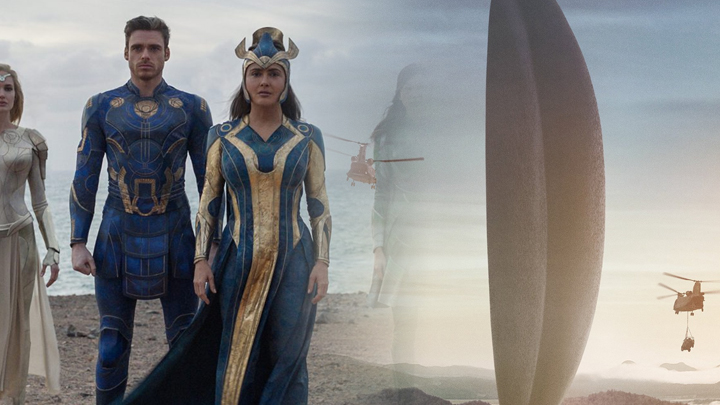
Although the premiere of Eternals is still ahead of us, promotional materials tease some visual inspirations taken from Denis‘ works. Among others, the Eternals’ ship with its brutalist and austere shape, embedded in the natural landscape, brings to mind the monumental Heptapod ship in a similar aesthetic from Villeneuve‘s Arrival.
We use cookies to improve your experience on our site. By using our site, you consent to cookies.
This website uses cookies
Websites store cookies to enhance functionality and personalise your experience. You can manage your preferences, but blocking some cookies may impact site performance and services.
Essential cookies enable basic functions and are necessary for the proper function of the website.
Name
Description
Duration
Cookie Preferences
This cookie is used to store the user's cookie consent preferences.
30 days
These cookies are needed for adding comments on this website.
Name
Description
Duration
comment_author_email
Used to track the user across multiple sessions.
Session
comment_author_url
Used to track the user across multiple sessions.
Session
comment_author
Used to track the user across multiple sessions.
Session
Statistics cookies collect information anonymously. This information helps us understand how visitors use our website.
Google Analytics is a powerful tool that tracks and analyzes website traffic for informed marketing decisions.
Contains information related to marketing campaigns of the user. These are shared with Google AdWords / Google Ads when the Google Ads and Google Analytics accounts are linked together.
90 days
__utma
ID used to identify users and sessions
2 years after last activity
__utmt
Used to monitor number of Google Analytics server requests
10 minutes
__utmb
Used to distinguish new sessions and visits. This cookie is set when the GA.js javascript library is loaded and there is no existing __utmb cookie. The cookie is updated every time data is sent to the Google Analytics server.
30 minutes after last activity
__utmc
Used only with old Urchin versions of Google Analytics and not with GA.js. Was used to distinguish between new sessions and visits at the end of a session.
End of session (browser)
__utmz
Contains information about the traffic source or campaign that directed user to the website. The cookie is set when the GA.js javascript is loaded and updated when data is sent to the Google Anaytics server
6 months after last activity
__utmv
Contains custom information set by the web developer via the _setCustomVar method in Google Analytics. This cookie is updated every time new data is sent to the Google Analytics server.
2 years after last activity
__utmx
Used to determine whether a user is included in an A / B or Multivariate test.
18 months
_ga
ID used to identify users
2 years
_gali
Used by Google Analytics to determine which links on a page are being clicked
30 seconds
_ga_
ID used to identify users
2 years
_gid
ID used to identify users for 24 hours after last activity
24 hours
_gat
Used to monitor number of Google Analytics server requests when using Google Tag Manager
1 minute
Marketing cookies are used to follow visitors to websites. The intention is to show ads that are relevant and engaging to the individual user.
Pinterest Tag is a web analytics service that tracks and reports website traffic.