Category: From Page To Screen

  • ‘Ms. Marvel’ From Page to Screen: Episode 6.2

    ‘Ms. Marvel’ From Page to Screen: Episode 6.2

    With Ms. Marvel’s Episode 6 and finale, entitled “No Normal”, the series’ connection to Ms. Marvel comics continues to be present, in both major and subtle ways. In Episode 1, we looked at how the series adapted from the comics the moment Kamala’s powers were activated; for Episode 2 we delved into the comics’ and series’ introduction and handling so far of the character Kamranin Episode 3 we looked at the interesting source material for the series’ villains, the Clandestinesand in Episode 4 we went into how Red Daggers were introduced and how they compare to the comics’ Red Dagger. As for Episode 5, following our dive into Kamala’s ancestors during Partition, we also looked at some Bruno-centric plotlines the series may have invoked or started.

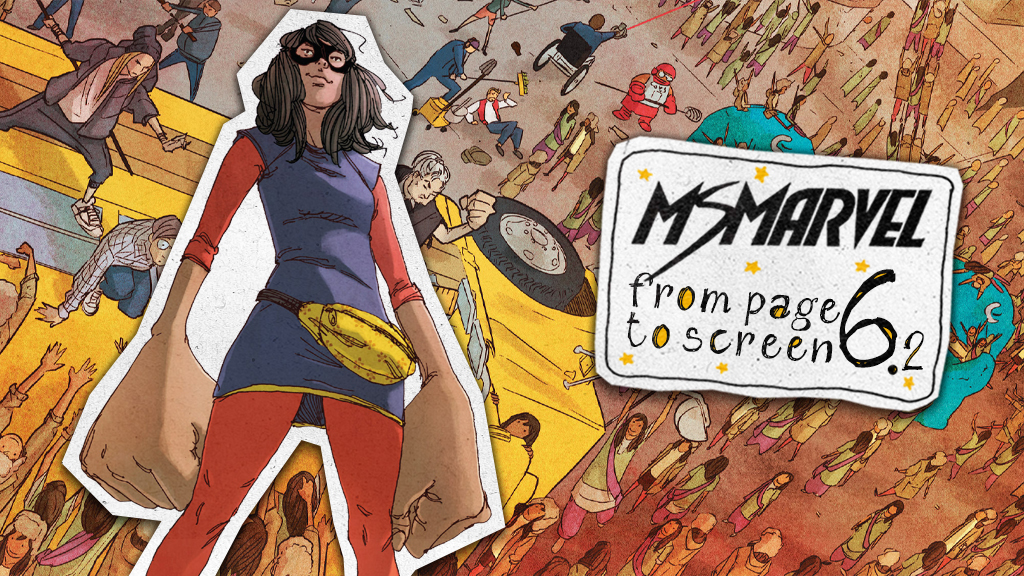
    The first From Page to Screen for the Ms. Marvel finale focused on the episode’s inclusion of major aspects of Ms. Marvel lore. In particular, we looked at the significance of Kamala saying “embiggen” and how Kamala got her “Ms. Marvel” name in the live-action series. In this article, however, we spend time on more subtle references that maybe were only apparent to more hardcore fans of Ms. Marvel comics.

    It All Ends In High School

    Many of the other obvious references to Ms. Marvel comics in the finale were based on well-known plots or arcs that were significantly altered—but included—in the finale. Fans of the first Ms. Marvel (2014) run will no doubt remember that that very run ended with the incursion that led into Secret Wars (2015). In this part of her story, Kamala also met Carol Danvers for the first time, and the eeriness of the pre-incursion madness made for a phenomenal read.

    But a major moment in those last few issues of Ms. Marvel (2014) revolves around Jersey City’s response to the incoming incursion. While the world is panicking and preparing emotionally for the end of the world, Jersey City congregates in Coles Academic High School at the request of Ms. Marvel. The community, even those normally opposed to one another, come together to create a space for supplies, worship, and comfort.

    It is a very different situation in Ms. Marvel, but the fact remains that the main characters sought refuge in the high school in the midst of the series’ final threat. The high school setting, of course, calls the comics into mind. But the fact that practically the whole ensemble gets involved in the Department of Damage Control “battle” also invokes the imagery of a community coming together in support of Ms. Marvel.

    Marvel Studios’ Ms. Marvel Episode 6
    Marvel Studios’ Ms. Marvel Episode 6

    Zoe Zimmerman’s Change of Heart

    Almost out of nowhere in the finale, Zoe Zimmerman because a friend rather than a foe. In Ms. Marvel comics, she had a personality overhaul after the traumatizing events of the incursion and became an activist-type who was self-aware of her prior bullying behaviors and worked to move past that time in her life. We can see some of this new change begin to happen in the last moments of Ms. Marvel, where she appears to be using her social platform for good to specifically amplify Nakia’s voice in on video.

    Ms. Marvel #19 (2014)
    Marvel Studios’ Ms. Marvel Episode 6
    Marvel Studios’ Ms. Marvel Episode 6

    She became a main figure in Kamala’a social group, along with Bruno and Nakia. Zoe’s further character development later involved her coming out as gay. Her unrequited crush on Nakia was a subplot that was both heartwarming and heartbreaking in some of the most high-school-type ways. Interestingly, the way the two characters interact at the tail end of the Ms. Marvel finale could be hinting at this development down the line in future projects. 

    “He Multiplies Now?”

    One small mention in the high school sequence of the finale came when DODC agents wondered if the suspect(s) could multiply because our characters were wearing identical outfits and the agents had no idea what was going on. It does bring to mind an interesting arc in Ms. Marvel #4-6 (2015) where Bruno created essentially low-functioning clones of Kamala, at first in an effort for Kamala to meet all of her school, family, and superhero responsibilities. The clones ultimately go out of control and essentially took over Jersey City. Captain Marvel and Iron Man eventually had to bail her out, reminding her that she is still human and needs help sometimes…and it also leads into Civil War II.

    Ms. Marvel #5 (2015)

    Ms. Marvel is now streaming on Disney+.
  • ‘Ms. Marvel’ From Page to Screen: Episode 6.1

    ‘Ms. Marvel’ From Page to Screen: Episode 6.1

    With Ms. Marvel’s Episode 6 and finale, entitled “No Normal”, the series’ connection to Ms. Marvel comics continues to be present, in both major and subtle ways. In Episode 1, we looked at how the series adapted from the comics the moment Kamala’s powers were activated; for Episode 2 we delved into the comics’ and series’ introduction and handling so far of the character Kamranin Episode 3 we looked at the interesting source material for the series’ villains, the Clandestinesand in Episode 4 we went into how Red Daggers were introduced and how they compare to the comics’ Red Dagger. As for Episode 5, following our dive into Kamala’s ancestors during Partition, we also looked at some Bruno-centric plotlines the series may have invoked or started.

    The finale had numerous references to Ms. Marvel comics, particularly its first 2014 run, though with plenty of references to the 2015 run as well. Like last week, this week will feature two From Page to Screen entries. In this article, we focus on two of the most obvious and major connections—Kamala’s powers and her Ms. Marvel mantle.

    “Embiggen”

    Those maybe less familiar with Ms. Marvel comics may have been caught slightly off guard when Kamala, seemingly out of nowhere, says, “embiggen” before using her light powers to essentially construct a massive version of herself. Now, “embiggen” is not its own word capable of ascertaining much meaning outside of Kamala in the comics. As we’ve discussed before, the power changes made from comics Ms.Marvel to live-action Ms. Marvel were significant. In the comics, her powers were called embiggening. In the DIsney+ series, we know that she summons power from the Noor Dimension to create hard light constructs.

    As different as those two power sets are, the series clearly has tried to link the two in some ways. When Kamala stretches her light constructs in a way that looks like an extended arm and fist, it invokes her embiggening powers in the comics. The live-action version of “embiggen” was Kamala’s use of her powers to essentially grow herself into a much more formidable and in-control being. While the seemingly abrupt “embiggen” did not make a ton of sense in the context of the show, it was one of the biggest pieces of fan service that anyone familiar with comics Ms. Marvel would have cheered at. 

    Marvel Studios’ Ms. Marvel Episode 6
    Marvel Studios’ Ms. Marvel Episode 6

    “Ms. Marvel”

    One of the mysteries of Ms. Marvel was how Kamala would end up with the name of “Ms. Marvel”. In the comics, Carol Danvers had previously used the moniker, and that was essentially the whole story. In live-action, Carol Danvers was always only Captain Marvel. Many fan theories suggested that the name would come from something family-based, as the show’s themes focused heavily on that topic. Moreover, names like “Ms. Marvel” are becoming a bit outdated now, so it would need to be something personal and loving.

    Ms. Marvel #5 (2014)

    And indeed the answer came in the finale that Kamala’s parents apparently nicknamed her “Ms. Marvel” as a young girl, based on the rough/expansive meaning of “Kamala.” An Arabic name, “Kamala” translates to “perfection”, which Kamala’s father tells her in Ms. Marvel #5 (2014). In Ms. Marvel, that same conversation takes place, though her dad expands upon it. He suggests that the “perfection” translation does not quite do it justice and that it also meant “marvel.” “Ms. Marvel” became a pet name from her parents, and Kamala seized on the opportunity to share the same name with Carol Danvers.

    Marvel Studios’ Ms. Marvel Episode 6
    Marvel Studios’ Ms. Marvel Episode 6
    Marvel Studios’ Ms. Marvel Episode 6

    Ms. Marvel is now streaming exclusively on Disney+.

  • ‘Ms. Marvel’ From Page to Screen: Episode 5.2

    ‘Ms. Marvel’ From Page to Screen: Episode 5.2

    With Ms. Marvel’s Episode 5, entitled “Time and Again”, the series’ connection to Ms. Marvel comics continues to be present, even if sometimes in a more subtle way. In Episode 1, we looked at how the series adapted from the comics the moment Kamala’s powers were activated; for Episode 2 we delved into the comics’ and series’ introduction and handling so far of the character Kamranin Episode 3 we looked at the interesting source material for the series’ villains, the Clandestinesand in Episode 4 we went into how Red Daggers were introduced and how they compare to the comics’ Red Dagger. As for episode 5, following our dive into Kamala’s ancestors during Partition, we now focus not so much on what happened in the show, but on what future comic events it might be hinting at.

    Episode 5 of Marvel Studios’ Ms. Marvel ended on a somewhat weird note. If on one hand the Clandestines’ subplot was apparently swiftly resolved, the Damage Control threat somehow gained traction with the attack on Kamran and Bruno at the Circle Q. While there is no real perfect counterpart to this sequence in the comics, the aftermath could perhaps lead Bruno down an interesting, yet painful path, taken straight out of the comics.

    Marvel Studios’ Ms. Marvel Episode 5
    Marvel Studios’ Ms. Marvel Episode 5

    Leading up to Secret Wars, Kamala finally met her hero Captain Marvel as New York was soon to be destroyed by an incursion. This later led to Carol making Kamala the leader of a group they named the Carol Cadets. The Cadets were created following the discovery of an Inhuman named Ulysses, who through the use of mathematics could basically predict the future. They were made to go after criminals who were yet to commit any sort of crimes but that Ulysses deemed likely to end up doing so. This was something that began not to sit right with Kamala’s friends, around the same time she also began to fight back against the idea behind the creation of the Cadets by questioning their methods.

    This all led to Bruno trying to break into the Cadets’ facilities in order to set free who, in his eyes, happened to be detained there without a valid reason. Said break-in went wrong and Bruno had to deal with the consequences, being left bedridden with third-degree burns all over the left side of his body, losing the use of his left hand (his dominant one), and with serious doubts if he’d ever be able to walk again.

    Ms. Marvel #10 (2016)

    Once he finally regained conscience, and even though Kamala tried her best to stay by his side throughout his hospital stay, Bruno made it extremely clear that he held her responsible for the situation that left him in the state he found himself in. He considered she was focusing too much on her superhero life without regarding the consequences to the people around her who loved her, taking everyone for granted. He vowed to never want to see her ever again, and that his next step would be moving away to study at the Golden City Polytechnic Prep, in Wakanda.

    Ms. Marvel #18 (2017)

    Once there, he was involved in an attempted vibranium robbery, he met King T’Challa and eventually went back home when he realized that Kamala was who he wanted to be near. Unfortunately for him, Kareem, the Red Dagger, had by then stepped into the frame.

    Marvel Studios’ Ms. Marvel Episode 1

    It’s hard to predict if the Circle Q explosion might end up serving as the catalyst to a similar journey for the MCU’s Bruno. If it does, it would certainly be something worth going into in the second season (?) of the show, with perhaps Black Panther: Wakanda Forever being a possible project in which to feature a Matt Lintz cameo in the meanwhile.

    The first five episodes of Ms. Marvel are now streaming on Disney+.

  • From Page to Screen: Gorr the God Butcher

    From Page to Screen: Gorr the God Butcher

    All Gods must die.” These are words uttered by the horrifying Gorr in both Thor: Love and Thunder and in the world of Marvel comics. The character, played by Christian Bale in his Marvel Cinematic Universe debut, was created by Jason Aaron and Esad Ribic for 2013’s Thor: God of Thunder run and has since become a fan-favorite member of Thor’s extensive rogues’ gallery. Known as the God Butcher, the villain’s main objective is to wipe all living deities out of existence. This remains his goal in the MCU, an adaptation that actually manages to match up quite well with its iconic source material. Although, very few things can ever be exactly the same. Join us as we take a look at Gorr’s transition from page to screen, exploring what the MCU borrowed accurately from the comics and what it decided to change.

    Design

    Let’s first address the elephant in the room. Gorr is still pretty scary in Thor: Love and Thunder, but his design is a far cry from the look comic book readers grew accustomed to. Christian Bale‘s antagonist is still chalk white, but he’s not nearly as undressed as the original model. The MCU puts Gorr in a flowing white robe in place of the skin-tight black speedo look the God Butcher rocks in the 616. Both versions of Gorr wear an ominous hood, but the colors are different for each one. Comic Gorr dons black, in contrast to his skin, while MCU Gorr wears more white, perhaps as a means of making him appear sort of nude from afar. Lastly, Bale‘s Gorr has a fairly humanoid head and body, doing away with the comic’s more alien, tentacled monster.

    Origin

    Thor: God of Thunder #6 (2012)

    Gorr has one of the more tragic origins of any Marvel villain, but of course, that may have been a requirement to explain why his desires are so extreme. In both the comics and the MCU, Gorr’s hatred of the Gods stems from the death of his loved ones. It’s just that, in Thor: Love and Thunder, the details are simplified for the sake of streamlining the story. Aaron‘s original books had Gorr losing his mother, his mate, and his son, all succumbing to the barren conditions they were subject to living in on their alien planet. Taika Waititi‘s version of this is incredibly similar, only on film, Gorr is only shown losing his child. There are no other relatives mentioned, and Gorr’s son Agar is replaced by a daughter mostly referred to as “Love”. That being said, MCU Gorr does still lose his daughter to the intense drought on his unnamed homeworld, just like his illustrated inspiration.

    After Agar breathes his last breath in the 616, Gorr comes across two gods duking it out in the lifeless environment he is barely surviving. One a god in golden armor, and the other a god of pitch black. The duo severely injure each other in battle, with the golden god falling at Gorr’s feet and requesting his help. Enraged by the fact no god had ever helped him, Gorr instead picks up the weapon of Knull (the aforementioned dark being, more on that later) and slays the golden god before him. Embued with new, lethal abilities by this weapon, called All-Black the Necrosword, Gorr vows to take revenge upon all gods and takes off into the unknown to begin his new journey in earnest.

    Thor: God of Thunder #6 (2012)

    This general concept of Gorr finding two gods is adapted for the MCU, but it doesn’t play out exactly the same. The live-action version of Gorr does not actually see two gods fighting to the death. Instead, he stumbles across an Oasis-like patch of greenery inhabited by the golden god of Light he had prayed to for his daughter’s safety. Initially relieved, believing he has finally found mercy, Gorr is shell-shocked to discover that the golden god is an arrogant, vain, gluttonous fool with no regard for the mortals he is supposed to protect. After insulting Gorr’s faith and family, the golden god reveals he has just killed a being corrupted by the Necrosword, gesturing to an all-black corpse on the ground. Enraged, Gorr renounces his devotion and uses the Necrosword to decapitate the god of Light, before making his famous vow and embracing his newfound powers. Many of the beats are the same as in the comic, it’s just adjusted slightly to fit Waititi‘s vision for the character.

    Abilities

    Thor: God of Thunder #2 (2012)

    Gorr’s abilities were going to have to change a little bit for the MCU. In the comics, the Necrosword is created by Knull (told you we’d get back to it), who is the progenitor of the Klyntar race and the black god-figure seen by Gorr in battle. For the uninitiated, “Klyntar” is the scientific term for “alien symbiotes”. The same symbiotes Spider-Man can never seem to stop running into, and the same symbiotes whose film rights are still firmly owned by Sony. The 616 All-Black operates using symbiote-like power, allowing its user to form large black tendrils and gooey black wings among other constructs. It also grants an accelerated healing factor and enhanced durability, and assists Gorr in creating a small army of shadow monsters to aid him in accomplishing his goals.

    Thor: God of Thunder #2 (2012)

    The MCU’s take on the Necrosword is very similar, but it drops all connections to the Klyntar. Gorr is still able to summon creatures and strange black tendrils, but everything is related to a shadow world instead of oozing symbiotic material. The Necrosword also still has the unique ability to slay any god and continues to grant Bale‘s Gorr with enhanced capabilities. One major difference is that the live-action Gorr does not sprout wings to travel. Instead, the sword seemingly allows him to travel via shadow, disappearing and reappearing in darkness as he pleases.

    Plot

    Both versions of Gorr begin their quest by quietly slaughtering pantheons of “lower-level” gods across multiple planets. There’s even a shot-for-shot recreation of the death of Falligar, the large animal-like god that Thor finds dead next to a wounded Sif in the movie. They both also have the same endgame – using a MacGuffin to wipe out the rest of the gods in one fell swoop. 616 Gorr uses an army of kidnapped god-slaves to create the “Godbomb”, which when detonated would purge the universe of all its deities. In the MCU, however, he’s looking for Stormbreaker as a means of getting to Eternity, the wish-granting higher power he could use to magically make all gods pop out of reality.

    Comic book Gorr uses a lot of timey wimey shenanigans to carry out his plot, but the movie adaptation gets rid of all that to make things less complicated. Bale’s Gorr simply kidnaps the children of the gods to lure Thor and his valuable weapon directly to him. Both Gorrs, however, use an odd, colorless planet as their base of operations. In Aaron’s books, it’s the Black World while in Waititi‘s film, it’s a place known as the Shadow World. Close, but not exactly the same.

    Death

    Thor: God of Thunder #11 (2013)

    Neither Gorr makes it out of their initial story alive, which is maybe in the universe’s best interest. MCU Gorr gets the better end of the deal, though, getting a touching reunion with his daughter before entering the final frontier. The final act of Love and Thunder sees Thor and Jane Foster convincing Gorr to use his wish to bring his child back instead of killing all gods, which enables him to give her a tearful goodbye before the corruption of the Necrosword ultimately kills him. In the comics, Gorr also sees his child one last time before death, only there it’s an evil construct of the Necrosword that berates him for the path he’s gone down. Not quite as cute.

    616 Gorr is also not killed by any sort of infection and is actually decapitated by the combined efforts of three different Thors from across the Marvel timeline. Thor: Love and Thunder manages to replicate this with a clever plot twist, where Thor temporarily passes his power to the group of kidnapped children he’s trying to save. This results in Gorr and his army having to deal with “three Thors” in the same way his comic counterpart did; Thor, Mighty Thor, and the combined force of all the Kid Thors.

    Thor: Love and Thunder is now in theaters.

  • ‘Ms. Marvel’ From Page to Screen: Episode 5.1

    ‘Ms. Marvel’ From Page to Screen: Episode 5.1

    With Ms. Marvel’s Episode 5, entitled “Time and Again”, the series’ connection to Ms. Marvel comics continues to be on full display. In Episode 1, we looked at how the series adapted from the comics the moment Kamala’s powers were activated; for Episode 2 we delved into the comics’ and series’ introduction and handling so far of the character Kamranin Episode 3 we looked at the interesting source material for the series’ villains, the Clandestinesand in Episode 4 we went into how Red Daggers were introduced and how they compare to the comics’ Red Dagger. As for episode 5, we focus on the bulk of the flashback that we got in the first half of the episode.

    One of the most interesting ways in which Ms. Marvel adapted the comics is by expanding upon the story of Kamala’s ancestors during Partition. Of course, it has been obvious since the second episode of the series that what happened with Kamala’s great-grandmother in 1947 was key to understanding Kamala’s powers and the bangle. In Episode 5, the thrust of the story was a flashback to Aisha and her husband, Hasan, in 1942-47, ending with Aisha’s death as Hasan and their daughter, Sana, made it on the last train to Karachi.

    Marvel Studios’ Ms. Marvel Episode 5
    Marvel Studios’ Ms. Marvel Episode 5

    In Ms. Marvel #8 and #9 (2015), we get a small snippet of this same time period in Kamala’s family history. In fact, it begins with a pregnant Aisha hastily getting ready to flee India to Pakistan with many of her family members. She sees a shooting star, which gives her some hope in the dark time. Notably, the comics’ only mention of Aisha’s bangles is in this brief story. She sold her jewelry and hid the money inside her wedding bangles in case she and her husband were separated.

    In the second half of the comics’ version of the flashback, we jump to Kamala’s mother in Karachi around the year 2000. She is living with her mother and family—Aamir is young and she is pregnant with Kamala. She had chosen to move to New Jersey for her family, but she had many doubts and worries about her children’s futures in a new country and culture. Kamala’s grandmother tells Kamala’s mother how strong Aisha was and tells her that they are a family of survivors.

    Ms. Marvel #9 (2016)

    Kamala’s grandmother then passes down Aisha’s wedding bangles to Kamala’s mother. The live-action version of this story is taken from the page yet altered significantly to meet the demands of the Ms. Marvel story. In the comics, the story was mostly to emphasize the struggles and journeys Kamala’s ancestors had to go through during Partition and beyond.

    Ms. Marvel #9 (2016)

    But it does also hint at the family’s Inhuman heritage, as it ends with Kamala’s grandmother saying she always felt there was some sort of secret and strength that the family carried. Ms. Marvel hits those same notes by tying the story to Kamala’s (and her ancestors’) powers and superhuman heritage.

    Marvel Studios’ Ms. Marvel Episode 5

    The first five episodes of Ms. Marvel are now streaming on Disney+.

  • ‘Ms. Marvel’ From Page to Screen: Episode 4

    ‘Ms. Marvel’ From Page to Screen: Episode 4

    With Ms. Marvel’s Episode 4, entitled “Seeing Red,” the series’ connection to Ms. Marvel comics is on full display. In Episode 1, we looked at how the series adapted from the comics the moment Kamala’s powers were activated; for Episode 2 we delved into the comics’ and series’ introduction and handling so far of the character Kamran; and in Episode 3 we looked at the interesting source material for the series’ villains, the Clandestines. This week, we look at the Red Dagger(s) introduced and how they compare to Red Dagger in the comics.

    Ms. Marvel #23 (2017)

    In the show, Kamala meets the Red Dagger while in Karachi. When she is investigating the train station looking for answers about the train in her vision, she is attacked by the Red Dagger. He then reveals that he knew she was Djinn because he could sense the Noor energy she was using. When he found out she was related to Aisha, he took her to the base of the Red Daggers where she met fellow Red Dagger Waleed. He explained to her that Clandestines come from another dimension that exists all around ours, but with a veil of energy that separates the two. 

    Marvel Studios’ Ms. Marvel Episode 4
    Marvel Studios’ Ms. Marvel Episode 4

    Red Dagger and Kamala bond in civilian mode as he introduces her to his friends at a bonfire. Ultimately, by the end of Episode 4, the Clandestines had tracked down Kamala and attacked the group, seemingly killing Waleed before Kamala is transported to what appears to be a 1947 Karachi train station.

    What They Kept From the Comics

    Ms. Marvel #12 (2016)
    Ms. Marvel #12 (2016)
    Ms. Marvel #12 (2016)

    In Ms. Marvel, Kamala also meets Red Dagger while visiting Karachi. She does not know his true identity for quite some time, but his name is Kareem and he is a family friend. He acts as a vigilante in Karachi similar to how Ms. Marvel patrols Jersey City. 

    His look and skillset are incredibly comic accurate, and his role in Kamala’s life may track that seen in the comics. The two were introduced in both iterations when Kamala visited Karachi in an attempt to figure out who she was. In the comics, Kareem gave her a new and optimistic perspective on her role as a superhero in Jersey City. Here, he may ultimately be a significant spark in Kamala fully embracing her hero identity.

    Ms. Marvel #23 (2017)

    Kareem is also a romantic interest for Kamala in the comics, and subtle hints of that can be picked up in Episode 4. Kareem is an instrumental figure in advancing Kamala and Bruno’s romantic storyline—Kareem ends up living in Jersey City for some time, creating a love triangle—which is certainly a dynamic Ms. Marvel seems like it could lean into. 

    Ms. Marvel #23 (2017)
    Ms. Marvel #29 (2018)
    Ms. Marvel #29 (2018)

    What They Changed

    The most obvious difference between the live-action and the comics is that Ms. Marvel introduced the Red Daggers as a society with advanced technology working to protect people from things that cannot be seen. In Ms. Marvel comics, Red Dagger is simply Kareem, who is a solo vigilante-type hero. The dramatic expansion of Red Dagger in the live-action likely speaks to the need to aid and support Kamala’s mysterious and complex background/origin mystery. Introducing the Red Daggers certainly seems to have added to and advanced that aspect of the story, while still paying homage to the source material.

    Marvel Studios’ Ms. Marvel Episode 4
    Marvel Studios’ Ms. Marvel Episode 4

    As to other differences, in Ms. Marvel, Kamala meets Kareem/Red Dagger extremely early on in her hero journey. She does not even have the Ms. Marvel mantle yet or donned a full costume. In the comics, she meets him as a well-established hero and Avenger struggling to come to terms with her self-identity and confidence as a hero.

    In her meetings with Red Dagger, she learns humility when she botches a hero job in Karachi because she did not understand the workings of the area. In Jersey City, she struggled with feeling replaceable as Red Dagger immediately got the media’s attention after they stopped a runaway train. 

    Ms. Marvel #12 (2016)
    Ms. Marvel #24 (2017)

    The character’s story will continue throughout the rest of Ms. Marvel at least, but there is every reason to believe Red Dagger can serve as a sort of reflection point for Kamala like he does in the comics, but with more emphasis on her beginnings and growth into a superhero in the first place. 

    Marvel Studios’ Ms. Marvel Episode 4

    The first four episodes of Ms. Marvel are now streaming on Disney+.

  • ‘Ms. Marvel’ From Page to Screen: Episode 3

    ‘Ms. Marvel’ From Page to Screen: Episode 3

    As Marvel Studios’ series Ms. Marvel reaches its halfway point, it is clear that the show borrows quite a lot from Ms. Marvel comics. With Episode 1, we looked at how the series adapted from the comics the moment Kamala’s powers were activated; and for Episode 2 we delved into the comics’ and series’ introduction and handling so far of the character Kamran. This week, we take a different approach with Episode 3. While the episode incorporates many small references to the comics, arguably its most significant and intriguing inclusion lies far outside Ms. Marvel comics. Below, we look at how and why the Clandestines in Ms. Marvel were brought to life from ClanDestine comics.

    Ms. Marvel’s Clandestines

    Marvel Studios’ Ms. Marvel Episode 3
    Marvel Studios’ Ms. Marvel Episode 3

    The beginning of Episode 3, titled “Destined”, brought forth a lot of information supposedly explaining much of Kamala’s origin and background. Najma, Kamran’s mother and the woman Kamala had visions of, tells Kamala that she and Kamala’s great-grandmother Aishia were not human. Specifically, Najma claims that she and some others she appears to live with are actually Djinn, who were exiled from their home Noor dimension. She states that they are called many names, including Clandestines.

    The explanation of who Djinn are that we get in Episode 3 of Ms. Marvel is pretty sparing. Kamala’s dad reads Bruno’s research, which says that Djinn are mythological beings of pre-Islamic folklore, sometimes referred to as genies. We also know from references throughout the series that Djinn seem to be viewed as demons to the superstitious, including Kamala.

    Marvel Studios’ Ms. Marvel Episode 3
    Marvel Studios’ Ms. Marvel Episode 3

    There are still a lot of questions about the group, but they appear to be a patchwork group of loosely-related Djinn who live together. It is unclear if anyone is closely related other than Kamran and his mother, but there is a clear theme of family and belonging within the Clandestines which Najma uses to manipulate Kamala.

    ClanDestine in the Comics

    ClanDestine #1 (2008)

    The Clandestines of Ms. Marvel are clearly influenced by the ClanDestine comics, although ClanDestine seems to provide minimal inspiration rather than being directly adapted into live-action. In the comics, ClanDestine is a large, kind of odd family comprised of the progeny of Adam Destine and a being named Elayath. All of their children inherited superhuman abilities of some kind. Adam himself is immortal and many of the children are decades or centuries apart in age.

    The family primarily sought to operate in secret rather than identifying themselves as super-powered beings or superheroes, though certain members try to follow this path. ClanDestine stories in the comics are driven by family conflict, such as when Adam killed his son Victor because he believed he had become evil.

    ClanDestine #5 (1994)
    ClanDestine #5 (1994)
    ClanDestine #5 (1994)

    The clear connection that the makers of Ms. Marvel made to ClanDestine is that the matriarch, Elayath, is a Djinn. Adam freed her from a wizard that had trapped her in a jewel around 1200 A.D. In return, she granted him his immortality and invulnerability.

    Why Would Ms. Marvel Adapt ClanDestine?

    ClanDestine #12 (1995)

    The comics’ ClanDestines and Ms. Marvel’s Clandestines seem extremely different in history, nature, and group members. The connection between the two seems to boil down simply to the name and the Djinn aspect. Even so, how the two groups incorporate Djinn is entirely different, as ClanDestine is a family descended from a single Djinn, whereas the Clandestines in the show appear to all be a type of being, known as Djinn, from another dimension.

    Why would Marvel make this connection between an extremely obscure group from the comics and a very different group in live-action? It all likely comes down to the series attempting to give Kamala’s background and origin the same type of explanation as her Inhuman heritage in the comics. Everything in the series suggests that Marvel Studios wants to mimic Kamala’s comic story without invoking Inhumans. So, in Ms. Marvel, the Clandestines are a family-like group of super-powered, or at least mystical, beings that Kamala is related to in some way, similar to her relationship to Inhumans in the comics.

    Ms. Marvel #7 (2014)

    That connection is relatively obvious, but the series clearly wanted that familial theme to be tied to Kamala’s religious and cultural heritage. This leads, of course, to using beings of pre-Islamic folklore, Djinn, as an option to explain why Kamala is more than human. There is very little comic basis for this, but ClanDestine happens to already contain those essential elements of Kamala’s story in Ms. Marvel.

    Marvel Studios’ Ms. Marvel Episode 3

    To be fair, Najma’s explanation of the Clandestines should be taken with a grain of salt given the fact that she is a clear villain and there is not much evidence yet to back up her claims. Still, Ms. Marvel certainly made a bold creative choice in adapting ClanDestine from the comics to build Kamala’s Khan’s story.

    The first three episodes of Ms. Marvel are now streaming on Disney+.

  • ‘Ms. Marvel’ From Page to Screen: Episode 2

    ‘Ms. Marvel’ From Page to Screen: Episode 2

    Welcome back to another installment of From Page to Screen. Last week we looked at how Marvel Studios’ Ms. Marvel adapted Kamala’s power-activation moment from Ms. Marvel comics in the series’ first episode. Episode 2, titled “Crushed,” is another example of how Ms. Marvel is taking quite a bit of inspiration from its comics origins. Looking at the comics, the story arc featured in Ms. Marvel #13-15 is also entitled “Crushed” and they have one major thing in common—Kamala’s crush Kamran. The character of Kamran played an important role in Kamala Khan’s early days as a superhero in the comics and is also clearly going to be a significant force in driving the series’ plot forward. 

    In both iterations of the character, Kamala falls head over heels for Kamran practically the second she sets eyes on him—sometimes that just happens. In the comics, he is a family friend who is visiting. In the series, however, Kamala meets him for the first time at school but otherwise does not know much about him. In any event, both page and screen Kamala find themselves enamored over Kamran, whom they share countless interests with on top of having in common similar life experiences. In the comics, the two bond over some wild coincidences in their lives, but in both comics and series, Kamala and Kamran have impassioned discussions over Bollywood movies and stars.

    Ms. Marvel #13 (2015)
    Ms. Marvel #13 (2015)
    Ms. Marvel #13 (2015)
    Marvel Studios’ Ms. Marvel Episode 2
    Marvel Studios’ Ms. Marvel Episode 2

    Interestingly enough, Aamir serves to interrupt the two’s first meeting/hangout in every version of the story. In the comics, he chaperoned the two on a walk but butted in when it looked like the two were about to hold hands. In Episode 2, Aamir arrives at a similar time to ruin the mood, but he does not actually know Kamran (yet) in live-action other than through this encounter. It is then also Aamir who first causes Bruno to admit he has feelings for Kamala. On both page and screen, Bruno is clearly jealous of Kamala’s interest in Kamran. In the comics, Aamir tells Bruno that he and Kamala could never work, and this is the first time in the Ms. Marvel comic that Bruno’s romantic interest in Kamala is made explicit. In the series, Kamala and Bruno’s relationship is sure to go down that path, and Kamran may just be the spark Bruno needs to figure out his own feelings and maybe someday make a move. 

    Ms. Marvel #13 (2015)
    Ms. Marvel #13 (2015)
    Ms. Marvel #13 (2015)
    Marvel Studios’ Ms. Marvel Episode 2
    Marvel Studios’ Ms. Marvel Episode 2

    But what happens next with Kamran in the comics is where the series’ adaptation will be most interesting. In the comics, Kamran reveals himself as an Inhuman to Kamala (whose comic iteration is also Inhuman) and shows her his powers. Kamala is shocked but also intrigued at yet another—and major—thing the two have in common. In Ms. Marvel, Kamran’s reveal was left as the cliffhanger at the end of Episode 2. Like in the comics, he clearly knew that Kamala was the masked, super-powered person dressed like Captain Marvel. He also introduces Kamala to his mother, who was the mysterious woman Kamala kept seeing in her bangle-induced visions. It is safe to say that Kamran may have some powers of his own given the connection, but we have yet to see any. 

    Ms. Marvel #13 (2015)
    Ms. Marvel #13 (2015)
    Ms. Marvel #14 (2015)
    Marvel Studios’ Ms. Marvel Episode 2
    Marvel Studios’ Ms. Marvel Episode 2

    It is easy to guess how the car conversation plays out. But first, it is fun to mention that Kamran essentially picks her up and kidnaps her in his car in both the comics and the series. But in the comics, Kamran is a member of an Inhuman faction that believes Inhumans should take their place as the superior beings on Earth and overthrow the existing Inhuman order. In short, he is a henchman for a group of villainous Inhumans who want to take over the world. He believes he can recruit Kamala for the cause, even if our superhero is not convinced by the evil rhetoric. At the end of the day, Kamran is a significant villain Kamala must ultimately defeat in the early days of being a superhero.

    Ms. Marvel #14 (2015)
    Ms. Marvel #14 (2015)
    Ms. Marvel #14 (2015)
    Marvel Studios’ Ms. Marvel Episode 2
    Marvel Studios’ Ms. Marvel Episode 2

    Kamran will certainly play some version of that role in Ms. Marvel. But with the absence of Inhumans, it will surely be a bit different. What might end up being the same, however, is the general theme of superior heritage—Kamran and his mother may very likely tell Kamala who she is in terms of where she got her powers from, tell her they come from the same lineage or have the same genes, and then pitch to her that they are superior to other people and should live up to that “destiny.” It is a strong storyline that would allow the series to utilize the comics extensively, but also use it to advance Kamala’s family history mystery and force Kamala to grapple with her own identity and who she or what she is meant to become.

    Ms. Marvel #15 (2015)

    In conclusion, while the Inhuman Problem (the lack of Inhumans in Ms. Marvel) throws a wrench in adapting the comics, the live-action series is actually doing quite an exemplary job of accurately translating Ms. Marvel’s pages to the screen. As stated before, live-action Kamran comes straight from Ms. Marvel #13-15, and “Crushed” certainly looks like a story arc that the series intends to play out.

    The first two episodes of Ms. Marvel are now streaming on Disney+. 

  • ‘Ms. Marvel’ From Page to Screen: Episode 1

    ‘Ms. Marvel’ From Page to Screen: Episode 1

    Ms. Marvel has finally premiered its first episode, which means it is time for another round of our From Page to Screen feature. Previously, we compared the comics to their live-action counterparts for each episode of Hawkeye and Moon Knight. Now, it is Ms. Marvel’s turn. Despite making headlines for significantly changing Kamala’s powers and origins for live-action series, Episode 1 has revealed that the show may be much more comics accurate than some would have guessed. Here, we look at how the first episode adapted the moment Kamala discovered she had powers from the comics.

    The Comics

    Kamala’s power discovery or power activation moment comes across the first two issues of Ms. Marvel (2014). In Ms. Marvel #1, Kamala is exposed to Terrigen mist from the Terrigen Bomb as she is leaving a party that her parents would not have allowed her to be at. After being exposed, she has a vision of some Avengers, including her hero Carol Danvers/Captain Marvel. After breaking out of her cocoon, she discovers she looks like Carol Danvers in her old Ms. Marvel costume.

    Ms. Marvel #1 (2014)
    Ms. Marvel #1 (2014)
    Ms. Marvel #1 (2014)

    Ms. Marvel #2 reveals the rest of the story. While wandering around after being exposed to the mist, Kamala realizes she has the ability to shapeshift and stretch and elongate parts of her body. She witnesses Zoe Zimmer fall into the water and not come back up. She rushes in—as Carol Danvers Ms. Marvel—to save her. She scoops Zoe out of the water with a giant and elongated arm and hand. 

    Ms. Marvel #2 (2014)

    There are people around who take photos and videos of “Ms. Marvel” saving Zoe, which leads people in Jersey City to think that Carol Danvers was around and saving the day in her old costume. Kamala tries to sneak back into her room late, but she is caught by her family. 

    What They Kept

    Ms. Marvel #1 (2014)
    Marvel Studios’ Ms. Marvel Episode 1
    Marvel Studios’ Ms. Marvel Episode 1

    Despite the MCU’s Kamala seemingly having a very different origin in terms of her powers, this “power discovery” moment for the character is, perhaps surprisingly, notably comics accurate. While AvengerCon is certainly no traditional high school party, Kamala’s mom calls it a “party” when she forbids her from going. 

    Ms. Marvel #2 (2014)
    Marvel Studios’ Ms. Marvel Episode 1
    Marvel Studios’ Ms. Marvel Episode 1

    At the “party”, Kamala’s powers get activated, but the differences in that aspect are discussed more below. In any event, she still has what appears to be a vision (or something vision-like) as they are awakened. Even more, she ultimately uses her newfound powers to save Zoe from danger. The moment she breaks Zoe’s fall from the giant replica Mjolnir, her powers create a light construct that looks like a giant extended arm and fist in a clear homage to the comics.

    People at AvengersCon took photos and videos of Kamala saving Zoe which go on to make Kamala go viral. Her identity is not known and all that is known about her is that she was dressed as Captain Marvel, aka Carol Danvers. Afterward, Kamala tries to sneak back home, but her mom catches her.

    Ms. Marvel #2 (2014)
    Marvel Studios’ Ms. Marvel Episode 1
    Marvel Studios’ Ms. Marvel Episode 1

    What They Changed

    The general narrative structure of Kamala’s power discovery moment is the same, but the MCU of course made significant changes. Obviously, the setting of AvengerCon is different, although this is likely to give Kamala a reason for looking like Captain Marvel when she first acts as a hero. Similarly, in Ms. Marvel Kamala is merely dressed like Captain Marvel rather than actually shapeshifting into Carol Danvers as Ms. Marvel. In that way, there is no confusion as to the fact that Kamala is not Carol, but she is still sort of “stuck” with that costume and association after getting attention for saving Zoe. Of course, she does not dress like comics Ms. Marvel because the MCU never had that mantle, though Zoe’s cosplay with that classic costume is another homage to the comics.

    Marvel Studios’ Ms. Marvel Episode 1
    Marvel Studios’ Ms. Marvel Episode 1

    The reason Kamala’s moment comes at a time when she happened to be dressed as Captain Marvel is a product of the changes Marvel Studios made to her powers. In live-action, she is not exposed to Terrigen mist and does not appear to be Inhuman, but instead, the bangle is what appears to awaken her abilities. Her “vision” is not of the Avengers but remains a mystery. Instead of having stretchy, embiggening, or shapeshifting powers, she appears to be able to create energy or light constructs that are crystal-like and breakable. She uses them to save Zoe, although her lack of control of her powers is what caused the danger in the first place. 

    Ms. Marvel #1 (2014)

    We will keep analyzing how the comics-inspired Ms. Marvel as the series continues. The first episode is now streaming on Disney+.

  • ‘Moon Knight’ From Page to Screen: Episode 6

    ‘Moon Knight’ From Page to Screen: Episode 6

    Over the past few weeks, we’ve delved into how Moon Knight show has continuously referenced a number of comic runs either within its greater storyline or with small details that helped make the show so rewarding when familiar with the source material. Following Episode 1, we looked at how the show explored Marc Spector’s dissociative identity disorder compared to the comics. In Episode 2 Mr. Knight was introduced through a rather different take than in the comics and in Episode 3 Layla’s backstory, along with her dad’s, was approached and so we delved deep into how those same events were presented in both the original Moon Knight comic run and the more recent Lemire/Smallwood one. After the twist ending of Episode 4, we again looked at the ways that the series was inspired by the psych ward introduced in that latter run something that continued into episode 5 with Marc becoming Moon Knight.

    As for episode 6, finding a specific moment that was worth exploring in terms of its comic counterpart became an issue in and of itself. With Marvel Studios so keen on being as unpredictable as possible when it comes to its storylines, especially its third acts (that obviously also include all series/season finales), the comics end up being referenced in a less obvious way. The thematic correlation is still there, and so being that’s perhaps the way to go about it: Focusing on what the show is trying to do that the comics already did—albeit in different ways—, and what that might hint towards the future of these characters.

    Marvel Studios’ Moon Knight Episode 6
    Marvel Studios’ Moon Knight Episode 6

    Two of the major takeaways from the latest Moon Knight episode were presented in the post-credit scene. There, we found out that despite Marc deciding to go against Khonshu’s will towards killing Harrow, the God of the Moon and the Night Sky was still very much determined to keep his body as his earthly vessel. And with that in mind, his third alter was finally revealed with Jake Lockley making this on-screen debut, showing himself to be the most unhinged and violence-prone of the identities sharing said body. Both these particulars seem to hint at a larger story being told, more connected to Marc’s dissociative identity disorder (DID) than to his superhero endeavors.

    Moon Knight #9 (2016)

    The relationship between Marc and Khonshu never seemed to be one based on mutual interests, and so this abuse is sure to strain it even further leading to greater altercations down the line. As we watched throughout the show, Marc’s motivations for going along with Khonshu’s greater plan were basically attached to concerns over Layla’s well-being. Even with his prominent sense of duty, the deal he made with Khonshu that led to him becoming his Fist of Vengeance did not seem worth keeping, as death was something Marc welcomed in order to escape his fate. Unless, of course, that meant that Layla would then have to endure his burden. Much as in the aforementioned Lemire/Smallwood run, Marc ends up understanding that a rejection of Khonshu’s ways was absolutely necessary in order for him, even with the other identities, to ever feel comfortable in his own skin.

    Marvel Studios’ Moon Knight Episode 6
    Marvel Studios’ Moon Knight Episode 6

    But this wasn’t always the case as Marc at times determined that the other identities were the issue. It wouldn’t be until later on that he understood that each personality was but a piece of the tapestry that made him whole and that Khonshu was the unnecessary appendage that only kept him down. This is somewhat similar to what we got to see in the show, as the initial confrontations between Marc and Steven then led to one of the best scenes in the entire show when both understood that they were so much less when trying to reject and keep each other at bay. Jake’s introduction will serve the purpose of giving the plot an extra layer of complexity as Marc and Steven will have not only external but also internal threats they must overcome.

    Moon Knight #14 (2017)

    Khonshu is then proving himself to be, if not the main villain in the series we just watched, the antagonist that will prove the biggest adversary for Marc, Steven, and possibly even Jake. Much as in the comics the several personalities ended up working together in order to obliterate Khonshu’s influence over their shared body, and so too it seems that this might be the way to go in future storylines on future live-action Moon Knight projects. 

    Moon Knight #14 (2017)

    Moon Knight is now streaming, in its entirety, only on Disney+.