Category: From Page To Screen

  • ‘Moon Knight’ From Page to Screen: Episode 5

    ‘Moon Knight’ From Page to Screen: Episode 5

    As Moon Knight nears its finale, we continue to explore how the live-action series has utilized (or not) the titular character’s comics source material. Following Episode 1, we looked at how the show explored Marc Spector’s dissociative identity disorder compared to the comics. In Episode 2 Mr. Knight was introduced through a rather different take than in the comics and in Episode 3 Layla’s backstory, along with her dad’s, was approached and so we delved deep into how those same events were presented in both the original Moon Knight comic run and the more recent Lemire/Smallwood one. After the twist ending of Episode 4, we again looked at the ways that the series was obviously inspired by the psych ward introduced in that latter run.

    This week, for the penultimate Episode 5, we compare and contrast how Moon Knight’s most iconic moment was portrayed in the series and the comics. Specifically, we look at the scene where Marc Spector becomes Khonshu’s avatar and dive into the details of the show and three major Moon Knight comics run—the original 1980 run, the Lemire/Smallwood run, and the ongoing MacKay/Cappuccio run.

    Moon Knight #14 (2017)

    All iterations of the classic Moon Knight scene are incredibly similar. It is the type of moment that is so attached to the hero that it somewhat defines him. As we see in Moon Knight, Marc is mortally wounded during a tomb raid. His mercenary partner Bushman killed a team of archaeologists outside of a tomb, including Layla’s father. Marc crawls into the tomb and prepares to take his own life, but he is stopped by a voice that seems to come from the statute of Khonshu that he is underneath. Khonshu tells Marc it would be a waste for him to die, that Marc has a fractured and broken mind, and that the god believes he would be a worthy candidate to be his avatar. Our protagonist agrees, and Khonshu saves his life. The last thing we see is Marc summoning the Moon Knight suit.

    Marvel Studios’ Moon Knight Episode 5
    Marvel Studios’ Moon Knight Episode 5

    There are many aspects that are entirely consistent across the live-action series and the comics. For one, all versions begin with Marc being a part of a tomb raid with Bushman, and the villain ultimately wounds Marc. It is also integral to every Moon Knight story that he is physically under Khonshu’s statue at the time he becomes his avatar.

    Moon Knight #1 (1980)
    Moon Knight #14 (2017)
    Moon Knight #1 (2021)

    It is unclear why he dragged himself into the tomb in the show. While the current MacKay/Cappuccio does not go into it, the way Spector winds up in the tomb itself varies slightly. The series seems to have taken more from the Lemire/Smallwood in terms of Marc literally dragging himself into it. In that comics run, he is apparently lured by Khonshu’s voice. In the original run, he roams the desert before eventually being taken into the tomb by Marlene and some survivors of the raid.

    Moon Knight #1 (1980)
    Moon Knight #1 (1980)
    Moon Knight #14 (2017)
    Moon Knight #14 (2017)

    Similarly, Moon Knight is more similar to the Lemire/Smallwood run in terms of Khonshu’s role. In the original, there is no dialogue that the reader sees between the two—Marc simply comes back to life after lying dead under the statue for a small amount of time. The Lemire/Smallwood run, however, features a very similar conversation to what we see in the series. This is the same run where Khonshu is trying to break Marc’s “weak” and fractured mind in order to use the human body for himself. He tells a dying Marc in both iterations about the gig of the Fist of Vengeance. As Steven tells Marc in Episode 5, it is clear that Khonshu is taking advantage of a soon-to-die mercenary with some substantial mental health issues.

    One aspect that is present in all three comics versions of the scene is missing in the series. In the comics, Marc Spector the mercenary grows a conscience during the raid. In both the original and Lemire/Smallwood runs, he seems to have an ethical awakening after Bushman kills the head archaeologist, Marlene’s father. In the MacKay/Cappuccio run, the scene is brief like it is in the series, but Mr. Knight does specifically mention that he grew a conscience while on the job. In Moon Knight, we see the aftermath of the violent raid but we do not know whether or not Marc had a true “change of heart”. It makes sense that he would have, but it is not as explicit as it is in the comics.

    Moon Knight #1 (1980)
    Moon Knight #13 (2017)
    Moon Knight #1 (2021)

    Another interesting difference in the series is that no one else seemed to be present in the tomb at the time. In both the original and Lemire/Smallwood runs, his future love interest Marlene (and others) are present when he comes back to life. In the current MacKay/Cappuccio take, it is not mentioned, and the only visual we get is simply Marc’s dead body below the statue. Layla (who is a much-improved Marlene in the series) was unaware of the details of her father’s death and Marc’s involvement in it prior to Arthur Harrow telling her in Episode 4, so that seems to confirm she was not there in the tomb. It begs the question in Moon Knight: how did Marc and Layla meet?

    Moon Knight #14 (2017)

    Perhaps the most interesting difference is subtle but fundamental. In all comics iterations far and wide, Marc Spector is resurrected by Khonshu before becoming Moon Knight. In Episode 5, Marc does not die. Khonshu apparently heals him and keeps him from dying, but there is no resurrection. This could perhaps be an oversight brought about by the ease of dialogue between the two characters if Marc is alive throughout the conversation.

    Marvel Studios’ Moon Knight Episode 5
    Marvel Studios’ Moon Knight Episode 5

    Still, the idea of resurrection is a major theme for Moon Knight in the comics, and so it could be a very intentional and meaningful decision. After the events of Episode 4, it looks like Marc Spector is in need of resurrection—he has had at least two (three according to the MacKay/Cappuccio run) in the comics, but they have always been major character-changing events. If Moon Knight decided that a resurrection during the series should be the character’s only one, there are strong themes connected to the hero’s “origin” that would certainly make such a moment in the series finale carry much more weight than any resurrection in a flashback.

    The first five episodes of Moon Knight are now streaming on Disney+.
  • ‘Moon Knight’ From Page to Screen: Episode 4

    ‘Moon Knight’ From Page to Screen: Episode 4

    Marvel Studios’ Moon Knight continues to bring us an original story in which similarities to a few of its more recent comic runs are always naturally found. Following Episode 1, we looked at how the show explored Marc Spector’s dissociative identity disorder compared to the comics. In Episode 2 Mr. Knight was introduced through a rather different take than in the comics and in Episode 3 Layla’s backstory, along with her dad’s, was approached and so we delved deep into how those same events were presented in both the original Moon Knight comic run and the more recent Lemire/Smallwood one. All things considered, and even though the series has shown us that it has taken inspiration from more than just one pivotal comic run, the aforementioned Lemire/Smallwood seems to be the Moon Knight volume we keep going back to. And the end of episode 4 was no exception.

    Marvel Studios’ Moon Knight Episode 4
    Marvel Studios’ Moon Knight Episode 4
    Marvel Studios’ Moon Knight Episode 4
    Marvel Studios’ Moon Knight Episode 4

    There, we find Marc and Steven, waking up in a psych ward filled with characters and objects that have found themselves referenced throughout the entire show. From Marc’s wife Layla to other less relevant characters, from Khonshu references to paintings depicting an Austrian village in the Alps, everyone and everything that played a part in the story so far seemed to be there in one way or another. This all worked as an incredible twist since the sequence was designed to present itself after the viewer was already invested in the story through prior events and to set up the third act of the show (the final two episodes) unlike what we get in the comics. There, the same idea (introducing the reader to Marc being stuck in a mental institution) was used to set up the story itself, since it came right at the start of the run. The references were still all there: CrowleyBobby & BillyMarlene/Layla, and Dr. Emmet/Harrow but were presented in a way where who they were and what they represented was still something to be figured out. In magic terminology, while in the comics this sequence was the setup as the beginning of The Pledge, in the series it was presented as The Turn, ahead of the upcoming third act, The Prestige.

    Moon Knight #1 (2016)
    Moon Knight #1 (2016)
    Moon Knight #1 (2016)

    Another big difference from the comics is that in the show Marc and Steven get to the psych ward at a time when Khonshu is already imprisoned in an ushabti leaving Spector and Grant’s body without both its powers and its guidance. Here they seemingly can only count on themselves to figure out what exactly are their surroundings (and if they are, in fact, real or not) and how to escape them. As for the Lemire/Smallwood run, Marc is awoken in the ward by Khonshu himself. He’s the one who tells Marc what to do and when to do it to free himself and, in Khonshu’s words “Rise.”

    Moon Knight #1 (2016)

    And this brings us to a similarity between the show and the comics that might get even clearer in Episode 5, but that is already heavily hinted at by the end of episode 4. As Marc escapes the psych ward’s rec room things get a bit.. off. This gives us signs of how fabricated the reality seems to be. In the show, this is where he and Steven find a couple of sarcophagi and come face to face with the goddess Taweret making it obvious that this was no ordinary Mental Hospital. Something that will surely be confirmed in this week’s episode 5. Similarly, in the comics, it’s when Marc finally decides to follow Khonshu’s will and prepare to escape that he sees the orderlies’ true faces as Death Dogs, Egyptian jackals, something that helps him feel validated in his eerie feelings towards the place.

    Moon Knight #1 (2016)
    Moon Knight #1 (2016)

    Then, as he finds his way through the building looking for a way out, he reaches the roof, where we are presented with one of the most ominous spreads of the entire run: New York City having been invaded by Seth, the Egyptian god of war, chaos, and storms.

    Moon Knight #1 (2016)

    If Marc and Steven end up finding something similar as they break free from what seems to be an intricate illusion we will surely see it in Episode 5. At the same time, and marking yet another way in which the series and the comic run differ from each other, it’s perhaps fair to say that while in the comics we were presented with a distorted vision of reality, the series will go beyond that and make, what seems to be the awakening following an extremely vivid dream, the dream itself.

    Marvel Studios’ Moon Knight Episode 4
    Marvel Studios’ Moon Knight Episode 4

    Marvel Studios’ Moon Knight is streaming exclusively on Disney+ with episode 5 premiering this upcoming Wednesday, ahead of the series finale on May 4.

  • ‘Moon Knight’ From Page to Screen: Episode 3

    ‘Moon Knight’ From Page to Screen: Episode 3

    Moon Knight continues to be a fresh combination of the character’s comic book history with a dash of original interpretation. Last week, we compared the live-action series version of Mr. Knight with the comics’. But for Episode 1, we took advantage of the lack of direct adaptation to explore the history of Marc Spector’s dissociative identity disorder in the comics. Like with that first episode, Episode 3 opens the door to dig deeper into what is only hinted at in Moon Knight.

    At the beginning of the episode, as Layla was getting her fake passport, we learn that her father was an archaeologist who was killed during an excavation in the desert. As Moon Knight clearly spends most of its time focused on Steven Grant and Marc Spector, it’s unclear how far back into Layla’s history the series will go. But the little we got is incredibly similar to the comics, and it also connects to Moon Knight’s origin. So, looking into what Episode 3 is referencing might give us a deeper understanding of Layla, Marc Spector, and Moon Knight.

    Moon Knight #1 (1980)
    Moon Knight #1 (1980)
    Moon Knight #1 (1980)

    Back in the day, when Marc Spector was still a mercenary, he worked for a man named Raoul Bushman, or the Bushman. He would become Moon Knight’s clear archenemy, but that is for another time. Bushman and Marc’s unit went on a raid of a newly discovered tomb in Sudan. Archaeologist Dr. Peter Alraune and his team—including his daughter Marlene—were the ones who discovered the tomb and were working at the site at the time of the raid.

    Moon Knight #13 (2017)
    Moon Knight #13 (2017)
    Moon Knight #13 (2017)

    While slightly varying versions of the events that took place to appear over the more than 40 years of Moon Knight comics, the traditional story finds Bushman murdering Dr. Alraune, and others, in front of Marlene. At this moment, Marc seems to have a moral crisis and is strongly opposed to Bushman’s murderous ways. Marc saves Marlene, who hates Marc at first, but is mortally wounded.

    Moon Knight #1 (1980)
    Moon Knight #14 (2017)
    Moon Knight #14 (2017)

    The next bit is, of course, at the core of all Moon Knight stories. In Moon Knight #1 (1980), Marlene brings Marc inside the tomb where he dies underneath a statute of Khonshu only to come back to life claiming to be the Fist of that same god. In Moon Knight (2016), Marc crawls into the tomb on his own without Marlene. After this, Marlene for some reason falls for Marc (and Steven, Jake, and Moon Knight) and they move in together in a Long Island mansion. Marlene supports Moon Knight’s vigilantism and they more or less (less) live happily ever after. In any event, the murder of Marlene’s father was always the connection between her and Marc.

    Marvel Studios’ Moon Knight Episode 3

    In Moon Knight, Layla is essentially a much-improved Marlene. So, the brief mention of Layla’s archaeologist father in Episode 3 is interesting for a few reasons. First, it could imply that Layla has a virtually identical backstory to Marlene’s in terms of the death of her father and connection to Marc Spector. However, Layla says that her father’s death was “lost to the sands”, implying that she does not know what happened. If that is the case, it begs the question of how she met Marc and whether she knows about his involvement with Bushman and the raid.

    Moon Knight #4 (2016)

    Whatever the case ends up being, it is fun to speculate elements of Moon Knight when the series makes clear references to the character’s or supporting characters’ comic book history. Layla’s father and his death may very likely play a significant role either in her relationship with Marc or in exploring the origin of Moon Knight in the series.

    The first three episodes of Moon Knight are now streaming on Disney+.

  • ‘Moon Knight’ From Page to Screen: Episode 2

    ‘Moon Knight’ From Page to Screen: Episode 2

    Last week’s From Page to Screen for Moon Knight Episode 1 explored the history of Marc Spector’s dissociative identity disorder in the comics, given that Steven’s revelation that another person also existed inside his body was that episode’s primary focus. Episode 2, however, introduced the major player Mr. Knight. When live-action projects diverge significantly from the comics, it always manages to create quite the discourse among fans. If you’re curious about Mr. Knight, this article compares the live-action version of the character in Moon Knight to his comics counterpart.

    Moon Knight #11 (2015)

    The Similarities

    While the live-action and comics version of Mr. Knight have major differences (see below), it is undeniable that they share significant features.

    Moon Knight #1 (2014)
    Marvel Studios’ Moon Knight Episode 2

    The Look

    Most obviously, the character’s appearance in Moon Knight looks like it was practically ripped from the pages of a Moon Knight comic. First introduced in the 2014 Warren Ellis and Declan Shalvey run, he stands out with his head-to-toe bright white attire. Unlike Moon Knight, he ditches the cape and cowl and opts for a pristine suit and a mask that gives off serial killer energy. As is obvious from Moon Knight, Oscar Isaac’s Mr. Knight looks virtually the same, other than his attire is more of a pale grey than Moon Knight artist Shalvey’s blinding white suitable for a whitening toothpaste commercial. They both also utilize their stick weapons quite often. Mr. Knight in the comics has consistently kept this nearly exact look in later runs such as the 2016 Jeff Lemire and Greg Smallwood run, and the ongoing Jed MacKay and Alessandro Cappuccio run.

    Moon Knight #14 (2017)
    Moon Knight #1 (2021)

    Just a Smidge of His Personality

    Before anyone gets up in arms over the suggestion that the two Mr. Knights have the same personality traits, the very clear differences are discussed below. However, it is worth noting that Moon Knight’s Mr. Knight still captures the essence of the comics’ character. Between his look and his more casual presence, Mr. Knight is always slightly goofier than Moon Knight. There is something odd about him, even compared to his caped Moon Knight alter. Steven Grant definitely checks off the “odd” box, but there’s something else. In the comics, Mr. Knight is much more sociable than Moon Knight. He walks the streets, visits crime scenes, works with police, interacts with ordinary people, and even goes to therapy. In Moon Knight, if anyone that we have met is going to fill that role in live-action, all bets are on Steven Grant, not Marc Spector.

    Moon Knight #4 (2014)
    Marvel Studios’ Moon Knight Episode 2
    Moon Knight #7 (2022)

    The Differences

    Mr. Knight’s introduction in Episode 2 was divisive because he is, fundamentally, sort of an entirely different character. On one hand, in the comics, Mr. Knight is generally considered another separate personality of Marc Spector’s, not one of the others in a suit. In Moon Knight, obviously, Mr. Knight is very much Steven Grant. To be fair, Mr. Knight in the comics sometimes has no problem identifying as Marc, and quite frankly his personality is not overly divergent from Marc or Moon Knight.

    Moon Knight #13 (2017)

    Still, Moon Knight’s Steven Grant—who is also a dramatic departure from the comics—is much more of an even goofier persona, so live-action Mr. Knight is the same. Mr. Knight in the comics has plenty of comic relief moments and is not constantly entirely dark or serious, but he is still much more dark and serious than Moon Knight’s version so far. Again, Mr. Knight in the comics almost operates as a more down-to-Earth Moon Knight (no pun intended), so he still functions as a nighttime vigilante who will take down a crowd of villains with the same intensity Moon Knight might.

    Moon Knight #1 (2014)

    Moon Knight, though, explains Mr. Knight’s origin. Steven Grant, as awkward and British as he is, came up with that dapper outfit while trying to summon a lunar-god-granted “suit”. The inclusion of the mental state that would end up with Mr. Knight’s attire is one of the best parts of the live-action change. In the comics, Mr. Knight just sort of appears as a new identity in the Ellis and Shalvey revival of Moon Knight, few questions asked.

    Moon Knight’s first two episodes are now streaming on Disney+.

  • ‘Moon Knight’ From Page to Screen: Episode 1

    ‘Moon Knight’ From Page to Screen: Episode 1

    Unlike the last Marvel Studios series, Hawkeye, Moon Knight has made it pretty clear so far that the series does not draw its inspiration from any particular comic book run. While that makes it more difficult to pull any particular page or panel from the comics and compare it to the live-action series, it does give us an excuse to explore much more of Moon Knight’s comics history. The premiere episode of Moon Knight had a heavy focus on Steven Grant’s dissociative identity disorder (DID) and his discovery of Marc Spector, his alter. Here, we give a rundown of Marc Spector’s DID throughout the character’s history.

    The origin of Spector’s DID was not explored until much more recently. But the first appearance of Moon Knight’s personalities came with Moon Knight #1 (1980). After Spector died under the statute of the Egyptian moon god Khonshu, he was seemingly revived. He vowed to act as the human fist of Khonshu as Moon Knight. Causally, though, it was mentioned that Marc Spector had two other personalities as well: millionaire Steven Grant and taxi driver Jake Lockley. In that first story, the caped Moon Knight persona was referred to as a combination of Spector, Grant, and Lockley, though later stories have considered Moon Knight his own personality. In Episode 1 of Moon Knight, Jake Lockley has yet to appear or be referenced. Spector has also had other identities including Mr. Knight, Captain America, Spider-Man, and Wolverine.

    ‘Moon Knight’ #1 (1980)

    Some Moon Knight stories had a tendency to downplay the fact that Spector had multiple identities, not mention it at all, or inaccurately reference it as schizophrenia. In 2016, the Jeff Lemire and Greg Smallwood run first acknowledged that Spector’s DID manifested as a child:

    ‘Moon Knight’ #10 (2016)

    Not too long after that, Max Bemis and Paul Davidson exposed that Spector’s DID may have been triggered by a traumatic event. Specifically, a family friend, whose real name was Ernst, was actually a Nazi and a serial killer, who brutally tortured and killed members of Spector’s Jewish community. Spector escaped, though his DID was apparently a coping mechanism to handle the trauma.

    ‘Moon Knight’ #194

    Generally speaking, Spector, Grant, and Lockley are aware of one another. Often, particularly in Moon Knight’s early days, they worked together as a unit in order to make the whole caped vigilante deal work.

    Episode 1 of Moon Knight, however, depicts a Steven Grant that has no idea Spector or Khonshu exists. A similar moment in the comics also comes from the Lemire-Smallwood run where Spector confronts his alters (or at least versions of them) in order to gain control.

    Marvel Studios ‘Moon Knight’ Episode 1

    The episode also depicts Steven blacking out when Marc takes control of his body. That also is not something that the comics Moon Knight seems to have much issue with, although there are times when certain personalities–often Marc–are intentionally suppressed for long periods. But in the Bemis-Davidson run, it’s revealed that Jake Lockley had a relationship with Marlene and fathered a child with her, and Marc was completely unaware of it. 

    ‘Moon Knight’ #190
    Marvel Studios’ ‘Moon Knight’ Episode 1

    How Moon Knight will continue to explore the titular character’s DID will be interesting, to say the least. It could take on the primary focus of the series like it did for the Lemire-Smallwood run, or it could remain somewhat on the sidelines as it has for most of Moon Knight’s comic book history. For now, enjoy one of the most iconic Moon Knight pages out there:

    ‘Moon Knight’ #14 (2016)

    Moon Knight is now streaming on Disney+.

  • ‘Hawkeye’ From Page to Screen: Episode 6

    ‘Hawkeye’ From Page to Screen: Episode 6

    With the finale in the rearview mirror, Marvel Studios’ Hawkeye series has come to a close. Each week we have looked at ways in which the live-action series has adapted parts of the Matt Fraction and David Aja Hawkeye comic book run. Between the origins of Lucky the Pizza Dog, Clint’s capture by the Tracksuit Mafia, Episode 3’s car chase and trick arrows, the connection between the live-action LARPERs and the comics’ neighbors, and Kingpin’s role, the series has covered a lot of ground. Looking at the finale episode of Hawkeye, a few things stand out as having strong ties to the source material: (1) the importance of Kate taking on the “Hawkeye” mantle; (2) the six-day Christmas-themed adventure; and (3) Kate’s parents’ role in the organized crime that the Hawkeyes go up against.

    Hawkeye and Hawkeye

    Marvel Studios’ ‘Hawkeye’ Episode 6
    Marvel Studios’ ‘Hawkeye’ Episode 6

    A clear goal of the live-action Hawkeye series was to introduce and establish Kate Bishop as the next “Hawkeye.” While the show follows Kate from her pre-superhero days through her first adventure with Clint, in the Hawkeye comic she is already established as Hawkeye alongside Clint’s own Hawkeye persona. While the series finale ended just shy of officially referring to Kate as Hawkeye, it’s almost certain that the next time we see Hailee Steinfeld’s character there won’t be any question about her superhero identity.

    The live-action and comic Hawkeye stories also both seem to have built a greater appreciation for Kate’s character over time. While both the series and comic are premised on Clint Barton’s story, Kate is a major character throughout his story. The Hawkeye series of course ends in a way that reflects Kate’s new role in Clint’s life and as a hero. The Hawkeye comic ends with a similar acknowledgment of the significance of the relationship between the two. On its final page, it also calls the Hawkeye comic run a “Clint Barton/Kate Bishop Comic Book,” giving further credit to Kate being deserving of the Hawkeye mantle on the same level as Clint.

    ‘Hawkeye’ #2 (2012)
    ‘Hawkeye’ #22 (2015)

    Six Days of Christmas

    Marvel Studios’ ‘Hawkeye’ Episode 6

    Hawkeye made itself a Christmas show, and it made sure you knew how Christmas-y it was as often as it could. The series was clever to use its six episodes to cover the six days leading up to Christmas, which served as a countdown for Clint to get home to his family for the holiday. Not only did the second issue of Hawkeye explore a heavy Christmas theme, it also specifically looked at the six days of Clint’s life during that time. The comic version of the six days of Christmas had cameos from Tony Stark, Wolverine, and Spider-Man, which obviously the series did not. But it did heavily feature Kate, as well as the Tracksuit Mafia like the live-action series, did. In Hawkeye, the six days were presented out of order, and that added to the intrigue of the narrative––it’s interesting to think about how the Hawkeye series would have played out if its reveals and investigative themes were similarly distorted in order.

    Both six-day stretches end with Clint having company for Christmas. In the Hawkeye series, Clint makes it home to Missouri with Kate to spend Christmas with his wife and kids. Comic Clint has a much different family life than MCU Clint, though. He is divorced with no children and is living alone. At the end of his six days, a family that lives in his apartment building comes to keep him company in a warming moment for the self-deprecating and down-on-his-luck archer.

    Bishop Family Values

    Marvel Studios’ ‘Hawkeye’ Episode 6
    ‘Hawkeye’ #22 (2015)

    One of the major reveals of the Hawkeye series was that Kate’s mother Eleanor Bishop was working for Wilson Fisk, also known as Kingpin, and her ties to New York City’s criminal underground was essentially the catalyst for the entire series. In the comics, Kate Bishop’s mother is the one who is presumed dead, and her father Derek Bishop raised her. In the live-action series, of course, the parents’ statuses are reversed, but in both iterations, they made deals with Kingpin among other criminal figures and organizations that ultimately impacted Kate and her safety.

    In any event, the Bishops were a wealthy family which gave Kate the status as a socialite on top of being a superhero. As a result, we get to see Kate bring Clint to a fancy event in a skyscraper in order to investigate some criminal activity in both the comic and the series.

  • ‘Hawkeye’ From Page to Screen: Episode 5

    ‘Hawkeye’ From Page to Screen: Episode 5

    The Hawkeye series finally introduced none other than Kingpin at the very end of its penultimate episode, after quite some time teasing the villain’s introduction. While Kingpin did not play a particularly central role in the Matt Fraction and David Aja My Life as a Weapon comic, it’s clear that his role in both the comics and show has some major overlaps worth exploring. Is the Kingpin, better known as Wilson Fisk, just the man behind the curtain, or is he more involved than it seems?

    In the comic he is heavily involved in three major areas of interest: (1) he’s at the top of the Tracksuit Mafia food chain; (2) he was at a black-market auction to buy incriminating evidence on Clint Barton; and (3) he was involved in hiring an assassin to kill Clint Barton. This article will explore each of these elements in turn and how they relate to the Hawkeye series.

    The Guy Clint’s Been Worried About

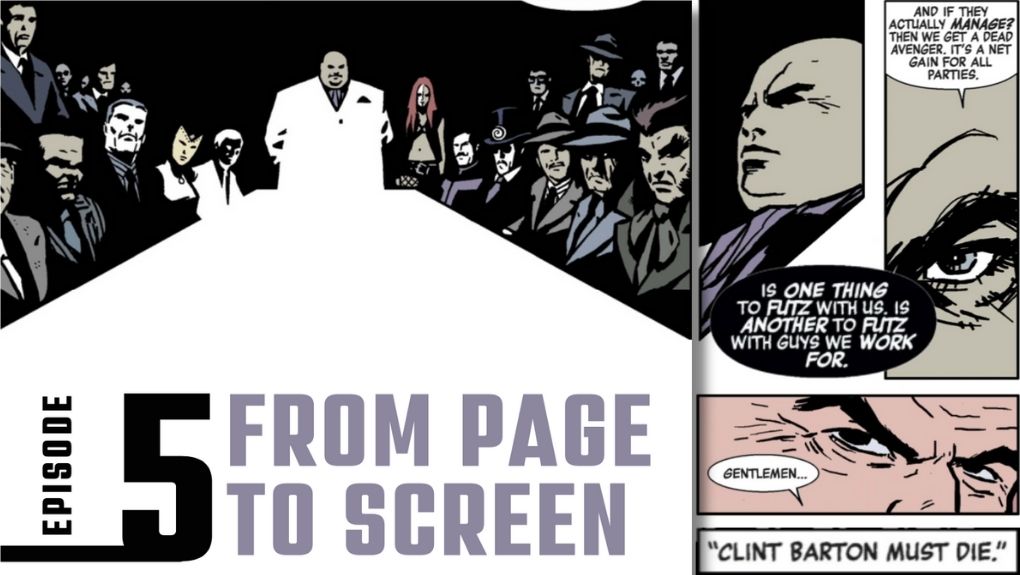
    One thing we know about Kingpin in every adaptation is that he is at the top of the New York City criminal organization pyramid. We know little so far from the Hawkeye series, but in the comics, Kingpin is a general presence that overshadows much of the crime syndicates below him. In both the series and the comic, Clint is hesitant to work with Kate or go about his general business, not because of the Tracksuit Mafia, but because of who they work for. In the series, Clint tells Kate that they do not want to get too involved, because they could run into the “Big Guy”. In the comics, Kingpin delivers a speech to a cohort of villains that “Clint Barton must die,” for interfering with their plans. The Tracksuit Mafia makes it pretty clear the Clint that they work for someone much more powerful. Later on, it’s obvious that Fisk is at least one of who they are referring to. As seen below, the comics make it much more explicit than the Disney+ series does.

    ‘Hawkeye’ #6 (2012)
    ‘Hawkeye’ #8 (2013)

    The Auction

    Curiously, both the comics and the series feature a black market auction for Barton and Avengers-related items. In the series, of course, we see people bid on the Ronin sword, but the Tracksuit Mafia break into the event to grab the still-mysterious Avengers-related watch before it goes up for sale. While Clint tells Kate that the watch could blow the cover of his friend, in the comics a tape of Clint assassinating targets on behalf of S.H.I.E.L.D. goes up for auction. Kate manages to buy the tape – in disguise as Madame Masque – and, you can guess, Kingpin is not too happy.

    ‘Hawkeye’ #4 (2012)

    In the series, the first episode shows Jack and Armand Duquesne at the said auction that featured several items found from the destroyed Avengers compounds, including Ronin’s sword, suit, and the mysterious watch. While we did not see Kingpin physically at the auction, we know the Tracksuit Mafia—that he controls—broke in to steal the watch. As little as we know about the watch, it’s clear it might have the same effect on the owner and Clint’s tape in the comics did on him.

    ‘Hawkeye’ #4 (2012)
    Marvel Studios’ ‘Hawkeye’ Episode 1

    The Assassin

    In the comics, Kingpin is one member of a group, including the Tracksuit Mafia, that decides to hire an assassin to kill Clint Barton. He hires Kazimierz Kazimierczak in the comics, who is otherwise known as the Clown. The Kazi in the series definitely strays from the Kazimierz in the comics, so we have not seen any elements of the “Clown” at this point. But in the series, Episode 5 tells us that Kate’s mother Eleanor hired Yelena Belova to kill Clint. Shortly after, we find out that Eleanor appears to be working with Kingpin, begging the question as to whether he was involved in the live-action scheme to take down Clint Barton.

    While Kingpin’s introduction was fairly small in Hawkeye Episode 5, it’s worth noting the connections he has to the Fraction-Aja comics. We’ll find out more about Kingpin’s involvement in the Hawkeye finale on Wednesday, December 22, 2021, when it airs on Disney+.

  • ‘Hawkeye’ From Page to Screen: Episode 4

    ‘Hawkeye’ From Page to Screen: Episode 4

    With Episode 4 ‘Partners, Am I Right?’ Marvel Studios’ Hawkeye is now moving into its third act. Unlike previous episodes where we could find entire sequences taken straight out of the Matt Fraction and David Aja’s Hawkeye comic run (introducing Lucky in episode 1Clint and the Tracksuit Mafia in episode 2the car chase and trick arrows in episode 3), these references were now a bit more subdued.

    Flipping the script
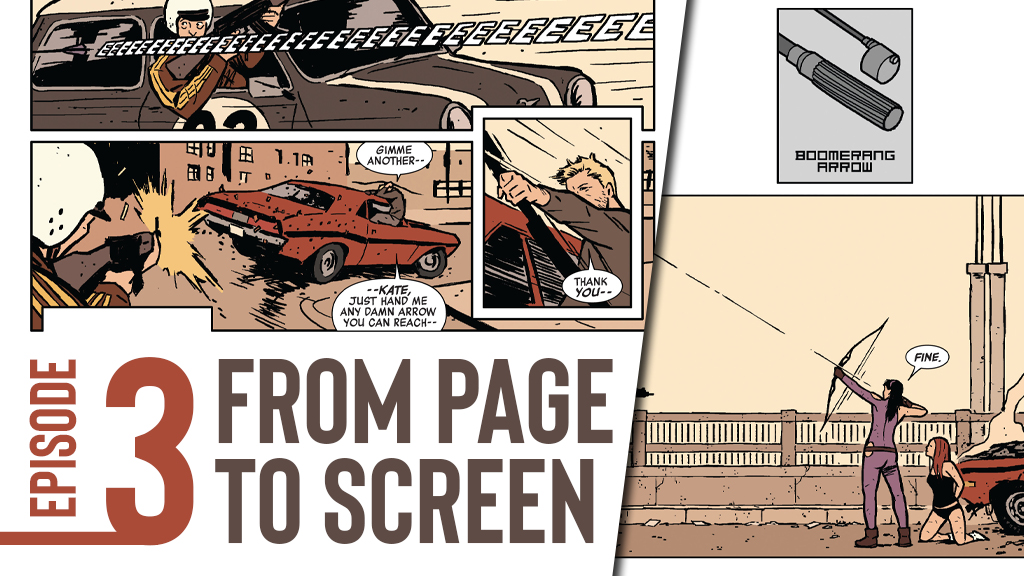
    Going back to the trick arrows theme that we focused on last week, we got a reference showing us how, at times, the series has managed to flip the script on the comic run. There’s a small gag in issue #3 that starts off with Clint praising the qualities of his Boomerang Arrows. Kate, on the other hand, doesn’t really see the point or how they could ever come in handy on the field. Later on while facing the Tracksuit Mafia, who have a machine gun to Clint’s head, Kate is asked not to engage and to ditch the arrow she has pointed at the Bro who has Clint. She complies, shooting it way above the Mafia Bro’s head, only for the arrow to come back and hit him in the back of the head, thus saving Clint. ‘Boomerang Arrow. It comes back to you in the end.”

    ‘Hawkeye’ #3 (2012)
    ‘Hawkeye’ #3 (2012)

    In the show that initial discussion goes the other way around. Boomerang Arrows aren’t a real thing but Kate kinda wishes they were. Clint, as Kate did in the comic run, doesn’t really see the appeal of having an arrow you shot coming back to bite you in the ass. Kate then mentions there might have a little bit of dodging involved. This might still be setting up a payoff down the line when a Boomerang Arrow is actually used in action but, for now, it serves as an example of how the series is approaching the Clint / Kate dynamic differently than the comic run. In the books, Kate was always the more level-headed of the two. Clint, a single guy living alone in NYC struggled to get his shit together and was often given crap about not doing the right thing. As we’ve been watching in the tv show, things are very differently portrayed.

    Marvel Studios’ ‘Hawkeye’ Episode 4
    ‘Hawkeye’ #9 (2013)

    This might be due to a number of factors with one being that, with the show being used to introduce Kate Bishop to the world, you still need to allow the character to have enough room to grow in upcoming projects. There would be no point in presenting Kate in the place you want her to be in five years from now. Just think of the amount of development you’d have to skip over. At the same time, the series, unlike the comic run, had to deal with preestablished Clint Barton’s background, both in terms of his family life and his past avenging. Even if the comic approach of making the young protégé being the sane one was a welcomed one, both the past and future of the MCU strongly benefit from approaching the Barton / Bishop relationship the way the show does.

    Marvel Studios’ ‘Hawkeye’ Episode 4

    LARPers helping out
    In a pretty good self-aware and self-deprecating bit of storytelling, we got introduced to the LARPers in episode 2, ‘Hide and Seek’. Episode four brought them back in a more active role, making them a part of Clint and Kate’s.. guild? If there’s one thing that the Tracksuit Mafia has over our heroes is strength in numbers and the LARPers could just be the missing pieces in order to level the playing field in the upcoming episodes.

    Marvel Studios’ ‘Hawkeye’ Episode 4

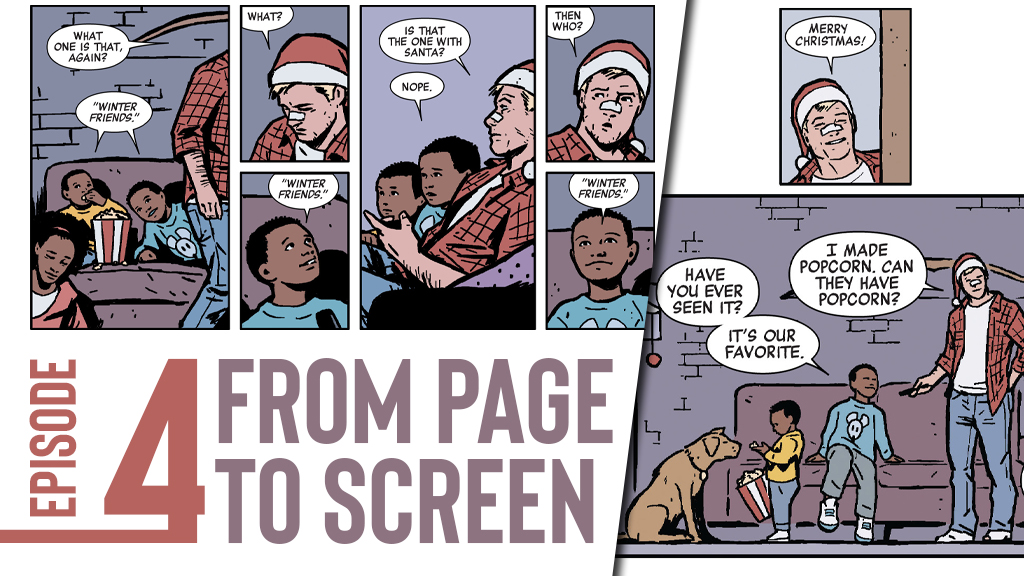
    The comic run didn’t feature these characters but still managed to deliver Clint and Kate the help they needed by having Barton’s neighbors step up and help out. Throughout the series, we get to see Clint, hesitantly at first, connect with his neighbors to the point where their well-being becomes as important to him as his own. He helps one of them (Grills, sound familiar?) reconnect with his dad and even babysits Simone’s kids. At the end of the series, as the Tracksuits prepare one final attack on their building, everybody plays a part in defeating them, some with more success than others.

    ‘Hawkeye’ #1 (2012)
    ‘Hawkeye’ #7 (2012)

    In a show that has been so much about family, be it through Clint’s point of view (where you value what you have) or through Kate’s (where she learns that there’s family to be found outside the typical idyllic entity) the development of a family-type unit with the help of LARPers found along the way seems like a welcomed prospect for both characters.

  • ‘Hawkeye’ From Page to Screen: Episode 3.2

    ‘Hawkeye’ From Page to Screen: Episode 3.2

    Marvel Studios’ Hawkeye is starting to hit its stride as it delivered its best episode yet in “Echoes” where, as in previous episodes, we again find several references to the Matt Fraction and David Aja’s Hawkeye comic run. After focusing on how Episode 1 incorporated the introduction of Lucky the Pizza Dog, and Episode 2 featured Clint’s capture by the Tracksuit Mafia we have now also looked at how Episode 3 adapted the stand-out car chase sequence. Considering that this episode justified more than one article it is now time to focus on some interesting elements scattered throughout say sequence: the trick arrows.

    ‘Hawkeye’ #3 (2012)

    Clint already has a history of using several types of arrows in the MCU, suited for each occasion, but Episode 3 takes them to a new level. As with the car chase, these came straight from the pages of Hawkeye #3, one of the most kinetic issues of the entire run. But according to artist and comic series co-creator David Aja, we have Ellio R. Brown to thank as it was his work in The Official Handbook of the Marvel Universe #5 published in 1986 that inspired both Fraction and Aja to create the pages that were to become Hawkeye #3.

    The Official Handbook of the Marvel Universe V.2 – Deluxe Edition #05
    The Official Handbook of the Marvel Universe V.2 – Deluxe Edition #05
    The Official Handbook of the Marvel Universe V.2 – Deluxe Edition #05

    From the 14 arrow-types Brown designed in the 80s, Fraction and Aja managed to use 12 of them in Hawkeye #3. A few were simply referenced, but most were actually put up to good use against the Tracksuit Mafia. Fast-forward a few years and, out of those 12, Marvel Studios’ Hawkeye re-used 7 of them in Episode 3, most with slight changes to them.

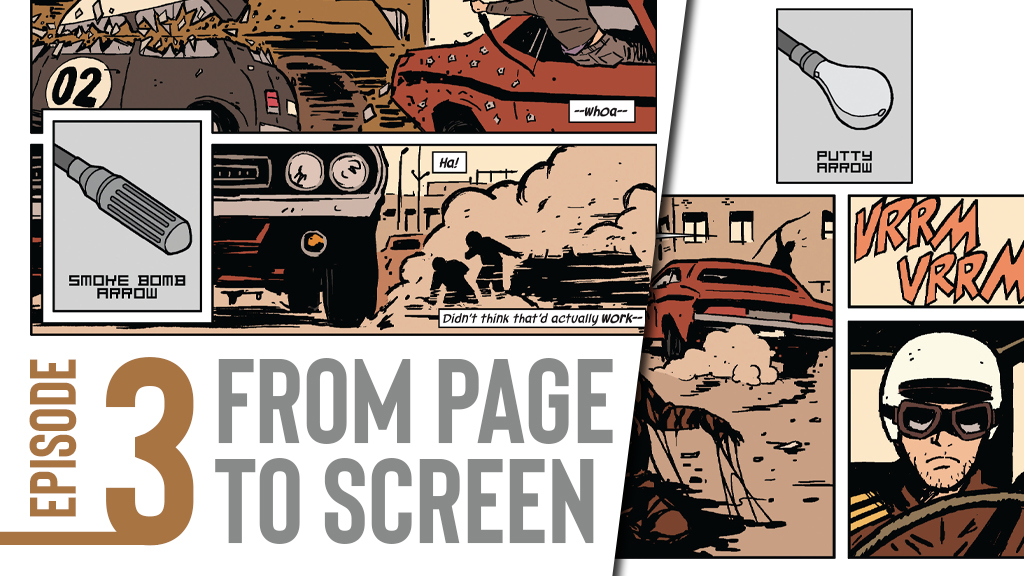
    Putty Arrow

    Marvel Studios’ ‘Hawkeye’ Episode 3

    The first arrow that Kate Bishop manages to fire at the pursuing Bros. It initially looks an awful lot like Ego, The Living Planet’s expanding seedlings we saw in Guardians of the Galaxy Vol. 2, before turning into a soft and malleable paste that blocks the Tracksuits’ windshield almost entirely. Kate ends up not using it as Clint intended, on the truck’s tires, as it would quickly harden thus definitively disabling the vehicle. The show also goes for a Hawkeye Purple whereas the comics, that have Clint holding the bow, go with a simple black-looking ooze that sort of glues one Bro to the asphalt.

    ‘Hawkeye’ #3 (2012)

    Explosive Tip Arrow

    Marvel Studios’ ‘Hawkeye’ Episode 3

    The most obvious and probably one of the handiest arrows in Clint’s arsenal. Not suitable for close-quarter combat but good for basically everything else. Kate still manages to get surprised by the explosion as if she hadn’t witnessed even bigger ones a decade earlier – We all saw the flashbacks, Kate! -. It did the trick though as that Trust a Bro moving van’s DVD player stealing days are as dead as DVD players themselves. In the comics, Clint and Kate were being pursued by Mini Coopers so anything that arrow did to a van, it probably did twice as much with twice the ease to those smallish compact city cars.

    ‘Hawkeye’ #3 (2012)

    Suction Tip Arrow

    Marvel Studios’ ‘Hawkeye’ Episode 3

    Initially treated as a gag it ended up as probably the most important (and peaceful) of arrows as it was used not to take lives, but to save them. Just like in the comics Clint uses it so as not to fall from a moving vehicle, saving Kate from having a shorter MCU career than Quicksilver. That would have been a major Bohn.. bummer. The suction-tip arrow proves to be the real MVP.

    Marvel Studios’ ‘Hawkeye’ Episode 3
    ‘Hawkeye’ #3 (2012)

    Bola Arrow

    Marvel Studios’ ‘Hawkeye’ Episode 3

    Ok so, I’m not totally sure on this one but a couple more people agreed that this might be it so here it goes. Kate used a Bola Arrow to get all those pine trees on top of the Putty Truck. It ended up being a bit more effective than the one Clint shot in the comics that managed to get a chuckle out of a couple of Bros. And, seriously, if you can’t hurt a Bro with an arrow with that much potential you should really be contemplating what you’re even doing with your life with a tequila shot in your hand. Point Bishop.

    ‘Hawkeye’ #3 (2012)

    Acid Arrow

    Marvel Studios’ ‘Hawkeye’ Episode 3

    Kate proved herself as an incredible archer with these shots alone. Clint, on the other hand, shot a Mini Cooper as it was facing him. Good for him. The subtlety of this specific arrow was better applied in the show as it allowed for a precise and disruptive use of the arrow in a way not many other types could. Since it was Clint’s idea to use it as they did he does end up deserving some recognition. Even if it was Kate doing all the work.

    ‘Hawkeye’ #3 (2012)

    Smoke Arrow

    Marvel Studios’ ‘Hawkeye’ Episode 3

    Again with the “Hawkeye Purple”, we get it. Kate manages to shoot it inside the Dodge Challenger which proves a much better idea than using it on the outside as Clint does in the comics. Could it be much worse than the usual NYC air pollution? My guess is Clint ended up doing the Tracksuits a favor. “Bro five!”

    ‘Hawkeye’ #3 (2012)

    Cable Arrow

    Marvel Studios’ ‘Hawkeye’ Episode 3

    One of the most well-known types of arrows we’ve seen Clint use over the years. In fact, this was one of the first-ever arrows Kate saw Hawkeye shoot first-hand as she witnessed his escape from the Chitauri in the Battle of New York. This was perhaps the main reason she knew what to do when he jumped off the bridge and therefore managed to grab the bow in order to swing into the train tracks beneath. In the comic Clint uses it to rip through a Mini Cooper, stripping it of its roof (see the Smoke Arrow image above). This probably speaks more of Clint’s upper body strength than the Mini Coopers’ lack of frame reliability.

    ‘Hawkeye’ #3 (2012)

    USB Arrow

    Marvel Studios’ ‘Hawkeye’ Episode 3

    Not present in Hawkeye #3, we get to see it put to good use seventeen issues later in Hawkeye #20 as Kate searches a computer for financial logs. I don’t know what’s more laughable, the fact that the pen drive only holds 256Mb of data or that the arrow exists in the first place. Either way, it opens up the door for future variations such as the LaserDisc Arrow (similar to the Predator’s Smart Disc) or the Kitchen Sink Arrow for the upcoming Young Avengers vs Looney Tunes.

    ‘Hawkeye’ #20 (2014)

    Pym Particle Arrow III (Goliath Arrow)

    Marvel Studios’ ‘Hawkeye’ Episode 3

    This isn’t something we’ve witnessed in the MCU (yet!) but in the comics, it is said that Hawkeye has three types of Pym Particle Arrows:

    • Pym Particle Arrow I (The Reduction Arrow) utilizes the famous size-shifting science to decrease the target’s size and strength.
    • Pym Particle Arrow II (The Growing Barrage) creates a swarm of arrows by releasing an entire shrunken volley at once.
    • Pym Particle Arrow III (The Goliath Arrow) uses Pym Particles for growth and is used to trigger his transformation into Goliath.

    As we see in this panel taken from Hawkeye: Blindspot #3 where Clint is doing his best giant Stay Puft Marshmallow Man impression, Clint has used it on himself while the show stuck to it being used on an inanimate object. All kidding aside, it was one of the best moments of the entire episode as it established a sense of the connected universe Marvel Studios intends these shows to have. All in a way that felt so natural, not needing any sort of exposition dump to have it make absolute sense.

    ‘Hawkeye: Blindspot’ #3 (2011)

    Episode four is just around the corner (it’s tomorrow!) so we’ll be getting to the next few From Page to Screen in just a few hours. See you next week!

  • ‘Hawkeye’ From Page to Screen: Episode 3.1

    ‘Hawkeye’ From Page to Screen: Episode 3.1

    The live-action Hawkeye series has openly taken bits and pieces of Matt Fraction and David Aja’s Hawkeye comic run. We looked at how Episode 1 incorporated the introduction of Lucky the Pizza Dog, and Episode 2 featured Clint’s capture by the Tracksuit Mafia that had some clear ties to the comic. This week, Hawkeye Episode 3, “Echoes, adapted one of the comic’s most iconic sequences: the trick arrow car chase. Unlike previous episodes, the car chase sequence is based heavily on Fraction and Aja’s work, and is as close to being “directly from the comic” as the series is likely to get. You might be surprised to see what the episode borrowed straight from the comic and what they changed.

    ‘Hawkeye’ #3 (2012)

    What They Borrowed

    The Chase

    Of course, the car chase sequence happens both in Hawkeye Episode 3 and Hawkeye #3. In both stories, Clint and Kate are being chased by hoards of the Tracksuit Mafia with one Hawkeye hanging out of the window to shoot arrows at their assailants, causing mayhem throughout the streets of New York. A major difference, though, is that in the comic the two archers are also the original chasers. But more on that below.

    Marvel Studios’ ‘Hawkeye’ Episode 3
    ‘Hawkeye’ #6 (2012)

    The Arrows

    The car chase wouldn’t be the car chase without the endless barrage of random trick arrows that Clint has on hand. We could write an entire article on the arrows in this episode alone…so we did. Check out the next “From Page to Screen” for that.

    Marvel Studios’ ‘Hawkeye’ Episode 3
    ‘Hawkeye’ #6 (2012)

    The Banter

    As is their thing, Clint and Kate have a lot of back-and-forth throughout the chase in both the series and comic. It’s a bit different in the live-action version, however, because Clint mostly can’t hear Kate. For example, a running joke in Hawkeye is that Clint set out to label his trick arrows on that day, which led him down a series of poor choices, including the car chase sequence itself. In the episode, Kate complains that Clint should label his arrows. Another running joke is Clint’s concern for the red 1970’s Dodge Challenger, and both versions end up wrecked.

    Marvel Studios’ ‘Hawkeye’ Episode 3
    ‘Hawkeye’ #6 (2012)
    ‘Hawkeye’ #6 (2012)

    The Bridge

    In both, the chase ends on a bridge and in a stand-off between archers and the Tracksuit Mafia. In the comic, Kate saves Clint, who’s held at gun point. A classic visual is Kate pointing an arrow at the sky, which is replicated in Hawkeye—the major difference being that the live-action scenario involved both Hawkeyes and a Pym arrow.

    Marvel Studios’ ‘Hawkeye’ Episode 3
    ‘Hawkeye’ #6 (2012)
    Marvel Studios’ ‘Hawkeye’ Episode 3
    ‘Hawkeye’ #6 (2012)

    What They Changed

    The Car

    Hawkeye prominently featured a red 1970 Dodge Challenger. That car drove the plot as much as it drove the characters, so it’s no wonder that Hawkeye Episode 3 did give brief nod to a ’72 Challenger. But live-action Kate and Clint don’t use it, even though there isn’t too great of a reason for why not.

    ‘Hawkeye’ #6 (2012)
    Marvel Studios’ ‘Hawkeye’ Episode 3
    Marvel Studios’ ‘Hawkeye’ Episode 3

    The Archer

    The most iconic part of the car chase sequence in both the comic and series is that Hawkeye is leaning out the window shooting wild arrows that the other one hands to them at the Tracksuit Mafia. Hawkeye flipped the archer, though, and featured Kate as the one with the bow. This isn’t too surprising, as its a solid way to give her more time in the series as an archery master, something the comic had already established.

    Marvel Studios’ ‘Hawkeye’ Episode 3
    ‘Hawkeye’ #6 (2012)
    ‘Hawkeye’ #6 (2012)

    The Reason for the Chase

    Like I said, the Challenger drove the plot in the Hawkeye comic. Clint meets a woman while looking for labelling tape. He offers the buy the car, and they end up sleeping together. It turns out this woman is dangerously connected to the Tracksuit Mafia, and Clint calls Kate for help after the Mafia knocks him and and abducts the woman. This begins the care change, but they find her pretty easily, because she’s tied up in the backseat of the Challenger next to Clint’s tracker arrow. They take the Challenger and keep fleeing the Mafia following them.

    In the series, Kate and Clint and solely escaping the Tracksuit Mafia. There’s no tied-up woman in the backseat—they’re simply trying not to be killed by Echo.

    Marvel Studios’ ‘Hawkeye’ Episode 3
    ‘Hawkeye’ #6 (2012)

    At the end of the day, if you enjoyed Hawkeye Episode 3’s car chase sequence, you can thank Matt Fraction and David Aja. It’s Aja’s art in particular that causes the original to standout—there’s an impressive amount of apparent movement on the page. Combined with the expertly layered panels that make it feel like you’re watching little details simultaneously with big moments, the original chase sequence in Hawkeye is one hell of a ride.