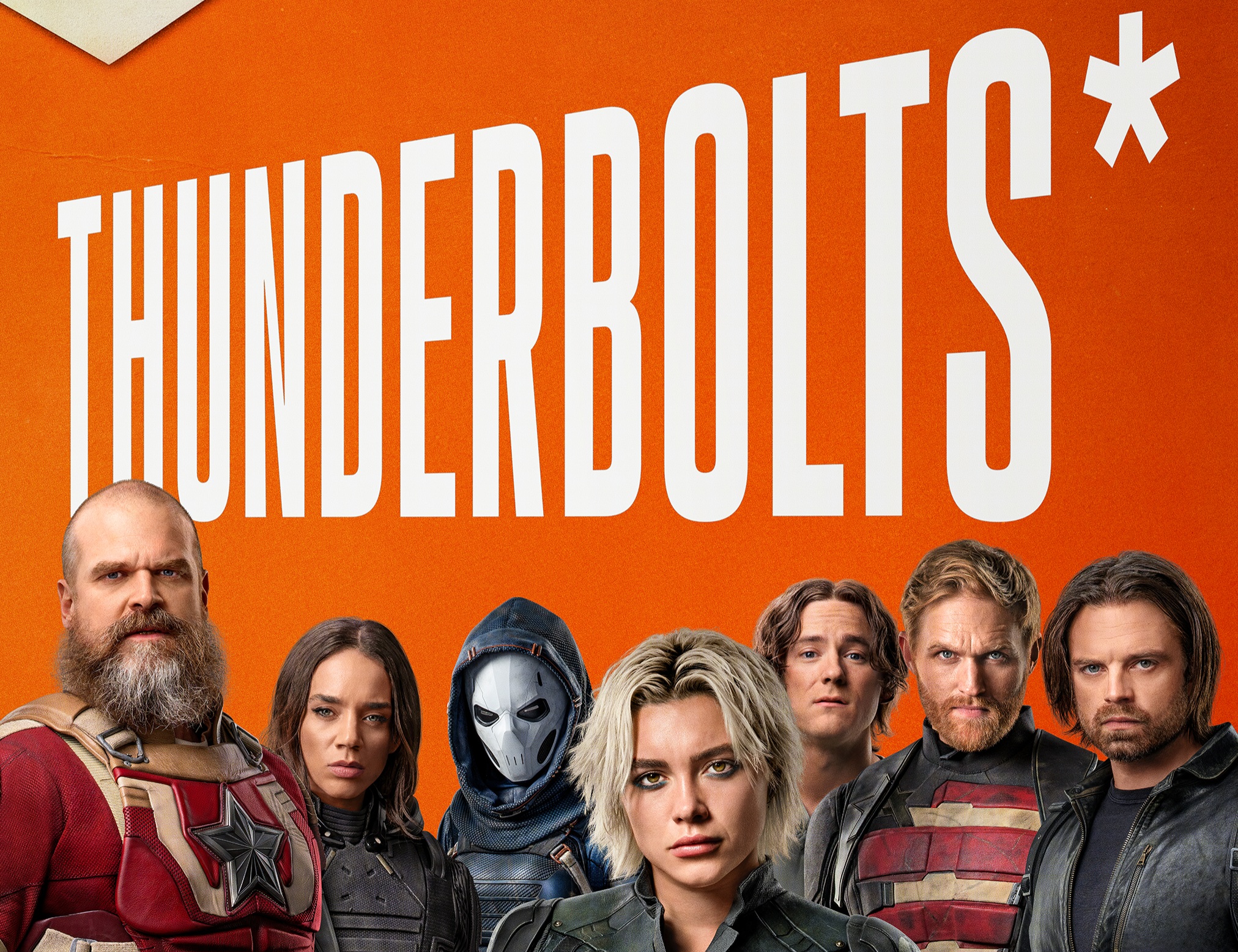
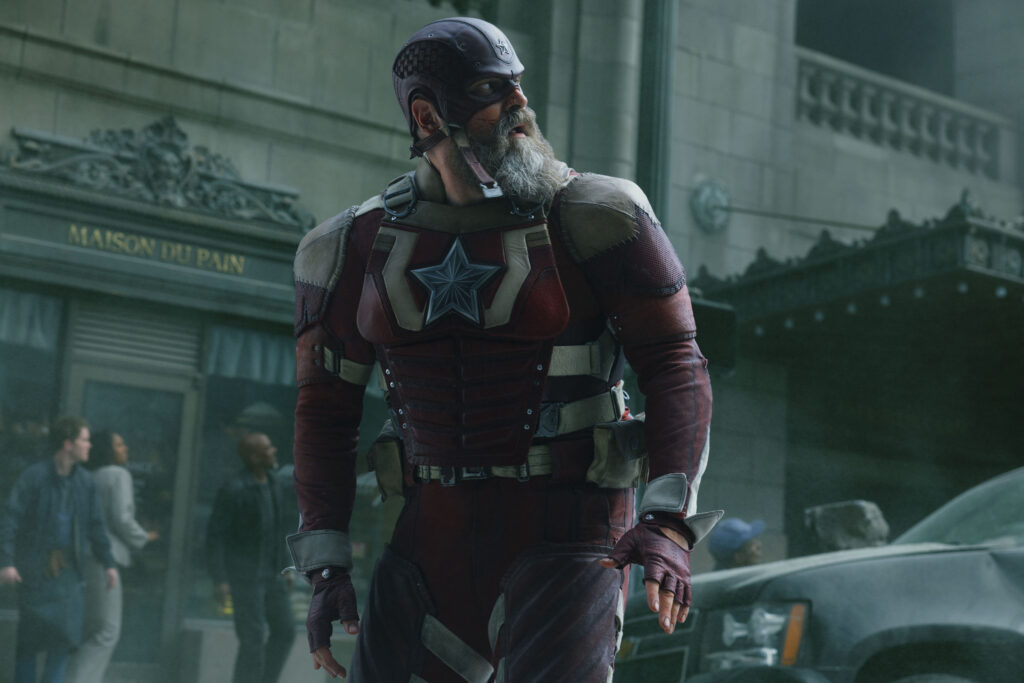
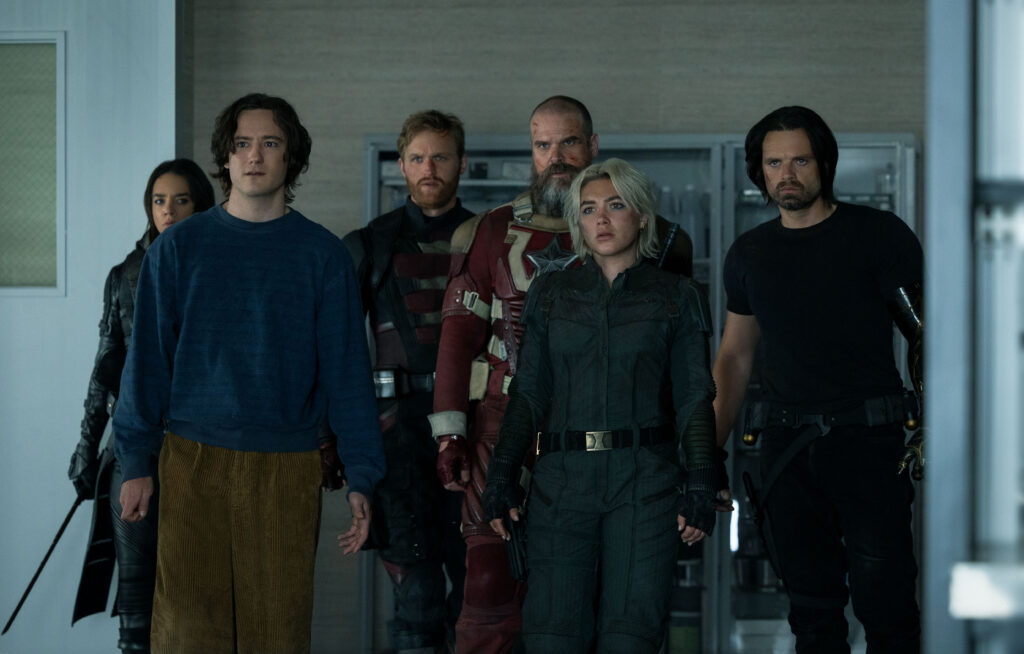
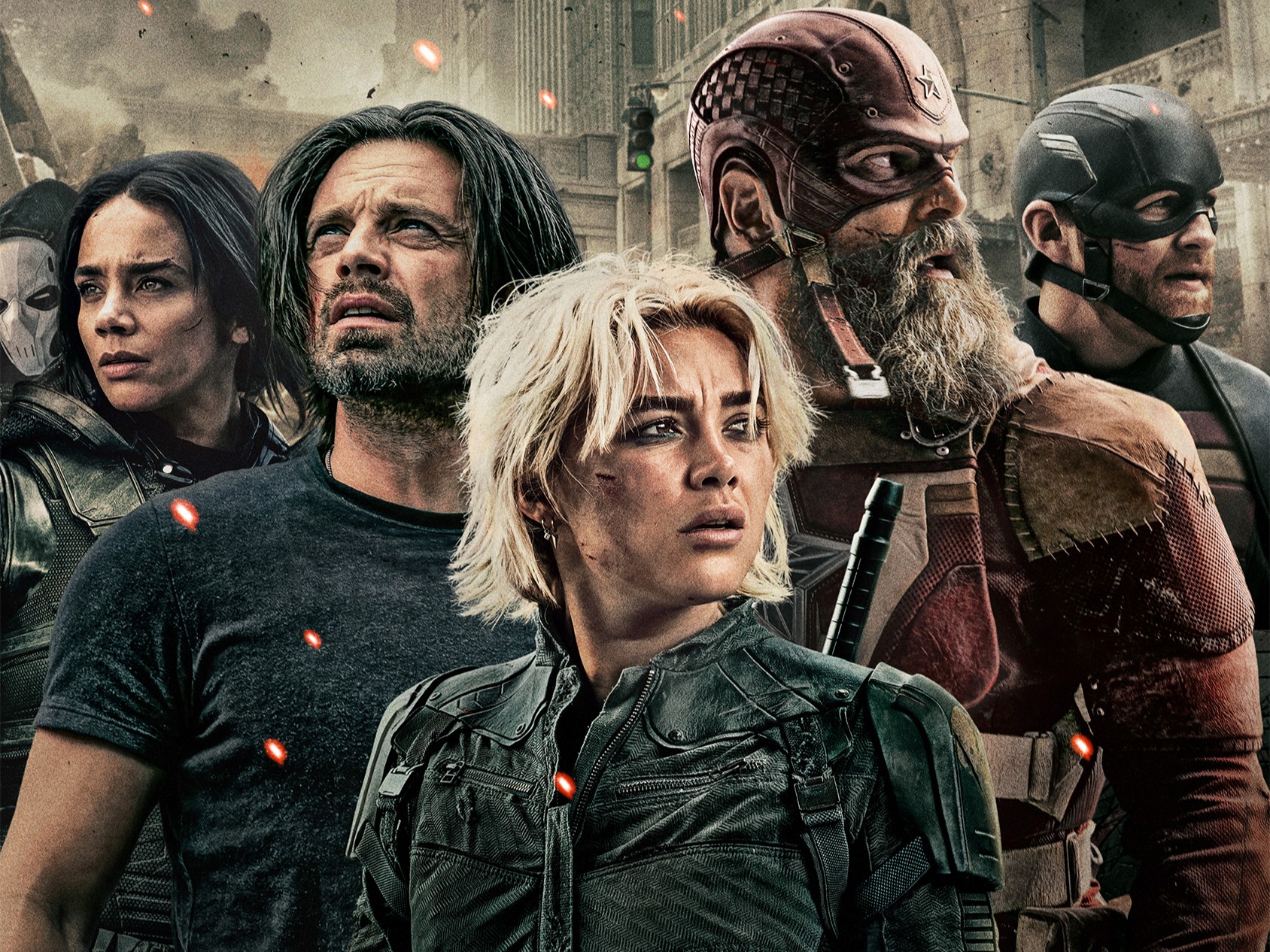
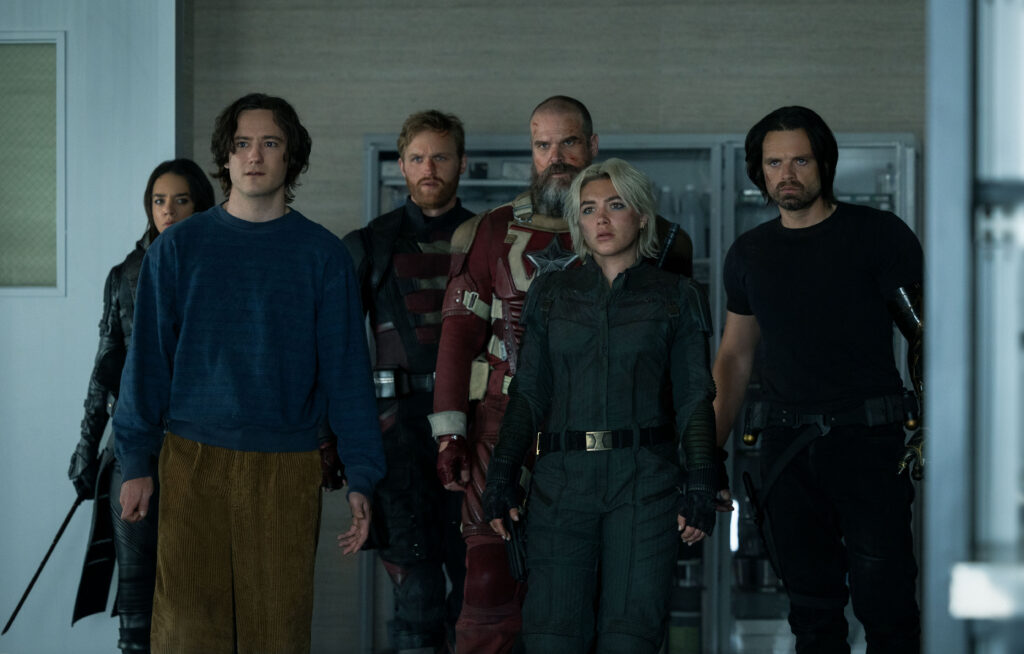
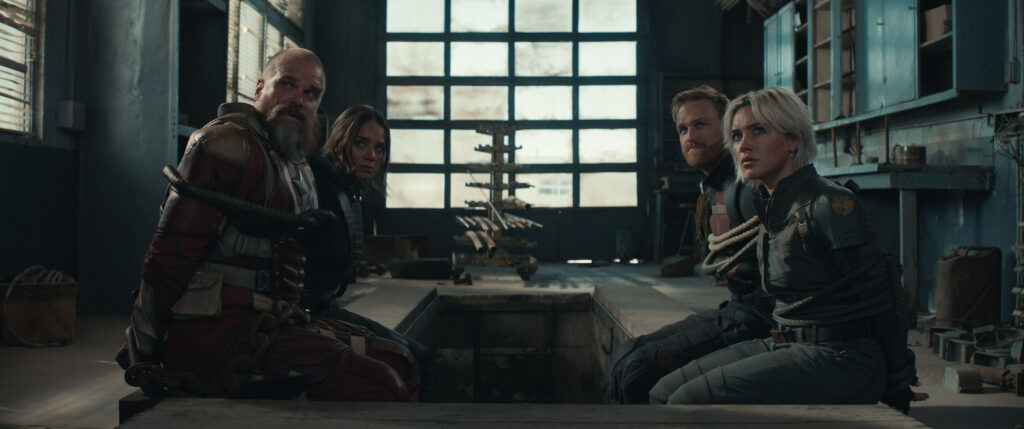
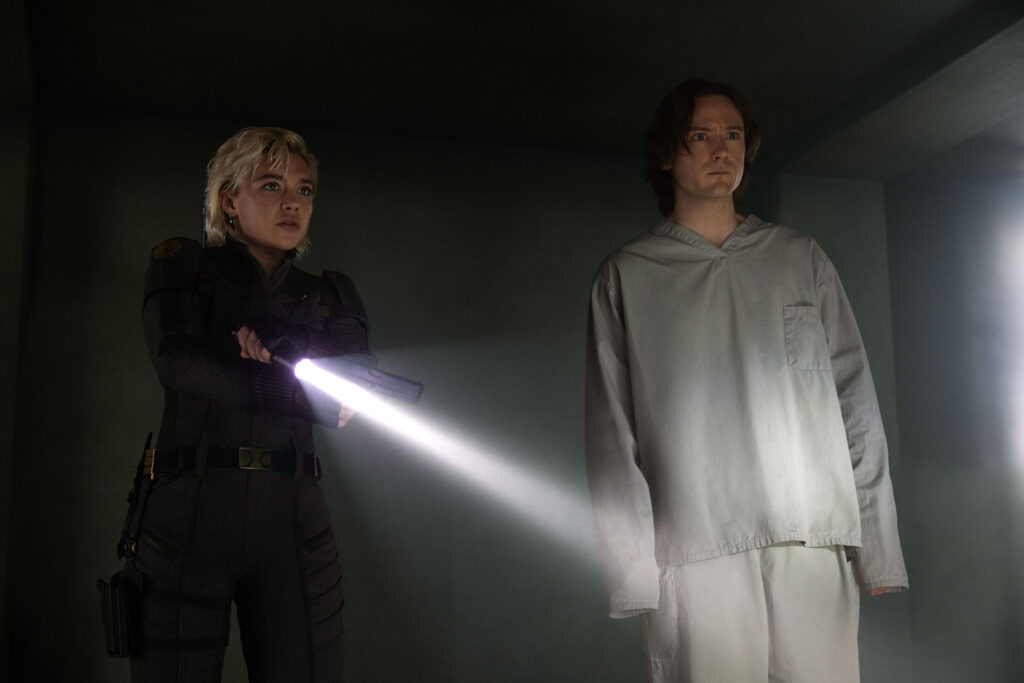
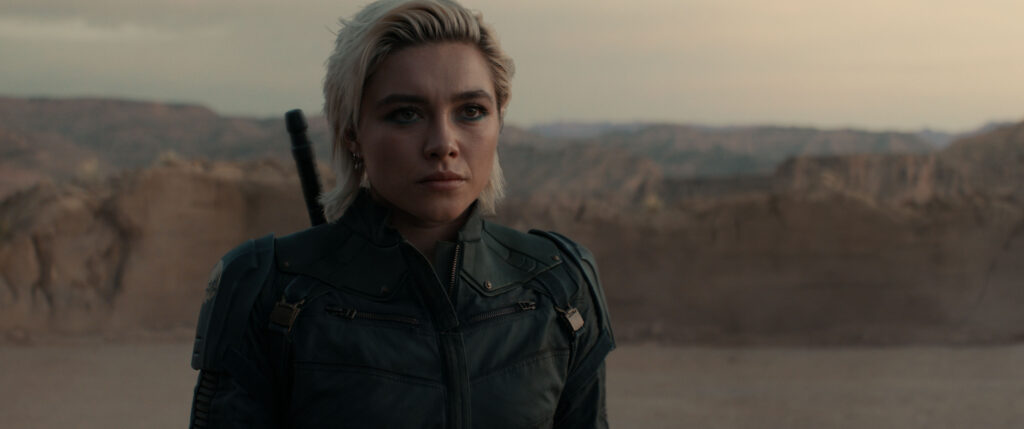
Marvel Studios took a chance with Thunderbolts* but all signs point toward the film, directed by Jake Schreier, opening to a solid weekend at the box office following very positive reviews by critics. With the surviving members of the eclectic group of anti-heroes already confirmed to appear in Avengers: Doomsday, it looks like the Thunderbolts are here to stay…at least in the short term. But in what capacity?
As explained here, following the team’s battle against The Void–the omnipotent dark shadow of Lewis Pullman‘s Sentry–Julia Louis-Dreyfus‘ Valentina Allegra de Fontaine, who is facing impeachment charges, saves face by introducing the group as The New Avengers…and Bob. With that big reveal, the 2-hour and 6-minute run time of Thunderbolts* draws to a close but, as audiences have come to expect from Marvel Studios’ projects, there’s more in store for those who stick around for the credits.
The film’s Mid-Credits scene features David Harbour‘s bombastic Alexi Shostakov and makes good on the Wheaties box premise of one of the project’s promotional posters. While out grocery shopping, a cleaned-up Alexi proudly shows off a box of The Breakfast of Champions, which features the New Avengers on the front. Though it’s mostly there to add another laugh when Alexi fails to convince a woman to purchase a box, the scene implies that the cast of castoffs have indeed become the public-facing heroes Yelena aspired to be, completing their redemption arcs.
Post-Credit
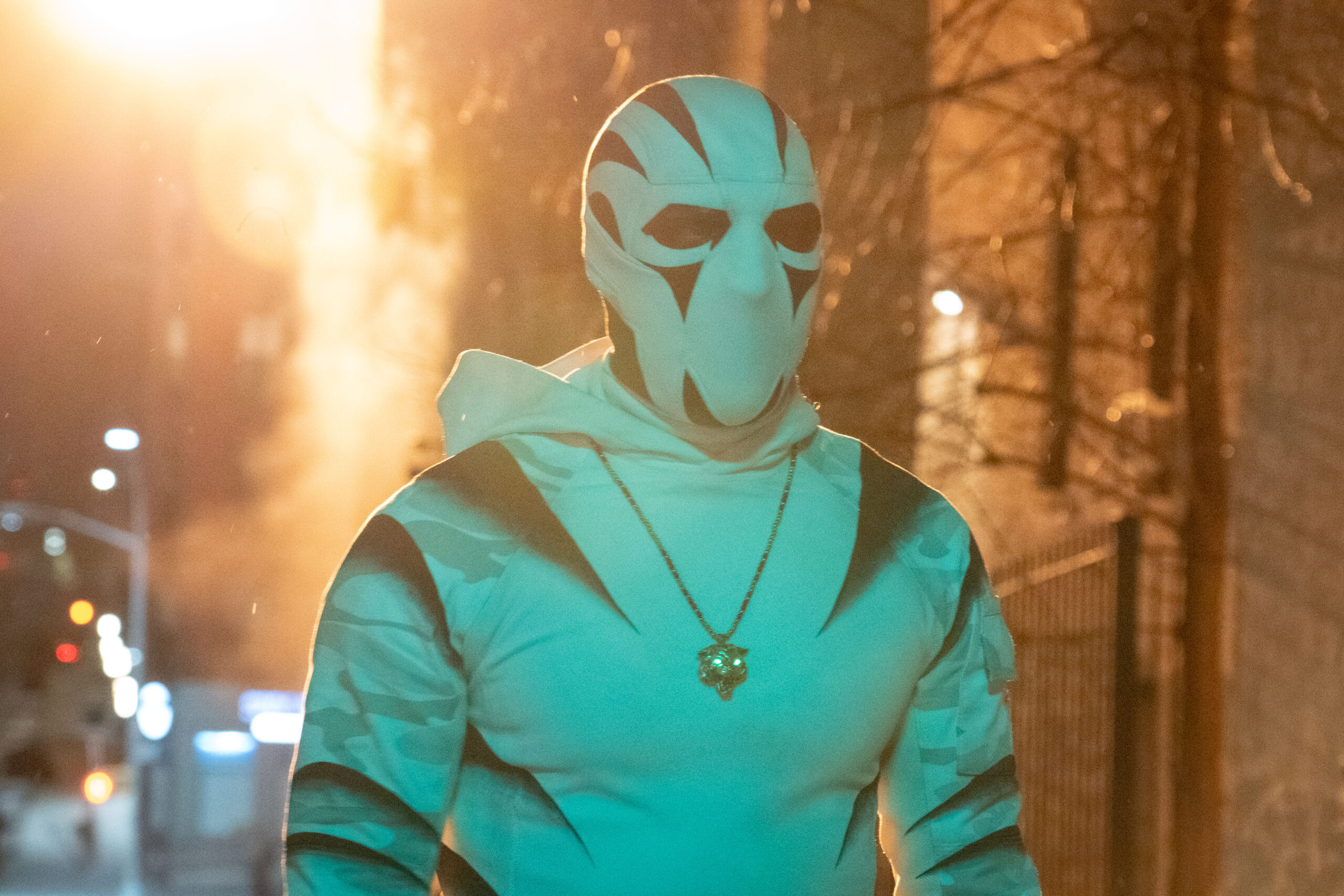
Set 14 months after the conclusion of the film, the second scene–which runs a Marvel record 2 minutes and 54 seconds–finds the team, complete with fancy new uniforms–regrouping at their new HQ, The Watchtower. Though it’s not clearly stated, the New Avengers seem to have an assistive AI helping them out as that may well be an homage to C.L.O.C. or Centrally Located Organic Computer, who helped run The Watchtower in the pages of Marvel Comics. While the team’s discussion about Sam Wilson filing a lawsuit to prevent them from calling themselves The Avengers leads Shostakov to reveal his “New Avengerz” outfit, Yelena’s conversation discloses that they are aware of a “space crisis.” As they process that, the computer warns them of an extra-dimensional ship entering Earth’s atmosphere. That ship? The Excelsior, belonging to The Fantastic Four!
While it’s not entirely clear what circumstances bring The First Family from their Earth to Earth-616, trailers for The Fantastic Four: First Steps have shown Reed Richards to be working on the math behind inter-dimensioal travel and with both The New Avengers and Fantastic Four slated to play big roles in Avengers: Doomsday, the scene teases the first meeting between the two.
During Marvel Studios’ CinemaCon presentation in April 2024, a minor change was confirmed to the title of one of the studio’s 2025 films, sparking interest among MCU fans. Without addressing its meaning, Marvel’s Head Honcho, Kevin Feige, revealed that the official title of Thunderbolts now included an asterisk. And the wild speculation about Thunderbolts* began.
Florence Pugh is here to show you a few things she can't show you.
Yes, you’ll notice the asterisk on Thunderbolts. That is the official title of Thunderbolts and we won’t talk more about that until after the movie comes out.
-Kevin Feige
As is always the case, speculation ran from absurd to astute, with many deducing a chance in the team’s name as the reason behind the mysterious addition of the symbol.
Now that the film has finally made its way into theaters, we can finally talk about why the asterisk was added to the title and it is exactly what we thought it was: a name change for the titular team of heroes.
After discovering that her Project Sentry was not a complete failure and that Lewis Pullman‘s Bob survived the process, Julia Louis-Dreyfus‘ Valentina Allegra de Fontaine plans to reveal Earth’s Mightiest Hero, The Sentry, to the public in a bid to make herself untouchable amidst her impeachment hearing. As the Thunderbolts arrive at the old Avengers Tower, now owned by Val and known as The Watchtower, in hopes of stopping her and helping Bob, Val reveals an all-new, all-different Bob, one who she’s not-so-subtly manipulated and attempts to use to kill the Thunderbolts, riding herself of the people who made up her CIA wetwork network…only Bob realizes he doesn’t have to play by the rules.
The asterisk tells us there’s so much more to the story.
-David Harbour
After saving Bob and all of New York City from The Void, the dark and powerful shadow of The Sentry that took control of Bob, the team turns its attention to Val who leads them directly to the press she had assembled for Sentry and introduces them as The New Avengers, revealing the meaning of the film’s cryptic asterisk.
With the Multiverse Saga headed toward its conclusion and Sam Wilson assembling his own Avengers, it’s not quite clear what the future holds for Yelena, Bucky, John Walker, Ava and Alexi; however, as promised during the credits of Thunderbolts*, The New Avengers will return with Avengers: Doomsday next up on their docket.
Over the years, Marvel Studios’ approach to storytelling has increasingly been the focus of criticism. The framework within which the studio chooses to spin its narrative, the “Marvel formula,” has come under fire for its predictable plot structure, overreliance on humor, and willingness to sacrifice character-driven stories to advance the MCU’s longform story. As the studio’s Multiverse Saga has moved forward, the type of nuanced performances that allow for true excavation of a character have been forgone in favor of spectacle and it has become increasingly difficult to “spectacle” an audience that grew up with fully realized heroes flying around on screen. That hasn’t stopped Marvel from attempting to outspectacle its latest spectacle and the result has been a saga largely composed of vapid films, void of any emotional resonance. And along comes Thunderbolts*…
Piecemealed together by a series of writers, Thunderbolts* cavorts in insouciance for the Marvel formula, delivering something audiences haven’t seen from the studio in quite some time: a story galvanized and energized by its characters rather than visual effects and nostalgia. Eric Pearson, Joanna Calo and Lee Sung Jin Frankensteined a script that provided director Jake Schreier the opportunity to tell an MCU-set Jekyll and Hyde (that’s an entirely different monster) story, steeped in metaphysics and exploring ontological dependence. A non-empty set depends on its elements and the respective successes of both the Thunderbolts and the Thunderbolts* are entirely dependent on their respective elements.
You’re talking about a group of characters that have done a lot of bad things, and maybe are struggling with feeling good about themselves. There’s an element that does speak to mental health, and loneliness, and how some of the darkness that we experience in our lives can’t be necessarily fixed, but can only really be made lighter through connection and finding others
Working solo, the titular team wouldn’t survive the film’s first act and, reading between the lines of some comments recently made by Schreier, it sounds as if the film might have been on track to turn out to be another hollow, one-note action flick (Schreier described it as a small-scale “Die Hard thing”) that wouldn’t have survived a critical bashing before Calo and Sung Jin weaved heart and emotion into Pearson‘s original script. Instead of another potential dud, the reworked script turned into the studio’s most impressive Multiverse Saga film to date, putting character first without sacrificing spectacle, delivering some of the most impressive action sequences the MCU has seen in a decade, while telling a story about human trauma that powerfully reverberates with the audience. Whatever Thunderbolts* originally was, it evolved into one of the studio’s most entertaining and evocative films.
Making a superhero film featuring a cast of charming, misfit losers meant that Thunderbolts* was inevitably going to be compared to Warner Bros. Suicide Squad films and Marvel’s own Guardians of the Galaxy. Thunderbolts* never feels derivative of those projects, however, because it leans so much harder into darker, more uncomfortable emotions and corners of human nature that are typically not part of superhero fare. For reasons each their own, Yelena Belova, John Walker, Ava Starr and Antonia Dreykov–all of whom find themselves in the employ of Julia Louis-Dreyfus‘ Valentina Allegra de Fontaine–have lived large portions of their lives as disposable tools to be used at the whims of others. Bucky Barnes and Alexi Shostakov–neither of whom are working for Julia Louis-Dreyfus‘ Valentina Allegra de Fontaine–have suffered the same fate. In one of the film’s more powerful moments, Bucky, who should know better than anyone given his past as The Winter Soldier, finds himself standing in the same shoes as those who were his masters in the past, seeking only to use the others as tools for his own ends without any value for consideration for them as human beings. Indeed his desire to succeed and inability to see them as anything other than means to an end prevents him from acknowledging their warnings about the film’s true threat. While parts of the scene are played off humurosly, it’s deeply tied to the film’s exploration of how emptiness can consume and how power can corrupt.
And we all have Paul Jenkins to thank for that. At the center of Thunderbolts* is Lewis Pullman‘s Bob, a tortured meth addict who volunteered to be a test subject for a program he’s told will help him and humanity reach new heights: Project Sentry. Though the studio kinda-sorta tried to hide it, Bob is Robert Reynolds, aka The Sentry, a Marvel Comics character created by Paul Jenkins. Jenkins always intended for Reynolds to be a study in mental health and while the MCU’s iteration of the character is not a beat-for-beat adaptation, he is as Jenkins intended him to be. Pullman‘s quirky, unassuming Bob–the only new character on the film’s main cast–enters the fray in the first act and quickly becomes the centerpiece of a story that subverts what fans have come to expect from the Marvel Cinematic Universe.
So I knew from the beginning that Sentry was the Void, and this story was about mental health. It was about two sides of him. And in part, it was about the part that he couldn’t accept. The Void is part of him.
Schreier‘s subversion of the Marvel formula comes attached to a story centered around the continued bastardization of a formula foundational to the ongoing MCU narrative: the Super Soldier Serum. As Stanley Tucci‘s Abraham Erskine forewarned, the Super Soldier Serum amplifies everything that already exists inside the subject. Steve Rogers–a good man–became Captain America, the Senintel of Liberty and the Symbol of Truth–while Johann Shmidt became the Red Skull–the aberrant face of the Nazi Third Reich. A bit of dialogue in the second act of Thunderbolts* illumintates just how far the science of the MCU has progressed since then, however, as Bucky Barnes, Alexis Shostakov and John Walker compare and contrast their varieties of the serum, all while the most volatile and unethical version of the serum has created the most imperfect Super Soldier yet in the Sentry. By injecting the latest and greatest version of the serum into someone broken and hollow, Valentina Allegra de Fontaine makes good on Erskine’s warning, amplifying the void inside Robert Reynolds to the point where it manifests itself as The Void, an omnipotent shadow version of The Sentry. Over the course of the film, The Void seems to be held at bay by Bob, though physical contact with him drags the characters into memories of their own, dark traumas. However, once he’s finally unleashed in what begins as an Avengers-esque third act, the film takes a welcome detour from the Marvel formula. This Battle of New York, fought inside The Void, is the battle we must all fight from time to time: a battle against our worst self. And none of these characters can make it out without the others.
It’s no surprise to me, I am my own worst enemy, ’cause every now I then I beat the living shit out of me.
-Lit
Fascinatingly, Thunderbolts* instantly becomes the standard for “new Marvel” while paying homage to one of the MCU’s most important legacies. Perhps coincidentally, it also works wonderfully as commentary on the struggles of the Multiverse Saga. The Thunderbolts and Thunderbolts* ride parallel rails. Pullman‘s Bob becomes analogous with Marvel’s Multiverse Saga struggles. Just as Julia Louis-Dreyfus‘ Valentina Allegra de Fontaine carelessly dosed Robert Reynolds, a hollow shell of a man, with an all-new, all-different formula intended to grant him the power of a thousand exploding suns, the studio carelessly assumed the Marvel formula would carry the hollow shells that were Ant-Man and The Wasp: Quantumania and Thor: Love and Thunder to all-new heights. But that did not happen. The MCU was in jeopardy, both in and out of universe…and along came the Thunderbolts and Thunderbolts*.
The serum amplifies everything that is inside, so good becomes great; bad becomes worse. This is why you were chosen. Because the strong man who has known power all his life, may lose respect for that power, but a weak man knows the value of strength, and knows… compassion.
-Doctor Abraham Erskine, Captain America: The First Avenger
Playing with a stacked deck that nobody saw coming, Thunderbolts* combines fresh visuals (Schreier‘s eye for action and unique shots will have him on every studio’s list), a pair of emotionally powerful performances by Marvel’s brightest star, Florence Pugh, and Pullman, and, yeah, some MCU humor delivered by David Harbour and, surprisingly, Wyatt Russell. If Thunderbolts* is representative of what can be accomplished when the studio is willing to tinker with its formula, these new* heroes will be at the forefront of an intriguing renaissance for Marvel Studios.
The first season of Lucasfilm’s Star Wars streaming series Andor hooked audiences right away and, over the course of 12 episodes, never let them off that hook. A tense and vast tale about the earliest days of the Rebellion, Andor gambled on itself and won big. Unlike so many other of Lucasfilm’s D+ Star Wars fare, Andor managed to captivate without relying on cameos and by diverging from the Dave Filoni-era narrative while still feeling very much like a key piece of the universe developed by George Lucas.
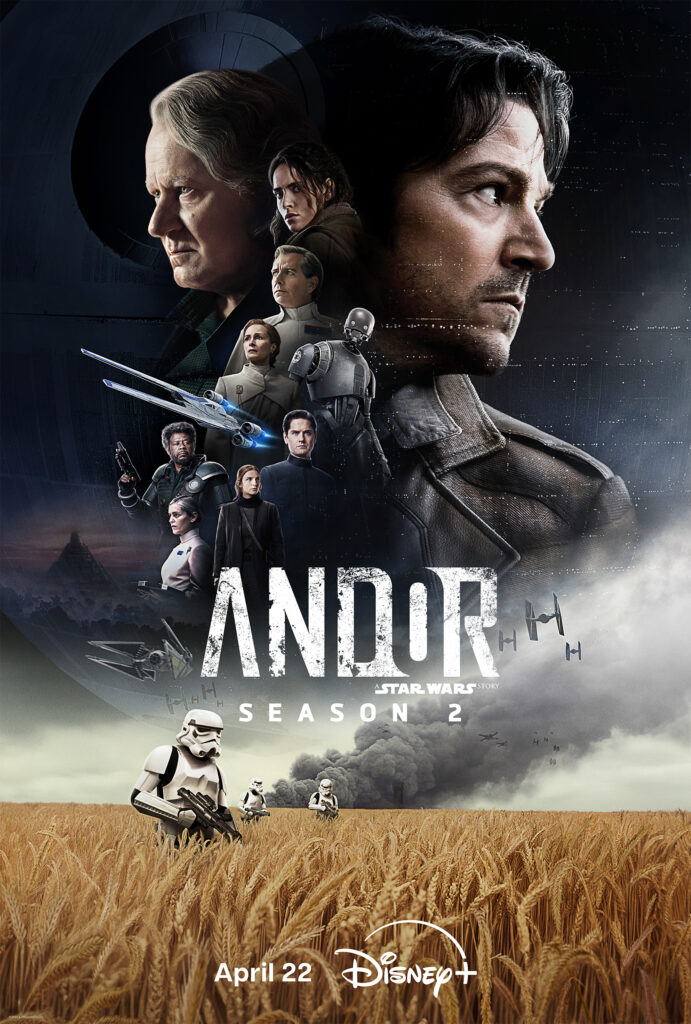
The second and final season of Andor will begin streaming on Disney+ on April 22nd and it’s unique storytelling structure will be mirrored in its release schedule. While the first season was wholly set in 5 BBY (five years before the Battle of Yavin), Season 2 will cover four years and will dovetail directly into the opening of Rogue One. To accomplish that, every three episodes will cover one year of time and so D+ will release the season in three episode pods each week. And since the series look to be doubling down on what was already an anxiety-filled Season One, audiences should prepare for some intense evenings at home. And speaking of preparing, with the three-episode debut creeping closer by the day, it’s time for…The ULTIMATE List of What to Watch before Season 2 of Andor.
Tier One
The only project that should be considered “must see” in preparation for Season 2 of Andor is Season 1. The season finale’s Rix Road riot felt like an inciting moment in the formation of the Rebellion and Season 2 should pick up right where that left off, so it would be safe to say not having any context from Season 1 might make things a bit confusing. Beyond that, Season 1 introduced at least a half dozen characters who will be integral to the new episodes, including Stellan Skarsgård‘s delicious bastard, Luthen Rael. Like Season 2, Season 1’s story was also told in three-episode pods, so try to carve out enough time to watch them together to really take in what’s happening in each one.
Tier Two
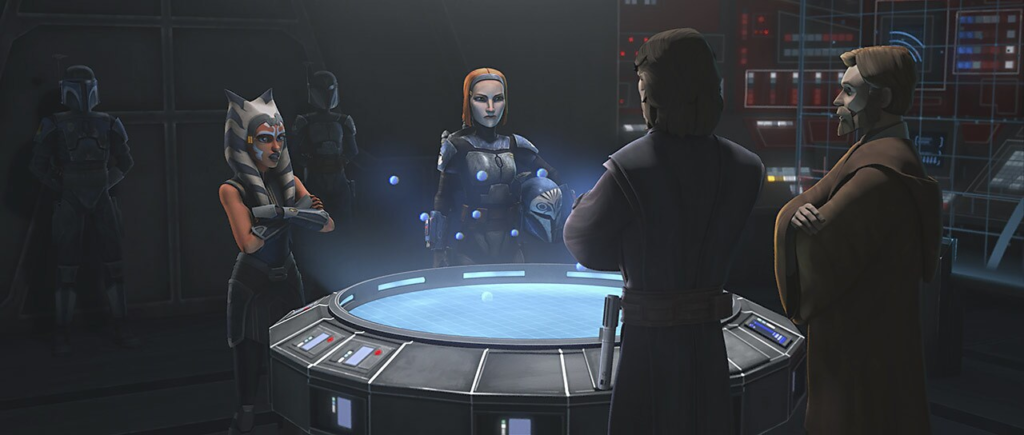
For a series named Andor, Season 1 certainly spent a great deal of time with other characters at the center of many of its episodes. Season 2 looks to do the same, with characters such as Mon Mothma, Saw Gerrera and Orson Krennic sure to have major arcs. Outside of those characters, it doesn’t seem like a stretch to wonder if others such as Bail Organa, Sleepy Sheev Palpatine or even Darth Vader might show up. And given the timeline of the final season–which will coincide with the timeline of Star Wars Rebels and The Bad Batch–any number of other surprise appearances could be in store. With that in mind, we’ve put together a list of episodes from Lucasfilm’s animated series that could directly or indirectly be related to what we expect to happen in Season 2. By no means should this list be considered official or all-inclusive but if you’re a Star Wars fan, you’ll enjoy revisiting some of these great episodes!
Without having seen the series, it wasn’t possible to accurately place some projects (Revenge of the Sith, some episodes of the animated series) on the list, so we did our best by sorting things out by year. Hopefully, in this case, our best is good enough.
NOTE: All official descriptions were taken from the Star Wars website. Additionally, the opening scrolls from the episodes of Star Wars: The Clone Wars and the first episode of Star Wars: The Bad Batch were included because they are awesome.
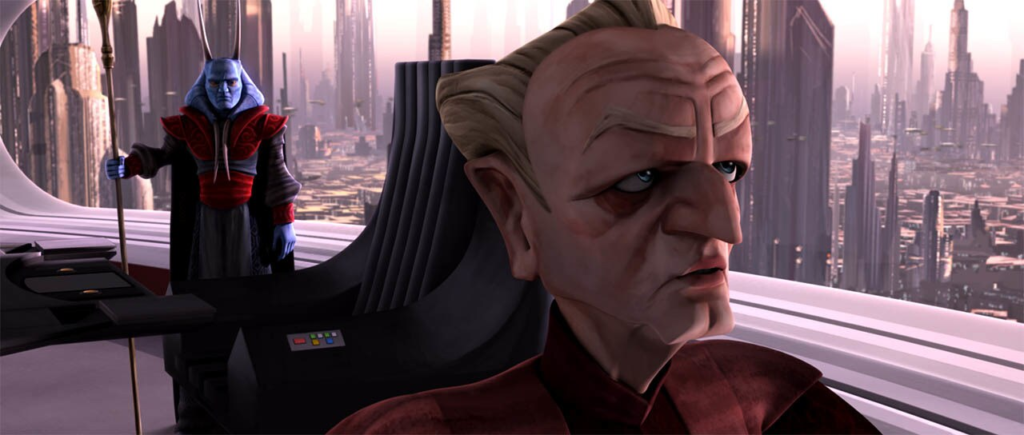
Star Wars: The Clone Wars, Season 2, Episode 19, “The Zillo Beast Strikes Back” (21 BBY)
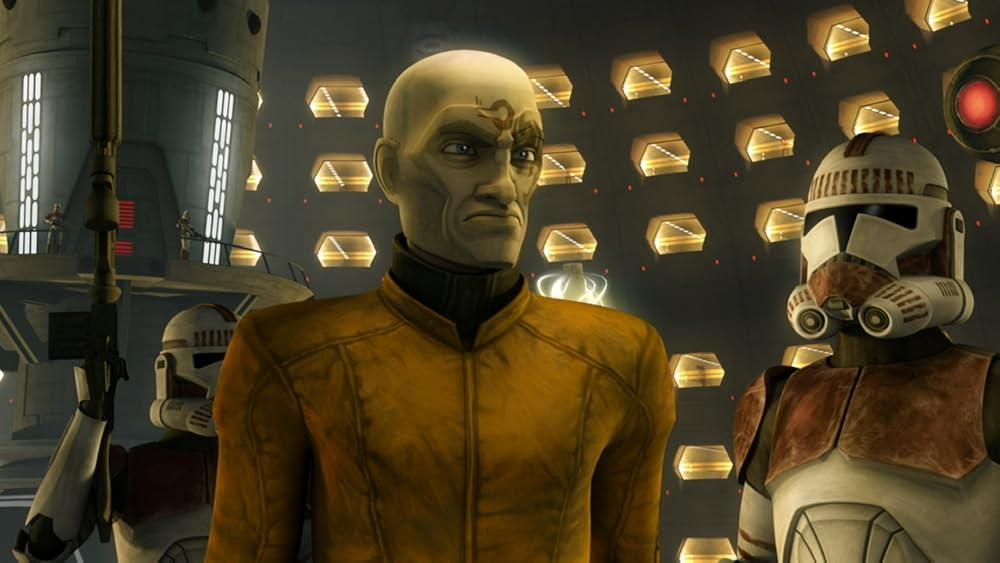
The Zillo Beast arrives on Coruscant and Chancellor Palpatine orders Dr. Sinovar Boll to study and then kill the creature. Instead, the Zillo Beast escapes from the lab with devastating consequences for the city and its inhabitants.
-Episode synsopsis per StarWars.com
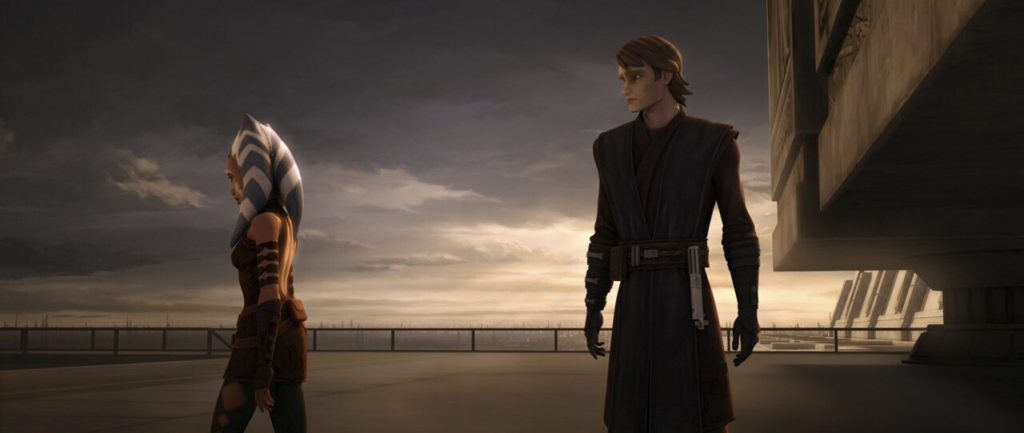
A calculated risk! Following a costly victory on the planet Malastare, Chancellor Palpatine orders Jedi Knights Mace Windu and Anakin Skywalker to transport a fearsome Zillo Beast captured during the battle back to Coruscant. After seeing that not even a lightsaber could harm the beast, Chancellor Palpatine hopes to unlock the secret of its invulnerability to create new armor for the Republic’s clone troopers. Tensions run high as the most dangerous life form in the galaxy touches down on the Republic’s most populous planet….
Chronologically set ahead of episode 2.04, “Senate Spy” (and thus also before episode 2.14, “Duchess of Mandalore”), “The Zillo Beast Strikes Back,” a continuation of the prior episode, plunges Coruscant into chaos as the captured Zillo Beast, transported for scientific study, breaks free from its containment. Chancellor Palpatine’s interest in the creature’s impenetrable hide quickly transforms from scientific curiosity to a city-wide disaster, as the enormous beast rampages through the urban landscape, evoking classic monster movie tropes reminiscent of King Kong and Godzilla. The Jedi, faced with the escalating threat, grapple with the ethical dilemma of destroying the last of a species to safeguard the populace. The episode highlights the contrast between Palpatine’s cold, calculated pursuit of military advantage and the Jedi’s struggle with moral responsibility, ultimately culminating in a desperate attempt to neutralize the Zillo Beast before it causes further destruction.
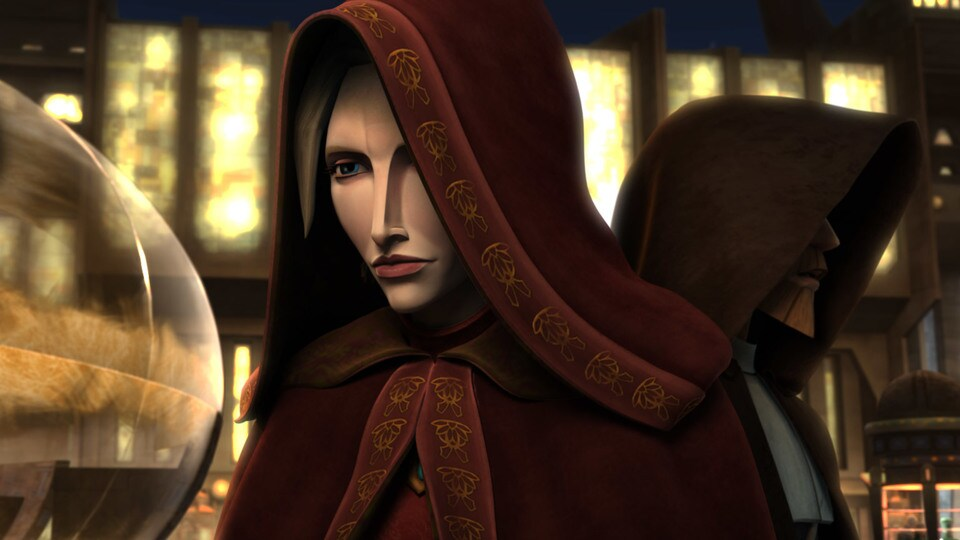
Star Wars: The Clone Wars, Season 2, Episode 14: “Duchess of Mandalore” (21 BBY)
On Coruscant, word reaches Duchess Satine that Death Watch is mobilizing, sparking a Republic invasion. On the run from Republic authorities, Satine turns to her old friend Obi-Wan Kenobi for help.
-Episode synopsis per StarWars.com
A diplomatic mission! As dissent threatens to tear apart the peaceful Mandalore system, Duchess Satine struggles to protect her people against the escalating violence. Betrayed by two of her trusted allies, Satine now travels to Coruscant. There, she hopes to convince the Senate that a destructive splinter group, Death Watch, does not represent the entire Mandalorian government…
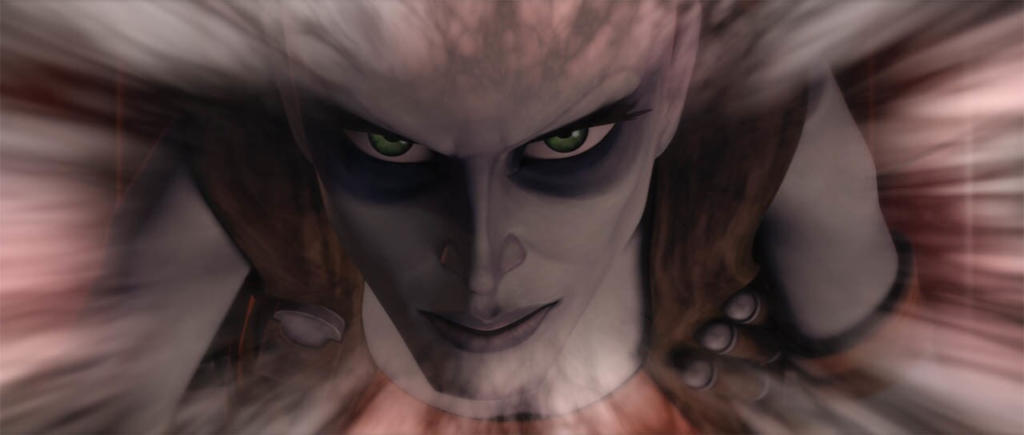
“Duchess of Mandalore” focuses on Duchess Satine Kryze’s efforts to maintain neutrality for Mandalore during the Clone Wars. The episode, and the arc it belongs to, explores the political complexities of the conflict, demonstrating that not all systems are willing to take sides. Satine, a pacifist, struggles to keep her world out of the war’s grasp, facing pressure from both the Republic and the Separatists. Her commitment to neutrality is constantly challenged, particularly by the growing presence of Death Watch, a Mandalorian terrorist group led by Pre Vizsla, who seeks to restore Mandalore’s warrior traditions. The episode highlights the internal conflict within Mandalorian society, pitting Satine’s peaceful vision against the violent ambitions of Death Watch. Obi-Wan Kenobi’s presence adds another layer of complexity, as his past relationship with Satine and his respect for her ideals create a personal stake in Mandalore’s fate. The episode reveals the fragility of neutrality in a galaxy consumed by war, and Satine’s unwavering dedication to her principles in the face of overwhelming odds. It also lays the groundwork for the later unraveling of Mandalore’s stability, setting the stage for future conflicts.
Star Wars: The Clone Wars, Season 3, Episode 7: “Assassin” (21 BBY)
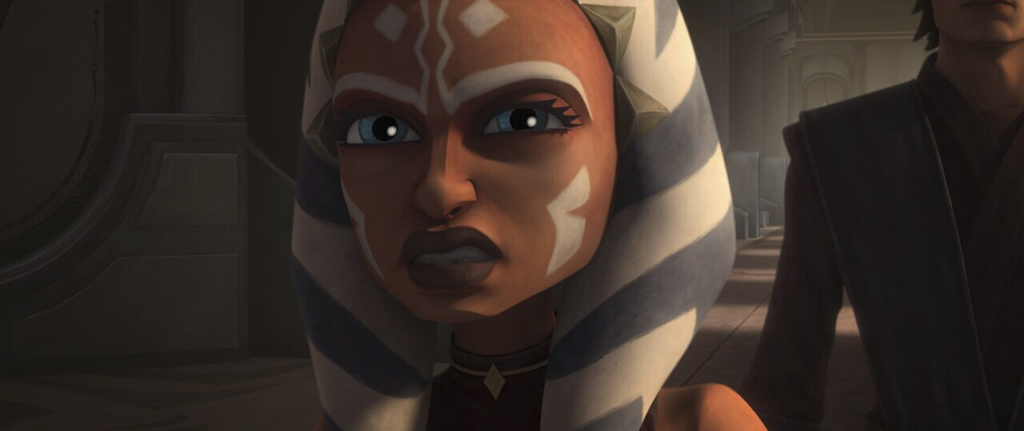
Aurra Sing, the ruthless Palliduvan bounty hunter presumed dead, returns in premonitions plaguing Padawan Ahsoka Tano. Now Ahsoka must protect Senator Padmé Amidala during a political mission to Alderaan and try to stop the assassination attempt in her visions — if they can be trusted.
-Episode synopsis per StarWars.com
Criminals captured! Jedi Master Plo Koon and Padawan Ahsoka Tano successfully thwarted an attempt on Mace Windu’s life, killing bounty hunter Aurra Sing in the process. Since that time, young Ahsoka has grown strong in the ways of the Force. Now, after several harrowing adventures alongside her Master, the two Jedi have returned to the Temple on Coruscant to receive their next mission….
A pivotal episode in Season 3, “Assassin” delves into Ahsoka Tano’s growing connection to the Force and her ability to perceive visions. The narrative unfolds as Ahsoka begins experiencing disturbing premonitions, revealing a plot to assassinate Senator Padmé Amidala. These visions, initially dismissed by the Jedi Council, become increasingly vivid and urgent, forcing Ahsoka to take matters into her own hands. The episode masterfully blends suspense and mystery, as Ahsoka races against time to uncover the identity of the assassin and thwart the impending attack. Her investigation leads her through the bustling underworld of Coruscant, where she encounters dangerous individuals and navigates treacherous alliances. The episode highlights Ahsoka’s developing skills as a Jedi, showcasing her resourcefulness and determination. It also underscores her emotional vulnerability, as she grapples with the weight of her visions and the responsibility of protecting Padmé. The episode’s climax features a tense confrontation with the assassin, Aurra Sing, revealing a deeper conspiracy and testing Ahsoka’s abilities to their limits. “Assassin” not only advances Ahsoka’s character development but also foreshadows the darker turns of the Clone Wars, hinting at the hidden forces manipulating events from the shadows.
Star Wars: The Clone Wars, Season 3, Episode 4: “Sphere of Influence” (21 BBY)
Chairman Papanoida’s daughters, Chi Eekway and Che Amanwe, are kidnapped and held for ransom and it’s up to Ahsoka Tano and the Senator from Pantora, Riyo Chuchi, to aid the new chairman and his son in recovering their family members.
-Episode synopsis per StarWars.com
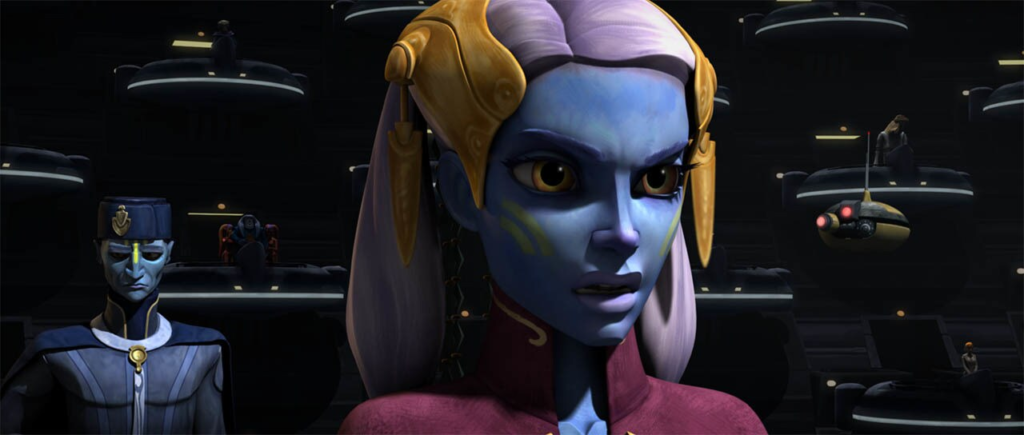
Pantora in peril! The newly elected Chairman of Pantora, Baron Papanoida, is caught in a deadly political game. The Trade Federation has blockaded Pantora and suspended all commerce with the system. Isolated from the rest of the Republic, the people of Pantora are beginning to rally against the Senate, who have seemed unsympathetic to their plight. To make matters worse, Count Dooku has come forward offering aid if Pantora joins the Separatist Alliance. Chairman Papanoida has dispatched Senator Chuchi to Coruscant with the hope that she can motivate the Senate to act in favor of Pantora before Lott Dod can legitimize the blockade….
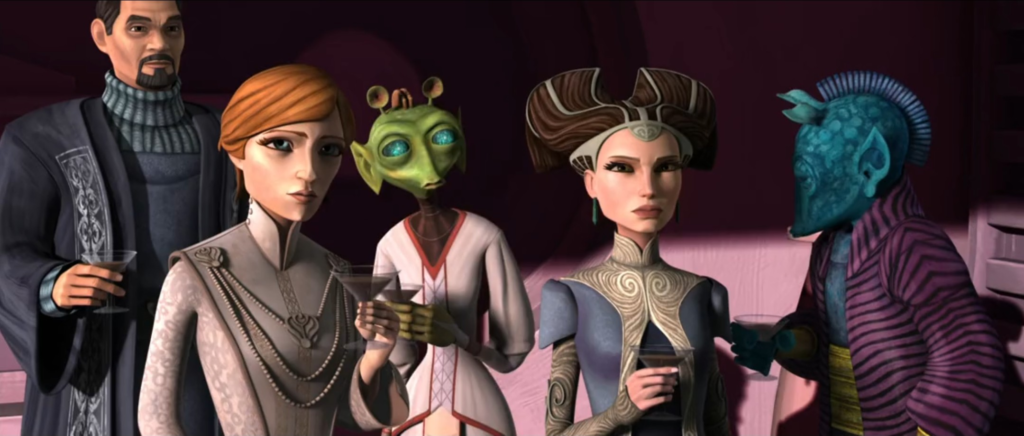
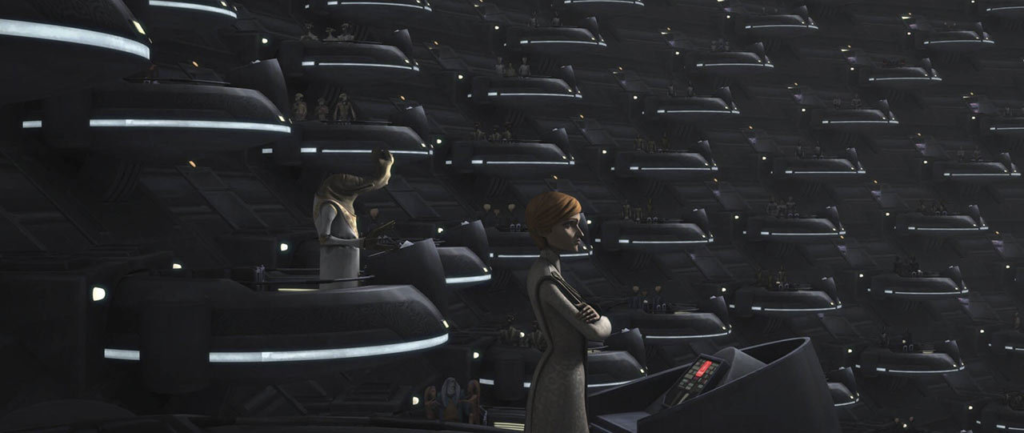
Another example of episodes not aligning chronologically with their release, “Sphere of Influence” explores the political machinations and personal vendettas that permeate the Clone Wars. The narrative centers on Chairman Papanoida, a Pantoran politician, who seeks the Jedi’s assistance after his daughters are kidnapped. Anakin Skywalker and Ahsoka Tano investigate, uncovering a web of intrigue involving the Trade Federation and Separatist forces, highlighting the delicate balance of power between the Republic and the Separatists. Mon Mothma appears as a senator, alongside Padmé Amidala, within the Senate scenes, demonstrating her early involvement in Republic politics. Her presence emphasizes the political ramifications of the Pantoran crisis and the Senate’s role in addressing intersystem conflicts. She is seen supporting Padmé’s and Papanoida’s efforts to bring the kidnappers to justice and restore stability to Pantora. The episode showcases the contrast between Anakin’s more impulsive nature and Papanoida’s calm, reasoned approach, highlighting the different ways individuals navigate the complexities of war and diplomacy. Mon Mothma’s inclusion underscores the importance of political solutions and the challenges of maintaining peace amidst widespread conflict, foreshadowing her later role as a leader in the Rebel Alliance. The episode highlights the personal cost of the conflict, as Papanoida’s desperation to save his daughters underscores the human toll of the war.
Star Wars: The Clone Wars, Season 3, Episode 8: “Evil Plans” (21 BBY)
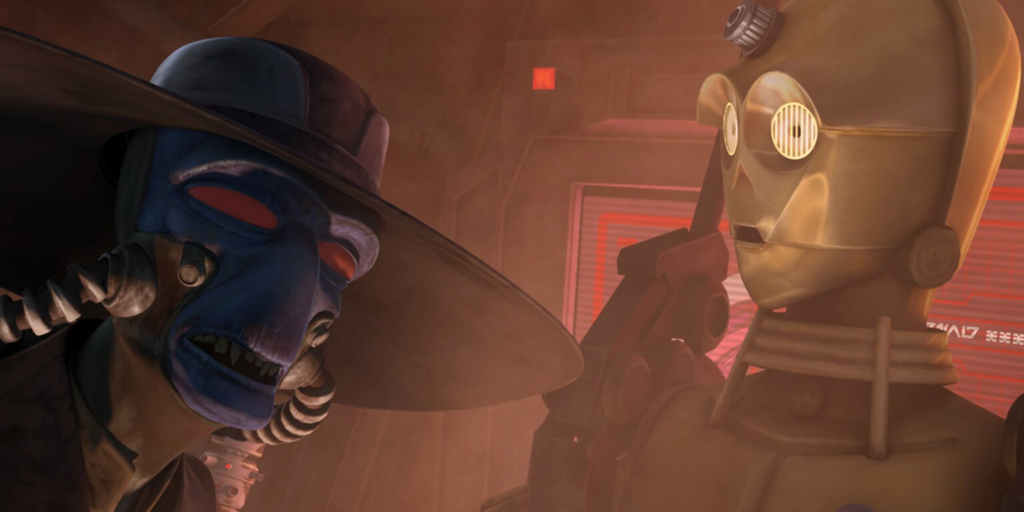
On Coruscant, C-3PO is abducted by the bounty hunter Cad Bane, who is working for Jabba the Hutt and searching for information about the Senate building. Finding C-3PO devoid of useful information, Bane and his accomplices kidnap R2-D2 and extract the vital data, before memory-wiping the droids and sending them on their way.
-Episode synopsis per StarWars.com
Evil plans! With the Jedi Council focused on the war effort, criminal minds are left unchecked to spread fear and corruption. Galactic gangster Jabba the Hutt has sent bounty hunter Cad Bane on a nefarious mission, which shall strike at the heart of the Republic. Meanwhile, the unsuspecting citizens of Coruscant go about their daily lives….
“Evil Plans,” a lighter episode from Season 3, offers a brief respite from the war’s heavier themes, focusing on R2-D2 and C-3PO’s unexpected adventure. The episode begins with the two droids being inadvertently separated from Anakin and Ahsoka during a mission to Naboo. Stranded and tasked with delivering crucial tactical data, R2-D2 and C-3PO find themselves caught up in a series of comedic mishaps and encounters. Their journey takes them through the bustling streets and hidden corners of Naboo, showcasing the planet’s diverse environments and inhabitants. Along the way, they encounter Cad Bane, who, unbeknownst to them, is also on Naboo to steal plans for the Senate building. The episode’s humor stems from the droids’ contrasting personalities – R2-D2’s resourceful ingenuity and C-3PO’s anxious prattling – as they navigate the challenges they face. The episode cleverly weaves in elements of suspense and adventure, as R2-D2’s quick thinking and C-3PO’s accidental involvement lead them into a collision course with Cad Bane’s nefarious scheme. While primarily a comedic interlude, “Evil Plans” also subtly advances the overarching narrative, setting the stage for future events and highlighting the crucial role that droids play in the Clone Wars.
Star Wars: The Clone Wars, Season 3, Episode 10: “Heroes on Both Sides” (21 BBY)
When the Senate begins debating a bill that would eliminate government oversight of the Banking Clan’s activities in order to fund the war, Padmé and Ahsoka travel in secret to the capital of the Confederacy of Independent Systems and gain fresh perspective on the conflict in a meeting with Mina Bonteri and her son, Lux.
-Episode synopsis per StarWars.com
Conflict with no end in sight! Across the galaxy, the quagmire of war continues. While clone troopers suffer casualties at alarming rates, the Galactic Senate convenes an emergency session to debate the true cost of the war….
“Heroes on Both Sides” delves into the complexities of the conflict, challenging the simplistic notion of good versus evil. The narrative follows Padmé Amidala and Ahsoka Tano as they embark on a diplomatic mission to Raxus Secundus, the Separatist capital, to negotiate a potential end to the war. Padmé, driven by her belief in peace, seeks to bridge the divide between the Republic and the Separatists, hoping to find common ground. During their time on Raxus, they encounter Mina Bonteri, a Separatist senator and an old friend of Padmé’s, offering a human face to the enemy. The episode highlights the shared experiences and concerns of ordinary citizens on both sides of the conflict, demonstrating that not everyone is driven by malice or ideology. It explores the moral ambiguity of war, revealing that individuals within the Separatist Alliance have legitimate grievances against the Republic. The episode also underscores the challenges of diplomacy in a time of widespread conflict, as entrenched political interests and the influence of figures like Count Dooku threaten to derail any progress. “Heroes on Both Sides” ultimately serves as a powerful reminder that war is not a black-and-white issue, and that understanding the perspectives of those on the opposing side is crucial for achieving lasting peace.
Star Wars: The Clone Wars, Season 3, Episode 11: “Pursuit of Peace” (21 BBY)
Padmé Amidala, Bail Organa, and Onaconda Farr attempt to rally Senators in opposition to a bill that would have disastrous financial consequences for the Republic, but their actions make them targets for intimidation and attacks by hired thugs.
-Episode synopsis per StarWars.com
Peace shattered! Once-promising negotiations between the Republic and the Separatists are now in shambles following a droid suicide bombing on the capital city planet of Coruscant.
As fear and anger prevail, the Senate overwhelmingly passes a bill to deregulate the banks, opening a gateway to additional troops, and an increase in fighting….
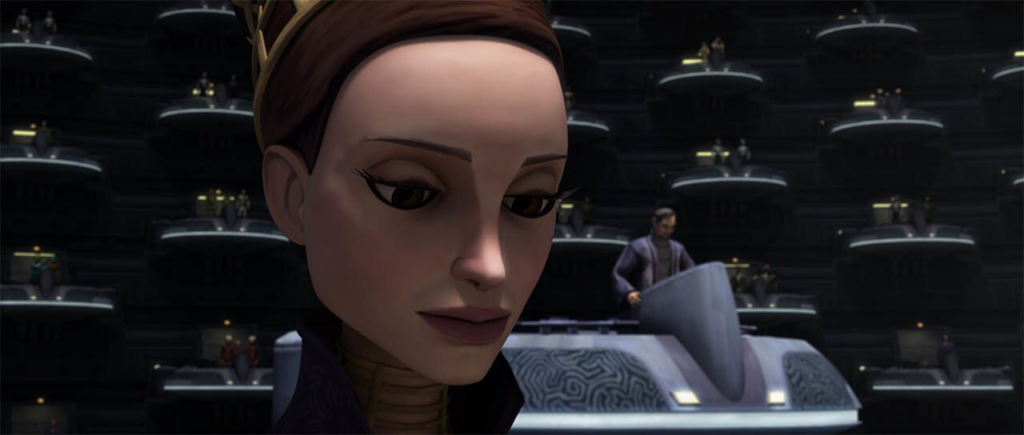
“Pursuit of Peace,” a continuation of the themes explored in “Heroes on Both Sides,” further examines the fraught attempts at diplomacy during the Clone Wars. Padmé Amidala, ever the advocate for peace, leads a delegation to the Senate to propose a bill aimed at reducing military spending and fostering negotiations with the Separatists. However, her efforts are met with staunch opposition from senators who prioritize military solutions, particularly those influenced by Palpatine’s subtle manipulations. The episode showcases the political gridlock and entrenched interests that hinder any progress towards peace, highlighting the war profiteering and the pervasive atmosphere of fear and distrust. Padmé’s struggle to garner support for her bill reveals the difficulty of maintaining idealism in a galaxy consumed by conflict. The episode also introduces Senator Rush Clovis, whose complex relationship with Padmé adds another layer of political intrigue. The narrative delves into the ethical dilemmas politicians face during wartime, as they grapple with the consequences of their decisions. The episode underscores the growing divide within the Republic, as some senators become increasingly disillusioned with the war and others remain steadfast in supporting military action. Ultimately, “Pursuit of Peace” portrays the uphill battle faced by those seeking a peaceful resolution, emphasizing the insidious forces working to prolong the conflict.
Star Wars: The Clone Wars, Season 2, Episode 15: “Senate Murders” (21 BBY)
War on many fronts! While battles are fought by clones in the field, a different war is waged in the Galactic Senate. As heavy losses add up, a group of senators led by Halle Burtoni of Kamino propose an escalation of troop production.
Senator Padmé Amidala, recognizing that more troops will only prolong the fighting, works tirelessly with her allies to introduce a bill to cut down military spending and stopthe creation of more clone troopers….
Though it aired during Season 2, “Senate Murders” chronologically fits into Season 3 between “Pursuit of Peace” and “Nightsisters.” The suspenseful episode delves into the treacherous political landscape of the Republic Senate. When Senator Onaconda Farr is found murdered, Padmé Amidala, a close friend, becomes determined to uncover the truth behind his death. The investigation, in which Mon Mothma plays a supporting role, reveals a web of political intrigue and hidden agendas, as Padmé and her allies navigate the complex power dynamics of the Senate. The episode masterfully builds tension, as Padmé and her security team race against time to identify the killer before they can strike again. Suspicion falls upon several senators, each with their motives and secrets, creating a sense of paranoia and distrust. The episode highlights the vulnerability of the Republic’s democratic institutions, demonstrating how easily they can be manipulated by those seeking power. It also showcases Padmé’s unwavering commitment to justice and her ability to navigate the treacherous political arena. As the investigation progresses, the true nature of the conspiracy is revealed, exposing a plot designed to destabilize the Senate and further the aims of the Separatists. The episode culminates in a tense confrontation, where Padmé must use her wit and courage to expose the murderer and bring them to justice. “Senate Murders” serves as a stark reminder of the hidden dangers lurking within the Republic, and the constant struggle to maintain integrity in a time of war.
Star Wars: The Clone Wars, Season 4, Episode 14: “A Friend in Need” (20 BBY)
Divided by war! In an effort to end the galactic conflict, the first ever sanctioned meeting between the Republic and the Separatists will be held and Mandalore is chosen as neutral ground for these precarious meetings. Tensions run high as many hold hope for these important negotiations….
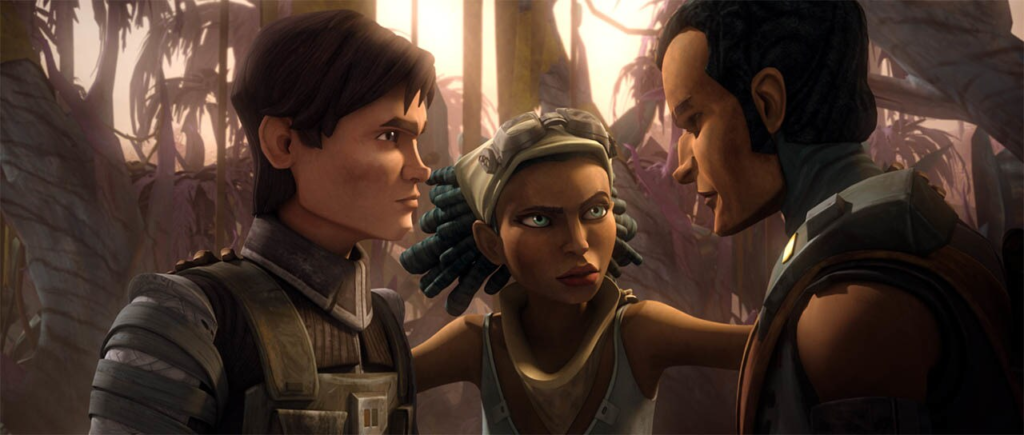
“A Friend in Need,” a politically charged episode from the fourth season of Star Wars: The Clone Wars, tackles the complexities of intervention and the consequences of supporting rebel movements. The narrative focuses on Lux Bonteri, the son of the late Separatist senator Mina Bonteri, who seeks the Republic’s assistance in liberating his planet, Onderon, from the Separatist-backed monarchy. Padmé Amidala, driven by her friendship with Lux and her belief in self-determination, advocates for providing aid, while Anakin Skywalker and Ahsoka Tano are dispatched to Onderon to train the rebel forces led by Lux and Saw Gerrera. The episode delves into the ethical dilemmas of arming and supporting insurgencies, showcasing the potential for unintended consequences and the slippery slope of involvement. It portrays the challenges of training inexperienced rebels and the inherent risks of guerrilla warfare. The clash of ideologies between Padmé’s diplomatic approach and Anakin’s more pragmatic, military-focused perspective highlights the ongoing debate within the Republic about the best course of action. The episode also explores the personal cost of rebellion, as Lux and Saw grapple with the sacrifices required to fight for their freedom. “A Friend in Need” ultimately serves as a cautionary tale about the complexities of foreign intervention, demonstrating that good intentions can often lead to unintended and far-reaching consequences.
Star Wars: The Clone Wars, Season 4, Episode 15: “Deception” (20 BBY)
A terrorist threat! Moralo Eval, mastermind of a Separatist plot to kidnap Chancellor Palpatine, has been captured by Republic forces. But even with the criminal behind bars, rumors swirl in the underworld of Coruscant that Moralo’s plot has already been set in motion.
With precious time running out, the Jedi Council hatches their own plot to keep the Chancellor safe….
“Deception” lures the audience into a web of subterfuge and disguise. The narrative centers on a daring plan devised by Obi-Wan Kenobi, Anakin Skywalker, and Ahsoka Tano to infiltrate a Separatist stronghold and capture Cad Bane, who holds vital information. To accomplish this, Obi-Wan undergoes a radical transformation, assuming the identity of the deceased bounty hunter Rako Hardeen. The episode masterfully builds suspense as Obi-Wan navigates the treacherous underworld of bounty hunters, attempting to gain Cad Bane’s trust while maintaining his cover. The tension escalates as Anakin and Ahsoka, posing as fellow criminals, work to support Obi-Wan’s mission, facing constant threats and the risk of exposure. The episode delves into the psychological toll of deception, as Obi-Wan grapples with the moral compromises inherent in his undercover operation. The narrative cleverly utilizes misdirection and reveals, keeping the audience on edge as the characters navigate the dangerous game of espionage. The episode’s climax features a thrilling confrontation, testing the limits of Obi-Wan’s disguise and the loyalty of his allies. “Deception” showcases the strategic brilliance of the Jedi and the lengths they are willing to go to achieve their objectives, highlighting the complex and morally ambiguous nature of warfare.
Star Wars: The Clone Wars, Season 5, Episode 2: “A War on Two Fronts” (20 BBY)
Separatist takeover complete! Another Republic planet has fallen. Onderon has seceded to the Confederacy of Independent Systems under the rule of a new king. However, a small band of rebels have taken refuge deep within the vast and savage wilderness.
From an abandoned outpost, they plot to take back the heavily fortified capital city of Iziz and end the Separatist occupation….
“A War on Two Fronts” marks the beginning of the Onderon arc and deepens the exploration of the rebellion against Separatist occupation. The episode follows Anakin Skywalker, Obi-Wan Kenobi, and Ahsoka Tano as they return to Onderon to further train the rebel forces led by Lux Bonteri and Saw Gerrera. This time, however, the training intensifies, focusing on strategic planning and coordinated attacks to liberate the capital city. The episode highlights the growing determination and resourcefulness of the Onderon rebels, showcasing their transition from a ragtag group to a more organized fighting force. Saw Gerrera’s aggressive tactics and unwavering commitment to freedom drive the narrative, contrasting with Lux’s more measured approach. The episode delves into the complexities of guerrilla warfare, demonstrating the challenges of fighting against a technologically superior enemy. The strategic planning and execution of the rebels’ attacks emphasize the importance of teamwork and adaptation in the face of overwhelming odds. “A War on Two Fronts” sets the stage for the intense conflict to come, establishing the stakes and showcasing the resilience of the Onderon people as they fight to reclaim their home. It also lays the groundwork for further character development, particularly for Saw Gerrera, whose radicalism begins to take center stage.
Star Wars: The Clone Wars, Season 5, Episode 3: “Front Runners” (20 BBY)
Jedi form rebel alliance! Led by Anakin Skywalker, the Jedi have trained a band of rebels to fight the Separatists on the planet Onderon. With the help of the Jedi, the rebels escaped capture and infiltrated the heavily fortified city of Iziz.
Now our heroes have launched an armed campaign to subvert the Separatist occupation of the planet. The Jedi Council continue to observe and advise as the rebels strive to gain momentum against the Separatist forces. Despite the absence of civilian casualties, public fear has ensued as reports of the rebels’ daring strikes circulate throughout the city….
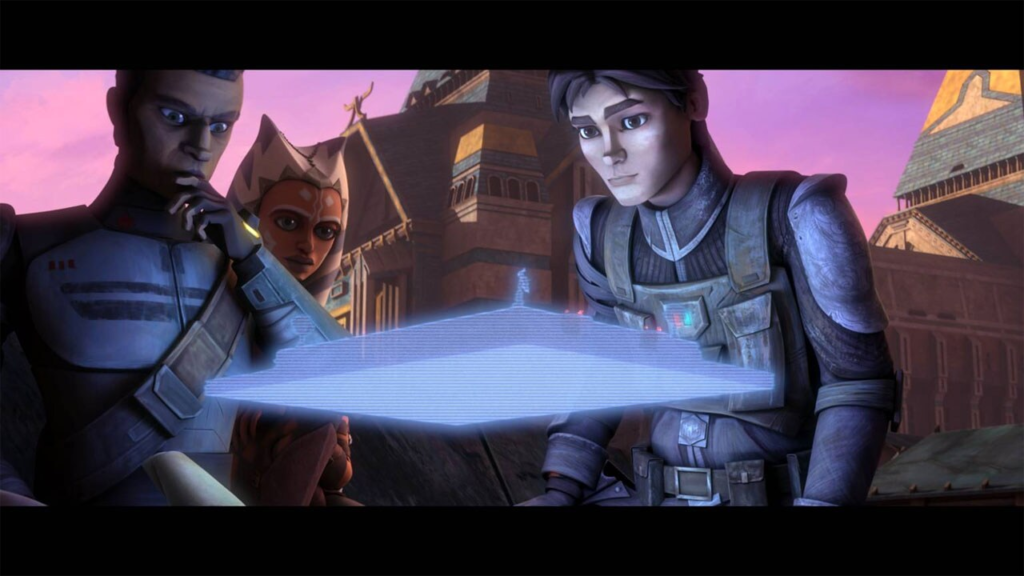
“Front Runners,” the second installment of the Onderon arc, escalates the rebellion’s efforts to liberate the planet from Separatist control. This episode focuses on the rebels’ strategic planning and execution of a daring mission to disrupt the Separatist supply lines. Anakin Skywalker, Obi-Wan Kenobi, and Ahsoka Tano continue to guide and train the rebels, emphasizing the importance of coordinated attacks and tactical awareness. The narrative highlights the growing leadership of Saw Gerrera and Lux Bonteri, who are forced to make difficult decisions that test their resolve. The episode delves into the challenges of guerrilla warfare, showcasing the rebels’ ingenuity and resourcefulness as they utilize unconventional tactics to overcome the Separatists’ superior firepower. The tension builds as the rebels execute a series of increasingly risky operations, demonstrating their growing confidence and determination. The episode also explores the internal dynamics of the rebellion, highlighting the conflicts and compromises inherent in a diverse group united by a common goal. The strategic importance of disrupting the Separatist supply lines is emphasized, showcasing the rebels’ understanding of the larger conflict and their ability to exploit weaknesses. “Front Runners” effectively builds momentum for the Onderon arc, showcasing the rebels’ progress and setting the stage for the climactic battles to come.
Star Wars: The Clone Wars, Season 5, Episode 4: “The Soft War” (20 BBY)
After a rebel attempt to rescue Onderon’s true king, Ramsis Dendup, an unexpected ally steps forward to halt Dendup’s execution and aid the rebel cause.
The rebels elect a new leader! With their training complete, Obi-Wan and Anakin have left Ahsoka on Onderon to monitor and advise the rebels as they continue to strike Separatist targets under the command of Steela Gerrera. Facing an escalation of rebel attacks, the Separatists have sent reinforcements to straighten their hold on the city of Iziz as the battle for the planet unfolds…
“The Soft War,” the pivotal third installment of the Onderon arc in Star Wars: The Clone Wars season five, escalates the rebellion’s efforts through strategic infiltration and psychological manipulation. Saw Gerrera, a driving force behind the resistance, spearheads the daring mission to liberate King Ramsis Dendup from his Separatist-imposed captivity. This episode pivots from overt warfare to covert operations, highlighting the rebels’ adaptability and the crucial role of intelligence gathering. Saw’s unwavering determination and tactical ingenuity are central, as he guides the rebels through the treacherous Separatist-controlled cityscape. The narrative delves into the nuanced challenges of liberating an occupied population, underscoring the necessity of both military precision and strategic cunning. The tension mounts as the rebels navigate the perilous environment, facing constant threats and the looming risk of discovery. Saw’s leadership galvanizes the rebels, and their actions become a beacon of hope for the oppressed Onderon citizens, fueling their resolve to resist. The episode emphasizes the delicate interplay between military strategy and political maneuvering, showcasing Saw’s understanding of the importance of securing the populace’s support. Ultimately, “The Soft War” amplifies the anticipation for the impending confrontation, underscoring the rebels’ escalating confidence and the Separatists’ growing desperation, with Saw’s radical approach driving the rebellion’s momentum.
Star Wars: The Clone Wars, Season 5, Episode 5: “Tipping Points” (20 BBY)
As a full-scale revolt embroils Onderon, the rebels strike a decisive blow against the planet’s Separatist-aligned king. Unfortunately, such victory comes at a high price.
-Episode synopsis per StarWars.com
War in the Inner Rim! Rebel leader Steela Gerrera has joined forces with General Tandin after boldly rescuing Onderon’s former king from execution, evading a trap set by Separatist ally King Rash and the droid general Kalani. Amid growing public support and rising unrest, Ahsoka continues to monitor the rebels’ efforts as they rally around Ramsis Dendup to restore his reign as the rightful king and finally put an end to the Separatist occupation of Onderon….
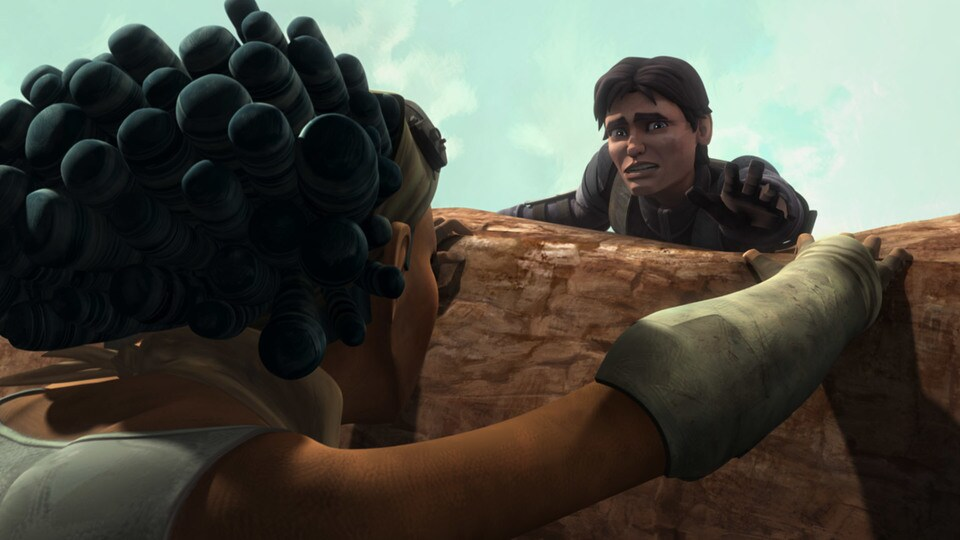
“Tipping Points,” the dramatic conclusion to the Onderon arc in Star Wars: The Clone Wars season five, culminates in a hard-won victory shadowed by tragedy. The episode showcases the rebels’ final, coordinated assault to reclaim their capital, with Saw Gerrera leading the charge with unwavering determination. The rebels, employing guerrilla tactics, clash with the Separatist forces, demonstrating their tactical ingenuity and hard-earned skills. Saw’s leadership is crucial, but his decisions are fraught with peril, balancing strategic necessity with the preservation of civilian lives. The liberation of King Ramsis Dendup ignites a surge of hope, symbolizing the rebels’ triumph. However, amidst the celebration, Steela Gerrera, Saw’s sister and a key rebel leader, faces a fatal fall. Despite Ahsoka Tano’s desperate attempt to save her with the Force, a stray shot from a damaged Separatist gunship causes Steela to plummet to her death. Her loss casts a somber pall over the rebels’ victory, highlighting the devastating cost of war. The episode powerfully illustrates the sacrifices made in the pursuit of freedom, and how even in victory, profound loss can leave an indelible mark. Saw’s grief and the harsh realities of the conflict begin to visibly shape his radicalism, foreshadowing his later, more extreme actions.
Star Wars: The Clone Wars, Season 5, Episode 18: “The Jedi Who Knew Too Much” (19 BBY)
As the Republic military takes over the Temple bombing case, Ahsoka finds herself accused of murder and running out of allies and alternatives.
-Episode synopsis per StarWars.com
Terror at the Temple! The Jedi Temple is in disarray after a vicious terrorist attack. Anakin Skywalker and Ahsoka Tano set out to find the truth of who was really behind this horrendous catastrophe. Their investigation led them to discover the true saboteur, Letta Turmond.
Now the Jedi attempt to return the Temple to normalcy. But first, Master Yoda must give a eulogy to the fallen Jedi warriors….
“The Jedi Who Knew Too Much” plunges Ahsoka Tano into a harrowing ordeal that tests her loyalty and trust. The narrative unfolds as Ahsoka is framed for the murder of Letta Turmond, a suspect in the bombing of the Jedi Temple hangar. Suddenly a fugitive, Ahsoka finds herself hunted by both the Republic forces and the Jedi Order, forcing her to rely on her own skills and instincts to clear her name. The episode masterfully builds a sense of paranoia and isolation, as Ahsoka struggles to understand the conspiracy against her. Mon Mothma, a senator known for her integrity, plays a crucial role by providing Ahsoka with vital information and support, demonstrating her unwavering belief in Ahsoka’s innocence. Mon Mothma’s presence underscores the political undercurrents of the situation, hinting at the manipulation and hidden agendas that permeate the Republic Senate. The episode delves into the psychological toll of being falsely accused, showcasing Ahsoka’s resilience and determination to uncover the truth. The tension escalates as Ahsoka navigates the treacherous underworld of Coruscant, facing constant threats and the growing suspicion of her former allies. “The Jedi Who Knew Too Much” sets the stage for the dramatic conclusion of Ahsoka’s arc, highlighting the fragility of trust and the dangers of unchecked power within the Republic.
Star Wars: The Clone Wars, Season 5, Episode 20: “The Wrong Jedi” (19 BBY)
On trial for murder, Ahsoka faces her greatest challenge.
-Episode synopsis per StarWars.com
Ahsoka Tano captured! While on the run to prove her innocence, Padawan Tano teamed up with the deadly Asajj Ventress to find the rogue Jedi who framed Ahsoka for murder. The Jedi Council sent Anakin Skywalker and Master Plo Koon to track Ahsoka down and bring her back to the Temple.
Now captured and imprisoned, Ahsoka faces punishment for crimes she did not commit….
“The Wrong Jedi,” the devastating conclusion to Ahsoka Tano’s arc in the fifth season of Star Wars: The Clone Wars, brings her trial to a climax. Framed for murder and facing mounting evidence, Ahsoka finds herself stripped of her Padawan status and put on trial before the Republic Senate and the Jedi Council. The episode intensifies the sense of betrayal and isolation, as Ahsoka’s former allies and mentors struggle to reconcile their belief in her innocence with the seemingly overwhelming evidence against her. Mon Mothma, a steadfast advocate for justice, continues to be a vital ally, speaking out in Ahsoka’s defense and questioning the integrity of the proceedings. Her presence highlights the political machinations at play and the growing corruption within the Republic. The episode delves into the emotional turmoil of Ahsoka, who must confront the possibility of being abandoned by the very people she trusts. Anakin Skywalker’s desperate attempt to uncover the true culprit, Barriss Offee, leads to a shocking revelation, exposing a conspiracy that shakes the foundations of the Jedi Order. The trial scenes are fraught with tension, showcasing the clash between justice and political expediency. Ahsoka’s eventual exoneration is bittersweet, as she chooses to walk away from the Jedi Order, disillusioned by their lack of faith in her. “The Wrong Jedi” serves as a powerful commentary on the erosion of trust and the devastating consequences of unchecked power, with Mon Mothma’s role emphasizing the importance of standing for truth in the face of overwhelming opposition.
Star Wars: The Clone Wars, Season 6, Episode 7: “Crisis at the Heart” (19 BBY)
Rush Clovis’s deal with the Separatists backfires and brings war to the banking world of Scipio.
-Episode synopsis per StarWars.com
Corruption discovered at the core of the Banking Clan! Reunited, Rush Clovis and Senator Amidala discover the full extent of the deception. Anakin Skywalker is sent to the rescue – he refuses to trust Clovis, and asks Padmé not to work with him. Determined to save the banks, she refuses her husband’s request, throwing their relationship into turmoil. Voted for by both the Separatists and the Republic, Clovis is elected new leader of the Galactic Banking Clan. Now all attention is focused on Scipio, as the important transfer of power begins….
“Crisis at the Heart” delves into the growing corruption within the Republic Senate and the insidious influence of corporate greed. The episode centers on a financial crisis that threatens to cripple the Republic, stemming from the mismanagement and manipulation of the Banking Clan. Padmé Amidala, alongside Senator Rush Clovis, investigates the intricate web of financial deceit, uncovering a conspiracy that implicates powerful figures within the Senate and the Banking Clan itself. Mon Mothma, a voice of reason and integrity, plays a crucial role by supporting Padmé’s efforts and demanding transparency in the Senate proceedings. Her presence underscores the importance of ethical governance and the need to hold those in power accountable. The episode explores the complex relationship between politics and economics, showcasing how easily corruption can infiltrate even the highest levels of government. The narrative highlights the challenges of exposing wrongdoing in a system where powerful interests are deeply entrenched. Padmé and Clovis face numerous obstacles, including attempts on their lives, as they strive to uncover the truth and restore stability to the Republic. The episode serves as a stark reminder of the dangers of unchecked corporate influence and the erosion of democratic principles, with Mon Mothma’s unwavering commitment to justice providing a beacon of hope amidst the growing darkness.
Star Wars: The Clone Wars, Season 6, Episode 8: “The Disappeared, Part I” (19 BBY)
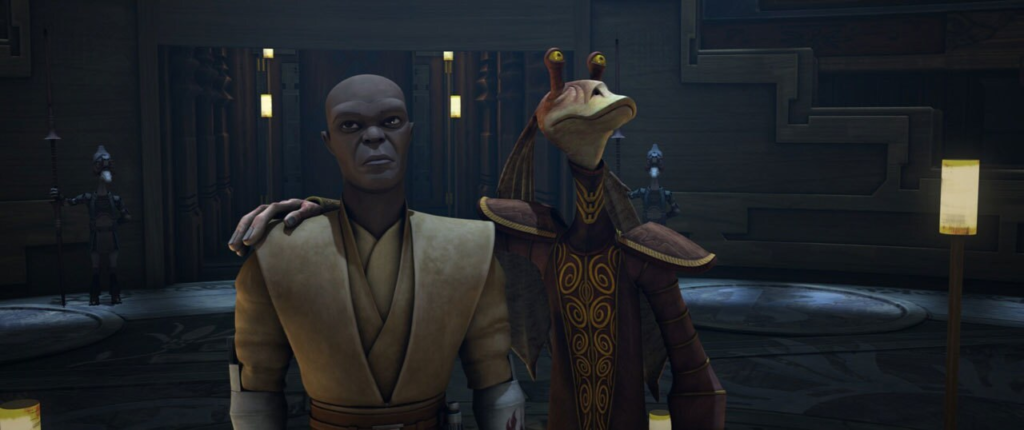
The peaceful world of Bardotta and its mystic ways are threatened by an ancient prophecy, and its top spiritual leaders have vanished. Queen Julia of Bardotta calls for help from her most trusted friend in the Senate, Jar Jar Binks. Recognizing the importance of Bardotta’s spiritual balance, the Jedi Council sends Mace Windu to accompany Binks and investigate.
-Episode synopsis per StarWars.com
Mystery on Bardotta! An oasis of peace during the Clone Wars, the galaxy-wide conflict now threatens the ancient ways of the Bardottan people. With their spiritual leaders mysteriously vanishing, the foundations of order in its system are near collapse. In desperation, the Queen of Bardotta has called upon the Republic Senate with a puzzling request – to help save her people from certain doom….
“The Disappeared Part 1” sees Anakin Skywalker and Mace Windu look into a mystery surrounding the disappearance of the Bardottan spiritual leaders, the Dagoyan Masters. The narrative unfolds as the peaceful planet of Bardotta, aligned with the Republic, suddenly faces a crisis, with its revered leaders vanishing without a trace. Anakin and Mace, tasked with investigating the disappearances, find themselves entangled in a web of ancient prophecies and hidden dangers. The episode explores the clash between the Jedi’s rational approach and the mystical beliefs of the Bardottans, highlighting the limitations of relying solely on logic. Mon Mothma, a senator known for her diplomatic skills and concern for the Republic’s allies, plays a significant role in urging the Jedi to intervene and assisting in the investigation. Her presence underscores the political implications of the disappearances and the importance of maintaining stability within the Republic’s allied systems. The episode introduces a sense of foreboding and unease, as Anakin and Mace delve deeper into the Bardottan culture and uncover the potential involvement of a dangerous cult. The narrative skillfully blends mystery and suspense, hinting at a darker force at play. “The Disappeared Part 1” sets the stage for a perilous journey into the unknown, highlighting the Jedi’s role as protectors and the importance of understanding diverse cultures in maintaining peace.
Star Wars: The Clone Wars, Season 7, Episode 9: “Old Friends Not Forgotten” (19 BBY)
The Siege of Mandalore begins, and Ahsoka turns to Anakin and Obi-Wan for help.
-Episode synopsis per StarWars.com
Outer Rim under siege! Separatist forces have launched a major offensive. Led by the evil droid General Grievous, Republic forces are pushed to the brink. In response to this overwhelming attack, the Jedi Council has dispatched its Generals, sending them far from the Core Worlds to bolster the beleaguered clones. On the distant planet of Yerbana, we find Commander Cody of the 212th in desperate need of reinforcements….
“Old Friends Not Forgotten,” a crucial episode in the final season of Star Wars: The Clone Wars, sets the stage for the Siege of Mandalore, intertwining familiar characters and foreshadowing the tragic events to come. Ahsoka Tano, now leading a portion of the 501st Legion under Commander Rex, responds to Bo-Katan Kryze’s plea to liberate Mandalore from Maul’s grasp. This episode acts as a reunion, highlighting the enduring bond between Ahsoka and Anakin Skywalker, despite the growing darkness surrounding them. During the strategic planning for the assault, Mon Mothma makes a brief but significant appearance, representing the nascent Rebel Alliance’s interest in disrupting Maul’s influence, as his criminal activities pose a threat to their fledgling operations. Her presence underscores the burgeoning resistance against the encroaching Empire. Additionally, a subtle nod is made to Saw Gerrera’s growing radicalism. While not physically present, his extremist tendencies and growing distrust of the Republic are referenced, subtly foreshadowing the future divergence of his path from the mainstream rebellion. The episode masterfully balances action and emotion, weaving together the personal relationships of the characters with the larger political context of the Clone Wars. The impending confrontation with Maul, combined with the subtle hints of Order 66, creates a palpable sense of tension, setting the stage for the devastating conclusion of the Clone Wars era.
Star Wars: Episode III-Revenge of the Sith (19 BBY)
Star Wars: Tales of the Jedi, Episode 6, “Resolve” (19 BBY-5BBY)
A former Jedi is faced with the truth that they cannot be something they are not.
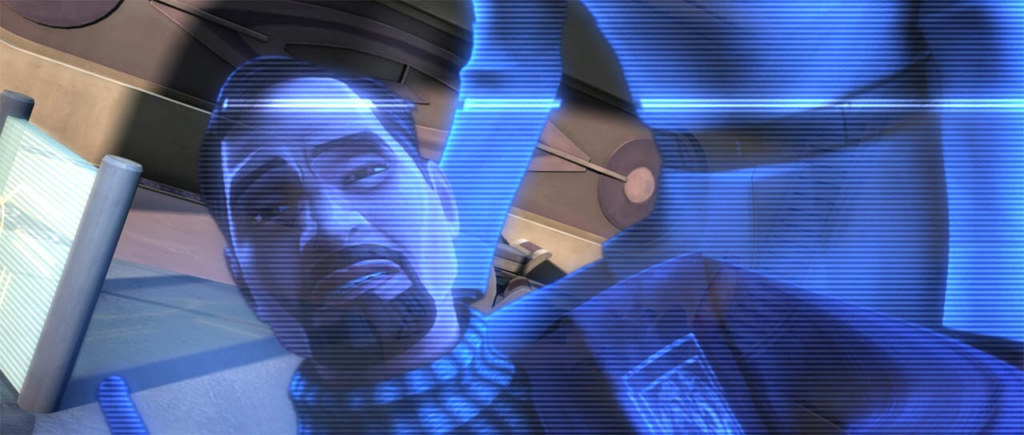
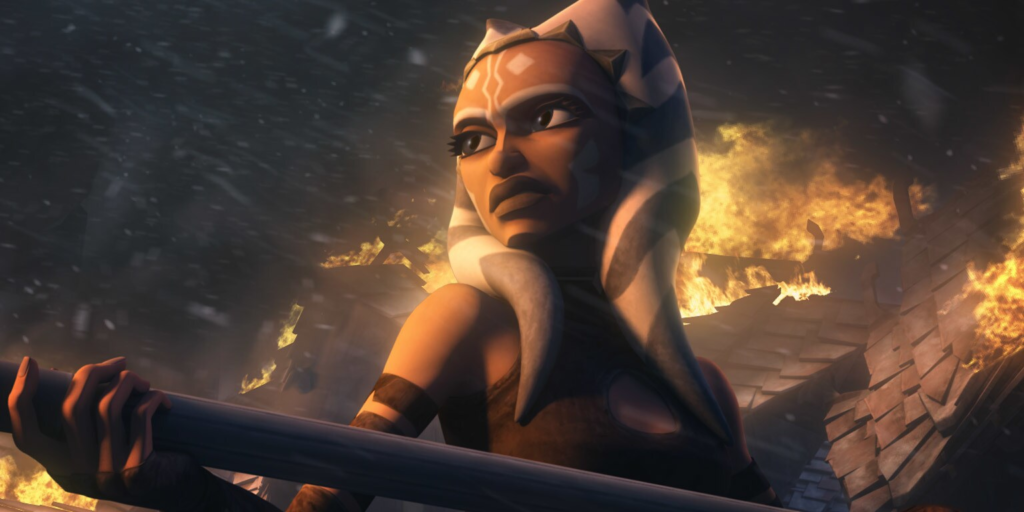
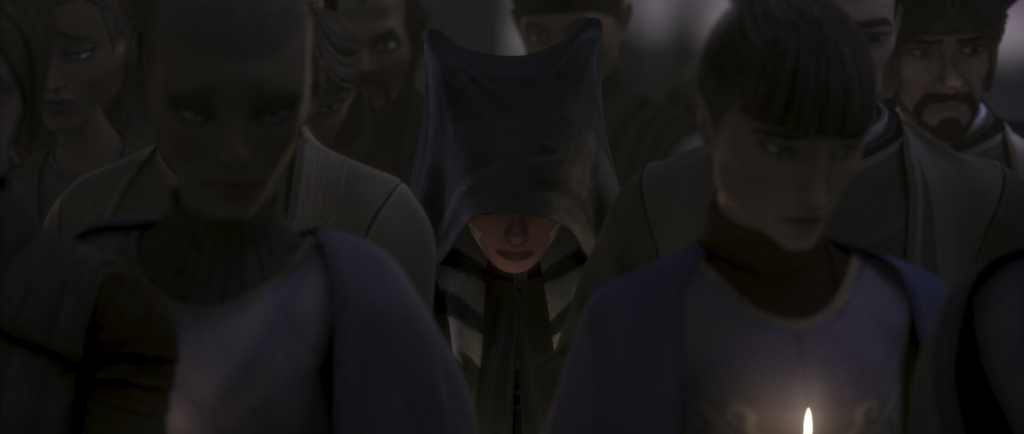
“Resolve,” the final episode of Tales of the Jedi, portrays Ahsoka Tano’s struggle to survive in the aftermath of Order 66. Seeking anonymity on a remote planet, she attempts to conceal her Force abilities, but is compelled to reveal them to save a local villager. This act of heroism draws the attention of an Inquisitor, forcing Ahsoka to confront her past and fight for her survival. The episode delves into Ahsoka’s internal conflict, showcasing her efforts to reconcile with the trauma of the Clone Wars and the Jedi Purge. Crucially, Captain Rex appears, carrying a message from Bail Organa. Bail’s involvement is pivotal, as he extends a hand of support to Ahsoka, offering her assistance and a path toward a greater cause. His actions highlight the nascent stages of the rebellion, demonstrating his commitment to resisting the Empire’s tyranny. Bail’s role emphasizes the growing network of individuals who oppose the Empire’s oppressive rule, and underscores Ahsoka’s potential as a key figure in the burgeoning resistance. The episode ultimately showcases Ahsoka’s resolve to continue fighting for justice, even in the darkest of times, and the start of her journey to a wider rebellion with the help of Bail Organa.
Star Wars: The Bad Batch, Season 1, Episode 1, “Aftermath” (19 BBY)
Separatists pushed to the brink! Republic forces continue to mount victories on battlefronts across the galaxy. After the Jedi Knights thwarted an attempt to kidnap Chancellor Palpatine, the evil droid general Grievous retreated to the Outer Rim. With his legions of battle droids severely depleted, Grievous mounts a desperate and brutal counterattack across several star systems. We find Republic clone troopers locked in deadly combat on the besieged world of Kaller. Led by Jedi Master Depa Billaba, they struggle to hold their position as they wait for reinforcements to arrive….
“Aftermath,” the premiere episode of Star Wars: The Bad Batch, picks up in the chaos following the execution of Order 66. The episode opens with Clone Force 99, the Bad Batch, witnessing the chilling transformation of their clone brethren as they turn against the Jedi. Their unique genetic modifications, however, render them immune to the inhibitor chip’s influence, leading to their growing isolation and suspicion within the newly formed Galactic Empire. The narrative follows the Bad Batch’s struggle to understand the seismic shift in the galaxy, as the Republic they served is replaced by an oppressive regime. During this turbulent period, Bail Organa makes a brief but significant appearance, offering a glimmer of hope amidst the darkness. He expresses his concern for the clones and hints at his nascent efforts to resist the Empire’s growing tyranny. Simultaneously, Saw Gerrera, already exhibiting his radical tendencies, emerges as a volatile figure, clashing with the Bad Batch’s more pragmatic approach. His appearance foreshadows his future role as a leader of extremist rebel factions. The established political landscape and Bail’s actions hint at the growing resistance she will eventually be a key part of. The episode emphasizes the Bad Batch’s disorientation and moral ambiguity, as they grapple with their place in a galaxy that has drastically changed. “Aftermath” effectively sets the stage for the series, introducing the central conflict and foreshadowing the emergence of the rebellion, with Bail and Saw’s roles highlighting the diverse responses to the Empire’s rise.
Star Wars: The Bad Batch, Season 2, Episode 15, “The Summit” (18 BBY)
An infiltration proves more challenging than expected.
“The Summit” delves into the burgeoning resistance against the Empire’s tightening grip. The narrative centers on a clandestine meeting on the planet of Safa Toma, where key figures of the emerging rebellion gather to strategize and coordinate their efforts. Mon Mothma plays a crucial role, representing the moderate and politically-minded faction, advocating for a measured approach and emphasizing the importance of securing public support through legal and diplomatic means. In stark contrast, Saw Gerrera, already exhibiting his radical and uncompromising tactics, pushes for immediate and violent action, showcasing the growing divide within the resistance. Bail Organa, ever the mediator, attempts to bridge the gap between these opposing viewpoints, emphasizing the need for unity and a coordinated strategy. He highlights the dangers of fracturing the rebellion and the importance of finding common ground. The episode underscores the challenges of forming a cohesive resistance movement, showcasing the diverse ideologies and conflicting approaches that threaten to undermine their efforts. The Bad Batch, caught in the middle of these political machinations, are tasked with a dangerous mission that tests their loyalty and forces them to confront the moral complexities of the rebellion. “The Summit” effectively portrays the nascent stages of the rebellion, highlighting the tensions and ideological clashes that will shape its future, with Mon Mothma, Saw Gerrera, and Bail Organa each playing distinct roles in defining its trajectory.
Star Wars: The Bad Batch, Season 2, Episode 16, “Plan 99” (18 BBY)
The heroes are tested.
“Plan 99,” a deeply impactful episode from The Bad Batch season two, delivers a tragic blow to the team, highlighting the escalating dangers of Imperial control. The episode revolves around the Bad Batch’s perilous mission to rescue captured clones from an Imperial facility, a mission that culminates in Tech’s heroic sacrifice, executing “Plan 99” to save his brothers. This act underscores the profound loyalty and familial bond within the team, and the immense cost of resistance. While Bail Organa and Mon Mothma are absent, the episode’s narrative is driven by the very threat they are working to combat: the expanding power of the Empire. Orson Krennic, appearing as a ruthless Imperial official, plays a significant role in demonstrating the Empire’s growing military might and its willingness to sacrifice its personnel for strategic advantage. His presence emphasizes the cold, calculating nature of the Imperial regime and the escalating stakes for those who dare to oppose it. Saw Gerrera is also not present, but the episode’s focus on the brutal reality of Imperial oppression mirrors the very conditions that fuel his radicalism. The captured clones, and the Bad Batch’s desperate attempt to save them, represent the broader struggle against Imperial tyranny, a struggle that Krennic’s actions exemplify. “Plan 99” serves as a stark reminder of the sacrifices required to resist the Empire, and the growing urgency to oppose its oppressive reign, with Krennic’s involvement highlighting the formidable enemy they face.
Andor, Season 1 (5 BBY)
Andor, Season 2, Episodes 1-3 (4 BBY)
Andor, Season 2, Episodes 4-6 (3 BBY)
Star Wars Rebels, Season 3, Episodes 12 & 13, “Ghosts of Geonosis (2 BBY)
After the legendary Saw Gerrera and his rebel squad go missing on Geonosis, the Ghost crew is sent in to investigate.
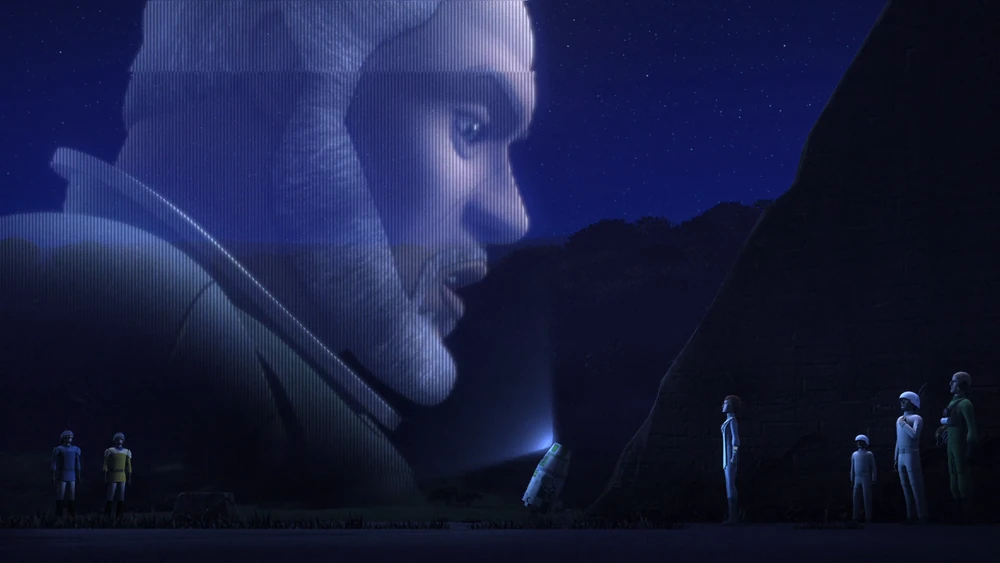
“Ghosts of Geonosis,” a two-part episode from the third season of Star Wars Rebels, focuses on the lingering consequences of the Empire’s actions on Geonosis and the growing desperation of the rebellion. The Ghost crew, tasked with investigating the disappearance of Saw Gerrera and his team, uncover a disturbing Imperial project: the continued development of weapons technology on the ravaged planet. The episode highlights the lasting devastation wrought by the Clone Wars and the Empire’s subsequent exploitation of Geonosis’s resources and population. Saw Gerrera, portrayed as increasingly radical and paranoid, plays a central role in the narrative. His obsession with uncovering the Empire’s secrets leads him to take extreme measures, clashing with the Ghost crew’s more cautious approach. Saw’s actions demonstrate his growing distrust of the Rebellion’s leadership, foreshadowing his eventual splintering from the main movement. His determination to expose the Empire’s weapons development, even at great risk, underscores his unwavering commitment to fighting tyranny, albeit through increasingly extreme methods. The episode reveals the existence of a surviving Geonosian, Click-Clack, who provides crucial information about the Imperial project, adding a poignant layer to the narrative. “Ghosts of Geonosis” serves as a stark reminder of the Empire’s cruelty and the lengths to which they will go to maintain power, while also showcasing Saw’s descent into extremism and his growing isolation.
Andor, Season 2, Episodes 7-9, (2 BBY)
Star Wars Rebels, Season 3, Episode 18, “Secret Cargo” (2 BBY)
The Ghost crew must escort Senator Mon Mothma, now wanted by the Empire, to a meeting that can change the galaxy.
“Secret Cargo” centers on the Ghost crew’s critical mission to safely transport Senator Mon Mothma. The episode underscores the perilous nature of building a unified rebellion against the Empire. Mon Mothma, a key figure in the burgeoning resistance, is portrayed as a beacon of hope and strategic leadership, her calm resolve contrasting sharply with the relentless pursuit of Imperial forces. The narrative emphasizes the delicate balance between diplomacy and direct action, highlighting Mon Mothma’s commitment to forging alliances and unifying disparate rebel cells through strategic planning and communication. The Ghost crew’s mission becomes a high-stakes operation, showcasing the risks and sacrifices involved in transporting such a vital figure. The episode effectively portrays the challenges of coordinating resistance efforts, demonstrating the importance of trust and collaboration in the face of overwhelming Imperial power. The narrative highlights the strategic importance of Mothma’s efforts in laying the groundwork for a cohesive Rebel Alliance, and the dangers involved in such operations. “Secret Cargo” serves as a significant step in the rebellion’s growth, showcasing the political maneuvering and strategic planning essential to its success.
Star Wars Rebels, Season 3, Episodes 21 & 22, “Zero Hour” (2 BBY)
While the rebels plot to attack the Imperial stronghold on Lothal, Grand Admiral Thrawn discovers the location of their secret base, leading to an epic clash.
“Zero Hour,” the intense two-part finale of Star Wars Rebels Season Three, depicts the Rebel Alliance’s desperate defense of their base on Atollon against Grand Admiral Thrawn’s calculated assault. The episode showcases the rebels’ struggle against overwhelming Imperial forces, forcing them to make critical decisions under extreme pressure. While the primary focus is on the Ghost crew’s fight for survival, the episode also subtly reinforces the growing unity of the rebellion. Mon Mothma, though not physically present, is referenced as a key figure in coordinating the larger rebel movement. The episode underscores the importance of the alliances she’s been building, as the rebels rely on reinforcements from various cells to bolster their defenses. Bail Organa’s influence is also felt, as his commitment to supporting the rebels and his diplomatic efforts are implied through the arrival of those reinforcements. His dedication to the rebellion, even from afar, reinforces his critical role. Saw Gerrera is absent, which serves to highlight the growing divergence between his extremist tactics and the more unified, strategically minded approach of the larger rebellion. The episode’s focus on coordinated rebel action underscores the value of the alliances being forged by Mon Mothma and Bail Organa, contrasting with Saw’s increasingly isolated and radical path. “Zero Hour” effectively portrays the high stakes of the rebellion’s fight for survival, while subtly emphasizing the importance of unity and strategic alliances in the face of Imperial might.
Star Wars Rebels, Season 4, Episodes 3 & 4, “In the Name of the Rebellion (1 BBY)
Saw Gerrera returns, determined to uncover an Imperial secret — no matter the cost.
“In the Name of the Rebellion,” a two-parter from Season 4, continues to examine the moral complexities of rebellion and the sacrifices required in the fight against tyranny. The episodes follow the Ghost crew as they set out to steal vital Imperial data, a mission that tests their resolve and forces them to confront the ethical implications of their actions. The episode explores the internal conflict within the rebellion, as the characters grapple with the consequences of their choices and the blurring lines between right and wrong in a time of war. Ezra Bridger, in particular, faces a moral dilemma, as he witnesses the harsh realities of rebellion and the sacrifices made by those fighting for freedom. The episode highlights the growing desperation of the rebellion, as they are forced to take increasingly risky actions to undermine the Empire’s power. The tension escalates as the crew encounters Saw Gerrera and his radical faction, whose extreme methods clash with the Ghost crew’s more measured approach. This encounter serves as a stark reminder of the diverse ideologies within the rebellion and the potential for conflict among those fighting for the same cause. “In the Name of the Rebellion” serves as a poignant exploration of the moral ambiguities of war and the difficult choices faced by those who dare to resist tyranny.
Star Wars Rebels, Season 4, Episode 5, “The Occupation” (1 BBY)
Ezra and the Ghost crew return to Lothal, but find that the Imperial occupation has taken a much darker turn.
“The Occupation” sees the Ghost crew return to occupied Lothal, where they undertake covert operations to ignite resistance against Governor Pryce’s oppressive regime. Mon Mothma plays a crucial role, sending a vital message to Ezra and the crew, directing their mission to gather intelligence on the Imperial TIE Defender project. Her communication underscores the strategic importance of Lothal to the wider rebellion, emphasizing the interconnectedness of rebel cells and the coordinated effort to weaken the Empire’s hold on key systems. The episode portrays the harsh realities of Imperial occupation, showcasing the fear and desperation of the Lothal citizens, and the challenges of guerrilla warfare. The crew’s clandestine operations highlight the risks and sacrifices involved in resisting Imperial tyranny, while Mon Mothma’s directive reinforces the strategic significance of their actions within the larger rebellion’s fight for freedom.
Star Wars Rebels, Season 4, Episode 7, “Kindred” (1 BBY)
The rebels look to move a stolen Imperial hyperdrive and flight data recorder off Lothal, while the mystery of the loth-wolves deepens.
“Kindred” intensifies the conflict between the Ghost crew and Grand Admiral Thrawn, focusing on acquiring vital intelligence about his TIE Defender project. The episode centers on a perilous mission to extract a captured Imperial freighter pilot, a key source of information, from Imperial custody. Ezra Bridger, Sabine Wren, and Zeb Orrelios undertake a dangerous infiltration, facing Thrawn’s forces and the relentless Rukh. Mon Mothma plays a crucial role by relaying the urgency of the mission and emphasizing the strategic importance of the TIE Defender data to the wider rebellion. Her communication underscores the high stakes of the operation and the necessity of acquiring this information to counter Thrawn’s tactical advantage. The narrative highlights the escalating tension and desperation of the rebellion, as they race against time to thwart Thrawn’s plans. The episode showcases Thrawn’s calculated tactics and his ability to anticipate the rebels’ moves, underscoring the formidable challenge they face. The introduction of the purrgil foreshadows their vital role in the future. “Kindred” serves as a critical turning point, escalating the conflict and setting the stage for the climactic confrontation, with Mothma’s strategic directives driving the rebels’ mission.
Star Wars Rebels, Season 4, Episode 8, “Crawler Commandeers” (1 BBY)
In need of a long-range transmitter, the rebels look to infiltrate one of the Empire’s massive ore crawlers.
“Crawler Commanders” centers on a crucial mission to disrupt Imperial supply lines on Lothal, highlighting the rebels’ strategic resourcefulness and the broader rebellion’s coordinated efforts. The episode centers on Ezra, Sabine, and Chopper’s infiltration of an Imperial mining operation, where they aim to disable massive crawler transports used to move vital resources. Importantly, the episode directly connects to the wider Rebel Alliance through a scene on Yavin 4. Here, Hera Syndulla briefs Mon Mothma on the progress of the Lothal operation. Mon Mothma emphasizes the strategic importance of disrupting these supply lines, underscoring how this localized action directly contributes to the larger rebellion’s goals. This meeting highlights Mothma’s involvement in coordinating and directing rebel activities across various fronts, showcasing her role in strategically guiding the rebellion’s actions. The episode also implicitly acknowledges the logistical support and strategic directives provided by the Alliance.
Andor, Season 2, Episodes 10-12 (1 BBY)
About Andor Season 2
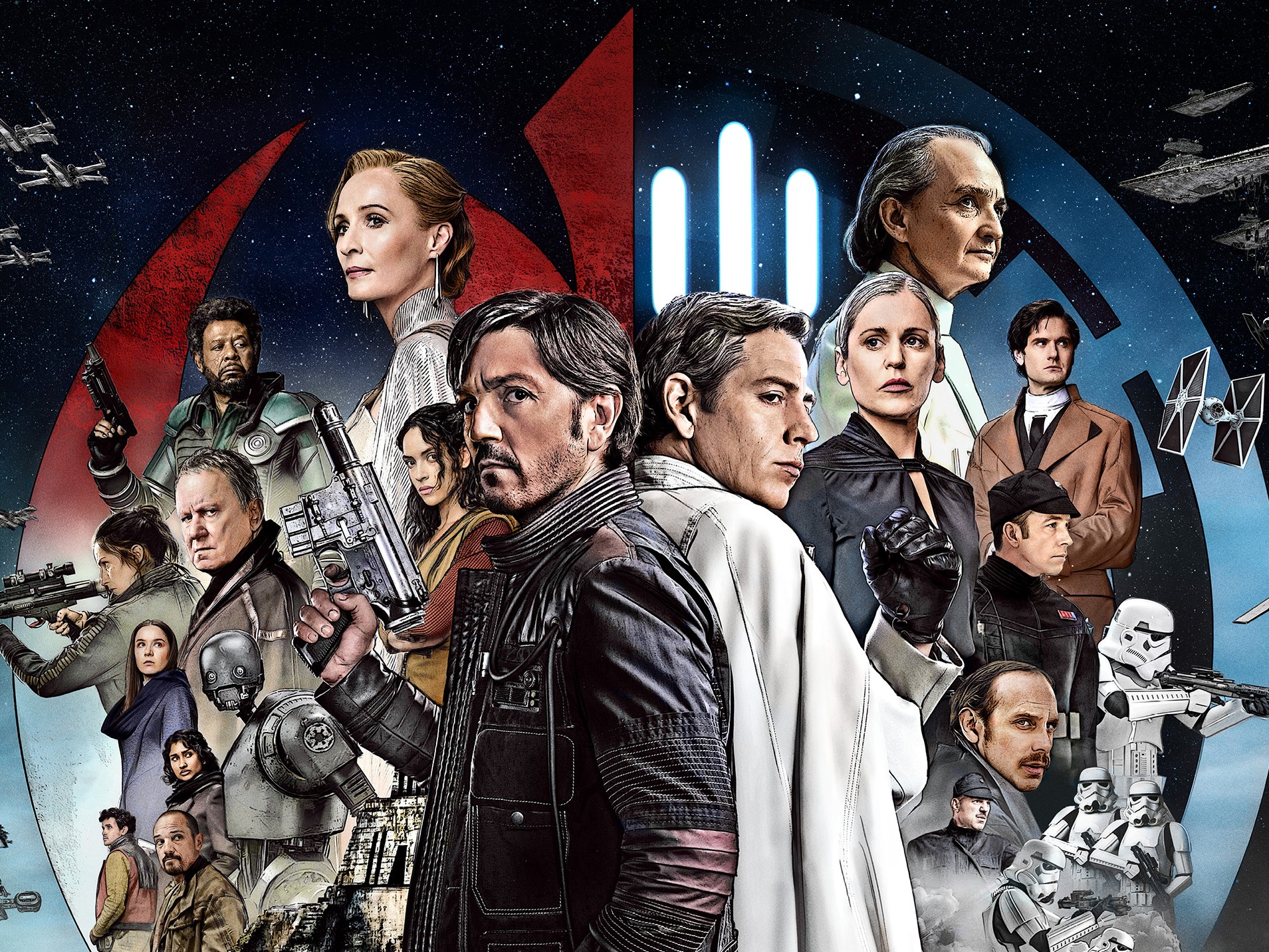
Andor Season 2 stars Diego Luna, Stellan Skarsgård, Genevieve O’Reilly, Denise Gough, Kyle Soller, Adria Arjona, Alan Tudyk, Faye Marsay, Varada Sethu, Elizabeth Dulau, with Ben Mendelsohn and Forest Whitaker.
The second season takes place as the horizon of war draws near and Cassian becomes a key player in the Rebel Alliance. Everyone will be tested and, as the stakes rise, the betrayals, sacrifices and conflicting agendas will become profound. Rife with political intrigue and danger, the series is a prequel to Rogue One: A Star Wars Story, which portrayed a heroic band of rebels who steal the plans to the Empire’s weapon of mass destruction—The Death Star—setting the stage for the events of the original 1977 film. Andor sets the clock back five years from the events of Rogue One to tell the story of the film’s hero, Cassian Andor, and his transformation from disinterested, cynical nobody into a rebel hero on his way to an epic destiny.
-Official synopsis, Andor Season 2
Andor is created by Tony Gilroy. Season 2 was written by Gilroy, Beau Willimon, Dan Gilroy and Tom Bissell and directed by Ariel Kleiman (Eps. 1-6), Janus Metz (Eps. 7-9) and Alonso Ruizpalacios (Eps. 10-12).
While it was nothing more than a line of empty chairs, Marvel Studios’ Avengers: Doomsday cast reveal left fans with a whole lot of questions about what might be going on in the 2026 flick. We certainly have no idea but there seems to have been a few key cast reveals that might give some clues…
Wakanda Forever…and Ever
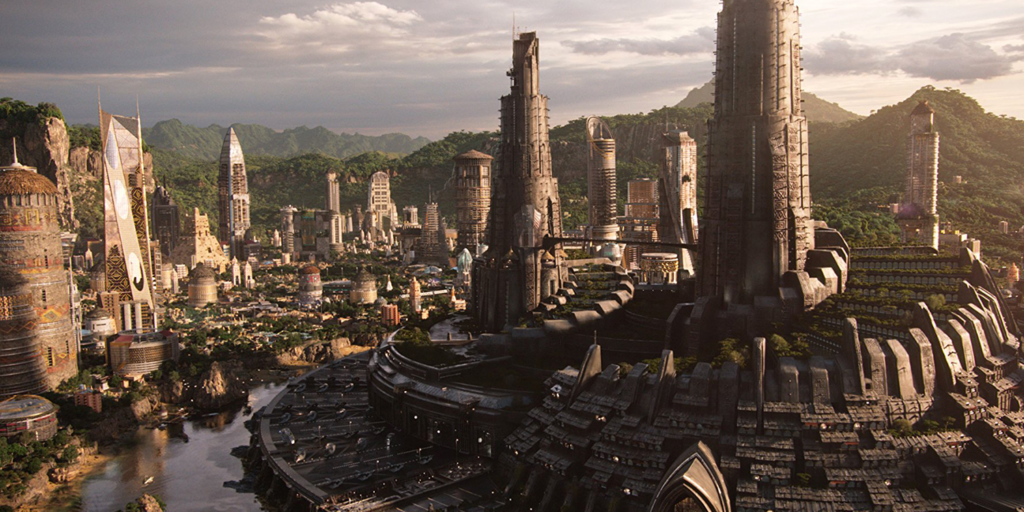
With the announcements of Letitia Wright, Winston Duke and, most surprisingly, Tenoch Huerta Mejia, it became clear that, once again, Wakanda will play a major role in an Avengers film. While Wakanda is likely still recovering from the devastating attack by Namor, the uneasy alliance with the Talokanil King does mean that not one but two Vibranium-powered armies stand ready to fight. However, if you don’t think Namor will stab Shuri in the back the minute it serves his best interests, which may actually align with Doom’s, you don’t know the man’s true nature.
Without a clear understanding of precisely what’s going to be going on in Avengers: Doomsday, it’s hard to say exactly what might be going on in Wakanda; however, it is worth remembering that Julia Louis-Dreyfus‘ Val made her ambitions to take over the country clear in Black Panther: Wakanda Forever and she now has her own group of Avengers Thunderbolts* to help her reach her goals. Other intriguing options for the location exist as well, including–but certainly not limited to–a loose adaptation of Doomwar that would see Robert Downey Jr.’s villain on Earth-616 and after the precious metal and the delicious opportunity to see Ian McKellen‘s Master of Magnetism turned loose over the Vibranium Mounds of Wakanda. While Vibranbium is not magnetic in the comics, that has not been the case in the MCU.
The Thunderbolts Are Here to Stay…At Least Some of Them
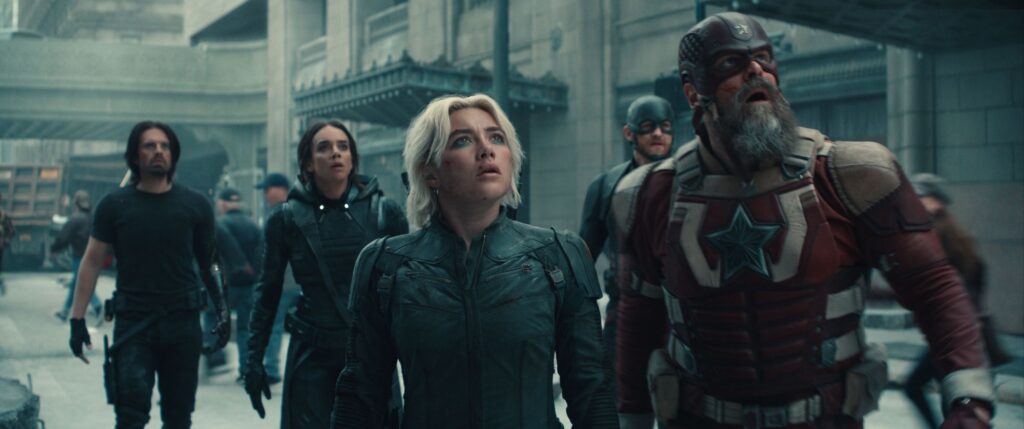
(L-R) Bucky Barnes (Sebastian Stan), Ghost (Hannah John-Kamen), Yelena Belova (Florence Pugh), John Walker (Wyatt Russell), and Red Guardian/Alexei Shostakov (David Harbour) in Marvel Studios’ THUNDERBOLTS*. Photo courtesy of Marvel Studios. ?? 2024 MARVEL.
Thunderbolts* doesn’t hit theaters for another five weeks but it now seems pretty clear that none of the members of the team will face any serious threat…other than poor Tasky. Whether or not Taskmaster makes it out of Thunderbolts* alive hardly seems like a major game-changer for the future of the MCU; to the contrary, however, the inclusion of Lewis Pullman‘s Sentry in Avengers: Doomsday does. Having a powerhouse like Sentry at her disposal puts Val in an enviable place, but are the Thunderbolts at her disposal? Is it Bucky’s team? Are they the U.S. Avengers now? Whatever the case, it seems as though The Watchtower will likely be visited in the film.
The fallout from Captain America: Brave New World is almost certain to ripple into both Thunderbolts* and Avengers: Doomsday. Without Ross in office, it’s worth wondering just how much pull Val might have in the government now and how she intends to use it. How might Sam react to Bucky leading a team of less-than-good guys? And what about that Adamantium? The inclusion of the Thunderbolts generates more questions than just about anyone on the cast list other than…
With the Multiverse likely at stake in Avengers: Doomsday, a trip to the Citadel at the End of Time and a visit to the man who sits on the throne there seemed inevitable. Within hours of the announcement that Tom Hiddleston had joined the cast of the film, theories had already begun to fly that Loki would fill the role played by Molecule Man in the different iterations of Marvel Comics’ Secret Wars events. Whether it’s to steal his powers for himself or use them to destroy the current iteration of the MCU, it seems as though Victor Von Doom will come face to face with Loki, God of Stories.
Avengers vs. X-Men
The inclusion of several of Fox’s original, early 2000s X-Men would seem to set up an incursion event that would see the heroes of Earth-616 take on a unified front of X-Men and members of the Brotherhood from whatever Earth these versions of Charles, Magneto, Cyclops et al are from. It seems relevant that while it’s clear members of the cast were left off the list, Marvel made sure to include Mystique actress Rebecca Romijn to make it clear that it would be all hands on deck when the two worlds collide. Call it Avengers vs. X-Men if you want but it seems like it will riff on Jonathan Hickman‘s Earth-616 vs. Earth-1610 Time Runs Out battle, forcing each world to fight until the end.
They’re Holding Back
Just as interesting as who was announced was, of course, who was not announced. By now, it’s been made clear by the studio that more stars will be joining the cast but that was already obvious. Very new rumors suggest that Tom Holland won’t be joining the film as Spider-Man 4 will be set concurrently with Avengers: Doomsday. Chris Evans is another notable omission, as is Lizzie Olsen, who recently claimed she will not be in either of the next two Avengers films. One name missing from the list that seems like a must (unless the studio has cooked up another project to deal with her character’s situation) is Teyonah Paris. The Multiverse Saga has been a mess but Monica’s presence in another reality is one of the only loose ends from the Saga that actually ties directly into what’s about to go down in Avengers: Doomsday and Avengers: Secret Wars.
Beyond that, several characters have entered the MCU since the Russo brothers’ last go-around that seem like the type of characters they’d like to have some fun with. Tatiana Maslany‘s She-Hulk seems like a perfect match for the Russos’ sensibilities and might pair perfectly with Chris Hemsworth‘s Thor. Leaving Charlie Cox on the sidelines would seem like a severely missed opportunity to take advantage of his popularity. Finally, it would stand to reason that if the original X-Men are back, more members of that cast, potentially including Hugh Jackman, will join the fray eventually.
Piecing It Together
While the cast reveal didn’t give away any plot points, it did point to some plot-related points: key settings. If one imagines a story structure similar to that of Avengers: Infinity War, it’s possible that Avengers: Doomsday might have 10-12 different settings. From the castings, it’s possible to deduce quite a few of them, though there’s always the chance one of two of these won’t be visited.
Possible Key Settings
Wakanda
Talokan
The Watchtower in New York City
The “Binary” X-Men Universe
The Citadel at the End of Time
Ta Lo
Latveria
The Fantastic Four Universe
Does Paul Rudd‘s presence mean another trip to the Quantum Realm? Possibly but we sure hope not, so leave it at 8 potential settings deduced from the casting. Allow for another 2 dozen or so characters to join the film and assume 2-4 more settings, depending on who joins the cast, and you’ve got yourself an event film…and maybe toss in Battleworld at the end to set up the next event film!
For nearly five hours, Marvel Studios had as many as 10 million fans on the edges of their seats by showing them…empty seats. In a barely-teased-but-definitely-not announced social media live stream, the cast of Avengers: Doomsday–or at least a good chunk of it–was revealed one at a time. By the time Robert Downey Jr. took a seat in his chair, the cast had grown to 27 members, many of whom were not part of any of the incredible amount of rumors about the 2026 project.
While it’s unlikely the entire cast, or even the entire main cast, has been revealed, let’s take a look at the biggest surprises from the event.
Fox’s OG X-Men
While Patrick Stewart and Ian McKellen had previously been rumored to be working with Marvel Studios on something, nobody had the returns of Alan Cumming, James Marsden and Rebecca Romijn on their bingo cards. Kelsey Grammer‘s Dr. Hank McCoy is set to return as well but it’s unclear if he’ll be the Earth-10005 Beast, the “Binary” universe Beast or if those two universes are the same, as has been theorized by many. Just what these heroes will be up to in the film remains to be discovered but it sure looks like the pieces could be in place for some Avengers vs. X-Men shenanigans.
Ch’ah Toh Almehen Is Back
It’s not too surprising to see Wakanda play some role in another MCU event film. It is, however, somewhat surprising to see Ch’ah Toh Almehen, aka K’uk’ulkan, aka El Niño sin Amor, aka Fish Man, aka Namor back in action for Avengers: Doomsday. Tenoch Huerta Mejia‘s name was the first real surprise of the day and fans are already dreaming of the potential interactions between Namor and Vanessa Kirby‘s Sue Storm and wondering just how much rizz the King of Talokan will lay on the Invisible Woman.
Cap’s Wingman…
(L-R) The Falcon/Joaquin Torres (Danny Ramirez) and Captain America/Sam Wilson (Anthony Mackie) in Marvel Studios’ CAPTAIN AMERICA: BRAVE NEW WORLD. Photo by Eli Ad??. ?? 2024 MARVEL.
Incredibly, despite potentially being the most annoying character in the Marvel Cinematic Universe, Danny Ramirez‘s Joaquin Torres is tagging along with Anthony Mackie‘s Captain America to… take on Doctor Doom? Worst case scenario: He does a few Fortnite dances and acts like an overgrown high schooler; best case scenario: Magneto strips him of his Falcon gear in mid-flight, and we never see the character again.
Shang-Chi Stays in the Lineup
When the film was originally being developed as Avengers: The Kang Dynasty, word was that it was essentially a sequel to Shang-Chi and the Legend of the Ten Rings. When Marvel scrapped the original idea and pivoted to Doomsday, Destin Daniel Cretton, who directed Shang-Chi and the Legend of the Ten Rings and was on board for The Kang Dynasty, left. At that point, it seemed as though Simu Liu‘s character would have to wait a while before making his way back to the big screen. Obviously the size and importance of his role in Doomsday remains to be discovered but Shang-Chi does possess some of the most powerful weapons in the MCU and does have access to the realm of Ta Lo and a pretty cool dragon.
A Pair of Powerhouses
With both Chris Hemsworth and Lewis Pullman, Avengers: Doomsday will feature two characters who are purt near indefatigable, invincible or otherwise really hard to kill. The real question here, though, is…whose side will Sentry be on? And if he’s not on Thor’s side, can Thor survive a tussle with him?
Outside of the Avengers films, Marvel Studios’ next film, Thunderbolts*, will demand more from audiences than any other MCU film to date. Thanks to its ensemble cast, the Jake Schreier-helmed film looks to serve as a sequel or follow-up to more projects than any other non-Avengers film in the MCU’s 17-year history.
Originally developed as a sequel to 2021’s Black Widow, Thunderbolts* has evolved significantly–perhaps more than any MCU project ever–over the past few years. While it will still feature Florence Pugh‘s Yelena Belova as the lead and introduce Lewis Pullman‘s not-so-mysterious Bob, it will also feature a heavier-than-originally-expected dose of Sebastian Stan‘s Bucky Barnes. Wyatt Russell, David Harbour, Hannah John-Kamen and Olga Kurylenko will all also reprise their MCU roles and team up with Yelana and Bucky to take on Julia Louis-Dreyfus‘ baddie, Val, and her enigmatic OXE group.
You’re talking about a group of characters that have done a lot of bad things, and maybe are struggling with feeling good about themselves. There’s an element that does speak to mental health, and loneliness, and how some of the darkness that we experience in our lives can’t be necessarily fixed, but can only really be made lighter through connection and finding others.
-Jake Schreier
With so many characters and their stories intersecting in Thunderbolts*, the upcoming film might require a bit more prep time than some of Marvel Studios’ recent projects. If you’re still reading, you’re probably ready to get started and so, as is our way, we present The Ultimate List of What to Watch Before… Thunderbolts*.
Tier One
If you’ve never seen a single second of any of Marvel Studios’ films or streaming series, these Tier One projects should be considered the bare minimum to get yourself ready for Thunderbolts*. These four projects will introduce you to the film’s main characters and set the stage for you to follow the next steps on their journeys.
Captain America: The First Avenger (2011)
🍅 80%
Captain America: The Winter Soldier (2014)
🍅 90%
Truthfully, Captain America: The First Avenger is tough to slot on a list like this until you realize it’s a fictional universe and nothing actually matters. That said, while a fair argument can be made for its inclusion in Tier One, a counterargument can be made that, for all intensts and purposes, the James Buchanan Barnes introduced in TFA died in the fall from the train. While he’s no longer the Winter Soldier, Bucky is not–and never has been–the character from this film. Pairing Captain America: The Winter Soldier with The Falcon and The Winter Soldier does enough to prepare a first-timer for Bucky’s role in Thunderbolts*; however, TFA does provide additional context for Bucky’s tortured persona and why he’s striving so hard to change the world around him.
So when he hears about my formula and what it can do, he cannot resist. Schmidt must become that superior man.” “Did it make him stronger?” “Yes. But there were other… effects. The serum was not ready. But more important, the man.
-Abraham Erskine, Captain America: The First Avenger
And after you logic your way through all of that, the simple fact remains that even though it’s not the first film in which it’s mentioned, Captain America: The First Avenger is chronologically the first time the Super Soldier Serum is a factor in the MCU. It’s continued to play a role in several projects and will do so again I Thunderbolts*.
While it’s not the first appearance of Bucky Barnes–that came in Captain America: The First Avenger—Captain America: The Winter Soldier is THE definitive Bucky film. Over a decade later, the 2014 film remains unparalleled as an action-packed thriller and helped set Sebastian Stan on the path to MCU royalty.
Ant-Man and The Wasp (2018)
🍅 87%
While the last film in the Ant-Man franchise may well be remembered as one of Marvel Studios’ worst films, Ant-Man and The Wasp, the franchise’s second installment, is a fun ride worth taking. It served a surprisingly major role in The Infinity Saga but if you’re prepping for Thunderbolts*, you’re watching it to get to know Hannah John-Kamen‘s Ava Starr, aka Ghost. Thunderbolts* is Ava’s first MCU appearance since Ant-Man and The Wasp, so there’s a lot to catch up on, including how her powers have evolved since we last saw her.
Valentina Allegra de Fontaine. Actually, it’s Contessa Valentina Allegra de Fontaine. I know it’s hard, but I don’t like to repeat myself, so you can just call me Val. But don’t call me Val, just keep it in your head.
-Valentina Allegra de Fontaine, The Falcon and The Winter Soldier
The Falcon and The Winter Soldier (2021)
🍅 85%
Marvel’s second streaming series, The Falcon and The Winter Soldier might do the heaviest lifting of any project on the list. Not only does the 6-episode introduce Wyatt Russell‘s John Walker, who looks to play a pretty major role in Thunderbolts*, it also tells a key chapter in Bucky’s story and introduces Julia Louis-Dreyfus‘ Val, who is responsible for assembling the Thunderbolts. The project also adds to the Super Soldier Serum narrative by introducing Isaiah Bradley, the Flag Smashers and by creating a new Super Soldier when Walker injects himself with the newest version.
They had blood samples from an American test subject with semi-stable traces of serum in his system. After much labor, I was able to isolate the necessary compounds in his blood. I was a god. I did what no other scientist since Erskine was able to do. But mine was going to be different.
Dr. Wilfred Nagel, The Falcon and The Winter Soldier
Black Widow (2021)
🍅 79%
Released simultaneously in theaters and via Disney Premier Access on D+, Black Widow not only finally gave Scarlett Johansson the lead after spending a decade in the MCU but it also introduced her messy family of Russian spies. Popping back Nat’s life after decades away, Florence Pugh‘s beautifully flawed Yelena Belova, David Harbour‘s bellicose and bombastic Alexi Shostakovich, Russia’s very own Super Soldier, and Rachel Weisz‘s shifty Melina Vostokoff helped show a more vulnerable side of the character. The chemistry between Pugh and Harbour was a highlight of the film and something to look forward to again in Thunderbolts*. And if you’re watching, stick around for the PCS which leads directly into the next project on the list…
Black Panther: Wakanda Forever (2022)
🍅 84%
Given how little screentime Julia Louis-Dreyfus‘ Val has had in the MCU, it stands to reason that the project in which she’s on screen the most is a must watch heading into Thunderbolts*. While it still isn’t a truly heavy dose of the character, it does provide plenty in the way of exposing the kind of person she is whilenalso revealing her lust for power and what she’s willing to do to acquire it.
Tier Two
Tier Two projects occupy an interesting place on The Ultimate Lists. While they’re never required viewing, they always offer something that can add to the viewing experience of the upcoming project.
The Incredible Hulk (2008)
🍅 68%
After being forgotten for a decade and a half, The Incredible Hulk is cool again…or at least relevant. Bruce Banner’s work on Project Gamma Pulse was meant to recreate Dr. Erskine’s Super Soldier Serum. Obviously that didn’t go as planned…TIH includes not one but two Super Soldiers gone wrong in Banner and Emily Blonsky. When will these people learn?!?!
Hawkeye (2022), Episodes 4-6
🍅 92%
One of the studio’s strongest beginning-to-end streaming series, Hawkeye features a three-episode appearance by Pugh‘s Yelena that while not necessary to enjoy Thunderbolts* will add to your enjoyment of it. Yelena’s time in Hawkeye–most of which is spent enjoyably with Hailee Steinfeld‘s Kate Bishop–is fascinating and allows for further excavation of the deeply rooted issues the former Red Roomer deals with.
Tier Three
For completists only…
Tier three projects may offer nothing more than cameos, passing references or relevant background information for upcoming projects but nothing in them will ever make or break a fan’s viewing experience.
The Avengers (2012)
🍅 91%
The best example of what type of information can be expected from Tier Three projects comes right off the bat: you’re watching this one just to visit Stark Tower for the first time. The building is a central location in The Avengers and, 13 years later, is again in Thunderbolts*, though now under new ownership.
Iron Man 3 (2013), Post-credit Scene
🍅 79%
Following Stark Tower becoming Avengers Tower in the final moments of The Avengers, the next visit to the facility can be found in the PCS to Iron Man 3 where the science bros are talking some things out.
Avengers: Age of Ultron (2015)
🍅 76%
The last project in which Avengers Tower serves as a key location in the Sacred Timeline, AoU sees the facility fully realized as a true home base for Earth’s Mightiest Heroes. Following the events of the film, the Avengers moved out of the tower and into the Avengers Compound in upstate New York.
Captain America: Civil War (2016)
🍅 90%
While Cap and Iron Man throwing down is the main attraction, Bucky’s very naughty past is what incites the Civil War. A great watch and full of plenty of interesting details about Bucky’s past and post-TWS present, skipping Captain America: Civil War won’t impact your viewing of Thunderbolts* but a watch/rewatch will help you better understand the new Bucky Barnes.
Spider-Man: Homecoming (2017)
🍅 92%
A brief trip to Avengers Tower reveals that the Happy is in charge of moving out the team’s things so that the new owner can take possession…that new owner is, of course, Julia Louis-Dreyfus‘ Val!
Avengers: Infinity War (2018)
🍅 85%
Avengers: Infinity War is always worth a watch though it really doesn’t have much to offer in the way of preparing for Thunderbolts*. A little bit of Bucky’s story is told here, including revealing what he’d been up to In Wakanda, but beyond that, just enjoy it for the action!
Avengers: Endgame (2019)
🍅 94%
Like Infinity War, Endgame offers a bit of Bucky but the real interest here, if there is any, is the ripple effect Nat’s death will eventually have on Yelena…but Yelena isn’t in the film, so just knowing Nat died will suffice. You could also argue that the Time Heist adds some additional context to what was going on inside Avengers Tower during the Battle of New York but how important will that be?
Captain America: Brave New World (2025)
🍅 48%
Because Bucky is in it…for a minute.
About Thunderbolts*
The film stars Florence Pugh, Sebastian Stan, Wyatt Russell, Olga Kurylenko, Lewis Pullman, Geraldine Viswanathan, Chris Bauer, Wendell Edward Pierce, with David Harbour, with Hannah John-Kamen, and Julia Louis-Dreyfus.
In Thunderbolts* Marvel Studios assembles an unconventional team of antiheroes—Yelena Belova, Bucky Barnes, Red Guardian, Ghost, Taskmaster and John Walker. After finding themselves ensnared in a death trap set by Valentina Allegra de Fontaine, these disillusioned castoffs must embark on a dangerous mission that will force them to confront the darkest corners of their pasts. Will this dysfunctional group tear themselves apart, or find redemption and unite as something much more before it’s too late?
-Official Synopsis for Marvel Studios Thunderbolts*
Jake Schreier directs Thunderbolts* and Kevin Feige is the producer. Louis D’Esposito, Brian Chapek and Jason Tamez serve as executive producers. The screenplay was written by Joanna Calo and Eric Pearson and Lee Sung Jin.
Stranger Things star Sadie Sink will co-star with MCU vet Tom Holland in Spider-Man 4 in what’s only been described to this point as a large role. Previously rumored to be a front-runner for the role of Omega mutant and original X-Men Jean Grey, the identity of Sink‘s character has generated a lot of conversation online though it remains unknown. With that in mind, we’re jumping into the conversation, adding a few dark horse candidates for the young ginger star’s MCU alter ego.
Given that the new Spider-Man film will follow Avengers: Doomsday, there’s no telling just yet what the project’s setting might be, so ruling out any one particular character on the grounds of a “why would they be there?” argument is nonsensical at this point. In a collapsing Multiverse, all bets are off.
Firestar
Insider Jeff “The In” Sneider’s late 2024 report that Sink was leading a pack of actresses for the part of Marvel Studios’ Jean Grey seems to still be carrying a lot of weight in the current conversation about Sink’s Spidey 4 role. On one hand, we’ve heard on more than one occasion that the studio wants to introduce its own variants of the mutant heroes into the MCU before the X-Men film hits in (probably) 2027, so Grey makes a lot of sense for Sink; on the other hand, another red headed mutant has a much richer history with the Web-Slinger.
When rights issues blocked the use of Johnny Storm in 1981’s for NBC’s animated Spider-Man and His Amazing Friends, Firestar was created to be the fire to Bobby Drake’s ice. In 1985, the character was written into the mainstream Marvel Comics continuity where she has been an X-Man, New Warrior and Avenger. As much as folksight want to write the character off as a random Z-lister, remember a whole generation of kids–the generation that includes director Destin Daniel Cretton–grew up believing Firestar was pretty amazing. And, in some ways, it might be easier for a non-major member of the X-Men to be introduced as native to Earth-616 than for Jean Grey to suddenly appear.
Hope Summers
If one host of the Phoenix is possible, why not another? Raised in the future by Cable, Hope Summers, the Mutant Messiah, is as powerful of an Omega-Level mutant as has ever existed and one of the most important X-Men characters created this century.
Hope was never even close to fully utilized by Fox, only having briefly appeared in Deadpool 2 and Marvel could tap into her role as the mutant savior by throwing her into the mix as the Multiverse (likely) collapses and is then remade. Spidey has long been a mutant ally, so it wouldn’t be out of place for him to work with Hope to solve whatever is going on after the events of Avengers: Doomsday.
Rachel Summers
Of all the possibilities here, I actually like this one the best. Rachel Summers stands out among potential choices because of her identity as a Multiversal anomaly: across all timelines, there is only one Rachel Summers. Though not Omega-Level like her mother, Jean Grey, Rachel is a powerful telepath who has also demonstrated the ability to control time and travel to other realities.
While it may be a bit of a stretch, it’s important to remember that actions have consequences so when Monica Rambeau found herself stuck in whatever reality she ended up in during the third act of The Marvels, a response is due. With the Multiverse in jeopardy, it’s possible an older Rachel Summers, complete with her Hound skills intact, could be sent to explore things in Monica’s home universe where she meets up with Peter Parker.
Paired with Episode 2, the third episode of Daredevil: Born Again adapted writer Brian Michael Bendis‘ “The Trial of the Century” arc from his early 2000s time on Marvel Knights Daredevil: The Man Without Fear. It’s rare for Marvel Studios to do direct adaptations of comic books storylines and the studio didn’t do that here. Instead, with Bendis‘ serving as a Consulting Producer on the two episodes, Marvel did something even more rare: they made a great comic book story better.
Elevated by an incredible performance by the late Kamar de los Reyes, “In the Hollow of His Hand” allowed Daredevil: Born Again time for Matt Murdock to do his day job and put on display just exactly what it is that makes him a really good lawyer. Though he probably is the “slippery shit” he was accused of being, Murdock’s instincts to let Hector Ayala take the stand as White Tiger and put the ethos of the Boricua spirit on trial served him well as Hector’s known standing as an ally to the cops and strong member of his community were more than enough to exonerate the hero. Unfortunately, wins don’t last for long in this show.
As in the comics, however, the legacies of Ayala and the White Tiger will live on. Sharp-eared viewers probably heard that Hector was living with his sister and niece and, if those same viewers were eagle-eyed during the trial, they saw his niece, Angela, in the courtroom. Created by Bendis, Angela del Toro showed up 20 issues or so after Hector’s trial and ultimately took up the mantle of White Tiger. Will Angela look to make Hector’s fight her own in Daredevil: Born Again?
Of course, what’s truly fascinating about the episode(s), which were originally set to be the series two-episode debut, is how strongly subversive they were to the pathos established by Netflix’s Daredevil. Despite serious tension in the courtroom and on the streets, a brutal, bloody battle wasn’t necessary in order to make a pair of episodes that are nothing short of must see DD…that take place almost entirely during the day.
Star Jon Bernthal will co-write the Special Presentation with Reinaldo Marcus Green, who will also direct it.
Cast
Jon Bernthal as Frank Castle/The Punisher
Cookie Consent
We use cookies to improve your experience on our site. By using our site, you consent to cookies.
This website uses cookies
Websites store cookies to enhance functionality and personalise your experience. You can manage your preferences, but blocking some cookies may impact site performance and services.
Essential cookies enable basic functions and are necessary for the proper function of the website.
Name
Description
Duration
Cookie Preferences
This cookie is used to store the user's cookie consent preferences.
30 days
These cookies are needed for adding comments on this website.
Name
Description
Duration
comment_author_email
Used to track the user across multiple sessions.
Session
comment_author_url
Used to track the user across multiple sessions.
Session
comment_author
Used to track the user across multiple sessions.
Session
Statistics cookies collect information anonymously. This information helps us understand how visitors use our website.
Google Analytics is a powerful tool that tracks and analyzes website traffic for informed marketing decisions.
Contains information related to marketing campaigns of the user. These are shared with Google AdWords / Google Ads when the Google Ads and Google Analytics accounts are linked together.
90 days
__utma
ID used to identify users and sessions
2 years after last activity
__utmt
Used to monitor number of Google Analytics server requests
10 minutes
__utmb
Used to distinguish new sessions and visits. This cookie is set when the GA.js javascript library is loaded and there is no existing __utmb cookie. The cookie is updated every time data is sent to the Google Analytics server.
30 minutes after last activity
__utmc
Used only with old Urchin versions of Google Analytics and not with GA.js. Was used to distinguish between new sessions and visits at the end of a session.
End of session (browser)
__utmz
Contains information about the traffic source or campaign that directed user to the website. The cookie is set when the GA.js javascript is loaded and updated when data is sent to the Google Anaytics server
6 months after last activity
__utmv
Contains custom information set by the web developer via the _setCustomVar method in Google Analytics. This cookie is updated every time new data is sent to the Google Analytics server.
2 years after last activity
__utmx
Used to determine whether a user is included in an A / B or Multivariate test.
18 months
_ga
ID used to identify users
2 years
_gali
Used by Google Analytics to determine which links on a page are being clicked
30 seconds
_ga_
ID used to identify users
2 years
_gid
ID used to identify users for 24 hours after last activity
24 hours
_gat
Used to monitor number of Google Analytics server requests when using Google Tag Manager
1 minute
Marketing cookies are used to follow visitors to websites. The intention is to show ads that are relevant and engaging to the individual user.
Pinterest Tag is a web analytics service that tracks and reports website traffic.