Tag: Kate Bishop

  • ‘Hawkeye’: Clint Barton Succeeds Where Tony Stark Failed

    ‘Hawkeye’: Clint Barton Succeeds Where Tony Stark Failed

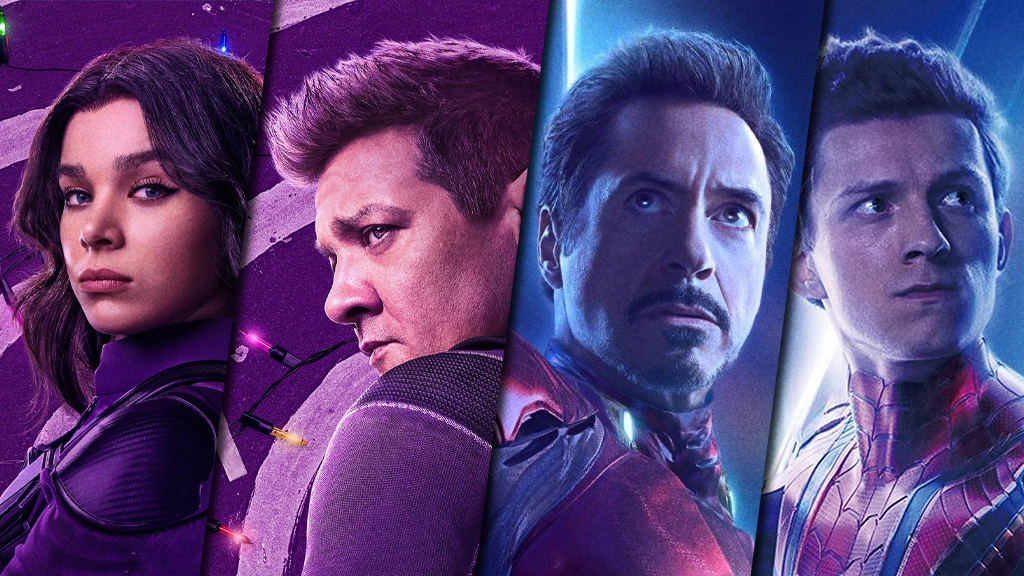
    The Marvel Cinematic Multiverse is in full-swing and, as it turns out, in a point of transition as it moves from a semi-grounded MCU into the next phase of the content Marvel wants to put out. I’ve long theorized that Phase 4 would be made up of smaller phases building out over one big story, as opposed to the first 23 films where it was all building to Thanos. We have original Avengers transitioning their titles to the next generation of heroes, some of which are even younger than they were when they joined the fray. One transition in particular deserves special attention, both for what it means for the future and how it handled the present in the shadow of the juggernaut that is Marvel’s latest big-screen offering. It also deserves kudos for successfully landing the plane on the mentor-mentee relationship in a way that Peter Parker’s arc really didn’t. We now have a new Hawkeye and that is Kate Bishop.

    After being put through the ringer while finding out her parents were willing members of organized crime, the world’s greatest archer ensures that her mother faces some consequences for her actions. The Elder Bishop is last seen asking her daughter if sending parents to jail is what heroes do after she is unable to gracefully exit the Kingpin’s criminal enterprise. It would not surprise me to see the Kingpin enlist a masked vigilante like Madame Masque to take the younger Bishop down if we get a Season 2 or a Hawkeye and Black Widow movie down the line. Whatever form she next shows up in, Kate Bishop won’t be alone.

    At the end of Hawkeye, Clint Barton solidified his relationship with Kate Bishop, and completes the arc that began in 2012’s Avengers. His family is safe, his wife’s past life is secure, and he can now finally rest. Not only does he do this, but he brings Kate home with him. At this point, only Nick Fury and the Avengers even knew his family existed. This shows how much he actually cares about Kate, and how much the “your mess is my mess” line isn’t delivered just for kicks, but actually symbolizes a partnership that began reluctantly. It’s a much better partnership than that of Peter Parker and Tony Stark.

    Whereas Iron Man recruited Spider-Man out of necessity, he then took the young man into space and watched him die in his arms. Before taking him to space, Stark wanted to have Peter join the Avengers: this was his grand gesture since letting him go against The Vulture alone as a way to clean up the public relations mess after Captain America broke the Avengers out of The Raft. He let a 16-year old kid keep a hyper-advanced suit and it was the way he treated past employees that led to one of them targeting Peter to the point of outing his identity. In a lot of ways, it was Tony Stark’s recruitment of a starstruck Peter Parker that has now led to the multiverse exploding.

    Clint Barton is no Tony Stark.

    Clint went out of his way to protect Kate from the beginning, and he risked his family just to make sure she was safe. He didn’t want her to get involved, then got to know her and doubled down on protecting her, and even tried to send her home when he realized things got too dangerous. When Kate wanted to confront her mother after receiving the video of the Kingpin, he told her he’d help. Clint taught Kate how to make arrows and how to assess targets. Compare that to Stark, who didn’t take Peter seriously when he told him about the Vulture and who left him (and the rest of the Avengers) absolutely no financial stability after his passing. Given her mentor, Kate Bishop has a chance to be a better Avenger than Spider-Man’s ever been.
  • ‘Hawkeye’ From Page to Screen: Episode 6

    ‘Hawkeye’ From Page to Screen: Episode 6

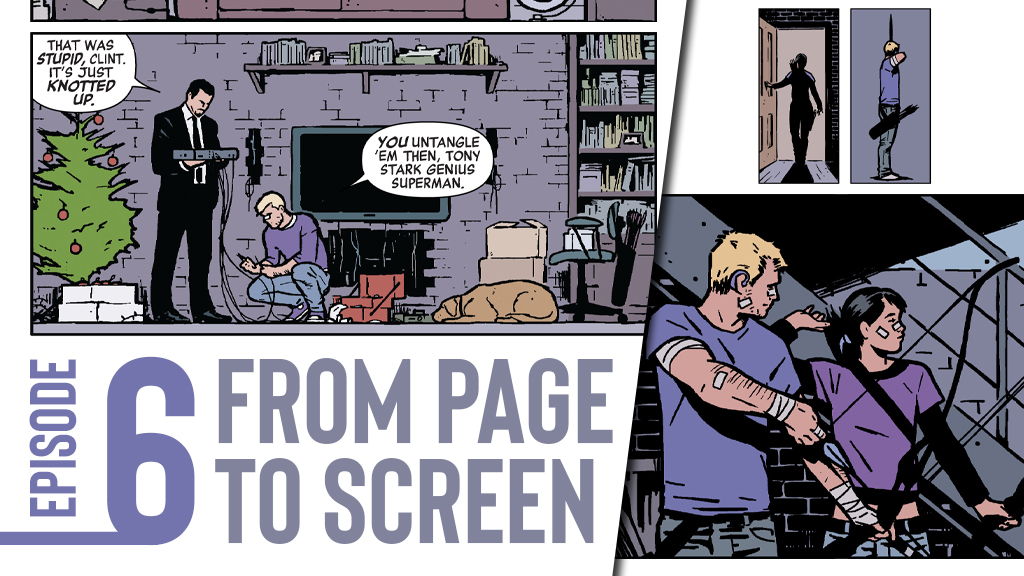
    With the finale in the rearview mirror, Marvel Studios’ Hawkeye series has come to a close. Each week we have looked at ways in which the live-action series has adapted parts of the Matt Fraction and David Aja Hawkeye comic book run. Between the origins of Lucky the Pizza Dog, Clint’s capture by the Tracksuit Mafia, Episode 3’s car chase and trick arrows, the connection between the live-action LARPERs and the comics’ neighbors, and Kingpin’s role, the series has covered a lot of ground. Looking at the finale episode of Hawkeye, a few things stand out as having strong ties to the source material: (1) the importance of Kate taking on the “Hawkeye” mantle; (2) the six-day Christmas-themed adventure; and (3) Kate’s parents’ role in the organized crime that the Hawkeyes go up against.
    Hawkeye and Hawkeye

    Marvel Studios’ ‘Hawkeye’ Episode 6
    Marvel Studios’ ‘Hawkeye’ Episode 6

    A clear goal of the live-action Hawkeye series was to introduce and establish Kate Bishop as the next “Hawkeye.” While the show follows Kate from her pre-superhero days through her first adventure with Clint, in the Hawkeye comic she is already established as Hawkeye alongside Clint’s own Hawkeye persona. While the series finale ended just shy of officially referring to Kate as Hawkeye, it’s almost certain that the next time we see Hailee Steinfeld’s character there won’t be any question about her superhero identity.

    The live-action and comic Hawkeye stories also both seem to have built a greater appreciation for Kate’s character over time. While both the series and comic are premised on Clint Barton’s story, Kate is a major character throughout his story. The Hawkeye series of course ends in a way that reflects Kate’s new role in Clint’s life and as a hero. The Hawkeye comic ends with a similar acknowledgment of the significance of the relationship between the two. On its final page, it also calls the Hawkeye comic run a “Clint Barton/Kate Bishop Comic Book,” giving further credit to Kate being deserving of the Hawkeye mantle on the same level as Clint.

    ‘Hawkeye’ #2 (2012)
    ‘Hawkeye’ #22 (2015)

    Six Days of Christmas

    Marvel Studios’ ‘Hawkeye’ Episode 6

    Hawkeye made itself a Christmas show, and it made sure you knew how Christmas-y it was as often as it could. The series was clever to use its six episodes to cover the six days leading up to Christmas, which served as a countdown for Clint to get home to his family for the holiday. Not only did the second issue of Hawkeye explore a heavy Christmas theme, it also specifically looked at the six days of Clint’s life during that time. The comic version of the six days of Christmas had cameos from Tony Stark, Wolverine, and Spider-Man, which obviously the series did not. But it did heavily feature Kate, as well as the Tracksuit Mafia like the live-action series, did. In Hawkeye, the six days were presented out of order, and that added to the intrigue of the narrative––it’s interesting to think about how the Hawkeye series would have played out if its reveals and investigative themes were similarly distorted in order.

    Both six-day stretches end with Clint having company for Christmas. In the Hawkeye series, Clint makes it home to Missouri with Kate to spend Christmas with his wife and kids. Comic Clint has a much different family life than MCU Clint, though. He is divorced with no children and is living alone. At the end of his six days, a family that lives in his apartment building comes to keep him company in a warming moment for the self-deprecating and down-on-his-luck archer.

    Bishop Family Values

    Marvel Studios’ ‘Hawkeye’ Episode 6
    ‘Hawkeye’ #22 (2015)

    One of the major reveals of the Hawkeye series was that Kate’s mother Eleanor Bishop was working for Wilson Fisk, also known as Kingpin, and her ties to New York City’s criminal underground was essentially the catalyst for the entire series. In the comics, Kate Bishop’s mother is the one who is presumed dead, and her father Derek Bishop raised her. In the live-action series, of course, the parents’ statuses are reversed, but in both iterations, they made deals with Kingpin among other criminal figures and organizations that ultimately impacted Kate and her safety.

    In any event, the Bishops were a wealthy family which gave Kate the status as a socialite on top of being a superhero. As a result, we get to see Kate bring Clint to a fancy event in a skyscraper in order to investigate some criminal activity in both the comic and the series.

  • ‘Hawkeye’ From Page to Screen: Episode 5

    ‘Hawkeye’ From Page to Screen: Episode 5

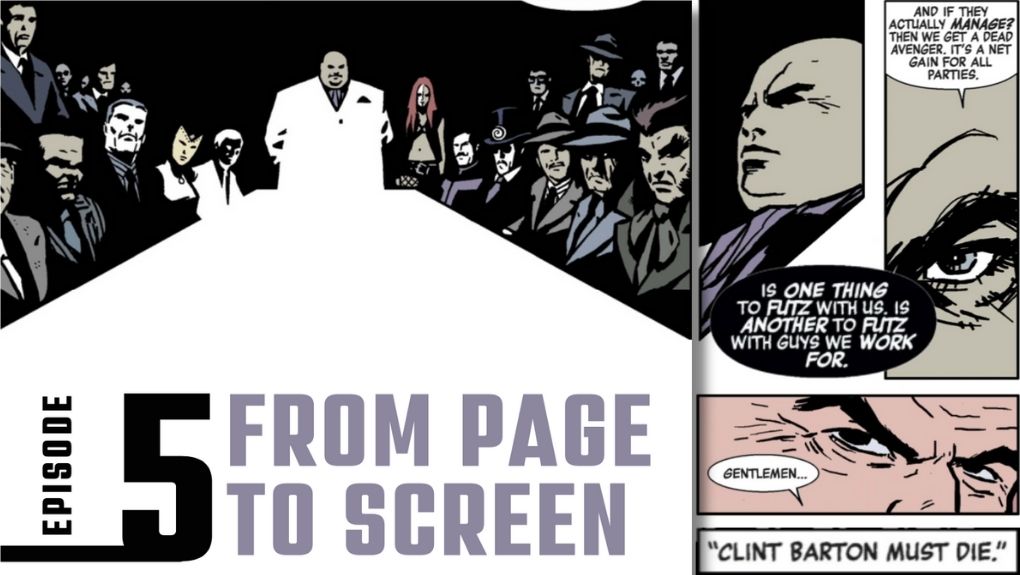
    The Hawkeye series finally introduced none other than Kingpin at the very end of its penultimate episode, after quite some time teasing the villain’s introduction. While Kingpin did not play a particularly central role in the Matt Fraction and David Aja My Life as a Weapon comic, it’s clear that his role in both the comics and show has some major overlaps worth exploring. Is the Kingpin, better known as Wilson Fisk, just the man behind the curtain, or is he more involved than it seems?

    In the comic he is heavily involved in three major areas of interest: (1) he’s at the top of the Tracksuit Mafia food chain; (2) he was at a black-market auction to buy incriminating evidence on Clint Barton; and (3) he was involved in hiring an assassin to kill Clint Barton. This article will explore each of these elements in turn and how they relate to the Hawkeye series.

    The Guy Clint’s Been Worried About

    One thing we know about Kingpin in every adaptation is that he is at the top of the New York City criminal organization pyramid. We know little so far from the Hawkeye series, but in the comics, Kingpin is a general presence that overshadows much of the crime syndicates below him. In both the series and the comic, Clint is hesitant to work with Kate or go about his general business, not because of the Tracksuit Mafia, but because of who they work for. In the series, Clint tells Kate that they do not want to get too involved, because they could run into the “Big Guy”. In the comics, Kingpin delivers a speech to a cohort of villains that “Clint Barton must die,” for interfering with their plans. The Tracksuit Mafia makes it pretty clear the Clint that they work for someone much more powerful. Later on, it’s obvious that Fisk is at least one of who they are referring to. As seen below, the comics make it much more explicit than the Disney+ series does.

    ‘Hawkeye’ #6 (2012)
    ‘Hawkeye’ #8 (2013)

    The Auction

    Curiously, both the comics and the series feature a black market auction for Barton and Avengers-related items. In the series, of course, we see people bid on the Ronin sword, but the Tracksuit Mafia break into the event to grab the still-mysterious Avengers-related watch before it goes up for sale. While Clint tells Kate that the watch could blow the cover of his friend, in the comics a tape of Clint assassinating targets on behalf of S.H.I.E.L.D. goes up for auction. Kate manages to buy the tape – in disguise as Madame Masque – and, you can guess, Kingpin is not too happy.

    ‘Hawkeye’ #4 (2012)

    In the series, the first episode shows Jack and Armand Duquesne at the said auction that featured several items found from the destroyed Avengers compounds, including Ronin’s sword, suit, and the mysterious watch. While we did not see Kingpin physically at the auction, we know the Tracksuit Mafia—that he controls—broke in to steal the watch. As little as we know about the watch, it’s clear it might have the same effect on the owner and Clint’s tape in the comics did on him.

    ‘Hawkeye’ #4 (2012)
    Marvel Studios’ ‘Hawkeye’ Episode 1

    The Assassin

    In the comics, Kingpin is one member of a group, including the Tracksuit Mafia, that decides to hire an assassin to kill Clint Barton. He hires Kazimierz Kazimierczak in the comics, who is otherwise known as the Clown. The Kazi in the series definitely strays from the Kazimierz in the comics, so we have not seen any elements of the “Clown” at this point. But in the series, Episode 5 tells us that Kate’s mother Eleanor hired Yelena Belova to kill Clint. Shortly after, we find out that Eleanor appears to be working with Kingpin, begging the question as to whether he was involved in the live-action scheme to take down Clint Barton.

    While Kingpin’s introduction was fairly small in Hawkeye Episode 5, it’s worth noting the connections he has to the Fraction-Aja comics. We’ll find out more about Kingpin’s involvement in the Hawkeye finale on Wednesday, December 22, 2021, when it airs on Disney+.

  • REVIEW: ‘Hawkeye’ Episode 5 – Ronin

    REVIEW: ‘Hawkeye’ Episode 5 – Ronin

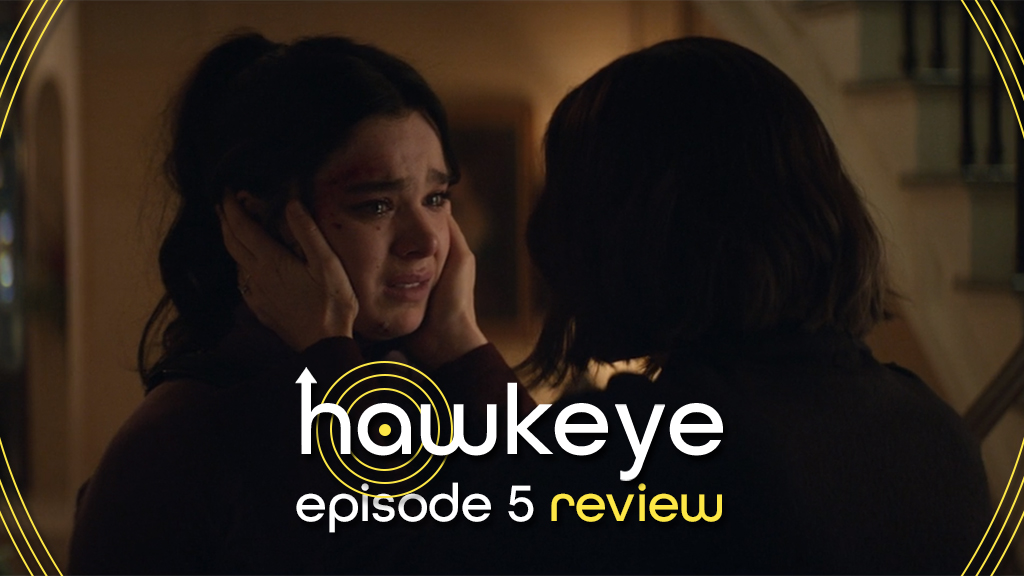
    Hawkeye Episode 5 expanded upon the last episode’s theme of rich character development and in-series world-building, but it fell short of providing a strong platform into the finale. While the penultimate episode certainly took its time to gather a lot of pieces of the big-picture puzzle, the final episode of the short series is left to try and resolve virtually every plotline already in existence as well as provide all of the Kingpin content it has teased. 

    What Ronin set out to achieve it did beautifully. There were several standout conversations and one-on-one moments that invoked emotion arguably better than the series has done previously. Florence Pugh’s witty Yelena was easily one of the biggest highlights and received much of the episode’s focus. While her “girl’s night” with Kate highlighted the chemistry between the two characters, the look at Yelena’s own blip was an intense opening to Ronin that set the tone for a grief-filled episode. Eleanor and Kate had a moving moment where Vera Farmiga puts in quite a compelling performance as a concerned mother which is impeccably timed with the late but unsurprising reveal that she likely is on the wrong side of the criminal line.

    Clint also has moments dripping with desperation and loss. Learning that the Black Widow was Natasha’s sister Yelena sent him into another spiral of guilt over Natasha’s sacrifice. There’s a simple but moving moment where he talks to an Avengers commemoration plaque as if it were her in silence. But mourning quickly turns to action as Clint wastes little time in going on the offensive to defend his family. Through another Linda Cardellini phone call, Clint explains that he has to end it or else the “big guy” might get involved. Laura Barton is again strangely supportive, lending a lot of credit to the theory that she is an ex-agent of some kind herself. This episode marks Clint moving away from much of his self-deprecating attitude and into a much more confidently self-aware place.

    The result is Clint revealing to Maya that not only is he Ronin, but that Maya’s “Uncle” is who wanted her father dead. This weaves itself into strong moments between Kazi and Maya, where his comforting protective instinct towards her starts to look twisted after it’s implied that he had a part in Maya’s father’s death. Still, the two have strong chemistry, and it’s a bit of a shame the series didn’t show more of it. The Clint-Maya confrontation represented the only action of the episode, leaving Episode 3 as the leader of the series in that respect, by far. 

    While Hawkeye can pull off quieter, investigative storylines, it has been teasing more over the course of its run. Episode 5 was in a prime position to kick off an intense action-packed ending to the series, but it curiously kept the slower pace of the last episode throughout. The much-awaited “reveal” was a bit of a letdown. While the name “Kingpin” has finally been dropped, it came via a less-than-dramatic line from Clint that the man in a very low-quality cellphone photo with Kate’s mom was “the guy [he’s] been worried about: Kingpin.”  Yes, it was Vincent D’Onofrio, but it may have well been Bradley Cooper’s Rocket or Alec Mapa’s Animal-Vegetable-Mineral Man—the photo would’ve looked about the same. While there’s every reason to believe D’Onofrio will be a star in the finale, his reveal was not particularly exhilarating. 

    Ronin set up virtually all of the series’ plotlines on a silver platter to be resolved or concluded. The tracksuit mafia’s vendetta against Clint/Ronin, Yelena’s quest to kill Clint, Jack’s criminal ties, Eleanor’s criminal ties, Kingpin’s overarching role in all of it, Clint and Kate’s relationship, Grills’ safety, and Clint getting home for Christmas. The problem is that the finale is forced to take on all of it in, presumably, the same general run time that the rest of the episodes have been allotted. While Hawkeye has been very successful in developing strong, compelling characters, delivering interesting and emotional arcs for them, it has yet to truly prove its ability to handle its own overarching storyline. Hopefully, the finale manages to streamline its moving pieces while capitalizing on the character work the series has worked hard to execute.

  • ‘Hawkeye’ From Page to Screen: Episode 4

    ‘Hawkeye’ From Page to Screen: Episode 4

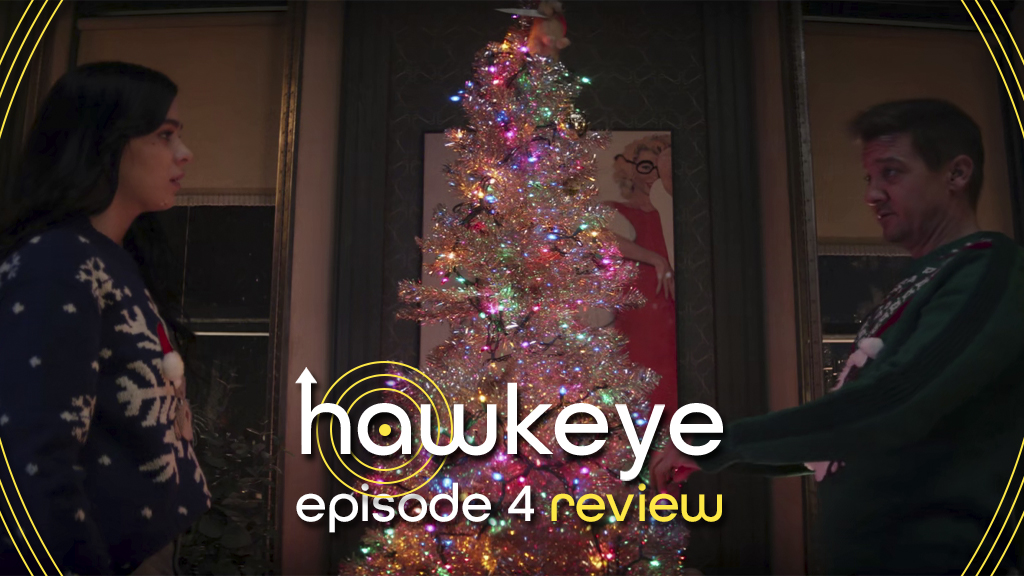
    With Episode 4 ‘Partners, Am I Right?’ Marvel Studios’ Hawkeye is now moving into its third act. Unlike previous episodes where we could find entire sequences taken straight out of the Matt Fraction and David Aja’s Hawkeye comic run (introducing Lucky in episode 1Clint and the Tracksuit Mafia in episode 2the car chase and trick arrows in episode 3), these references were now a bit more subdued.

    Flipping the script
    Going back to the trick arrows theme that we focused on last week, we got a reference showing us how, at times, the series has managed to flip the script on the comic run. There’s a small gag in issue #3 that starts off with Clint praising the qualities of his Boomerang Arrows. Kate, on the other hand, doesn’t really see the point or how they could ever come in handy on the field. Later on while facing the Tracksuit Mafia, who have a machine gun to Clint’s head, Kate is asked not to engage and to ditch the arrow she has pointed at the Bro who has Clint. She complies, shooting it way above the Mafia Bro’s head, only for the arrow to come back and hit him in the back of the head, thus saving Clint. ‘Boomerang Arrow. It comes back to you in the end.”

    ‘Hawkeye’ #3 (2012)
    ‘Hawkeye’ #3 (2012)

    In the show that initial discussion goes the other way around. Boomerang Arrows aren’t a real thing but Kate kinda wishes they were. Clint, as Kate did in the comic run, doesn’t really see the appeal of having an arrow you shot coming back to bite you in the ass. Kate then mentions there might have a little bit of dodging involved. This might still be setting up a payoff down the line when a Boomerang Arrow is actually used in action but, for now, it serves as an example of how the series is approaching the Clint / Kate dynamic differently than the comic run. In the books, Kate was always the more level-headed of the two. Clint, a single guy living alone in NYC struggled to get his shit together and was often given crap about not doing the right thing. As we’ve been watching in the tv show, things are very differently portrayed.

    Marvel Studios’ ‘Hawkeye’ Episode 4
    ‘Hawkeye’ #9 (2013)

    This might be due to a number of factors with one being that, with the show being used to introduce Kate Bishop to the world, you still need to allow the character to have enough room to grow in upcoming projects. There would be no point in presenting Kate in the place you want her to be in five years from now. Just think of the amount of development you’d have to skip over. At the same time, the series, unlike the comic run, had to deal with preestablished Clint Barton’s background, both in terms of his family life and his past avenging. Even if the comic approach of making the young protégé being the sane one was a welcomed one, both the past and future of the MCU strongly benefit from approaching the Barton / Bishop relationship the way the show does.

    Marvel Studios’ ‘Hawkeye’ Episode 4

    LARPers helping out
    In a pretty good self-aware and self-deprecating bit of storytelling, we got introduced to the LARPers in episode 2, ‘Hide and Seek’. Episode four brought them back in a more active role, making them a part of Clint and Kate’s.. guild? If there’s one thing that the Tracksuit Mafia has over our heroes is strength in numbers and the LARPers could just be the missing pieces in order to level the playing field in the upcoming episodes.

    Marvel Studios’ ‘Hawkeye’ Episode 4

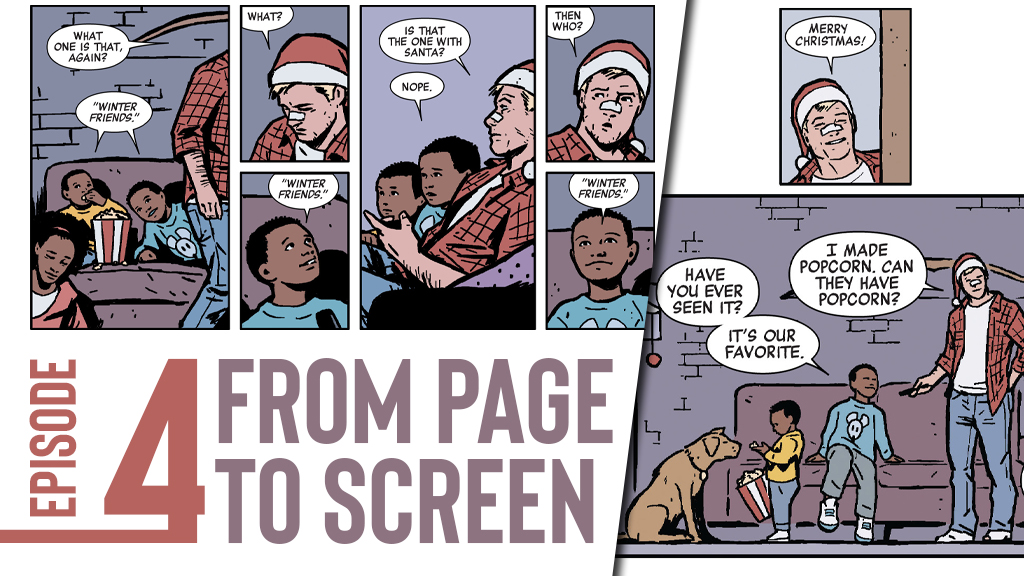
    The comic run didn’t feature these characters but still managed to deliver Clint and Kate the help they needed by having Barton’s neighbors step up and help out. Throughout the series, we get to see Clint, hesitantly at first, connect with his neighbors to the point where their well-being becomes as important to him as his own. He helps one of them (Grills, sound familiar?) reconnect with his dad and even babysits Simone’s kids. At the end of the series, as the Tracksuits prepare one final attack on their building, everybody plays a part in defeating them, some with more success than others.

    ‘Hawkeye’ #1 (2012)
    ‘Hawkeye’ #7 (2012)

    In a show that has been so much about family, be it through Clint’s point of view (where you value what you have) or through Kate’s (where she learns that there’s family to be found outside the typical idyllic entity) the development of a family-type unit with the help of LARPers found along the way seems like a welcomed prospect for both characters.

  • REVIEW: ‘Hawkeye’ Episode 4—Partners, Am I Right?

    REVIEW: ‘Hawkeye’ Episode 4—Partners, Am I Right?

    Hawkeye Episode 4, Partners, Am I Right?, slowed down from last week’s episode to focus more on psychological themes and more investigative-type activity, in contrast to the action-heavy previous episode. While the episode’s slower and more character-based work is well-executed, the episode advanced the plot very little. With so many elements and unknowns still on the table, it begs the question of whether or to what extent the final two episodes of the series can succeed. 

    Episode 4 is generally dedicated to themes of family and loss, particularly the loss of Natasha Romanoff. Clint has his ongoing dilemma of trying to be there for his family at Christmas. This episode is pulling back on that further by delving into his psyche surrounding his time as Ronin after he lost his family in the Blip. There’s more recognition now about how his 5-year reversion into a hell-bent weapon affects who he is and his relationship to his family, even though Ronin is “dead” at this point.

    It’s fun that his wife Laura can be so involved in what he is doing—it’s certainly a fresh change of pace than the usual keep-spouse-in-the-dark story. Still, we learn this episode that Maya is keeping tabs on Clint’s wife and kids, so Clint’s family situation seems like it could go beyond simply trying to return for Christmas. This should be a major issue for Clint, even though the episode ends before he can really react to it. He’s still dealing with the grief and consequences of losing his family once, so one can only expect that this news would be met with a wave of emotion, and likely, a reversion back into some violent and vengeful places out of fear.

    Natasha Romanoff’s death is given more attention in this episode, too. There are brief references to her and her death every episode, but Clint finally gives a more formal statement on how he’s dealing with the loss by opening up to Kate about the “best shot he ever took” being the one he didn’t take when he was sent to assassinate the Black Widow. Through a brief and quiet moment with Clint, we get insight into his ongoing messy and dark psyche—he’s plagued by memories of the loss of his family and Nat, and it looks like it haunts him all too frequently. The focus on Nat definitely led up to Yelena’s brief cameo, but it further teases that a darker, more Ronin-like Hawkeye could be on the near horizon. Jeremy Renner is only getting better with these moments, and Clint’s subtle under-the-surface suffering is compelling

    Perhaps the only person who can save him, if that happens, is Kate. On one hand, this is also Hailee Steinfeld’s and the character’s best episode in terms of charisma and performance. While the episode ends with Clint telling Kate that they’re done, common sense suggests that their partnership will return. Their relationship is built up extremely well throughout the episode, which is clearly in part to make the ending more dramatic. The two share their best banter and back-and-forths of the series between their interrogation by Jacques and Eleanor and Kate bringing Christmas cheer to Clint.

    But while the two’s partnership/friendship/relationship looked stronger than ever, it was not free from the ails of the themes of the episode. Eleanor Bishop is the first to bring up Natasha’s death to Clint, pleading with him to leave Kate out of their investigation and not let her get hurt. Clint acknowledges that he plans to keep her safe, but he seems relatively unphased at this point. Kate’s confidence in and of itself likely makes it easier for the elder Hawkeye to feel comfortable with her involvement. It isn’t until Kate is thrown off of the roof of a building, narrowly surviving, that Clint reacts all at once. Between the parallel to Natasha’s falling death and his promise to keep someone’s child safe, his panic and emotion burst out, leading to his proclamation that his and Kate’s time together is over.

    Another interesting part of their dynamic this episode is that Kate discovers that Clint was Ronin. It seemed like this would be a much bigger moment than it was—Kate was certainly a bit shocked and upset at the idea, but by the next scene she had moved on. Knowing her hero was the notorious vigilante assassin probably should have affected her more, but perhaps her infatuation with Hawkeye blurs her perception of the situation. That, or, it simply wasn’t explored enough.

    Episode 4 was definitely slower than the previous episode, but it left all of its high-intensity moments for the end. The final, but relatively brief fight featured Clint, Kate, Maya, and Yelena Belova. Yelena arrived, as promised, and her hand-to-hand combat style made everyone else look incompetent and added a lot of strength to the scene itself. She says nothing, and we only see her face revealed right before she escapes. There’s also a nod to Clint’s introduction to Natasha when Kate refuses to take a shot at Yelena. Is a more personal friendship between the two being foreshadowed?

    While Yelena’s appearance is undoubtedly exciting, it’s hard not to notice that the final two episodes of Hawkeye will have quite a few elements it needs to resolve or address. A quick list includes Yelena, Maya, Kazi’s likely attempt to persuade Maya to stop going after Ronin, the Rolex from the Avengers compound, the rumored BIG reveal next episode, the LARPers and the Hawkeyes’ new suits, Jacques’ role as a money launderer for the Tracksuit Mafia, the Tracksuit Mafia itself, Clint still getting home in time for Christmas, the Hawkeye mantle being passed down, clearing Kate’s name as Ronin, Clint’s family potentially being in direct danger, Clint’s psychological turmoil, and Lucky the Pizza Dog eating more pizza. 

    Overall, Episode 4 does well with its slower pace in terms of addressing overarching themes, including family and grief stemming from loss. It was important for Clint in this series to have moments where he lives within his own trauma, and some of that is definitely highlighted. The relationship between Clint and Kate gets more depth as well, between the growing friendship and partnership combined with Clint’s fear and guilt pushing her away at the end. Yelena’s introduction is exciting and promising, but the burden that the next two episodes carry seems at risk of being too much to handle effectively. 

  • ‘Hawkeye’ From Page to Screen: Episode 3.2

    ‘Hawkeye’ From Page to Screen: Episode 3.2

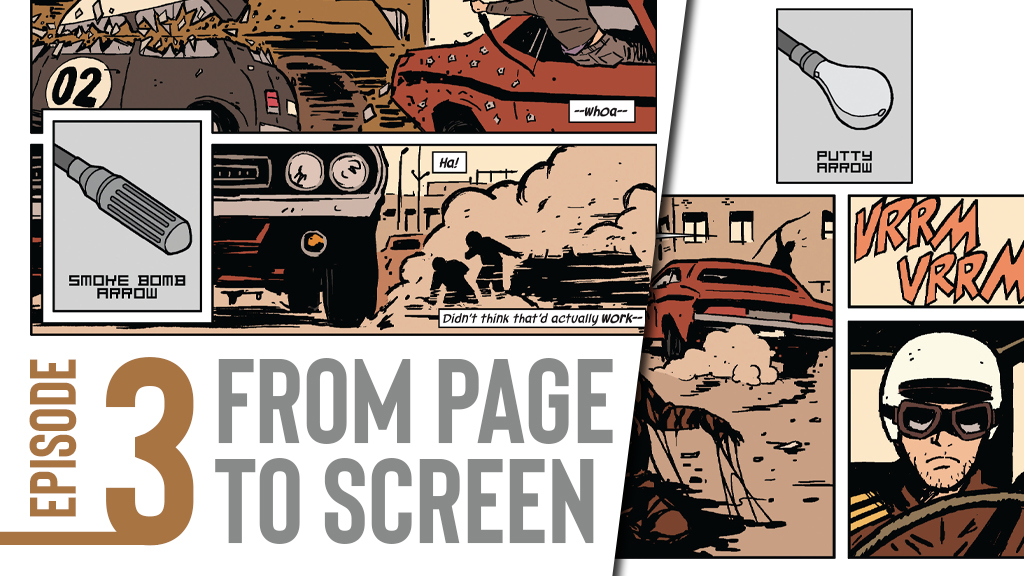
    Marvel Studios’ Hawkeye is starting to hit its stride as it delivered its best episode yet in “Echoes” where, as in previous episodes, we again find several references to the Matt Fraction and David Aja’s Hawkeye comic run. After focusing on how Episode 1 incorporated the introduction of Lucky the Pizza Dog, and Episode 2 featured Clint’s capture by the Tracksuit Mafia we have now also looked at how Episode 3 adapted the stand-out car chase sequence. Considering that this episode justified more than one article it is now time to focus on some interesting elements scattered throughout say sequence: the trick arrows.

    ‘Hawkeye’ #3 (2012)

    Clint already has a history of using several types of arrows in the MCU, suited for each occasion, but Episode 3 takes them to a new level. As with the car chase, these came straight from the pages of Hawkeye #3, one of the most kinetic issues of the entire run. But according to artist and comic series co-creator David Aja, we have Ellio R. Brown to thank as it was his work in The Official Handbook of the Marvel Universe #5 published in 1986 that inspired both Fraction and Aja to create the pages that were to become Hawkeye #3.

    The Official Handbook of the Marvel Universe V.2 – Deluxe Edition #05
    The Official Handbook of the Marvel Universe V.2 – Deluxe Edition #05
    The Official Handbook of the Marvel Universe V.2 – Deluxe Edition #05

    From the 14 arrow-types Brown designed in the 80s, Fraction and Aja managed to use 12 of them in Hawkeye #3. A few were simply referenced, but most were actually put up to good use against the Tracksuit Mafia. Fast-forward a few years and, out of those 12, Marvel Studios’ Hawkeye re-used 7 of them in Episode 3, most with slight changes to them.

    Putty Arrow

    Marvel Studios’ ‘Hawkeye’ Episode 3

    The first arrow that Kate Bishop manages to fire at the pursuing Bros. It initially looks an awful lot like Ego, The Living Planet’s expanding seedlings we saw in Guardians of the Galaxy Vol. 2, before turning into a soft and malleable paste that blocks the Tracksuits’ windshield almost entirely. Kate ends up not using it as Clint intended, on the truck’s tires, as it would quickly harden thus definitively disabling the vehicle. The show also goes for a Hawkeye Purple whereas the comics, that have Clint holding the bow, go with a simple black-looking ooze that sort of glues one Bro to the asphalt.

    ‘Hawkeye’ #3 (2012)

    Explosive Tip Arrow

    Marvel Studios’ ‘Hawkeye’ Episode 3

    The most obvious and probably one of the handiest arrows in Clint’s arsenal. Not suitable for close-quarter combat but good for basically everything else. Kate still manages to get surprised by the explosion as if she hadn’t witnessed even bigger ones a decade earlier – We all saw the flashbacks, Kate! -. It did the trick though as that Trust a Bro moving van’s DVD player stealing days are as dead as DVD players themselves. In the comics, Clint and Kate were being pursued by Mini Coopers so anything that arrow did to a van, it probably did twice as much with twice the ease to those smallish compact city cars.

    ‘Hawkeye’ #3 (2012)

    Suction Tip Arrow

    Marvel Studios’ ‘Hawkeye’ Episode 3

    Initially treated as a gag it ended up as probably the most important (and peaceful) of arrows as it was used not to take lives, but to save them. Just like in the comics Clint uses it so as not to fall from a moving vehicle, saving Kate from having a shorter MCU career than Quicksilver. That would have been a major Bohn.. bummer. The suction-tip arrow proves to be the real MVP.

    Marvel Studios’ ‘Hawkeye’ Episode 3
    ‘Hawkeye’ #3 (2012)

    Bola Arrow

    Marvel Studios’ ‘Hawkeye’ Episode 3

    Ok so, I’m not totally sure on this one but a couple more people agreed that this might be it so here it goes. Kate used a Bola Arrow to get all those pine trees on top of the Putty Truck. It ended up being a bit more effective than the one Clint shot in the comics that managed to get a chuckle out of a couple of Bros. And, seriously, if you can’t hurt a Bro with an arrow with that much potential you should really be contemplating what you’re even doing with your life with a tequila shot in your hand. Point Bishop.

    ‘Hawkeye’ #3 (2012)

    Acid Arrow

    Marvel Studios’ ‘Hawkeye’ Episode 3

    Kate proved herself as an incredible archer with these shots alone. Clint, on the other hand, shot a Mini Cooper as it was facing him. Good for him. The subtlety of this specific arrow was better applied in the show as it allowed for a precise and disruptive use of the arrow in a way not many other types could. Since it was Clint’s idea to use it as they did he does end up deserving some recognition. Even if it was Kate doing all the work.

    ‘Hawkeye’ #3 (2012)

    Smoke Arrow

    Marvel Studios’ ‘Hawkeye’ Episode 3

    Again with the “Hawkeye Purple”, we get it. Kate manages to shoot it inside the Dodge Challenger which proves a much better idea than using it on the outside as Clint does in the comics. Could it be much worse than the usual NYC air pollution? My guess is Clint ended up doing the Tracksuits a favor. “Bro five!”

    ‘Hawkeye’ #3 (2012)

    Cable Arrow

    Marvel Studios’ ‘Hawkeye’ Episode 3

    One of the most well-known types of arrows we’ve seen Clint use over the years. In fact, this was one of the first-ever arrows Kate saw Hawkeye shoot first-hand as she witnessed his escape from the Chitauri in the Battle of New York. This was perhaps the main reason she knew what to do when he jumped off the bridge and therefore managed to grab the bow in order to swing into the train tracks beneath. In the comic Clint uses it to rip through a Mini Cooper, stripping it of its roof (see the Smoke Arrow image above). This probably speaks more of Clint’s upper body strength than the Mini Coopers’ lack of frame reliability.

    ‘Hawkeye’ #3 (2012)

    USB Arrow

    Marvel Studios’ ‘Hawkeye’ Episode 3

    Not present in Hawkeye #3, we get to see it put to good use seventeen issues later in Hawkeye #20 as Kate searches a computer for financial logs. I don’t know what’s more laughable, the fact that the pen drive only holds 256Mb of data or that the arrow exists in the first place. Either way, it opens up the door for future variations such as the LaserDisc Arrow (similar to the Predator’s Smart Disc) or the Kitchen Sink Arrow for the upcoming Young Avengers vs Looney Tunes.

    ‘Hawkeye’ #20 (2014)

    Pym Particle Arrow III (Goliath Arrow)

    Marvel Studios’ ‘Hawkeye’ Episode 3

    This isn’t something we’ve witnessed in the MCU (yet!) but in the comics, it is said that Hawkeye has three types of Pym Particle Arrows:

    • Pym Particle Arrow I (The Reduction Arrow) utilizes the famous size-shifting science to decrease the target’s size and strength.
    • Pym Particle Arrow II (The Growing Barrage) creates a swarm of arrows by releasing an entire shrunken volley at once.
    • Pym Particle Arrow III (The Goliath Arrow) uses Pym Particles for growth and is used to trigger his transformation into Goliath.

    As we see in this panel taken from Hawkeye: Blindspot #3 where Clint is doing his best giant Stay Puft Marshmallow Man impression, Clint has used it on himself while the show stuck to it being used on an inanimate object. All kidding aside, it was one of the best moments of the entire episode as it established a sense of the connected universe Marvel Studios intends these shows to have. All in a way that felt so natural, not needing any sort of exposition dump to have it make absolute sense.

    ‘Hawkeye: Blindspot’ #3 (2011)

    Episode four is just around the corner (it’s tomorrow!) so we’ll be getting to the next few From Page to Screen in just a few hours. See you next week!

  • ‘Hawkeye’ From Page to Screen: Episode 3.1

    ‘Hawkeye’ From Page to Screen: Episode 3.1

    The live-action Hawkeye series has openly taken bits and pieces of Matt Fraction and David Aja’s Hawkeye comic run. We looked at how Episode 1 incorporated the introduction of Lucky the Pizza Dog, and Episode 2 featured Clint’s capture by the Tracksuit Mafia that had some clear ties to the comic. This week, Hawkeye Episode 3, “Echoes, adapted one of the comic’s most iconic sequences: the trick arrow car chase. Unlike previous episodes, the car chase sequence is based heavily on Fraction and Aja’s work, and is as close to being “directly from the comic” as the series is likely to get. You might be surprised to see what the episode borrowed straight from the comic and what they changed.

    ‘Hawkeye’ #3 (2012)

    What They Borrowed

    The Chase

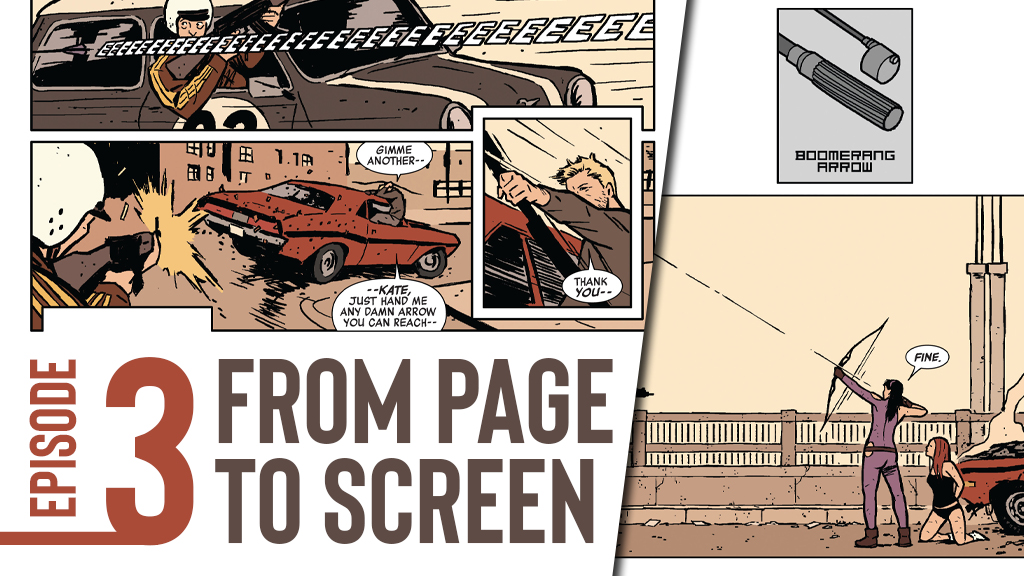
    Of course, the car chase sequence happens both in Hawkeye Episode 3 and Hawkeye #3. In both stories, Clint and Kate are being chased by hoards of the Tracksuit Mafia with one Hawkeye hanging out of the window to shoot arrows at their assailants, causing mayhem throughout the streets of New York. A major difference, though, is that in the comic the two archers are also the original chasers. But more on that below.

    Marvel Studios’ ‘Hawkeye’ Episode 3
    ‘Hawkeye’ #6 (2012)

    The Arrows

    The car chase wouldn’t be the car chase without the endless barrage of random trick arrows that Clint has on hand. We could write an entire article on the arrows in this episode alone…so we did. Check out the next “From Page to Screen” for that.

    Marvel Studios’ ‘Hawkeye’ Episode 3
    ‘Hawkeye’ #6 (2012)

    The Banter

    As is their thing, Clint and Kate have a lot of back-and-forth throughout the chase in both the series and comic. It’s a bit different in the live-action version, however, because Clint mostly can’t hear Kate. For example, a running joke in Hawkeye is that Clint set out to label his trick arrows on that day, which led him down a series of poor choices, including the car chase sequence itself. In the episode, Kate complains that Clint should label his arrows. Another running joke is Clint’s concern for the red 1970’s Dodge Challenger, and both versions end up wrecked.

    Marvel Studios’ ‘Hawkeye’ Episode 3
    ‘Hawkeye’ #6 (2012)
    ‘Hawkeye’ #6 (2012)

    The Bridge

    In both, the chase ends on a bridge and in a stand-off between archers and the Tracksuit Mafia. In the comic, Kate saves Clint, who’s held at gun point. A classic visual is Kate pointing an arrow at the sky, which is replicated in Hawkeye—the major difference being that the live-action scenario involved both Hawkeyes and a Pym arrow.

    Marvel Studios’ ‘Hawkeye’ Episode 3
    ‘Hawkeye’ #6 (2012)
    Marvel Studios’ ‘Hawkeye’ Episode 3
    ‘Hawkeye’ #6 (2012)

    What They Changed

    The Car

    Hawkeye prominently featured a red 1970 Dodge Challenger. That car drove the plot as much as it drove the characters, so it’s no wonder that Hawkeye Episode 3 did give brief nod to a ’72 Challenger. But live-action Kate and Clint don’t use it, even though there isn’t too great of a reason for why not.

    ‘Hawkeye’ #6 (2012)
    Marvel Studios’ ‘Hawkeye’ Episode 3
    Marvel Studios’ ‘Hawkeye’ Episode 3

    The Archer

    The most iconic part of the car chase sequence in both the comic and series is that Hawkeye is leaning out the window shooting wild arrows that the other one hands to them at the Tracksuit Mafia. Hawkeye flipped the archer, though, and featured Kate as the one with the bow. This isn’t too surprising, as its a solid way to give her more time in the series as an archery master, something the comic had already established.

    Marvel Studios’ ‘Hawkeye’ Episode 3
    ‘Hawkeye’ #6 (2012)
    ‘Hawkeye’ #6 (2012)

    The Reason for the Chase

    Like I said, the Challenger drove the plot in the Hawkeye comic. Clint meets a woman while looking for labelling tape. He offers the buy the car, and they end up sleeping together. It turns out this woman is dangerously connected to the Tracksuit Mafia, and Clint calls Kate for help after the Mafia knocks him and and abducts the woman. This begins the care change, but they find her pretty easily, because she’s tied up in the backseat of the Challenger next to Clint’s tracker arrow. They take the Challenger and keep fleeing the Mafia following them.

    In the series, Kate and Clint and solely escaping the Tracksuit Mafia. There’s no tied-up woman in the backseat—they’re simply trying not to be killed by Echo.

    Marvel Studios’ ‘Hawkeye’ Episode 3
    ‘Hawkeye’ #6 (2012)

    At the end of the day, if you enjoyed Hawkeye Episode 3’s car chase sequence, you can thank Matt Fraction and David Aja. It’s Aja’s art in particular that causes the original to standout—there’s an impressive amount of apparent movement on the page. Combined with the expertly layered panels that make it feel like you’re watching little details simultaneously with big moments, the original chase sequence in Hawkeye is one hell of a ride.

  • REVIEW: ‘Hawkeye’ Episode 3 — Echoes

    REVIEW: ‘Hawkeye’ Episode 3 — Echoes

    The third episode of Hawkeye gave the series quite the boost. In fact, Echoes seemed to upgrade nearly every element of the show. The action-packed episode stands out from the first two in terms of its energy level and tone-shifting scenes—Hawkeye now feels like a bonafide superhero romp while its potentially intricate street-level organized crime plot still grounds the episode. While the action is undoubtedly loud, the quieter moments in Echoes spoke volumes and let the characters shine in competition with the high-speed car chase and explosive trick arrows.

    Right off the bat, the episode jumps into action sequences that feel miles beyond Hawkeye’s first two episodes. It emphasizes that Clint Barton is, in fact, pretty cool, and can fight off an entire gang both with and without a bow and arrow. We know that Clint pulled this off as Ronin, but it’s a different experience to see family-man Clint in action. Kate Bishop’s skills were also upgraded and highlighted in this episode, as we see her holding her own hand-to-hand against the Tracksuit Mafia and later showing off her masterful archery skills during the car chase. 

    The car chase was certainly the prized action sequence of the episode, and it gave the series as a whole a needed and appreciated extra dose of adrenaline after a fairly sleepy start to the series. The camerawork and editing allowed it to play out as hectic and wild. The high-speed chase was clearly heavily inspired by Matt Fraction and David Aja’s original in the Hawkeye comic. While the iconic red 70’s Dodge Challenger was inexplicably not used as Clint and Kate’s getaway vehicle, nearly all of the listed trick arrows from the comic—putty arrow, suction arrow, electric arrow, etc.—were given a nod, though with Kate in the archer’s seat this time around. But the episode also fit in a broader MCU reference with Clint’s Pym arrow, which gave an ordinary arrow a larger-than-life moment.

    As given away by the episode title, Echoes prominently features Alaqua Cox’s newcomer Maya Lopez, or, Echo, who is introduced as one of the highest-ranking members of the Tracksuit Mafia. Cox is phenomenal in the role and no doubt was pivotal in the wonderful and stunning debut. Maya’s and the actress’s own deafness was highlighted and portrayed as a personal and physical strength, and Cox’s prosthetic leg—lent to Maya as an unbreakable weapon—took the character to new heights. It was not ambiguous in the slightest whether Maya was a crushing force and an extremely powerful character. 

    The episode also gives the first real “look” at Kingpin, referenced as Maya’s “Uncle” and his iconically large body was briefly teased. Clint hints that this character is at the very top of the Tracksuit Mafia food chain and, more importantly, is incredibly dangerous. It is revealed that Clint killed Maya’s father when Ronin attacked the Mafia during the Blip. This gives Maya her motivation to stay connected to Clint and Kate. Combined with Kingpin’s stronger introduction, this episode gave the Hawkeye plot more shape. While Kate’s own investigation into Jacques remains on the side, Episode 3 painted a clearer picture of the story the series is trying to tell.

    While the action was flashy, the scaled-down moments in the episode were extraordinary. Maya’s origin managed to be both heartwarming and heartbreaking in the same moments, as well as hitting notes purely at each end of that spectrum throughout. It’s not an easy feat by any means, but it was the perfect start to the episode that set the tone for all character moments.

    Clint struggled with his own hearing loss, which the episode used as much to its comedic benefit as it did to Clint’s own development. But seeing an Avenger in such an isolated space added new layers to the elder Hawkeye, which Jeremy Renner continued to excellently portray. The scene in which he struggles to talk on the phone with his youngest son, needing help from Kate, was a standout moment. Not only did we see Clint as a tender father—a role which was barely explored in the larger MUC—but we see his emotional range between the joy of speaking to his son and the guilt of not being with his family. 

    Clint and Kate’s relationship took off, rendering their reported chemistry in the first two episodes virtually void. The two moved past their introductory phase and started to look and act like partners rather than simply two entirely separate characters. Their banter throughout definitely improved, though Clint’s hearing loss did a lot of work at times in that regard. For the first time, Clint compliments Kate, specifically giving her credit for her self-proposed “World’s Greatest Archer” title. It’s refreshing that Clint spent very time or effort trying to dissuade Kate from getting physically involved in the conflict, and he ultimately even casually joins her in her further investigation of Jacques. 

    A particularly noteworthy moment for the two Hawkeyes came as they discussed Clint’s views on heroism. In particular, he says that he is no role model, which Kate vehemently disagrees with. While Kate has her suspicions about Ronin, Clint’s identity as the assassin is still a secret, and it’s unclear what effect the reveal might have on Kate down the line. It highlights a series theme about the Hawkeye symbol being important. What is the series trying to tell us about Hawkeye’s significance and place in society versus how Clint views himself? Like the Captain America mantle—and the upcoming onslaught of other legacy heroes—the MCU has an opportunity to tap into the franchise’s masterful amount of underlying story to truly say something about what makes a hero in this series.

    To sum it up, Episode 3 of Hawkeye delivers on many of the series’ promised elements that had yet to truly be seen in the first third of the show. While the Tracksuit Mafia is still delightfully entertaining, the introduction of Cox’s Maya gave the story a threat to actually care about. The character development, mostly of Maya and Clint, was exceptional. The action in this superhero series went from virtually zero to one hundred almost immediately, giving Hawkeye a much-needed edge. With the episode ending with Jacques holding a sword to Clint’s throat, it seems likely that more physical battles are to come. 

  • ‘Hawkeye’ From Page to Screen: Episode 2

    ‘Hawkeye’ From Page to Screen: Episode 2

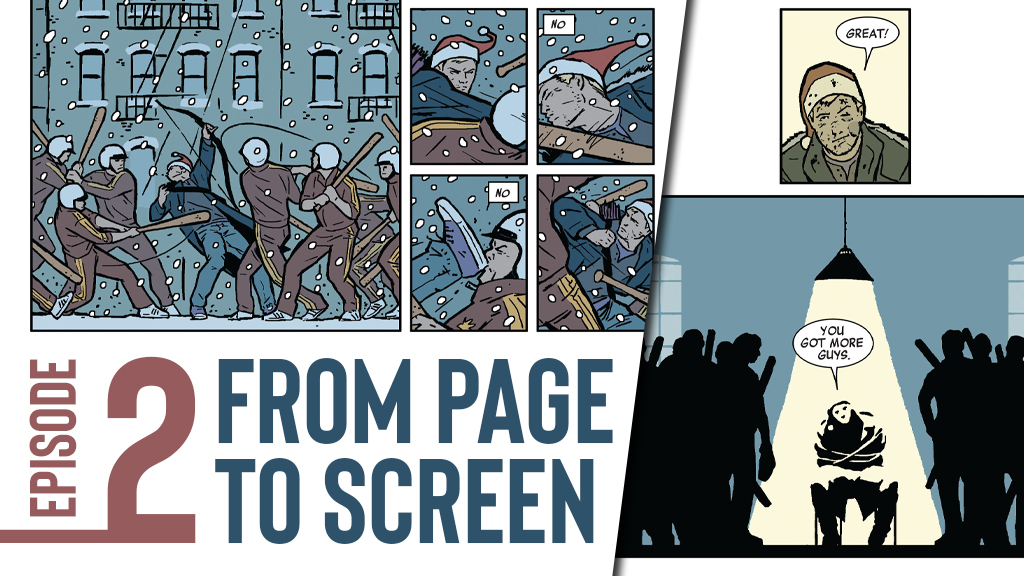
    Following the Episode 1 introduction of Lucky The Pizza DogHawkeye‘s second episode saw Clint go against at least a few vans worth of Tracksuit Mafia bros. This sequence bears some fairly obvious similarities with the one from Hawkeye #6 (probably one of the best issues of the entire run), where Clint Barton presented himself in a way the Mafia couldn’t miss him, inviting a much-needed confrontation.

    In the Disney+ series, Clint made this decision as a way of getting to the bottom of the issues Kate stirred up by wearing the Ronin suit out in public. By facing the Mafia head-on, allowing them to take full control of the situation, he managed to get himself caught without much hassle. Finding himself in their hideout will then lead to uncovering the woman making all the calls, someone he’ll have to go through to make it home for Christmas. What he didn’t count on was that by not making his intentions clear to Kate Bishop, his actions might have ended up making her find herself in a much more dire situation than the one he was trying to get her out of.

    Marvel Studios’ ‘Hawkeye’ Episode 2
    Marvel Studios’ ‘Hawkeye’ Episode 2

    Just like in the series, the comics show Clint placing himself in harm’s way by tacking on the Tracksuit Mafia head-on to protect people he learned to care about. By issue #6, we’d come to realize how Clint had become somewhat protective towards his neighbors with who he shared a building. With the Mafia endangering their enjoyment of the holiday season, he stepped up. As two full vans of Tracksuit bros drove up to the building he, unlike in the Hawkeye series, put up a fight and got himself captured against his will. He is then dragged to the Mafia’s hideout and we see him, much like we did in Episode 2, tied up to a chair as the Mafia brings forth their leader who presents Clint with an ultimatum: Leave the city in 24h or all-out war against himself will be a reality.

    ‘Hawkeye’ #6 (2012)
    ‘Hawkeye’ #6 (2012)
    ‘Hawkeye’ #6 (2012)
    ‘Hawkeye’ #6 (2012)

    Episode 3 isn’t out yet so we’re yet to know what happens to Clint and Kate. In the comics, Barton is released and decides to, once again, stand his ground by not leaving town and living up to the idea of what a hero should do by protecting those who can’t protect themselves. In Hawkeye that would mean again postponing his trip back home and putting an end to the Ronin mix-up once and for all.