Tag: Review

  • Review: ‘Skeleton Crew’ Episodes 1 & 2

    Review: ‘Skeleton Crew’ Episodes 1 & 2

    First announced at Star Wars Celebration 2022, Lucasfilm’s Star Wars streaming series, Skeleton Crew, has finally arrived on Disney Plus. After being delayed by over a year, the eight-episode series now finds itself in the unenviable position of following one of the studio’s most harshly treated projects in The Acolyte. While Skeleton Crew is the tonal antithesis of The Acolyte, a growing subset of Star Wars fans have begun to approach every new project with an accumulated skepticism and, in many cases, an increasingly choral disregard for the Dave Filoni era of storytelling in the galaxy far, far away. Skeleton Crew may well provide Lucasfilm’s best effort to combat and contravene the online vitriol that has become endemic to Star Wars fandom. And it does so with kids!

    I’ll break protocol for a moment to explain that this review won’t conclude with some judgment of whether Skeleton Crew is “good” or “bad” nor make any accurate predictions about how fans will feel about it. That’s because I cannot know if it is “good” or “bad” or even begin to evaluate how I feel about it. Members of the media were given a screening package that included the first three episodes of an eight-episode series. By the time the third episode ends, it is clear that the show has the potential to continue in an entertaining direction; however, anyone pretending to review a full season after only seeing 38% of a series is at best disingenuous and at worst, deliberately causing chaos and harm.

    Following an opening scene steeped in Star Wars tradition, Episode 1 of Skeleton Crew presents as a slice-of-life project before quickly morphing into a rollicking and spirited adventure into some peripheral corners of the Star Wars universe that have always existed but have never been explored in live-action. Pirates have played a major role in canonical animation and in Legends continuity and after first popping up in The Mandalorian where the Pirate King Gorian Shard caused some issues, here, there be pirates. From the daring boarding that breaks the silence of space and is Pirates of the Caribbean in space to the boisterous and bawdy Port Borgo full of scurvy swashbucklers, Skeleton Crew is all hands hoay into buccaneering, including some elusive booty that will likely sit as a central mystery throughout the series. That said, calling it a show about pirates wouldn’t be fair.

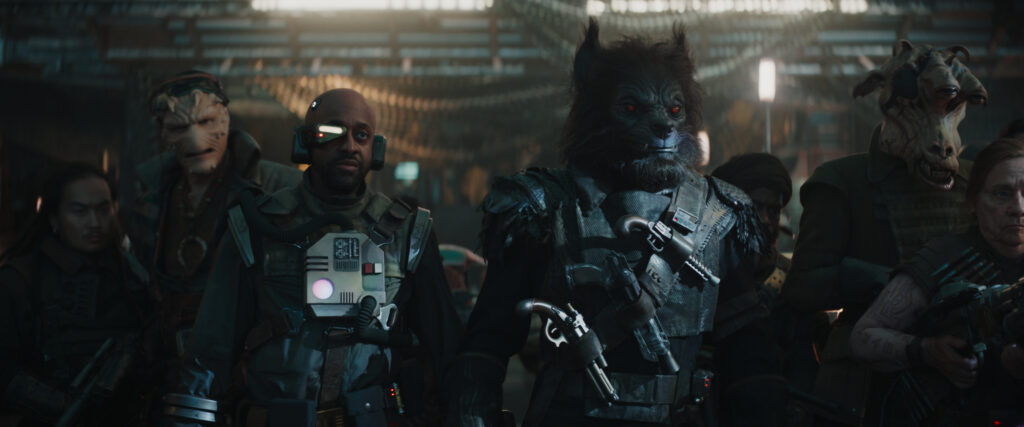
    (L-R, second from left): Vane (Marti Matulis), Gunter (Jaleel White), Brutus (Frank Tatasciore, performance artist: Stephan Oyoung), Pax (performance artist: Mike Estes), and Chaelt (Dale Soules) in Lucasfilm’s SKELETON CREW, exclusively on Disney+. ©2024 Lucasfilm Ltd. & TM. All Rights Reserved.

    Despite boasting Jude Law as a key figure who is kind of mysterious and kind of dangerous and definitely none of the people he says he is, Skeleton Crew is a show about children but probably not specifically for children. Rather, in the mold of Stand By Me, it’s a little coming-of-age adventure that also vibes with, yes, The Goonies but also with a less well-known adventure film like 1985’s Explorers and maybe even a little bit with the ridiculous Ice Pirates. Skeleton Crew treats its core kids a bit in the way Stephen Spielberg always did. They get to behave a little older than they are, live out their fantasies, meet people they’ve only read of in legends and be in danger without actually being endangered. And most importantly, not one of these kids is learning any lessons through two episodes.

    However, putting children at the center of the story allows co-creators Christopher Ford and Jon Watts to create within their comfort zones As a result, at a time when the Star Wars franchise is in need of renewed hope and a return to the innocence that the first audiences to see Star Wars and Empire Strikes Back took with them into the theater, along comes a Star Wars project full of kids who while vulnerable, are full of true wonder.Skeleton Crew‘s core four are the archetypal rebel (Fern), explorer (Wim), innocent (Neel) and caregiver (KB) who may well provide exactly what audiences need to reconnect with the magic of the Star Wars universe. Despite having kids at its core, Skeleton Crew looks to be intended to do some expansive world-building which seems likely to be why Filoni gave it the green light and set it in the New Republic era. I won’t even tease spoilers here but there are enough hints in the first two episodes to catch on to the fact that At Attin, the homeworld of the leads, is quite unlike any planet we’ve ever seen in the franchise.

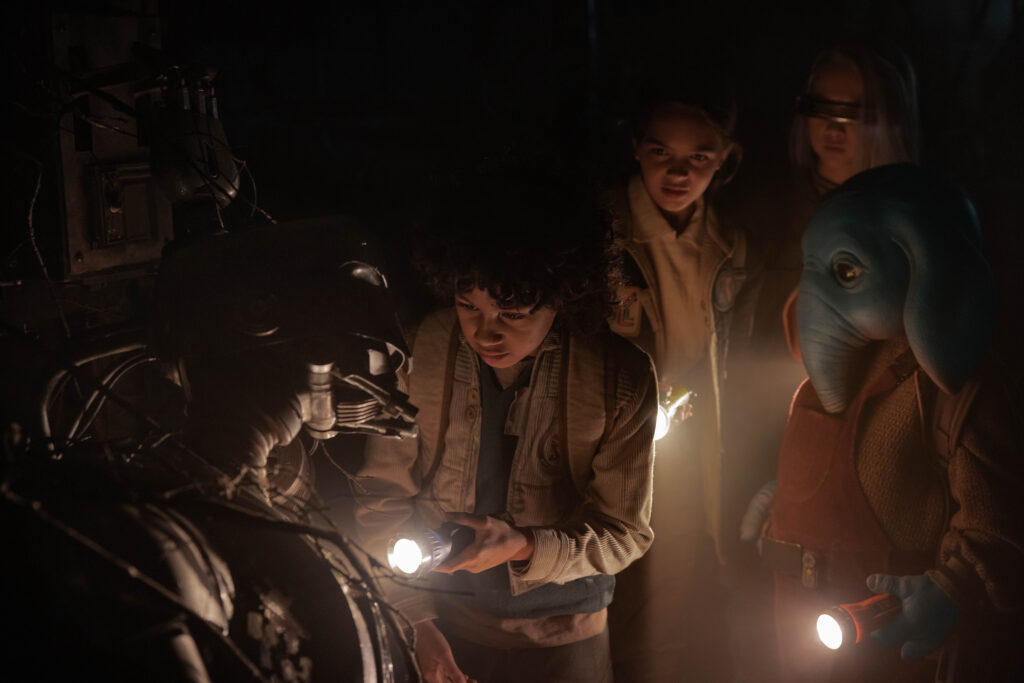
    (L-R): SM-33 (voiced by Nick Frost), Wim (Ravi Cabot-Conyers), Fern (Ryan Kiera Armstrong), KB (Kyriana Kratter), and Neel (Robert Timothy Smith) in Lucasfilm’s STAR WARS: SKELETON CREW, exclusively on Disney+. Photo by Matt Kennedy. ©2024 Lucasfilm Ltd. & TM. All Rights Reserved.

    Following a bit of a slow, exposition-heavy start, Skeleton Crew does weigh anchor and hoist the mizzen and it looks like it’s going to be one hell of a ride through space as the crew tries to find their way back home. Despite its small sample size, accentuated by Mick Giacchino‘s quirky, uncanny and neo-nostalgic themes, Skeleton Crew checks the boxes of an adventure worth taking. Indeed in the best ways, it feels quite like a successful adaptation of a Disney theme park attraction into a live-action project, except there’s no Disney theme park attraction being adapted. Perhaps it’s best to take it for exactly what it is: a return to innocence that’s been missing from one of the world’s premiere franchises for far too long.

    Episodes 1 and 2 of Skeleton Crew are now streaming on Disney Plus.

  • REVIEW: ‘One Piece’ is Among Netflix’s Best First Seasons

    REVIEW: ‘One Piece’ is Among Netflix’s Best First Seasons

    It’s been seven years since One Piece was first announced to be getting a live-action adaptation. The production survived a pandemic, constant delays, a long production in South Africa, one of Netflix’s biggest marketing strategies, and so much more. On August 31st, it finally made its way to Netflix as a binge-drop. Was the wait worth it or did Tomorrow Studios repeat the same mistakes that sank Cowboy Bebop?

    To get the easiest comparison out of the way fast: it’s not another Cowboy Bebop (though to be upfront, I felt it as actually decent if taken as its own thing). Showrunners Steven Maeda and Matt Owens managed to do what seemed impossible and bring a goofy but heartfelt series to live-action like One Piece in this new take on the iconic East Blue saga that started it all.

    The manga series by Eiichiro Oda is somewhat special in many ways: it is a very goofy, almost childlike story that has some of the most heartfelt moments that truly tug on your heartstrings while managing to still tell the same story for over 26 years at this point. Yet, East Blue is very distinct when compared to the rest as it was the time when Oda was still figuring out the story he wanted to tell with very distinct stories that only loosely connect through the first recruits for Luffy’s journey to the Grand Line.

    So, the showrunners are given quite a daunting task having to bring such an iconic series to life and stay true to the original while having to establish a more Western-style connected adaptation of the saga that has the least connective tissue. And, somehow, they managed to pull it off. The smartest move they did was to ensure that the main cast where perfect for their respective characters, which became one of its biggest selling points. Netflix was smart to make good use of pre-recorded interviews and videos of the caster interacting to further sell their dynamic as a team.

    Inaki Godoy was a perfect choice for the loveable Monkey D. Luffy. He has just the right energy to play the character and also has that inspiring energy that keeps the story going. Mackenyu is a more subdued Zoro who is inspired by his later appearances but actually adds a bit more variety to the cast with his straight-man reactions and dry humor. Jacob Romero Gibson is a lot of fun and they do more with him than just being comedic relief; they also really embrace his cowardly habits.

    Emily Rudd is a standout for her more emotionally-centered performance; not too surprising given the importance of this arc and her story. Lastly, Taz Skylar is a great rendition of Sanji that finds that right balance but given when he is introduced, we sadly don’t get a lot of time with him. However, they make good use of his “new guy” dynamic and want to prove himself. The Straw Hats are the selling point of this series and are definitely the highlights throughout, as you just want to spend time with them even when the show’s first season wraps.

    The rest of the cast is also great and outside of maybe one or two, they are probably the most accurate castings I’ve seen in an adaptation. They also give some great and varied performances with Jeff Ward truly being the stand-out as the always loveable but terrifying Buggy. Arlong (McKinley Belcher III) is also a stand-out who has a lot more depth and wasn’t done justice in the trailers. Overall, the villains were great even if one really deserved way more screen time but at least got a slight spotlight. Vincent Regan’s Garp is also a great character who is given a bigger role inspired by a later arc.

    One thing many were a bit concerned about early on was the CG and outside of maybe one or two shots, there’s some fantastic work in this show. News Coo and the Lord of the Coast are visually impressive. There’s a scene of swords falling apart that looked off later on in the series but the big surprise is just how well they pull off Luffy’s stretchy powers. They don’t shy away from it and make good use of it whenever they can. Even the Gum Gum Balloon looks convincing which is impressive given how even big-name studios avoid those kinds of powers like with Ms. Marvel.

    The most impressive aspect of this series is how they keep this tight balance of having it grounded but the series still has its goofy elements. It makes it stand out from other adaptations that either go too serious or generally just replicate the original source material. There are iconic moments in here but they changed enough that allow it to connect more effectively with an overarching plot and set-up. There are a lot of changes that are here to focus more on the character dynamics and overarching thematic plotline.

    Speaking of, the smartest move was to give it a strong connective tissue through the theme as a way to also explore a story that is a bit removed from our main Straw Hat’s journeys. While some of the parts with Garp and the Marines seem disconnected, the way the story comes together actually gives it a strong meaning on why it is being told here and now. The scenes are a bit slower and can break the overall pace, but don’t feel like they overstay their welcome; especially with some great moments from Garp and Helmeppo. Personally, the pay-off of these sequences gives it a lot more weight and made me like the addition to further elevate the themes.

    The biggest challenge with these adaptations is the direct comparison to the original. A lot of minor and even some bigger characters were removed which is a shame, but after leaving behind the “I missed this from the original” makes sense in how the story is being told this time around. It’s a different adaptation that feels like how Oda might’ve told it given how his storytelling has evolved since he first worked on the East Blue back in the 90s. Especially in how some characters get a bit more screen time to flesh them out more. The early introduction of characters like Mr. 7 is also a clever way to establish elements that might pay off quite a bit later for new viewers and give reasons to rewatch.

    I do have some gripes which are likely due to this being the first season to begin with, as the show is trying to finds its identity. They have created a variety of lenses just for this series but tend to overuse them at times, especially at the beginning of Syrup Village it feels unnecessary. However, the strong use of face close-ups feels inspired generally by Oda’s love for showing expressions that’ll get better with more time. There are also some moments that perhaps could’ve used some additional work to balance it out better as it tends to slip into being a bit goofier than necessary.

    Though,t these elements don’t take away from what the team behind One Piece accomplished. With this first season, I believe that Netflix should give this show multiple seasons moving forward to allow it to grow just like the original. I would even go as far to say that this season gives us a stronger East Blue saga even if some characters could’ve used a bit more love and some iconic scenes were sadly missing to add relevance. Still, this might be one of Netflix’s strongest first seasons which makes the small issues I have just a way to truly refine it going into the next arc that is famous for doing the same for the manga.

    One Piece truly stands out from most series nowadays with its style and wacky world. Small details like the cast interacting with the wanted posters that introduce them give it a lot of charm. Even if some CG looks a bit wonky, the practical sets are really impressive and it has such distinct style that makes it stand out from other projects out there. If this is the first season; I cannot wait to see a lot more in the future and hopefully spend more time with this cast for many seasons to come.

  • REVIEW: ‘The English’ Tells a Bleak Story on a Beautiful Canvas

    REVIEW: ‘The English’ Tells a Bleak Story on a Beautiful Canvas

    There’s always something about the Wild West that has been turned into a more “heroic” showcase of the good Sherrif taking down the bad. Even when people are being shown at their worst, there’s generally a very specific view that is offered with these kinds of stories to not lose the audience in the depravity reflected of a time we barely can imagine the way it was lived. The English doesn’t hold back in that regard to offer the bleak view you’d expect from that time. At its center, it keeps two hopeful souls to center the story’s most bleak moments.

    There is something honest about the portrayal of that time and the people that lived through it. In this story, there’s no true right or wrong but people simply trying to find a way to survive. At its center, we have the simple story of Emily Blunt‘s Cornelia Locke and Chaske Spencer‘s Sgt. Eli Whipp. Two strangers meet at a crossroads of fate which ends up intertwining in unlikely ways throughout their journey. There’s a tough balance this story has to handle to not fall into rather questionable territory, but it manages to keep that sturdy line throughout.

    The series is on the slower side of pacing, which is surprising given the six episodes given to explore a rather simple story. At many points in time, a story is being spun beyond our leading two which works at times but also leaves you wanting more from the dynamic that was set up. A lot of time is spent in this time period with an unflinching eye that does evoke a “who do you trust” mentality in the viewer throughout. It’s the series’ most effective weapon to establish a believable world these characters live in and the challenges set given their own unique backgrounds.

    Spencer‘s performance is strong throughout, as Whipp is put into positions that ostracize him from either side of the conflict in this world. Once the safety belt is off early on, the series doesn’t waste time to showcase just how brutal this world is and it adds to the bleak outlook of this time period. He’s put to the test often, and there’s a subtlety in how he handles the character; fitting for the world he’s living through. We see how these challenges try to push him in one direction, while he tries to stay true to his own path.

    On the other side, Emily Blunt gives us the look at a person changing as a result of events unfolding around her. She starts off innocent in a world ready to devour her. It almost does if it weren’t for surprising help that would push her further down a path of change. It’s refreshing to see a character that starts off on the meeker side and see her adapt to this dangerous place. She still shows her softer side throughout and it’s not that consequences don’t affect her; she simply has to live with it for as long as possible.

    There are some moments where the story tends to take its time before suddenly rushing. Given its mostly slow pace, it feels like a suprrising rush through plotlines that seemingly are relevant before completely left behind. It also seems to set up a mystery with additional characters that sometimes get sidelined and creates this uncertainty about how exactly it’ll tie together. At times the story feels like it could’ve been told with fewer episodes, but in others, it feels just right.

    It should be highlighted that this bleak story is punctuated by the irony of its beautiful shots. Some of the beautiful shots act as a contrast to the dark world they live in. The cinematography is worth highlighting at times even if it does seem to rely mainly on dialogue. It doesn’t reinvent the wheel, but there’s no necessity to do so. Director Hugo Blick makes great use of shot composition to build up tension, which is highlighted by a great score by Federico Jusid.

    The English is a recommendation for those that enjoy something with a slower pace and more personal storytelling. It’s not quite your typical Western but doesn’t shy away from elements that are familiar to fans of the genre. What makes it stand out is how it tells a bleak story on a beautiful canvas, not shying away from the darker sides of a world long forgotten while still trying to keep that glimmer of hope alive. We all face our personal demons, but sometimes the question is if the world around us makes us confront them.

  • REVIEW: ‘Andor’ Episode 9

    REVIEW: ‘Andor’ Episode 9

    Andor, a series built on mini-arcs, is in the midst of an arc that paints a bleak picture for the characters who have put themselves in the crosshairs of the Empire. Whether it’s Bix being tortured by the all-too-eager Doctor Gorst, Mon’s voice being ignored in the Senate or Cassian continuing along as a cog in the Imperial machine, Episode 9, “Nobody’s Listening” exists to show the extent of the Empire’s scope and power and contrast it against the Rebellion. Though Meero hasn’t caught the big fish she’s hoping to snag in her net, the fact that she and the Empire can do their work openly and without recourse, while the Rebellion has to strike from the shadows, serves to remind the audience that the galaxy is still a long way from openly embracing the Rebels. However, the events, which take place five years before the Battle of Yavin see in Star Wars: Episode IV-A New Hope, also work to show exactly why the Rebellion eventually grew into what audiences know it to be. In this way, Andor continues to be a prequel story worth telling and one that future generations of Star Wars fans will come to view as an essential piece of the overall story of the galaxy far, far away.

    The centerpiece of this arc, of course, is the very THX 1138-inspired prison where Cassian spends his days avoiding electrocution while serving as an Imperial laborer. While most of the prisoners seemed resigned to their fates, as best personified by Andy Serkis‘ Kino Loy, Cassian has recruited at least one fellow prisoner in an escape plan that, to put it nicely, is in its infancy. Despite his efforts to recruit Loy to assist in his efforts to escape, Cassian finds himself unable to break Loy free from the fear that the Empire is listening in on their conversations. Cassian’s tense conversation with Loy in their sleeping quarters is reminiscent of his conversation with Luthen Rael earlier in the series: the Empire isn’t listening because they don’t have to. They’ve come to believe themselves to be so omnipresent and omnipotent that they can simply rule through fear and intimidation. Meero is the face of that in Episode 9, though Cassian’s time in the prison only serves as an ironic display of the fact that the Empire has grown so large that they aren’t even aware that the person they’re searching for is already being held in one of their prisons. As Meero and the ISB scour the galaxy and leave behind a trail of dead and broken bodies, the man they’re attempting to catch is plotting his escape from them.

    With that in mind, it seems that the incident on Level 2 serves as the pivot point of the episode (and potentially the entire prison arc) as it is likely to ultimately lead to Meero and the ISB learning they already had Cassian in their grasp. The mass murder of the prisoners is sure to be a breaking point for Loy, but it also works as an example of exactly the type of behavior Rael hoped the Aldhani heist would provoke out of the Empire. The Empire’s dedication to swift and terrible retribution can’t be overlooked, even within the walls of a prison. Imagine the response if word were to get out…

    “Nobody’s Listening” stands as an incredibly strong episode because it allows the audience to feel the enormity of everything that has come before and what feels like is about to come next. Andor, both the character and the series, seems poised on a precipice that promises to lead to an exciting downhill ride over the next three episodes of the series. That’s built on season-long character development and intricate attention to detail in slowly tying together season-long plot threads. Once again, Andor proves that taking time to tell a story can be a brilliant choice as long as it’s a story worth telling.

  • REVIEW: ‘Stargirl’ 3×03: “The Blackmail”

    REVIEW: ‘Stargirl’ 3×03: “The Blackmail”

    A period of change can be incredibly stressful for any person, whether you’re trying to find a new job or if you’re uprooting your entire life. You never know where it might lead you. Yet, what happens when that big period of change is being buried alive? Well, Sylvester Pemberton is living that very nightmare and Stargirl has certainly flipped the veteran hero’s life upside down.

    The episode dives deeper into the suspects on the board that was set in the last episode. This time around it shifts its focus onto the Crock’s, as the team finds out that they’d been blackmailed by the Gambler for months. A little more of the Crocks is never a bad thing though, one of the best choices they could’ve made was bringing back Neil Hopkins and Joy Osmanski for season 3. The two just have great chemistry together as they somehow have this perfect harmony when interacting with each other.

    The reintroduction of Starman has been a surprisingly classic fish out of water story. Joel McHale works incredibly well as an out-of-touch, grizzled hero who just doesn’t know what his place in the world is anymore. The parallels between him and Courtney, as well as how they choose to act with the power of the Cosmic Staff gives the show an interesting balance.

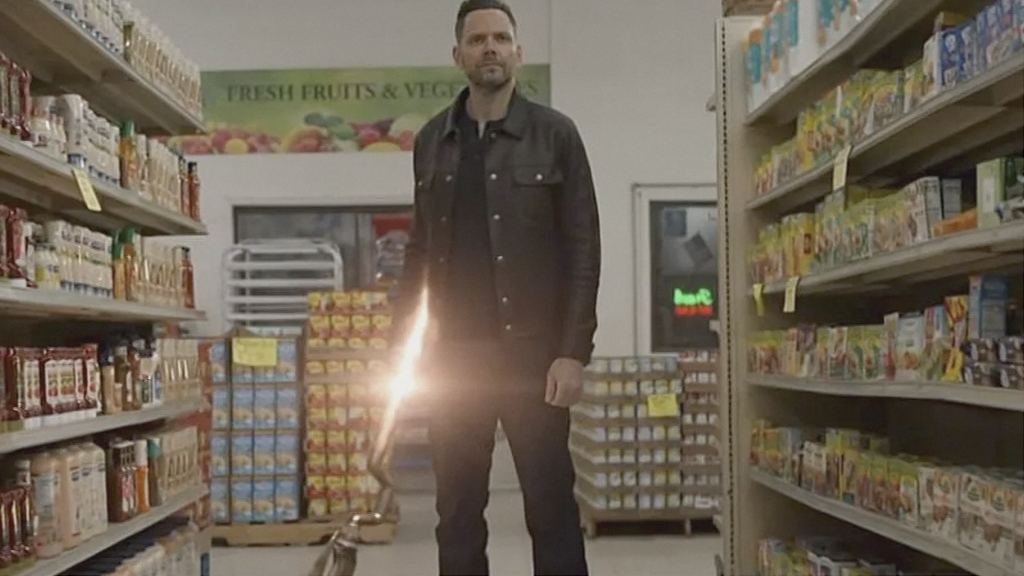
    Fans will also find some enjoyment in a perfectly choreographed fight sequence within a grocery store. With that worryingly impulsive nature, Starman takes things into his own hands to confront the Crocks, leading to an dynamic and incredibly pleasing scuffle between him and the duo of Sportsmaster and Tigress.

    The stunt team for this series deserves some insane recognition for what they managed to put together. It’s one of the best aspects of the show that they continously improve upon and push the limits of whats possible for these characters. The dual style that Sportsmaster and Tigress have mastered truly makes this sequence pop the way it does.

    The best way to watch this season is to get into the mindset as if you’re watching an experiment unfold, seeing how these characters continue to coexist as if they’re reactive materials that could easily lead to an explosion at any time. In a way, it feels like a whole new way to enjoy the veteran show on CW.

  • REVIEW: ‘Ms. Marvel’ Episode 3—”Destined”

    REVIEW: ‘Ms. Marvel’ Episode 3—”Destined”

    Ms. Marvel’s third episode, “Destined”, does a remarkable job at maintaining the heart and integrity of the series while also bringing it to new heights in an exciting way. The episode hit the ground running straight off of Episode 2’s cliffhanger in Kamran and his mother’s car. There is a very welcome shift in pace throughout the beginning of the episode, which also takes the series in a very bold new direction. While the bangle remains mysterious, Kamran’s mom, Najma’s, explanation of its history to Kamala suggests that Najma (along with her family) and Kamala’s mysterious great-grandmother Aisha are Clandestines, or Djinn, from another dimension. While their narrative should be taken with a grain of salt at this point, they seek Kamala’s power to get them back to their home Noor dimension from which they had been exiled. The very end of the episode suggests there is more to the story of Aisha’s disappearance still, as Najma shows both Kamala and her grandmother Sana a vision of a train marked “Karachi”, which seems to be a callback to Sana’s family’s escape from India and Aisha’s disappearance. 

    The rest of the third episode once more brought the Kamala Khan charm to the screen. Particularly in the wedding scene, the episode proves that Ms. Marvel is one of the most colorful Marvel Studio’s projects in existence and is filled to the brim with personality. The teenage drama involved in Kamala’s story is amplified here, as she struggles to maintain trust, confidence, and honesty with and from her friends and family. Bruno begins to hesitate about Kamala’s plans with the bangle and tells her he is headed to CalTech, which complicates their adorably awkward crush-type relationship. Nakia angrily discovers that Kamala is actually the masked person who has caused problems for the community, and Kamala’s relationship with her family is further strained by her inability to tell them what she is going through. 

    The episode spends much time celebrating and dissecting the concept of family. This theme was introduced, foreshadowed, and explored in the first two episodes, but Episode 3 featured multiple scenes back to back that explicitly state the importance of family through dialogue. Kamala’s relationship with the Clandestines is yet another layer to that discussion—assuming they are to some extent her family, what is her duty to them? How can Kamala honor her lineage or heritage while not betraying her closer family and community?

    While we have still yet to see Kamala go into full superhero mode, the episode’s first major action scene set to Bon Jovi’s “Livin’ On a Prayer” was a strong start for the series in that regard. This episode also solidified the villains of Ms. Marvel even if there was no surprise to it. The tease of the mask Bruno made Kamala tees up her eventual triumphant debut as her own bona fide superhero, but that moment still seems potentially distant on the horizon.

    Overall, Episode 3 of Ms. Marvel dramatically raises the stakes and implications for both Kamala and the series. While the more “classic” elements of the series are still going strong—teenage awkwardness, crushes, family responsibilities, and self-discovery—there is now an additional element of inter-dimensional or multiversal travel and Kamala’s direct connection to it. The fact that there is a missing bangle is a mystery that foreshadows its inclusion down the line. Sana’s request that Kamala and her mother come to Karachi is clearly setting up an adaptation of the Ms. Marvel comics “Mecca” arc, but it also is the prime (or closer to it) location for exposing the truth about Kamala’s family history, the significance of the bangles, and Kamala’s powers.

  • REVIEW: ‘One Shot’ Feels Like a Soulless Gimmick

    REVIEW: ‘One Shot’ Feels Like a Soulless Gimmick

    As part of the Malta Film Week, I was given the opportunity to attend a screening of the 2021 film One Shot. Director James Nunn‘s shared during the live Q&A that he had the idea for the project six years ago and the success of films like Birdman or (The Unexpected Virtue of Ignorance) would eventually convince producers to greenlight his dream project of an action film made to look like a singular shot. Yet, as the title of the review might give away, this didn’t quite work out.

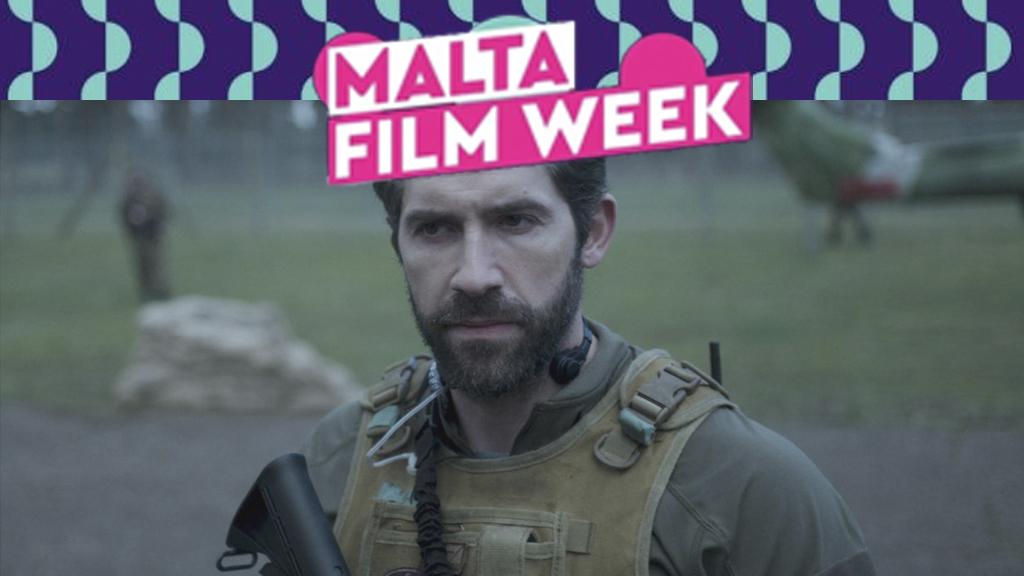
    Nunn’s concept isn’t a bad one. The tension of closely following a Navy SEAL (Scott Adkins) during a covert prisoner transport as terrorists attack the camp works on paper. Yet, the project went with a style over substance approach in how the one-shot turns more into a gimmick rather than a way to enhance the experience. I will state that the action choreography is impressive, especially as he revealed they only had three weeks time to prepare everything in pre-production and it shows that the film mainly focuses on it.

    There are characters here, but they are quite one-note. Adkins‘ Jake Harris is a blank slate by-the-numbers action hero that seemingly survives any scenario. Ashley Greene‘s Zoe is introduced as what seemed like another main character that is underutilized outside of long exposition sequences early on. We technically have a villain, but his character is mostly every villain cliché you can imagine. We get a tragic character in the form of Waleed Elgadi‘s Amin Mansur, but he repeats the same lines throughout the entirety of the film that just drags down a good performance by the actor.

    The only character with any real personality is Terence Maynard‘s Tom Shields, but mostly due to him chewing the scenery throughout most of the film. He’s also the only one that doesn’t talk in pure exposition but actually gives us some personality. Even the more jokey characters that are part of Harris’ SEAL team talk in mostly clichés that pretty much give away their fate for anyone that has seen a film like this.

    Cliché is a fitting way to describe the film overall. There’s just nothing to make it stand out from other films in the genre, especially those with a lot to say about the current climate surrounding soldiers and war. The film mostly uses a good base concept – which could’ve built up an incredible amount of tension for viewers – and is more focused on showcasing how cool Adkins is taking down evil bad guys while the camera never cuts away.

    There are drawn-out sections in this film that are just pure action. It tries to build up some kind of tension, and there are small moments of it, but overall it felt like a non-interactive video game. If Call of Duty ever had a movie adaptation, this film pretty much is that with some Metal Gear Solid sneaking thrown into the mix. Not just that, we spend hours of people talking as they just shoot down goon after goon with their main issue being the lack of ammo that only becomes relevant when the story requires it to build some last-minute tension.

    Speaking of, there’s an uncomfortable element on how this film approaches its “antagonists.” Not only do we see Americans torturing prisoners – mostly to make you feel bad for Mansur – and it comes at the cost of not caring for any of our supposed “heroes.” We get gratuitous violence with the camera shying away from people getting stabbed but forces us to watch as an innocent civilian is shot in the head. It just feels like it’s sending the wrong message and lacks any nuance.

    I want to especially highlight one sequence that comes at a later point in the film. So, beware of spoilers in this paragraph before continuing. The film does take some time to “flesh out” its villains and we get a brief sequence of a young soldier being convinced to sacrifice his life with a bomb vest. Besides the obvious problems with this, there’s a lot of build-up for this and he just randomly shows up in another sequence. And, the results of his action made me scratch my head and wonder what was the point of this film.

    There are a lot of sequences that drag out, and Nunn confirmed in the Q&A that his initial script only truly worked for a 60-minute film. The fact he had to add another 30 minutes to meet his quota shows It’s just action for the sake of action. The opening is pure exposition without any real character development. So, the only selling point is the gimmick in the title – which also seems depressing that it doesn’t actually play into the story of the film – and it doesn’t add anything. The shot composition is restricted as a result and you mostly can see some fun action choreography. If that is something you’re interested in, then you can give this one a shot.

  • REVIEW: ‘Cowboy Bebop’ 1×09 “Blue Crow Waltz”

    REVIEW: ‘Cowboy Bebop’ 1×09 “Blue Crow Waltz”

    What is it with Western shows and their pre-season finale flashback episodes? It’s a funny trend that continues in Cowboy Bebop. Yet, in a way, the timing is perfect as Spike’s fight with LeFou knocked him out land Vicious unleashed his wrath. So, once again we move away from the trio that is supposedly at the forefront of the series and explore Spike’s time as Fearless and what lead to his new identity. Is it worth the detour, or are we just treading water until the show comes to an end?

    COWBOY BEBOP Recap: (S01E09) Blue Crow Waltz

    John Cho carries the show once again, but Alex Hassell does continue to have some fun with the role this time around. It feels like we get more of the unhinged version at times that we were given a glimpse of during the last episode. It does add a lot of weight to this interpretation of Vicious, who is described as mostly unhinged and childish. It’s definitely the character we’ve seen in the past episodes, but it does seem like a more cliché approach given how little he changes across the season’s runtime.

    Julia also gets more character development, as we find out how exactly she met our two Syndicate members. I’ll be honest, the romance feels a bit rushed here, especially when you consider how strong it was in “Binary Two-Step.” Elena Satine gives a good performance but having to know how she became a singer didn’t seem like a necessary addition to this story. Her introduction through the song may have been more efficient as it adds a layer of mystique to her that is gone, especially given what happens in the finale.

    Do Julia and Spike End Up Together in Cowboy Bebop?

    The strength of the episode, however, lies in Fearless’ storyline. We finally find out what the references for what he blames himself for were all about. It’s a strong moment that punctuates a well-done action sequence, but it adds one point of confusion. He has his affair with Julia, who Vicious is dating at the time, but also goes out of his way to save his “best friend.” While I get why he wants to leave the Syndicate and it’s a rushed action out of love, it still seems like the build-up to that moment was a bit, lacking. That’s kind of the drawback of telling this entire story in an episode, just in time to highlight the eventual meeting of everyone involved in the finale.

    While a lot happens in this episode, it feels like there’s not that much to talk about. We mostly get some clarifications on some smaller elements that were built up, but it felt like it could’ve been also scattered through flashbacks by Spike. I liked the idea to use the new storytelling structure to build up the mystery of our protagonist’s time with the evil corporation, but it’s not the strongest landing. Most revelation or story elements were already hinted at, which makes most of the “bigger revelations” less impactful s they could’ve been. It’s a competently made episode with some strong moments but a bit forgettable overall. Here’s hoping the finale can continue where episode eight left us off on.

  • REVIEW: “The Hitman’s Wife’s Bodyguard” is a LOUDER Version of its Predecessor

    REVIEW: “The Hitman’s Wife’s Bodyguard” is a LOUDER Version of its Predecessor

    Let’s get one thing straight off the bat. I did not go into this film expecting a masterclass of cinematic action. I based my expectations on my experience with the first film in 2017 and set the bar for its sequel at around a decent action popcorn flick that you could have a couple of chuckles with your friends. And having that expectation going into the movie probably aided the moviegoing experience overall. The Patrick Hughes-directed sequel somehow managed to essentially be a much louder version of its predecessor. 25% of that loudness can be attributed to the decent amount of action, explosions, and high stake chases while the other 75% can be attributed to the rest of the cast; 50% of it going to Salma Hayek.

    PRO: The A+ Star-Studded Cast

    Without a doubt, one of the saving graces in this movie was the superb acting from this stellar cast. Ryan Reynolds once again nails his role as Michael Bryce, ex-AAA Bodyguard. Comparing his performance in this series of films as the safety-obsessed, careful-to-detail ex-bodyguard to his more outlandish and unhinged portrayal of Deadpool really is a testament to the range that so very few actors can deliver when it comes to their films. Samuel L. Jackson also returns as the lawless hitman, Darius Kincaid. There was no limit to his resorting to violence, guns, puns, and a whole ton of expletives. You could tell Jackson had fun working on this project and enjoyed every second of screentime he shared with his costars. Speaking of co-stars, Antonio Banderas was introduced to the franchise as this film’s big bad, Aristotle Papadopolous. Comparing it to the antagonist of the sequel’s predecessor, Banderas’ role in this film kind of fell flat, mainly because I couldn’t invest in Banderas as a character. At least with Gary Oldman, you could feel invested in the motives and be convinced that this was a dangerous individual. But in the end, he served his purpose. The true wild card of this film was without a doubt Morgan Freeman. The collective gasps and shocks in the theater really delivered as one of the film’s coolest twists. And, saving the best for last, Salma Hayek just absolutely killed it as Sonia Kincaid. Her completely unhinged portrayal as the wife of the most dangerous hitman in the world really is on par with Samuel L. Jackson’s performance and both were able to play off each other so well in so many aspects. Her interactions with her costars were fantastic and she pretty much stole the scenes she was in with her incredibly powerful voice and loud use of Spanish expletives. She just goes to show that you should never piss off a Latina woman.

    CON: Almost everything else

    Let’s break it down by category:

    Cinematography: The shots and visual aesthetic of the film were great. The sights and locations all across the Mediterranean were fantastic. Where it falls flat was more on the editing process. There were so many scenes that cut from one place to another and really affected the pacing of the film overall. It felt as if there were some pieces missing when going from one scene to another. Regardless, the overall grade was a B-.

    Script: The writing in this film was just all over the place. There were some points where the film really tried to make genuine approaches to the psyche behind Bryce’s backstory before making a complete joke out of it. Every character’s motives in this film were simple and to the point and I don’t really see that any of these characters grew thanks to the events of the story so they all remained 1 dimensional to me. So, the grade for the writing there was a C.

    Sound and Score: Atli Örvarsson really delivered on the score of this film. The 70s inspired Cop vibe was fantastic and loved it through and through. The grade there was an A+.

    Final Score: If you’re looking for a film where you don’t have to think too much into the character’s motives and want a couple of good laughs and a good time, then The Hitman’s Wife’s Bodyguard really has got you covered on that front. So the final grade for this film overall is B-.

    The Hitman’s Wife’s Bodyguard hits theaters on June 16th.

  • MORTAL KOMBAT: A Painful Sheeva Stomp to the Franchise’s Mythology

    MORTAL KOMBAT: A Painful Sheeva Stomp to the Franchise’s Mythology

    Approaching this review has been a contemplative battle for me. Mortal Kombat 11, in the past year or so, has revitalized my long-lost love for video games. A chunk of my 2020 was spent online, at least 2 hours daily, losing my mind over getting teabagged and fatalitied by a scrubs on wifi playing Searing Rage Scorpion and crackhead Kung Lao players that do cross-up divekicks every 2 seconds. Over 800 hours was tallied for Mortal Kombat 11 alone in my 2020 Playstation Network wrap-up. When I was in high school, while all my classmates were into playing Tekken, I immersed myself in the lore-heavy era of MK games from Deadly Alliance to Armageddon. Needless to say, Mortal Kombat has been a huge part of my life in general. So do I approach this review first as a diehard fan? 

    The thing is, I’m also a fan of filmmaking. I love a well-written story: characters that have fleshed out motivations and a plot with some semblance of functionality. Video game movies are still as bad as they’ve always been and I think that’s in due part to everyone’s resignation that as long as a film replicates the dumb, mindless fun offered by a game, it gets a pass. While “It’s not that deep. It doesn’t need to be serious,” can be at times a valid argument, it’s oftentimes used to validate bad filmmaking. The bar will always be low if we think violent fight scenes solely make a Mortal Kombat movie great. So should I be uptight about how video game movies can’t seem to be ever good movies? 

    The lore of Mortal Kombat has always been difficult to fully comprehend. Even for myself, who partakes in an incomprehensible canon such as the Marvel Universe, still cannot process why things are a certain way in this world. I don’t understand how the modernity of Sonya Blade’s world manages to clash with the foregone feudal age of Scorpion’s on a daily basis and that’s okay. The Mortal Kombat lore is so overwhelming and rich that it’s bound to have some inaccessibility which leads to creative liberties in any attempted adaptation. This modern version is no exception.

    For starters, there is no tournament in the movie about the tournament. The movie establishes that Earthrealm is on a 9-tourney losing streak to the evil Outworld. Mortal Kombat stipulates that if a realm wins against another in a FT10 (first-to-10, a fighting game staple), said winner may invade the losing realm. So it’s match point for Outworld and one more win would doom Earthrealm for good. There’s one catch though: Shang Tsung doesn’t want Earthrealm to have a fighting chance against him so he hatches a plan to kill off all the good guys before the tournament begins, while they’re all training. Instead of giving us one final tournament to rule them all, the movie just gives us the pre-game locker room rumbles. That’s when the movie starts falling apart. 

    The problem isn’t that having no tournament is bad. The games have been far removed from the tournament concept for several years now. If anything, the current Mortal Kombat landscape is more Days of Future Past than Bloodsport, the movie the franchise built itself on. The problem is that the plot predicates itself on the tournament and spends time building on it, only for it to get ignored completely by the finale. The entire first 2 acts are already plodding to begin with, solely about exposition about Mortal Kombat and the heroes preparing themselves for the tournament. With the promise of a tournament, those 2 acts work in spite of the plodding but without it, they end up feeling not only pointless but also undermined. 

    And then there’s that thing about dragon marks and arcanas. In order to streamline some of the more fantastical concepts in the lore, they introduce these two things. Dragon marks are markings found on people who are worthy of joining Mortal Kombat. These markings are passed on by killing those who have the mark. It’s an absolutely ludicrous concept that barely makes any sense. Not to mention it kinda defeats the purpose of lineages and bloodlines. Also if anything, it adds more wrinkles to Shang Tsung’s master plan. What happens when a 60-year old housewife accidentally runs over Liu Kang with her car? Does she have to join Mortal Kombat? 

    Being a marked person also means you are eligible to acquire a random power called arcanas. The movie makes it clear that being a good fighter isn’t enough for Mortal Kombat and that arcanas are needed to level the playing field. Problem is, arcanas can’t seem to be acquired through training. When we see Cole Young and Kano get theirs, it’s during highly emotional situations. The movie treats the concept like it’s a latent mutant power that manifests when you need it the most. This lore change is easily my biggest nitpick in the film. I say nitpick because fundamentally I understand what they’re trying to do but just as a fan of the material, I don’t agree with the need to explain why everyone has powers. They just do. Liu Kang can throw fireballs. Kabal has super speed. Kung Lao can teleport and manipulate his hat. This isn’t the early-2000s anymore. Audiences can get by seeing powered people in a fantastical world without explanation. It’s even dumber seeing that applied to tech-based characters like Kano, Sonya, and Jax. 

    Cole Young is on the frontier of all these changes. This character raised a lot of eyebrows when it was revealed the filmmakers were introducing a brand new character in the film. In a mythology rich with diverse characters that could have functioned as a surrogate for audiences, creating a new one just seemed pointless. Having seen the movie now, he’s mostly fine albeit cookie-cutter. There’s not much to his character other than being a family man. There’s no intrigue to his lineage nor does there seem to be any pathos as to why he’s a has-been fighter. It doesn’t help that Lewis Tan isn’t that great of an actor. But despite all that, he certainly wasn’t a sore spot in the film like some people initially expected. The question still stands as to whether creating him was the way to go but his barebones character arc serves the story enough. 

    The filmmaking of this movie is interesting. It’s certainly a shinier, sleeker, more expensive, next-gen version of the 1995 classic but it also has a weird choppiness to the way the movie is edited that is at odds with the impactful energy the scenes desire to have. And it’s a problem that you can feel in a lot of scenes, from the fights to the transitions. There’s a moment where Raiden teleports himself in between the good guys and bad guys and it’s evident that it’s supposed to be this momentous badass arrival. Instead of showing the full scale of his electrifying entrance, they cut to him several frames after he arrives. There’s a Twitter thread out there that perfectly articulates why some of the fight scenes don’t feel as impactful as they should be and it’s down to the editing once more. The inconsistent editing becomes a disservice to the skilled real-life fighters they brought to star in the film. 

    All of this is not to say that Mortal Kombat is a movie you should write off. The movie gets a lot of the game’s spirit correct. Not the least of which is how it handles the core roster. I think more than anything, a lot of fans – casual and diehard – are coming out of the woodwork to express their happiness with how these iconic characters are portrayed. Kano for me and many others is probably the surprise MVP. They get the personality right; he’s an asshole you love to hate and hate to love. 

    The Shaolin Monks are done right. Ludi Lin and Max Huang as Liu Kang and Kung Lao, respectively, are pitch-perfect in the role. Lin plays the textbook teacher’s pet really nicely while Huang nails Kung Lao’s brash persona. Jessica McNamee’s take on Sonya feels familiar in a good way though I wish we got more of her military expertise in the movie. Like Sonya, Jax doesn’t really get to flex his military expertise but it’s hard to complain when he gets to fatality Reiko’s head. 

    Clearly, the true stars of this movie are Joe Taslim and Hiroyuki Sanada. Two legends playing two icons, what else can you ask for? Much of this movie is anchored around Scorpion and Sub-Zero and the pay-off we get in that 3rd fight almost makes all bad stuff in this movie forgivable. Granted, Taslim doesn’t get much to do but stare coldly at his fellow cast members but his version of Bi-Han absolutely works. If he doesn’t return as Noob Saibot in the sequel, what’s the point of this franchise? Sanada’s turn as the vengeful specter Scorpion is so good to see. He even manages to add a bit of pathos to the role in the film’s really strong opening sequence. It’s a shame it takes the movie 90-minutes to get to his showstopping appearance but it’s worth it in the end. 

    Because they’re such key players in the lore, there’s a lot to be desired from this film’s Raiden and Shang Tsung (two of my mains in the game!). Chin Han is unfortunately tasked to ape Cary Hiroyuki-Tagawa’s version of the sorcerer. In most scenes, it feels like a forced imitation of a role with such an iconic disposition. Should a sequel be in the books, I want this Shang Tsung to actually do some stuff for once. Give Chin Han more to do than just sit and watch and distinguish him better from the 1995 version. 

    Tadanobu Asano’s weary take on the character is a far cry from the broad version of the Thunder God voiced by Richard Epcar diehard fans like myself have gotten used to (I could care less about Christopher Lambert’s version, sorry). Like Shang Tsung, part of the problem is they don’t really give Asano’s Raiden anything to do other than to teleport people. Raiden in the lore functions a lot like Optimus Prime; he’s the guy who brings everyone together, holds the fort down, and gives inspirational speeches when the team hits their bottom. I would’ve loved to have seen Asano’s world-weary grumpy Raiden come into his own here.

    But really, the only two reasons people partake in anything Mortal Kombat related are violence and kombat. This movie offers a lot of that. The movie even goes so far as to replicate Kung Lao’s MK9 buzzsaw fatality, which to me is still the most disgusting fatality they’ve put out to date. And even though not all the fights are up to par, when they’re good, they’re pretty damn good. That Scorpion and Sub-Zero fights alone are worth the admission.

    Mortal Kombat does its due diligence as it will have fans recreate the OUATIH DiCaprio meme whenever a catchphrase or signature move plays on screen. It’s violent, indulgent, and nonsensical most of the time which in many ways lines up with the video game’s basic tenets.  But getting basic stuff right can only give a film so much mileage. Mortal Kombat’s lasting legacy to the public may be its gore but to diehards like me, it’s the widely imaginative mythology that keeps drawing us back. It’s why the 1995 film is still so beloved despite it being a bad film (and there’s barely even blood in it!). That awe is, unfortunately, missing in this brand new iteration. Like a scrubby Sheeva player with no other strings at their disposal, this film leans heavily on the unblockable stomp; the easy win by way of the franchise’s lucrative brand of violence. If anything, watch this for the gore but play the game instead for the full Mortal Kombat experience.