Tag: Moon Knight

  • ‘Moon Knight’ Finale Primer

    ‘Moon Knight’ Finale Primer

    Last week’s fifth episode, “Asylum”, didn’t do much to clear things up for me. The episode did quickly reveal that Marc and Steven were on a boat headed through the underworld on which they had to weigh their hearts to see if they were balanced enough to make it into The Field of Reeds. When the scale wouldn’t balance, they were forced to relive a series of rough memories that led Marc to create a second personality.

    Steven was forced to relive some of Marc’s worst memories: the drowning of his brother, Randall. Marc’s mom went crazy, blaming Marc for it, and became hateful and abusive. Marc and Steven’s hopes that their trip through these memories would balance their scales were dashed, and the goddess Taweret’s ship kept taking them to their destination. The ship was boarded by a bunch of souls from the sands and a big fight followed that ended with Steven falling overboard and turning into stone. Losing Steven made Marc’s heart balance, allowing him to pass into the Field of Reeds. So he’s dead??!

    Arlyn’s Assumptions

    Ethan Hawke Admits 'Moon Knight' Wasn't His First Time Flirting With the MCU

    For the first time in a Marvel Studios series, I have no idea how it’s going to end. Marc will obviously have to make it back out of the Field of Reeds, free Khonshu, and reclaim his power as Moon Knight, but given where he left off and the fact that the other gods aren’t too fond of Khonshu, it’s hard to guess which one, if any, will help Marc return and stop Harrow. Marc has had some help along the way, if you remember though, so it’s possible that Hathor, the Egyptian goddess of many things, including fate, might return.

    The season finale of Moon Knight streams tomorrow!

  • 5 Open Questions Ahead of the Moon Knight Finale

    5 Open Questions Ahead of the Moon Knight Finale

    Marvel Studios’ Moon Knight is heading into its finale after a powerful and emotional fifth episode last week. We saw Marc Spector and Steven Grant attempt to tip the scales, but not without some heartbreaking revelations. Now we have plenty to wrap up in one episode, but what are the most important plot threads? Let’s take a deeper look at what we might expect going into the final episode of this Disney+ series.

    Will we see Jake Lockley?

    There have been hints and nods to a third personality throughout every part of the series. In “Asylum,” there’s a 20-second stretch where it seems that during his conversation with Dr. Harrow, Marc seemingly seems off. His accent changes and he seems way more unhinged than usual. As fellow Murphy’s Multiverse scribe Mary Maerz detailed last week, we have enough pieces for the puzzle. It’s time to see Jake and how he fits into the larger narrative of the story.

    Will there be a concrete MCU reference in the show?

    One of the most common refrains in praise of Moon Knight is that there are no outward MCU references. It’s in its own part of the world telling a self-contained story. With all that being said, you have to wonder if Marvel decides to drop in something that pushes the story forward. With the Werewolf by Night-focused Halloween special coming later this year and Moon Knight’s comic book connection, it does open up a possible connection. Odds would say no but you can’t help but wonder if they find a way to fit it into the overall story.

    When Khonshu gets freed and this is all over, what are his plans?

    Earlier in the series, it felt that Marc was always trying to protect Layla from Khonshu’s plans to use her as an avatar. That didn’t feel like it was dropped in the show for giggles. It’s clear that Khonshu will be freed again and Marc will have to deal with that once the fight with Ammit and Harrow concludes. This show has always felt like control was one of its main themes since the outset. The expectation is we’ll come full circle in some type of way. Though, who knows if there’s more to Khonshu than we might expect at first.

    How will Arthur Harrow’s story end?

    Arthur Harrow has been one step ahead of everyone since the very beginning of the series. His plan looks like it’s reaching its apex of success. We have a decent idea that Moon Knight will overcome the adversity he’s facing and defeat Harrow and the one he serves, Ammit. It’s all about how we get there, and how Arthur closes out his run. Most MCU villains usually don’t survive, so the hope is there’ll be a creative and satisfying close to Harrow’s character. 

    Will we see Steven Grant again?

    Seemingly lost to the Duat at the conclusion of “Asylum”, Steven Grant sacrificed his life to save Marc. It puts the remaining Alter in an unenviable position of having to fight without his companion. Steven has been very popular and it was a tough ending for the character. It does beg the thought of whether he’s actually gone through. Marc could use that intelligence and quick wit in the final fight. Here’s to hoping we get one more visit with Mr. Grant and maybe even his Mr. Knight.

    The Moon Knight finale is sure to leave us with more questions than answers. The hope is those questions tantalize and fascinate us, and the answers feel gratifying as a viewer.

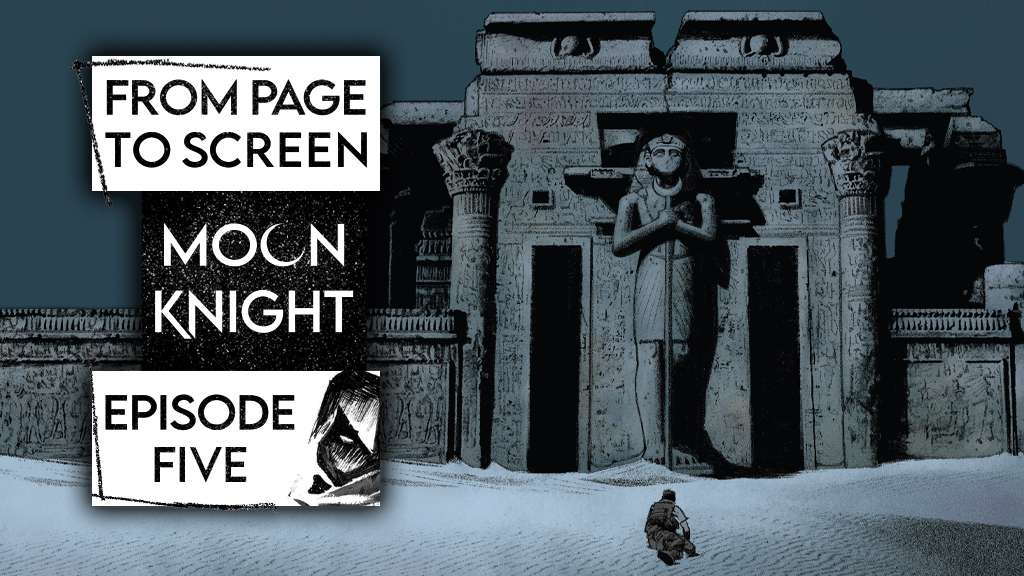
  • ‘Moon Knight’ From Page to Screen: Episode 5

    ‘Moon Knight’ From Page to Screen: Episode 5

    As Moon Knight nears its finale, we continue to explore how the live-action series has utilized (or not) the titular character’s comics source material. Following Episode 1, we looked at how the show explored Marc Spector’s dissociative identity disorder compared to the comics. In Episode 2 Mr. Knight was introduced through a rather different take than in the comics and in Episode 3 Layla’s backstory, along with her dad’s, was approached and so we delved deep into how those same events were presented in both the original Moon Knight comic run and the more recent Lemire/Smallwood one. After the twist ending of Episode 4, we again looked at the ways that the series was obviously inspired by the psych ward introduced in that latter run.

    This week, for the penultimate Episode 5, we compare and contrast how Moon Knight’s most iconic moment was portrayed in the series and the comics. Specifically, we look at the scene where Marc Spector becomes Khonshu’s avatar and dive into the details of the show and three major Moon Knight comics run—the original 1980 run, the Lemire/Smallwood run, and the ongoing MacKay/Cappuccio run.

    Moon Knight #14 (2017)

    All iterations of the classic Moon Knight scene are incredibly similar. It is the type of moment that is so attached to the hero that it somewhat defines him. As we see in Moon Knight, Marc is mortally wounded during a tomb raid. His mercenary partner Bushman killed a team of archaeologists outside of a tomb, including Layla’s father. Marc crawls into the tomb and prepares to take his own life, but he is stopped by a voice that seems to come from the statute of Khonshu that he is underneath. Khonshu tells Marc it would be a waste for him to die, that Marc has a fractured and broken mind, and that the god believes he would be a worthy candidate to be his avatar. Our protagonist agrees, and Khonshu saves his life. The last thing we see is Marc summoning the Moon Knight suit.

    Marvel Studios’ Moon Knight Episode 5
    Marvel Studios’ Moon Knight Episode 5

    There are many aspects that are entirely consistent across the live-action series and the comics. For one, all versions begin with Marc being a part of a tomb raid with Bushman, and the villain ultimately wounds Marc. It is also integral to every Moon Knight story that he is physically under Khonshu’s statue at the time he becomes his avatar.

    Moon Knight #1 (1980)
    Moon Knight #14 (2017)
    Moon Knight #1 (2021)

    It is unclear why he dragged himself into the tomb in the show. While the current MacKay/Cappuccio does not go into it, the way Spector winds up in the tomb itself varies slightly. The series seems to have taken more from the Lemire/Smallwood in terms of Marc literally dragging himself into it. In that comics run, he is apparently lured by Khonshu’s voice. In the original run, he roams the desert before eventually being taken into the tomb by Marlene and some survivors of the raid.

    Moon Knight #1 (1980)
    Moon Knight #1 (1980)
    Moon Knight #14 (2017)
    Moon Knight #14 (2017)

    Similarly, Moon Knight is more similar to the Lemire/Smallwood run in terms of Khonshu’s role. In the original, there is no dialogue that the reader sees between the two—Marc simply comes back to life after lying dead under the statue for a small amount of time. The Lemire/Smallwood run, however, features a very similar conversation to what we see in the series. This is the same run where Khonshu is trying to break Marc’s “weak” and fractured mind in order to use the human body for himself. He tells a dying Marc in both iterations about the gig of the Fist of Vengeance. As Steven tells Marc in Episode 5, it is clear that Khonshu is taking advantage of a soon-to-die mercenary with some substantial mental health issues.

    One aspect that is present in all three comics versions of the scene is missing in the series. In the comics, Marc Spector the mercenary grows a conscience during the raid. In both the original and Lemire/Smallwood runs, he seems to have an ethical awakening after Bushman kills the head archaeologist, Marlene’s father. In the MacKay/Cappuccio run, the scene is brief like it is in the series, but Mr. Knight does specifically mention that he grew a conscience while on the job. In Moon Knight, we see the aftermath of the violent raid but we do not know whether or not Marc had a true “change of heart”. It makes sense that he would have, but it is not as explicit as it is in the comics.

    Moon Knight #1 (1980)
    Moon Knight #13 (2017)
    Moon Knight #1 (2021)

    Another interesting difference in the series is that no one else seemed to be present in the tomb at the time. In both the original and Lemire/Smallwood runs, his future love interest Marlene (and others) are present when he comes back to life. In the current MacKay/Cappuccio take, it is not mentioned, and the only visual we get is simply Marc’s dead body below the statue. Layla (who is a much-improved Marlene in the series) was unaware of the details of her father’s death and Marc’s involvement in it prior to Arthur Harrow telling her in Episode 4, so that seems to confirm she was not there in the tomb. It begs the question in Moon Knight: how did Marc and Layla meet?

    Moon Knight #14 (2017)

    Perhaps the most interesting difference is subtle but fundamental. In all comics iterations far and wide, Marc Spector is resurrected by Khonshu before becoming Moon Knight. In Episode 5, Marc does not die. Khonshu apparently heals him and keeps him from dying, but there is no resurrection. This could perhaps be an oversight brought about by the ease of dialogue between the two characters if Marc is alive throughout the conversation.

    Marvel Studios’ Moon Knight Episode 5
    Marvel Studios’ Moon Knight Episode 5

    Still, the idea of resurrection is a major theme for Moon Knight in the comics, and so it could be a very intentional and meaningful decision. After the events of Episode 4, it looks like Marc Spector is in need of resurrection—he has had at least two (three according to the MacKay/Cappuccio run) in the comics, but they have always been major character-changing events. If Moon Knight decided that a resurrection during the series should be the character’s only one, there are strong themes connected to the hero’s “origin” that would certainly make such a moment in the series finale carry much more weight than any resurrection in a flashback.

    The first five episodes of Moon Knight are now streaming on Disney+.

  • Oscar Isaac on Potentially Returning to the MCU after ‘Moon Knight’

    Oscar Isaac on Potentially Returning to the MCU after ‘Moon Knight’

    Moon Knight is something special among the Marvel Cinematic Universe’s ever-expanding connective tissue. While it still is definitely part of this universe, it’s probably the most standalone project since Phase 1. Still, there’s always going to be the hope that Oscar Isaac would reprise the role in future projects, especially as the Disney+ series was hinted at as a limited series. In an interview with New York Times, he has talked about the future of his character and highlighted that he’s just happy that the project is a more self-contained story.

    It’s a new character that we’re taking a chance on. The nature of the story is this investigation, this slow-reveal mystery. If it goes somewhere else, that’s great. I’m glad it’s not just an advertisement for synergy.

    Oscar Isaac

    He does compare it to his experiences with previous blockbuster projects like X-Men: Apocalypse and the Star Wars Sequel trilogy. While he seemingly burnt out on these types of franchises, the Marvel project reignited that excitement and pulled him back in. He was also the one that pulled in Ethan Hawke to join the project, as it gave him that spark he was hoping to get.

    It’ll be interesting to see what the future has in store for Marc Spector beyond his own series. We’re only a few days away from the Moon Knight finale finally releasing on Disney+. He’s been a prominent member of the Avengers and Marvel comics throughout the years. It would be a shame to not see him interact with others throughout, especially replicating some of his hilarious interactions with Spider-Man as well as further exploring his psychology.

    Source: New York Times

  • Bushman was Originally Going to be ‘Moon Knight’ Main Antagonist

    Bushman was Originally Going to be ‘Moon Knight’ Main Antagonist

    Moon Knight is set to wrap up its six-episode run this week with its finale that hopefully can avoid the curse of other series rushing its ending. The finale will see the next confrontation between the avatar of Khonshu and Arthur Harrow, whose determination to free Ammit may have unleashed an unexpected evil.

    It looks like this was not always the plan, however, and the series initially featured a much more familiar foe to fans of the Moon Knight comics. In an interview with the House of R podcast, Jeremy Slater revealed that Raul Bushman was originally set to be the main antagonist of the series.

    There was a lot of specifics in the pitch that didn’t wind up working in the show, Bushman was intiailly going to be the main villain, I think he was going to be possessed by an egyptian god by the end of it, and you’d have a big sort of avatar battle.

    Jeremy Slater

    This of course did not happen, and we’ve only gotten a brief reference to Bushman. So, his only real “appearance” was in the recent episode where Marc confirms that his partner killed the group of archeologist when he got greedy, leaving Marc for dead. So, the series still is following the comic’s origin story but does not focus too much on it, keeping it open for future exploration.

    Its been reported that when developing the story the team had decided that the character of Bushman was too similar to that of Erik Killmonger, the main antagonist of Black Panther. The series instead opted to take a minor character from the comics and rework him into a bit of an original character, but it seems like they may have kept the plans for Bushman and used him for Harrow.

    Source: TV Line

  • ‘Moon Knight’ Almost Featured Echo as a Love Interest

    ‘Moon Knight’ Almost Featured Echo as a Love Interest

    Here’s a rather surprising reveal, but it seems that at one point Echo, better known as Maya Lopez, was considered to be the love interest for Marc Spector in the Moon Knight Disney+ series. Head writer Jeremy Slater revealed in an interview with the House of R podcast that they had Echo as the love interest at one point in its scripting phase, especially as Marvel Studios was interested in introducing the character.

    At the time, Echo was going to be our love interest, solely based on the fact that they knew Marvel liked the character of Echo and was trying to find a show to put her in.

    Jeremy Slater

    While the character was a love interest in the comics, they had a hard time fitting her into the storyline. As it’s a collaborative process, they pitched different ideas and it seems that they’ve realized the bigger potential to explore her character in Hawkeye at some point in the process.

    They were like, ‘You know what, we’ve got this Hawkeye show and we feel like she would fit in a lot better there and we were like, ‘Oh, thank God.”

    Jeremy Slater

    It looks like they had gone through quite a few ideas early on in the process, which was teased in the past as they had concept artists and writers support the teams to bring these ideas together. The Disney+ shows are also a new venture for Marvel Studios which also comes with many new learnings moving forward. So, we’ll see what other projects went through quite a few changes as they release more.

    Source: House of R via TV Line

  • Marvel Studios’ Disney+ Venture Needs to Embrace the Diversity of TV Storytelling

    Marvel Studios’ Disney+ Venture Needs to Embrace the Diversity of TV Storytelling

    Moon Knight‘s fifth episode has been quite loved due to the way it continues a trend of Marvel Studios’ series having a penultimate episode that takes its time to explore our protagonist’s psyche or the underlying theme of the series. Still, there is a current trend that the Disney+ series are facing that could backfire with each new release. While not a fan of the overused buzzword “Marvel formula,” there is a certain danger with their reliance on the three-act structure to construct their series. There are still distinctions in their approach, but a six-episode benchmark muddles that vision. In a way, they are suffering from something that was started in Netflix’s early days and have yet to fully embrace the diversity of TV’s storytelling possibilities.

    Marvel Studios has always been flagged for having a “formula” behind each film. Even as they broke away from their more streamlined films due to the infamous Ike Perlmutter era, the genre has an inherent expectation that creates that very issue. One could argue that certain expectations and perceptions play a key influence due to the brand and its heroic genre; something we’ve seen in comics over and over again. It’s not a Marvel Studios-specific issue, they just so happened to be the one to stick out the most. While saying that, their TV offerings are suffering from a different yet similar issue that is more inherent to the long-form storytelling format.

    Yet, with a strict six- or ten-episode structure, you are setting a certain tempo for your series. If you adhere to the three-act structure, it becomes even more restrictive, as most of the “action” or meat of the story happens within the final two episodes. We’ve seen it a few times, such as with Falcon and the Winter Soldier, Hawkeye, and even potentially Moon Knight. They end up exploring important themes in Episode 5 but have to quickly wrap up the story in its finale, sometimes not as effective as it hopes to. Knowing that there are “only” six episodes available, also creates the before-mentioned perception issue that not everything will be wrapped up.

    Ironically, Netflix’s issue was that thirteen episodes were at times too many. It’s a funny contrast to Marvel Studios’ six facing the opposite criticism. For the sake of comparison, Peacemaker‘s used an eight-episode structure and was less a “film” but more traditional TV in its storytelling. While it did have some minor pacing issues like any other show nowadays does, it built its story per episode with an overarching narrative. Plus, a character like Peacemaker has fewer expectations because the story can explore whatever it wants due to the character being a blank slate. This is in stark contrast to Netflix’s Daredevil series back in the day or even now with Moon Knight, they both have very set expectations that restrict just how much a story can tell.

    Speaking of Netflix, the issues Marvel Studios is currently facing have their roots in that era. The promise of “a 13-episode film” created this illusion of having a film being told with more time. Yet, even the much-loved Daredevil had pacing issues with many at the time pointing out that elements dragged a bit. Similar to what we’re seeing now, as more shows were released they faced the same issue but became more apparent. By the time The Punisher rolled around, they fell victim to having the episode count set the pacing and certain story beats were expected.

    Was it formulaic? To a certain degree, yes and it was and Marvel Studios is going to fall victim to the same issue if they strictly remain on this course. Throw on top of the issue of a rather short episode count, they potentially will keep facing the issue of their final episode ending up rushed as the internet will repeat. “How will they wrap it all up after that?” That issue becomes even more apparent if you realize they are moving away from one monumental aspect that defines TV storytelling, multiple seasonal arcs for their characters.

    So far, only Loki got a second season and it’s hard to say if any of these series will actually continue moving forward. Marvel Studios’ reluctance to even communicate multi-seasonal plans creates a new issue with expectation. It creates the illusion that this specified six-episode season needs to wrap up everything. Technically speaking, their “second season” commonly are film appearances such as The Falcon and Winter Soldier setting up Captain America 4. Yes, it’s great to see this expansion from TV to film and potentially back, but it creates a whole new issue that they seemingly are struggling with.

    We have no idea where and when Moon Knight might show up next. Lots of coverage is hinting at his series is a limited run, which adds to the issue that the titular hero is not very present in his project. Yet, they are setting up a lot of elements that affect its pacing within the six episodes. While I don’t agree with everything, a discussion on the show’s quality from ScreenCrush made a good point that the penultimate episode feels a bit late and may hit harder if it was earlier in the series. We won’t have much time to actually spend with Marc now that he had his revelation and the loss of the alter that helped him through his trauma.

    To give an example, Loki had his mental revelation at the beginning of the series, and it worked because we already knew his character. So, we got to explore that storyline which we won’t really get to with Moon Knight, as we have to wrap up the plot, character development, and set up for whatever is next. It’s great they aren’t restricting themselves to old-fashioned origin tales, but their current model restricts exploring it fully. While it’s great that we might get Oscar Isaac‘s Moon Knight in a future movie, the fact we never know when or how–a Marvel staple–may see the company’s usual secrecy backfire on them. WandaVision with 10 episodes waited until the end for the big emotional story arc but at least a mystery to keep us wondering.

    Speaking of mystery, Wanda’s town-altering storyline and Hawkeye‘s big bad added an additional issue to what was mentioned previously. They keep the “big reveal” until the very last episode. While it makes sense to build up suspense on whatever the mystery is, especially the excitement of Vincent D’Onofrio‘s return as Kingpin and its implications, it creates the issue of having to bring everything together at the last moment. Even Moon Knight‘s Episode 4 revelation has now been limited due to the time available afterward. Loki‘s second season is following a year after its premiere and we don’t know when we’ll get it or how it fits in the overarching story.

    So, the ever-expanding universe is showing its fangs a bit. Even if comedy series are teased to have ten episodes, the fact they are restricting the episode count to specific formats is surprising given the freedom they should have. TV storytelling is diverse, may it be planning multiple seasons in mind, structuring the episode count to abide by the story, or even having each episode work as a standalone storyline. Even with that potential, modern streaming offerings tend to share similar issues due to the formatting. Even Peacemaker and The Boys rely on shock value at times to keep you watching from week to week.

    Moon Knight‘s been said to “fit better as a film” because that’s what it is. It’s a six-hour film just like how Netflix promised its series and many other streamers are copying. While it does have cliffhangers to keep you watching, they are more character-driven than story-driven. It’s something that makes this storyline a personal favorite among the Disney+ shows, but it does face the issue that also expectations play a massive role when exploring a potentially one-time project based on 70 years of comic history. Expectations on what makes a “Moon Knight” show become a crux for viewers and those creating the series. We have no idea if there’s going to be a second season, ironically unlike how most films get sequels.

    So, the weekly wait for episode 6 with a slower start ends up creating a pacing issue that is very perceptive due to the uncertainty moving forward. WandaVision probably worked the best as a weekly release due to the formatting of the actual show as different eras of sitcoms. The later episodes that broke away from it are much closer to what we see with its six-episode offerings. Each Marvel Studios show has its strengths, and, like everything else out there, weaknesses, but one can see the roots of the issue from the Netflix era. It has affected many series within the market, especially now that we’re moving away from the binge model. In a way, the distribution model is changing but not the expected storytelling element.

    Marvel Studios has a lot of opportunities with their Disney+ series. Yet, their venture into cross-media storytelling has been showing its fangs, as it restricts them from truly embracing the TV model. That is on top of long-term trends within the industry, and we can’t forget this is a completely new venture for this film-focused production studio even if they took in employees from the former Marvel TV subsidiary. Moving forward, if they want this concept to stick out more it might be time to embrace the TV model.

    Give us a series that was built with multiple seasons in mind, something we’re seeing already with Lucasfilm’s Andor. Allow a character to grow over a few years before integrating into the bigger picture, or have their appearances be independent of what’s happening. Ms. Marvel is the perfect opportunity. Yes, she will appear in The Marvels but her “usual” world is the one we’ll see in the June release. Let her character grow over multiple seasons with that experience adding to her character but not redefining her story. It’s what happened in Spider-Man: Far From Home, as it was a sequel to Avengers: Endgame rather than Homecoming.

    A lot of inspiration for the Marvel Cinematic Universe lies in comics, and the Disney+ series is becoming an opportunity for ongoing storylines with the films acting as “detours” for some of the characters. Their stories still should remain ongoing rather than one-time moving forward. Plus, let the show breathe and move away from a strict episode count. Not every story needs to follow a third act structure or something related to it. You can see they are still trying to find their footing with these new ventures on Disney+, and they have an opportunity to truly embrace the diversity of TV storytelling.
  • ‘Moon Knight’: The Bushman Reference and the Future of the Superhero’s Classic Comics Cast

    ‘Moon Knight’: The Bushman Reference and the Future of the Superhero’s Classic Comics Cast

    Marvel Studios’ latest television series, Moon Knight, has been notable for plenty of things including Oscar Isaac’s performance, the focus on a relatively obscure Marvel character, the exploration of complex mental health issues, and the wacky journey into supernatural realms not yet seen in the Marvel Cinematic Universe. Another interesting aspect of the series is how distant it can be from its comics source material at times.

    Not only does Moon Knight make significant changes to the identities of Moon Knight and Mr. Knight, but the hero’s supporting cast from the comics has either been missing or reduced to cameos and Easter eggs. Ethan Hawke’s villain is original (though he looks like a combination of several comics villains) and May Calamawy’s Layla was also meant to be an original character for the series despite having a what looks like nearly the exact same background and general role as Moon Knight’s love interest from the comics.

    After the reference to Jean-Paul “Frenchie” Duchamp, multiple cameos from Bertrand Crawley, and Layla’s similarities to Marlene Alraune, a decent proportion of Marc Spector’s classic supporting characters have made some type of appearance in the live-action series. One of the biggest characters in Moon Knight’s history has been notably absent, but Episode 5 of Moon Knight dropped a quick reference to him.

    ‘Moon Knight’ (1980)

    While Marc was revealing to Steven how he met Khonshu and became his avatar, they walked through the desert area where numerous people, including Layla’s archaeologist father, were killed. Marc explains to Steven that he was not responsible for the massacre and that his mercenary partner, Bushman, got greedy and killed the crowd. It is a single, quick reference, but it is the latest purposeful inclusion of Moon Knight’s classic characters.

    In the comics, Bushman (or “the Bushman”) is easily Moon Knight’s greatest enemy, and the villain appears many times over the decades of comics. As Marc mentions in the episode, he worked with Bushman while a mercenary, and Bushman killed those people in a tomb raid before nearly killing Marc as well. The superhero’s origin story in the comics is almost identical with respect to Bushman’s role in those events. Since then, Bushman remained iconic in Moon Knight comics and was a major part of numerous different arcs. 

    Marc did not need to say “Bushman” in Episode 5. But, obviously, the writers of Moon Knight included it for a reason. In a story that has not relied on the comics, these references were probably placed throughout the live-action series for a couple of reasons. On one hand, they could be simple nods to Moon Knight’s history and nothing more. While fan service can be great (and may sometimes be the best route), there are reasons to believe that the superhero’s supporting characters are being saved for future stories.

    A couple of references to the comics stand out, but Bushman in particular should pique people’s interest. As mentioned, Bushman is an absolutely integral character in the Moon Knight comics. The villain’s actions and presence have influenced the costumed vigilante time and time again. Bushman’s importance goes far beyond the hero’s early days. Moon Knight’s arguably most violent moment came decades after his origin and involved Bushman (he tore off his face), which led into a severe depressive episode for Marc that changed the character’s course as well as heightened the mental health element of his stories. 

    ‘Moon Knight’ (2006)

    The point is that Bushman has always been an obvious choice for a live-action Moon Knight adversary. If the superhero gets more time in the MCU, he remains a clear choice. If the series wanted to totally avoid the character and his impact, he did not need to be name-dropped. Similarly, the Crawley cameos in Moon Knight make his future appearance seem more likely—not only did he make a physical appearance, but he has appeared across multiple episodes. 

    Moon Knight may very well be saving some of these classic characters for future stories with Oscar Isaac’s hero. As was clear from Episode 5, the live-action series is not making too big of a deal of Marc’s original meeting with Khonshu where he agrees to be his avatar. The Disney+ show is likely setting up its finale to be, for all intents and purposes, the Moon Knight origin in the MCU. 

    If that is the case, the character moving forward may likely take on a more traditional superhero role. With that role, a solid supporting cast is bound to follow. The basic setup in the live-action series could be signaling that the iconic comics characters will be around in the long run. And who knows? The Moon Knight finale could prove quite informative about the future of Marc Spector’s, Steven Grant’s, and Jake Lockley’s classic entourage.

    ‘Moon Knight’ (2016)

    The first five episodes of Moon Knight are now streaming exclusively on Disney+.

  • Why the ‘Moon Knight’ and ‘WandaVision’ Memory Episodes Were So Successful

    Why the ‘Moon Knight’ and ‘WandaVision’ Memory Episodes Were So Successful

    Moon Knight Episode 5 is arguably one of the best installments in the Marvel Cinematic Universe’s television series. While answering a lot of questions about our protagonists and the nature of the show itself, it managed to feel incredibly unique from its companion episodes. Despite being a standout for the Oscar Isaac-led series, it had quite a few similarities to a popular episode of the first Phase Four installment, WandaVision

    If Episode 5 of Moon Knight reminded you of Episode 8 of WandaVision, you are not alone. Both penultimate episodes carried similar themes and structures that ultimately accomplished the same task: rewriting the origin stories of the MCU characters. This article explores the resemblances and differences between the two episodes to highlight Marvel Studios’ fresh technique in introducing or re-introducing heroes.

    Marvel Studios’ ‘WandaVision’

    No Flashbacks

    While often referred to as the “flashback” episode, WandaVision Episode 8 does not actually feature any true flashbacks, and the same can be said for Moon Knight’s most recent installment. While there are numerous memories showcased in each, they are in the form of physical spaces that the main characters can, essentially, be a part of. In both episodes, the physical path to the memories was represented by doors–Agatha leads Wanda through a door in her basement, while Marc Spector and Steven Grant travel from room to room in the mentally-projected psych ward. 

    Marvel Studios’ ‘Moon Knight’

    A slight difference is how the characters exist within these memory spaces. In Moon Knight, Marc and Steven could move around as separate entities from their past selves as highlighted by Steven desperately trying to save the young Marc and his brother from drowning. In WandaVision, however, Wanda generally relives the memories and takes on the form of her past self. For example, rather than watching herself go through the HYDRA experimentation with the mind stone, she inhabited that past body and lived through it once more. Even with that slight variation, the outcome is the same. The memories of the lead characters play out in what feels like real-time, and the fact that our heroes relive these dark moments makes it more potent for the audience.
    Timing

    Obviously, both of the episodes at hand were the penultimate installments of the series. Both Moon Knight and WandaVision took a break from their ongoing plots to spend virtually an entire episode in the past. Because they were immediately before the finales, they changed the momentum of the Phase Four entries and paved the way to conclusions that feel drastically different than their beginnings. The memories served to answer many questions that plagued the shows. In both, there existed a sort of “final” or “peak” memory that revealed the most fundamental concepts that had before been mysteries. 

    In WandaVision, we see the build-up and finally the actual moment that Wanda created Westview. Previously, the viewer did not know when Westview started, and the memory furthermore explained how the Scarlet Witch’s background and then-current grief combined to manifest as the series. While Moon Knight has not yet concluded, it is safe to say that the reveal that Marc is the original personality is a watershed moment for the show. It answered several questions surrounding the existence and relationship between him and Steven, which is the bedrock of the series.

    Spotlight on Mental Health

    Neither the MCU nor other comic book franchises are known for their deep character-level emotional explorations or dives into the sphere of mental health. But both Moon Knight Episode 5 and WandaVision Episode 8 put the spotlight on those themes. These two episodes spend a great deal more time on the mental health or emotional aspects of their lead characters than other series or films in the MCU. Because of that, they are noticeably different experiences than what the viewer is used to.

    Marvel Studios’ ‘WandaVision’

    Wanda’s depression, trauma, and grief were the underlying cause of Westview and all of the events of the series. While often media is satisfied in suggesting that, for example, a character is grieving deeply, the WandaVision penultimate episode genuinely and successfully elected to show it. 

    Similarly, Episode 5 of Moon Knight put the spotlight on Marc’s inner struggles. While deep trauma is unrooted like in WandaVision, the presence of and respect given to the character’s dissociative identity disorder leads the series to explore a much more concrete and narrow area of mental health. Still, Marc is developed as a well-rounded character with emotional and psychological turmoil beyond it.

    Marvel Studios’ ‘Moon Knight’

    New Origins

    Marvel Studios’ ‘WandaVision’

    While the emotional penultimate episodes certainly add fresh and enriching experiences to their respective series and the MCU at large, they both appear to do something interesting for their titular heroes. We know that WandaVision’s finale acted as a sort of renewed origin story for the Scarlet Witch in the cinematic universe. There, Wanda had been introduced as a character years before and her series served to re-establish the hero and her mantle. Moon Knight, in contrast, was introduced in the current series. While Moon Knight has less to rework, it is likely building up to establish the MCU’s own unique take on the character’s origin. His classic comics origin was very briefly shown in Episode 5, and it seems as though the show is eager to establish Moon Knight in a way unique from his history and expectations. The penultimate episode is almost certainly laying the foundations for the superhero’s true MCU-specific origin story to be fully revealed in the Moon Knight finale. 

    The first five episodes of Moon Knight are now streaming on Disney+, while the entire series of WandaVision is currently available on the streamer.

  • ‘Moon Knight’ is Most In-Demand Show, as Marvel Studios Influence on Disney+ Subscriber Growth Slows

    ‘Moon Knight’ is Most In-Demand Show, as Marvel Studios Influence on Disney+ Subscriber Growth Slows

    New data offers new opportunities, as Business Insider has shared some more analysis of how exactly the Disney+ series are performing. They provided data by Parrot Analytics that showcases how the various Disney+ shows from Marvel Studios have rather similar developments. They are massive hits for the service, yet have one curious flaw. The Marvel projects aren’t drawing in new fans to further boost the subscriber base even if Moon Knight is the most in-demand series currently.

    They share an overview that seemingly hints at the overall demand, but the takeaway is that the service is having issues bringing in new subscribers even if current ones are quite happy with the offering. The Direct questions if perhaps the streaming service may have potentially reached its high point when it comes to subscriber growth yet it may also be a bit more complicated than that. Moon Knight is ahead of Loki and Hawkeye 25 days after its debut but trailing behind WandaVision and The Falcon and the Winter Soldier.

    parrot marvel tv series disney plus data

    While Marvel’s offerings do have diversity in genre, they are still technically connected through the overarching brand, the main focus of Disney+. Most of their focus is on branding over individuality, which might be one of the issues they are facing. Subscriptions services like Netflix can offer more varied series and films due to them not having strong IPs, to begin with. The family-friendly focus also became a crux due to limiting its audience potential but is on a path to potentially grow with their new adult-focused content such as the Netflix Marvel series.

    It also becomes clearer if we look back at data from November of 2021. At the time, Marvel was responsible for 60% of its subscription base. So, it’s no wonder that most of the current subscribers are going to focus on those series and the growth might stagnate slightly. Disney+ will likely focus on diversifying its portfolio while also making sure they keep its current subscribers with the help of the Marvel projects. The data provided is by a third party, which also might not fully reflect subscriber growth due to Disney focusing on a different metric. SambaTV analysis shares some different perspectives, which adds to the issue of how true this data is. For now, it just offers a foggy window rather than a clear view.

    Source: Business Insider, The Direct