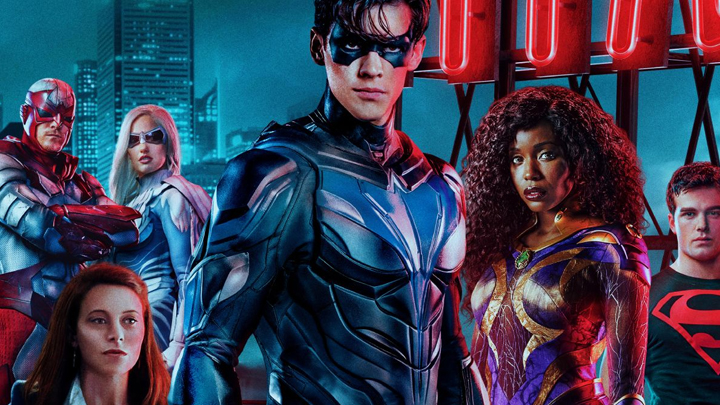
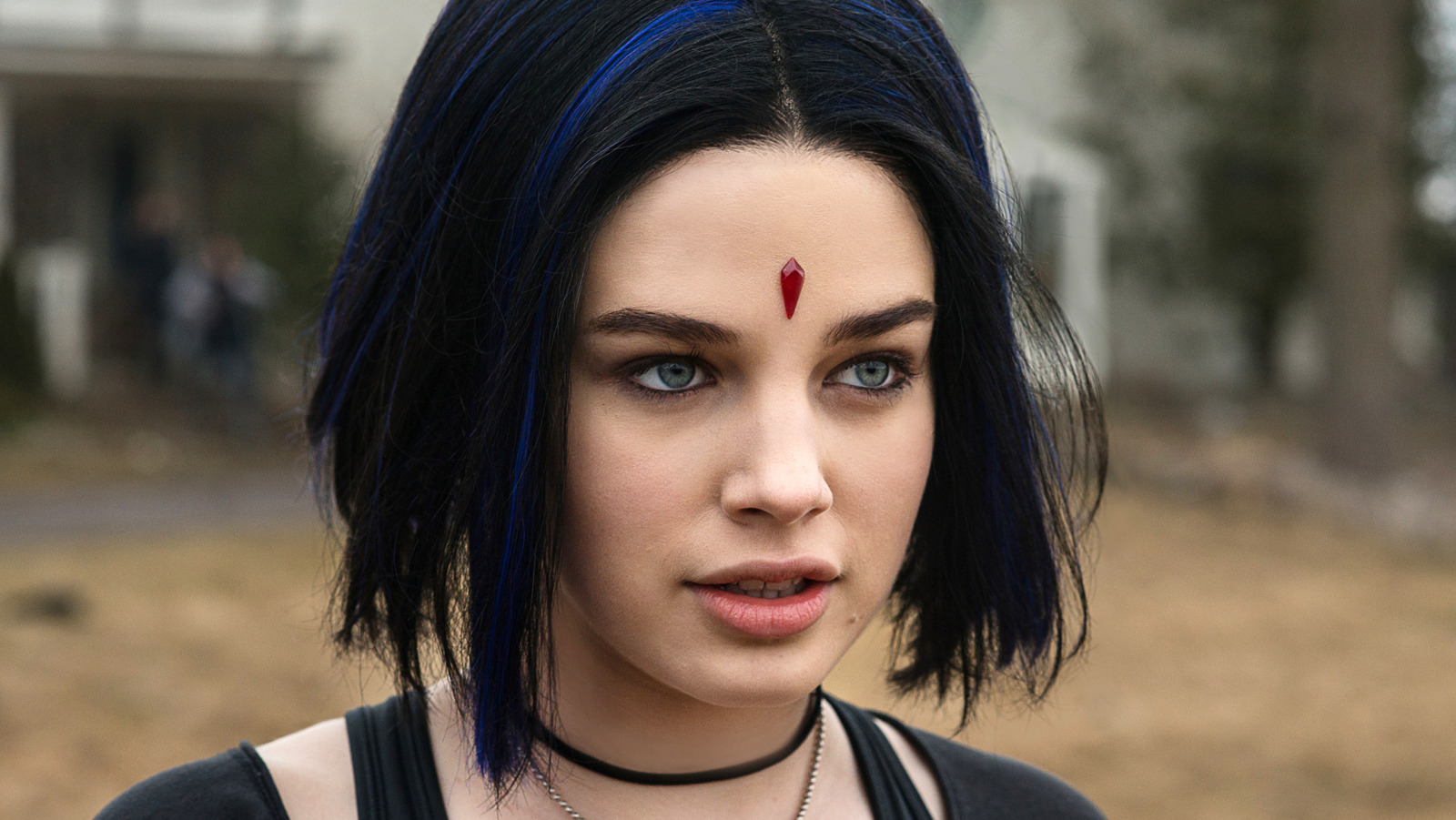
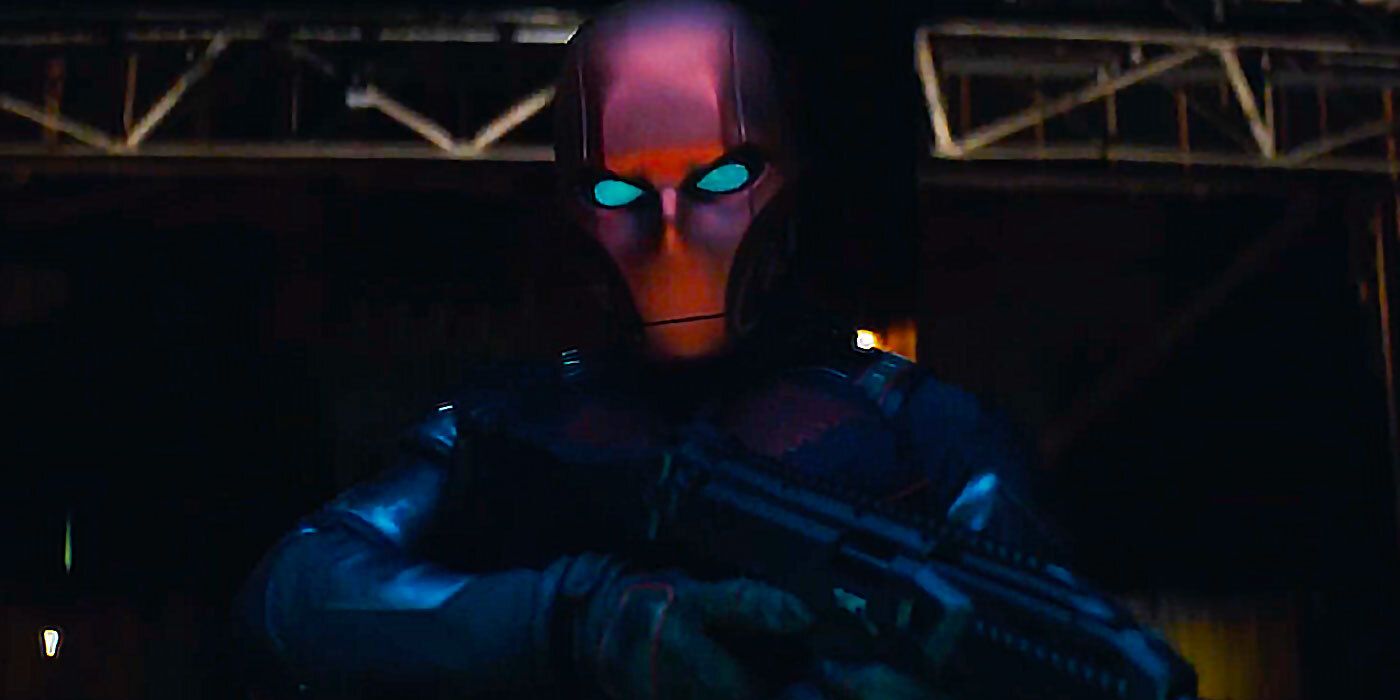
The third season of the now-HBO Max original Titans promises to be the best season yet, easily leaving the first two in the rearview mirror. It does not fail to recognize what it did well in previous seasons and not only amplifies it but uses it more purposefully. The result is a much more cohesive and engaging plotline that evenhandedly threads itself out across the season. This approach is in stark contrast to the patchwork of character introductions and scattered stories that weighed down the previous seasons. Sadly, it still suffers slow and even tedious points, but ultimately is a vast improvement on the series’ ability to tell a story.
The series is noticeably lighter in tone this time around. Titans has by no means become “light”, but much of the overly dark visuals and broody, dejected tone have been pulled back some. With that, the severity of violence, the amount of blood and gore the series puts forth is significantly lower. While there may be some loss in terms of how gritty the HBO Max series could be, it also feels like there is more space now for the show to deliver a story and explore its characters.
One of the biggest strengths of the season is highlighted in the very first scenes of the first episode. Titans, for the first time, has really established that the Titans are, in fact, a team. While they took time to call themselves a team and a family in the last season, it never felt particularly believable until now. The series is starting to truly take advantage of the groundwork it laid for itself. While the series still does what DC often does well by opening the series up to a wide and versatile survey of DC characters and storylines, this season feels like it is building upwards for the first time rather than outwards.
Instead of endlessly adding new elements into the show just to leave others to wilt, Titans finally takes existing elements and uses them to their higher potential while more subtly and tactfully adding in new pieces. There are certain themes and characters that were simply dull in the past but are redesigned into powerful and emotional moments in Season 3 that make the show great at times.
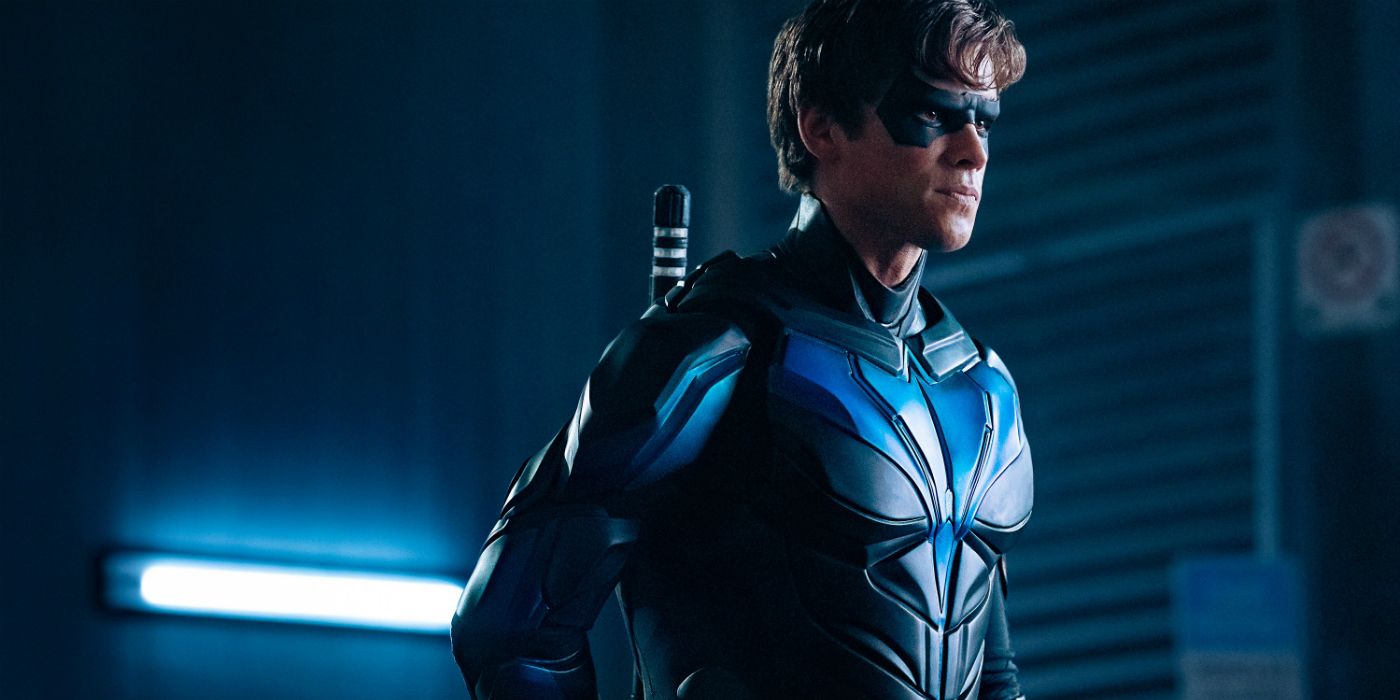
Where Titans truly shined in the past is its portrayal of its leading character, Dick Grayson. Brenton Thwaites’ Grayson, newly minted as Nightwing, continues to steal the spotlight. The series doubles down on the character to the point that the show could, at times, arguably be titled Nightwing without being misleading. This direction can come at the obvious expense of other characters’ development, but it also genuinely aids the organization, consistency, and quality of the season. Where some characters are afforded more limited attention, it is often deliberate and of higher quality than in previous seasons.
Rather than portraying itself as a typical superhero action show, the latest season often operates under the guise of a detective thriller. This does, unfortunately, lead to a deficiency of action, particularly of those characters whose powers are dependent on visual effects. To be fair, where the action is highlighted – particularly hand-to-hand combat – it is well executed and enjoyable to watch. There’s just not enough of it.
At the end of the day, Titans retains plenty of its flaws going into its sophomore season. Still, it does stand out, though, by being noticeably and significantly better. It seems like the creators meaningfully took stock in what the series was doing well and what it was not, and tailored this season specifically to address that. Because of that, it can feel like a different show than what it has been, but the result is a much more compelling and enjoyable Titans.
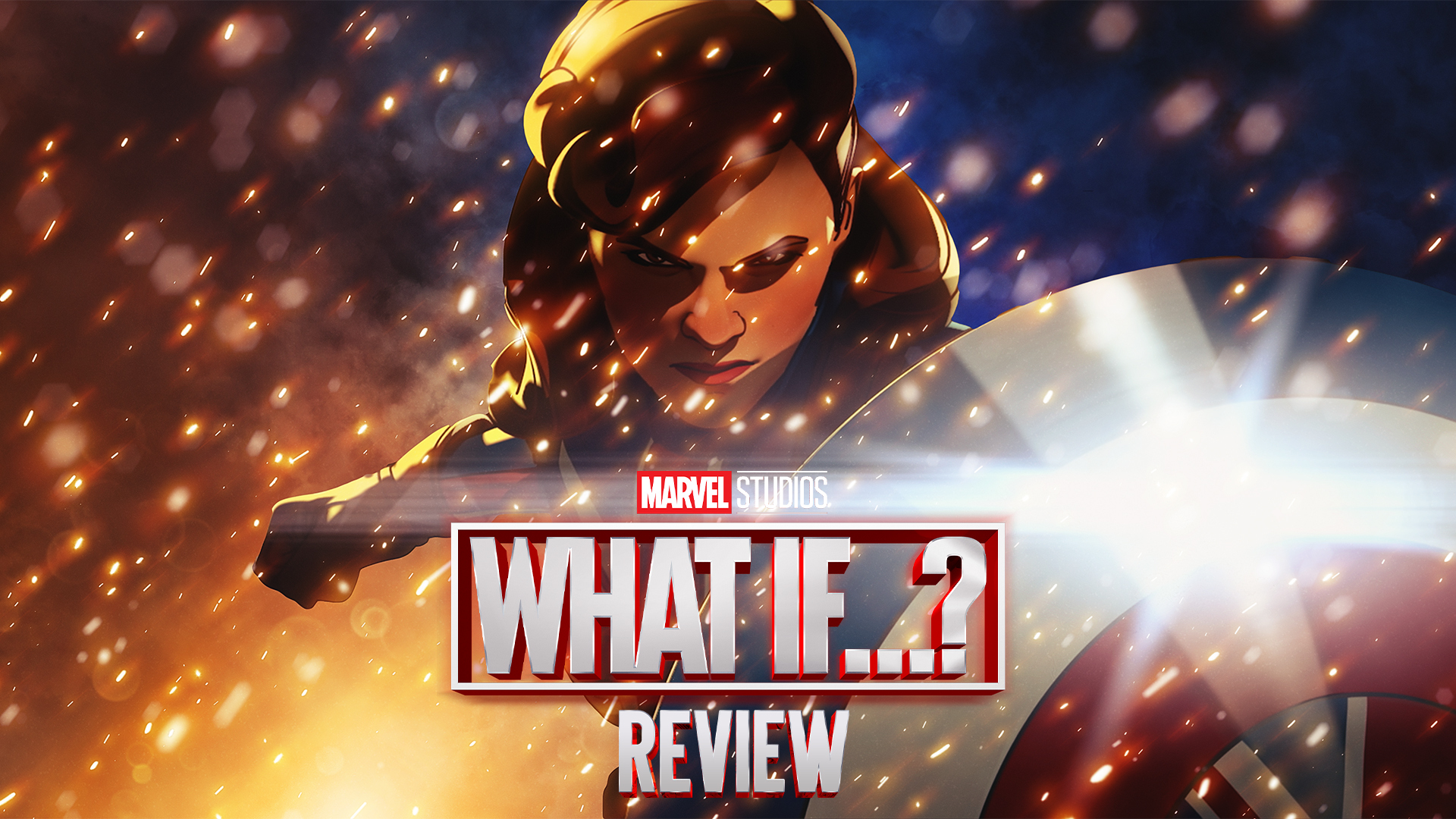
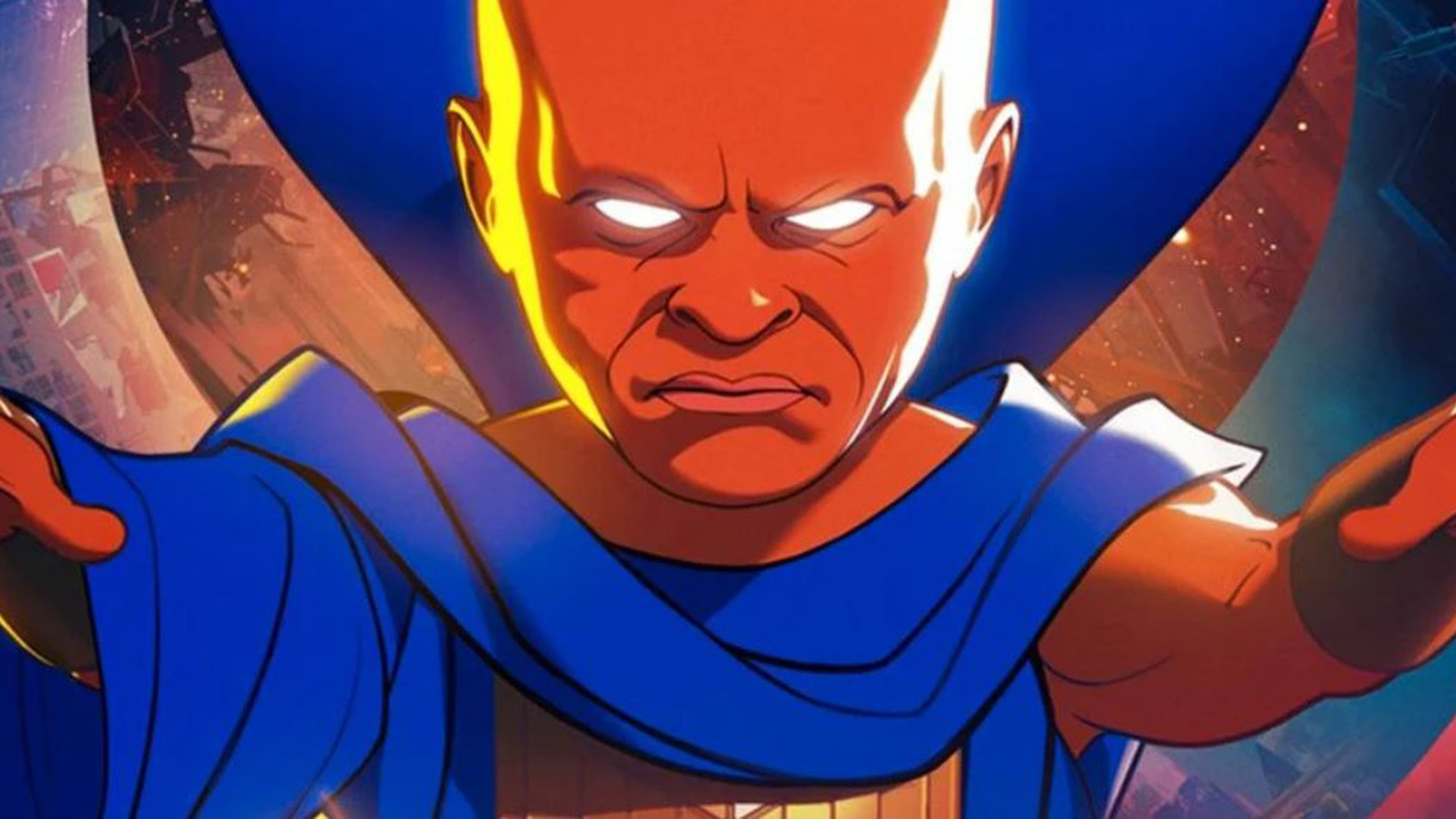
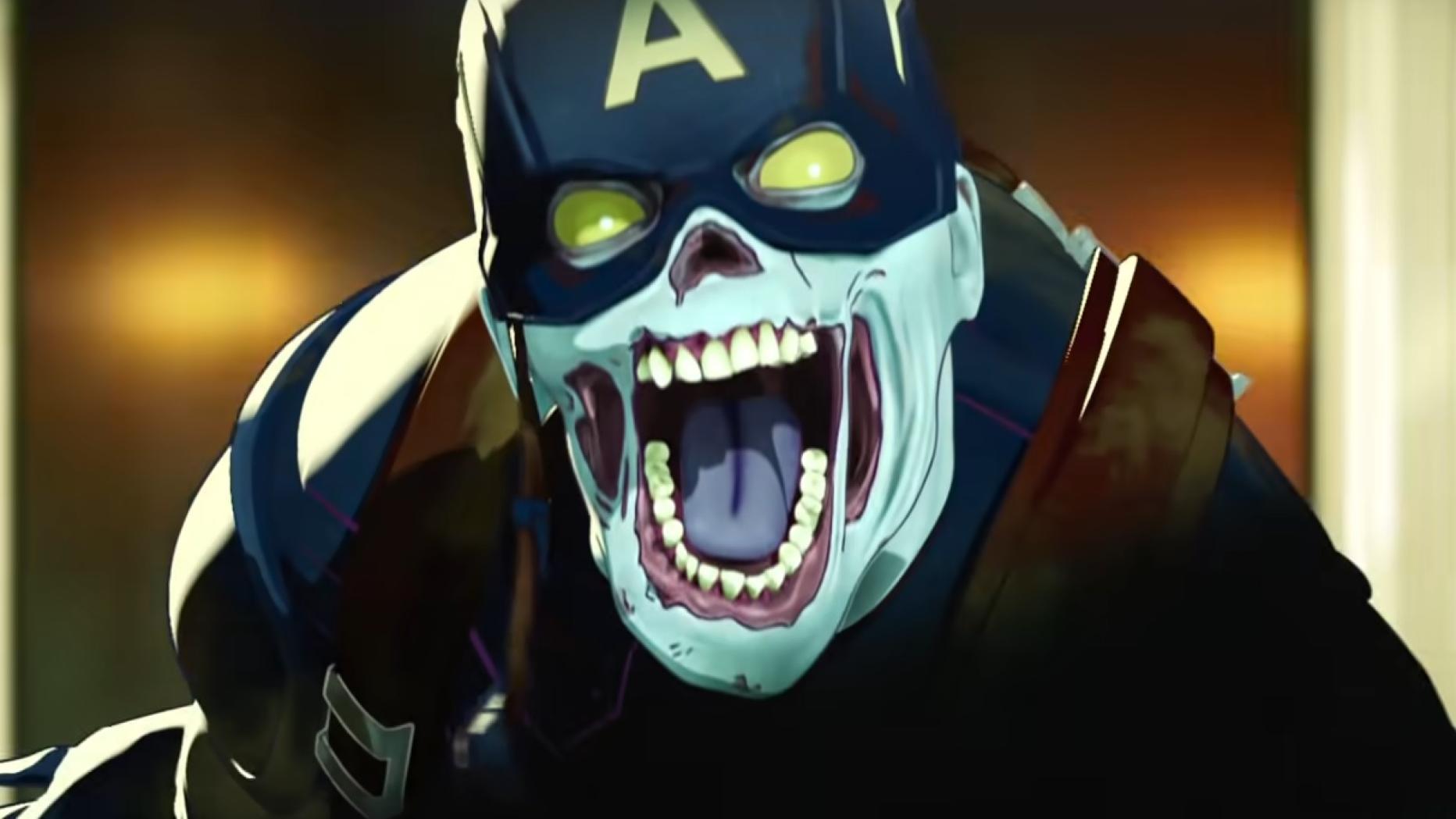
With the opening of the MCU’s multiverse still very fresh in our memories, the first episode of What If…?promptly delivers content to give color to the infinite branching timelines seen at the end of Loki. The series ambitiously depicts these alternate realities in an animated light, which will undoubtedly change how the MCU as a whole is perceived for better or for worse. While, consequently, there are growing pains, the first episode of the series is intriguing enough for the average viewer to accept the invitation to dive further into the prism of time. Here we are introduced to Jeffrey Wright’s The Watcher, who promises to be the guide.
The animation style adopted by the series requires some getting used to throughout the episode. Not only is it a stark change from the MCU’s exclusively live-action history, but it certainly comes with its own flaws. It doesn’t start off strong—it’s clunky, stiff, and less than stellar with dialogue. Ultimately, though, it settles itself in and the story is laid out relatively unhindered by it. Part of its success there is likely its heavy use of familiar voices. While Chris Evans does not return to voice Steve Rogers, virtually every other major character in the episode features returning cast. This makes everything easier to swallow and accept as related to original timeline, but it can come at the cost of stellar voice acting. Dialogue overall came across awkward and forced. Even Hayley Atwell’s Captain Carter seemed off, but it’s arguably a reasonable and maybe preferable trade-off for the series to make.
The use of animation in general is an incredibly valuable operation for What If…? It allows the series to tell a variety of stories easily and with versatility, creating space for prolific storytelling that is unencumbered by the constraints of live-action. The fact that these stories are animated also brilliantly underscores the series’ premise that they exist in alternate realities. Still, given the rumors that characters from the series will make transitions into live-action down the line, the switch between styles likely won’t be able to escape being a jarring and tricky experience.
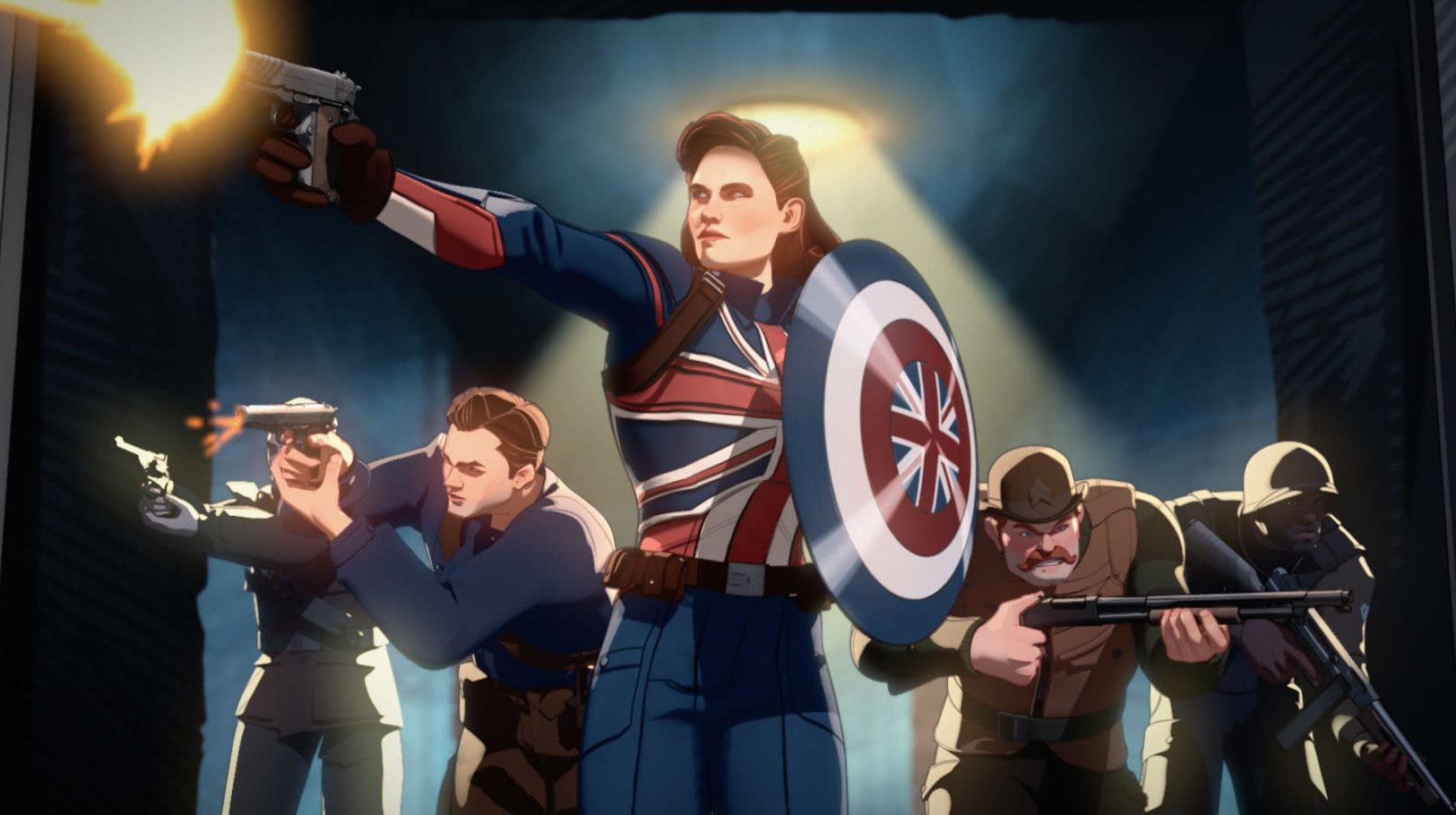
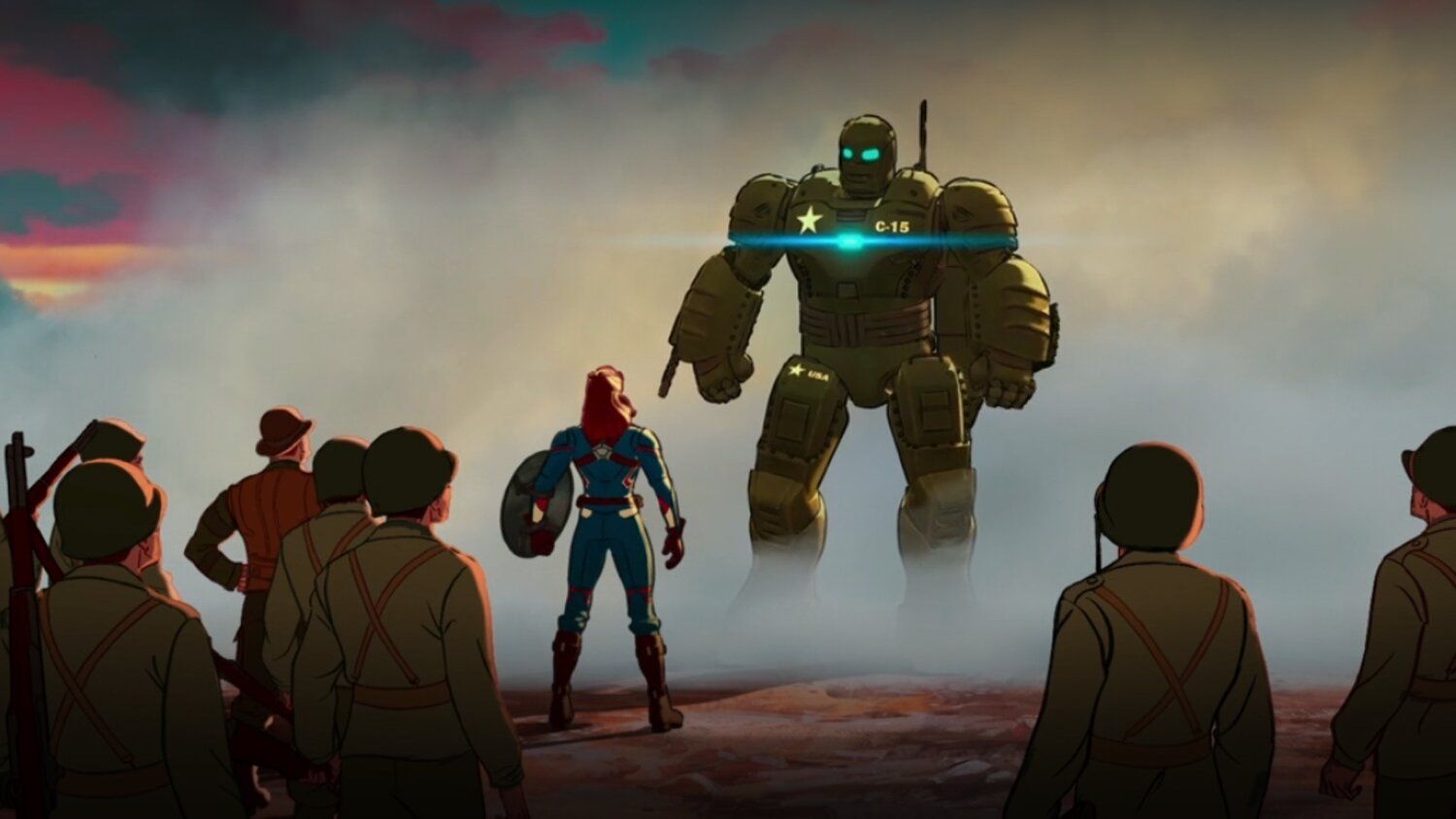
As to the actual story of the episode, What If…Captain Carter Were the First Avenger? indeed follows the simple premise of exploring what the events of Captain America: The First Avenger would have looked likely had Peggy Carter taken the Super Soldier Serum instead of Steve Rogers. Overall, most of the elements of the film lingered. The notable differences were that Steve took on the role of the HYDRA Stomper, Bucky Barnes did not fall off the train and ultimately become the Winter Soldier, and the Red Skull uses the tesseract to create an interdimensional portal. Peggy, now branded as “Captain Carter”, charges into the latter at the end of the episode only to emerge in a lab identical that the one seen at the start of Avengers. This is the most radical departure and significant development in the story, as it already opens up the multiverse to Captain Carter. The Union Jack shield-bearing Captain at the end of the episode is definitively set on a path very much unique from that of our known Captain America’s.
Obviously, though, the second major implication of this alternate reality is that the world’s first and only super soldier was a woman. The show rightfully takes pains to emphasize the significance of this in Carter’s 1940’s scenery. While this focus could be altogether dropped once she distances herself from the classic old-fashioned ways of her time period, it probably won’t be in the long run. Either way, Captain Carter is unfortunately otherwise fairly one-note and uninteresting. Her entire personality is displayed through the lens of a perfect soldier, and Carter simply and unfailingly punches her way through the bulk of the episode. She shows virtually no vulnerabilities or weaknesses other than her romance with Steve. It’s great that she is being planted as an unwavering and strong character, but it just isn’t compelling yet.
Given that the entire point of the series and this episode is to briefly explore a hypothetical situation, the lack of depth to a character is not surprising or even unwarranted. However, because Captain Carter is confirmed to be returning for every season of What If…?and rumored to be making a live-action debut in Doctor Strange in the Multiverse of Madness, it’s entirely fair to ask for a leading character to be more engaging and—honestly—fun. Captain Carter still has time and space to further develop and bring more to the table, but hopefully she will become someone easier and more entertaining to tag along with on this wild journey through the multiverse.
At the end of the day, the first episode of What If…? is a taste of what a wider sampling of the Marvel universe can offer to the MCU. While it may not be completely satisfying, it does do its job of persuading viewers to give the whole meal a chance. As the threads of the series start to intertwine, the novel overall style of What If…? will be put to the test. For now, though, we can just sit back, relax, and keep an open mind about what the MCU is throwing our way
The idea of live-action stories living in harmony with animated stories in one cohesive canon is a dream I’ve had for the MCU for a decade. When Star Warsstarted doing it back in the day, there was an excitement to it. Invigorating energy that made George Lucas’ world feel truly alive in a way that his live-action films couldn’t come close to. The Clone Wars was an incredible dissection and reconstruction of all the things Lucas wanted to make cool with his Prequel trilogy but failed to do. The medium of animation allowed for all that. The palette artists have is essentially limitless. They can conjure whatever they want and how they want it. Whatever concept they couldn’t execute smoothly in live-action could now be done in an unbridled fashion. The animation was at one point the future of Star Wars and those shows proudly waved that distinction.
What If…? makes that dream come true for me, an experiment in its own right to expand the MCU in ways unexpected. It dissects all the things that make the MCU so good and reconstructs them in ways that feel alive. Through the ethereal voice of Jeffrey Wright, Kevin Feige dares pose the question, “What if the MCU as we know it turned out differently?” The result feels ambitious in a lot of aspects. The show attempts to be visually distinct from most superhero animated shows out there. It boasts an ensemble of actors that would make any animated show jealous. And it’s filled with premises that deepen the tapestry of the MCU.
Not every bit of it works but the ones that do make the show worth watching. If anything, What If…?’s biggest strength lies in its titular premise. What if Steve Rogers didn’t become Captain America? What if Ultron won? What if Fury’s Big Week didn’t go as planned? And like most Marvel films nowadays, these quirky premises are underpinned by genre trappings. One episode has a hard-boiled mystery tone to it while another has a heist tone akin to Ant-Man. These tonal flourishes accent the entire package, imbuing them with excitement that goes beyond an interesting logline.
What If…? also hones in on the best parts of the movies which are the character interactions. When making Infinity War and Endgame, one of the things the Russo Brothers as well as Markus and McFeeley made sure to thoroughly explore was the unlikely character pairings i.e. who would have the most interesting moment with who. It’s why you end up with a moment where Groot and Steve Rogers introduce themselves to one another. It’s how moments like Nebula and Stark bonding while marooned in space are created. The guys making What If…? understand that part of the assignment.
Perhaps what they didn’t understand was that getting marquee movie stars won’t always equate to good voice acting. What If…?’s vocal performances are its biggest drawback. It ranges from being decent in the films to sounding eerily unrecognizable. The whole thing is this weird uncanny valley situation where it should sound familiar since it’s the actual actors voicing them but ends up feeling so disjointed to what we’re familiar with. Some of the performances feel like they were done in a bubble as if they just sat in a booth with their pages and no reference of what’s happening on screen. Some voices are over-the-top and stiff while some are true to the performances in the films. It’s frustratingly inconsistent.
To point out the bad voice performances of the actual MCU actors in light of the mixed reactions everyone had hearing some other guy voice Tony Stark in the trailers feels ironic now. Having heard non-MCU, real voice actors inhabit these characters feels surprisingly okay. It’s a placebic feeling in that it’s easier to accept someone who’s not Sebastian Stan fumble at sounding perfectly like Bucky than it is to accept Sebastian Stan himself failing to replicate the Bucky he does in live-action. On one hand, it’s a testament to how infused these characters and actors have become. The slight difference in performance and even voice quality feels unnatural. On the other hand, the bad performances make the experience less special and sometimes unsettling.
Visually, it looks fine. They get points for trying something different despite it not always working The show’s cel-shaded 3D animation feels rigid at certain moments but when it gets good, it looks really graceful. The style comes to life whenever a big fight scene takes place and really, in a show like this, that’s what matters. Though in an interview we did with director Bryan Andrews, he admitted that they wanted to go full big-budget 2D with the show which would have been incredible. A lot of 2D animated shows nowadays feel cheap. Even Invincible, for all the acclaim and love that show got, looked really rusty at times. Knowing that this show could have brought back good 2D animation makes me feel wistful.
Among the three episodes screened for press, my least favorite has to be the Captain Carter one which is unfortunate because the character is the show’s most important one. It’s not that it was bad but it’s the episode that plays the story the straightest. It riffs on the first Captain America movie real hard up until the end with no monumental deviation other than Peggy Carter is Captain America. What If…? is all about exploring multiple big ideas in one episode and Episode 1 seems to just focus on one. Episodes 2 and 3, however, go big with their subversions. Episode 3 finally tells the story of Fury’s Big Week, a story only explored in a tie-in comic prior to the show but then throws a big curveball, causing a series of escalating twists.
But the T’Challa Star-Lord episode is something else. At a glance, it’s a fun twist on the Guardians of the Galaxyensemble but the deeper subtext of the episode’s themes about home and family hit harder now that Chadwick Boseman is gone. The episode marks the actor’s final performance and it just plays so powerfully. People are sure to feel something when they watch it. Overall, What If…? is sure to scratch the itch for fans awaiting the next big live-action release. The premises are fun. The easter eggs are abundant. The cameos will send fans into lengthy discourses in the forums. It’s a great addition to the MCU.
A year ago, I would’ve told you that Lokiwas in the bottom rung of all the stuff Marvel was slated to do. At the time of the show’s announcement in 2018, we already saw the character die thrice (!!!), only for him to show up in subsequent films beyond those deaths. “Just how many more times do we have to see Loki run the same game all over again?” said 2020 me who didn’t know better. But then the first trailer of the show came out during Disney’s Investors Day conference last December, which gave a convincing argument that this show was going to be weird and bonkers. Having now seen the first two episodes, I’ve never been happier to eat those words I uttered last year because the show absolutely destroys.
That’s because Kevin Feige, Michael Waldron, and Kate Herron have found new engaging ways to give more mileage to this decade-old MCU character. Mileage that will likely last the character more than many lifetimes in the MCU. This kind of longevity feels organic and untrodden for the God of Mischief himself. Not only that, the show introduces a concept that is so outrageous within the current confines of the MCU, that it almost breaks it in the best way possible. Everything you understand about the MCU will radically change after you watch these episodes.
The way the show treats the titular character is unlike that of what we’ve seen. While previous Loki appearances had the God of Mischief stopping at nothing in his pursuit of glory, the show exposes him for the jobber he truly is. In the world of wrestling, he’s the guy that has to lose to crown the new WWE champion. As the fates would have it, Loki isn’t destined to win; he’s born to lose. He’s only around to make people around look better and the show brilliantly forces him to come to terms with this harsh truth. For a character that’s been nothing but a sore loserand winner, there’s nothing more compelling than seeing him get humbled.
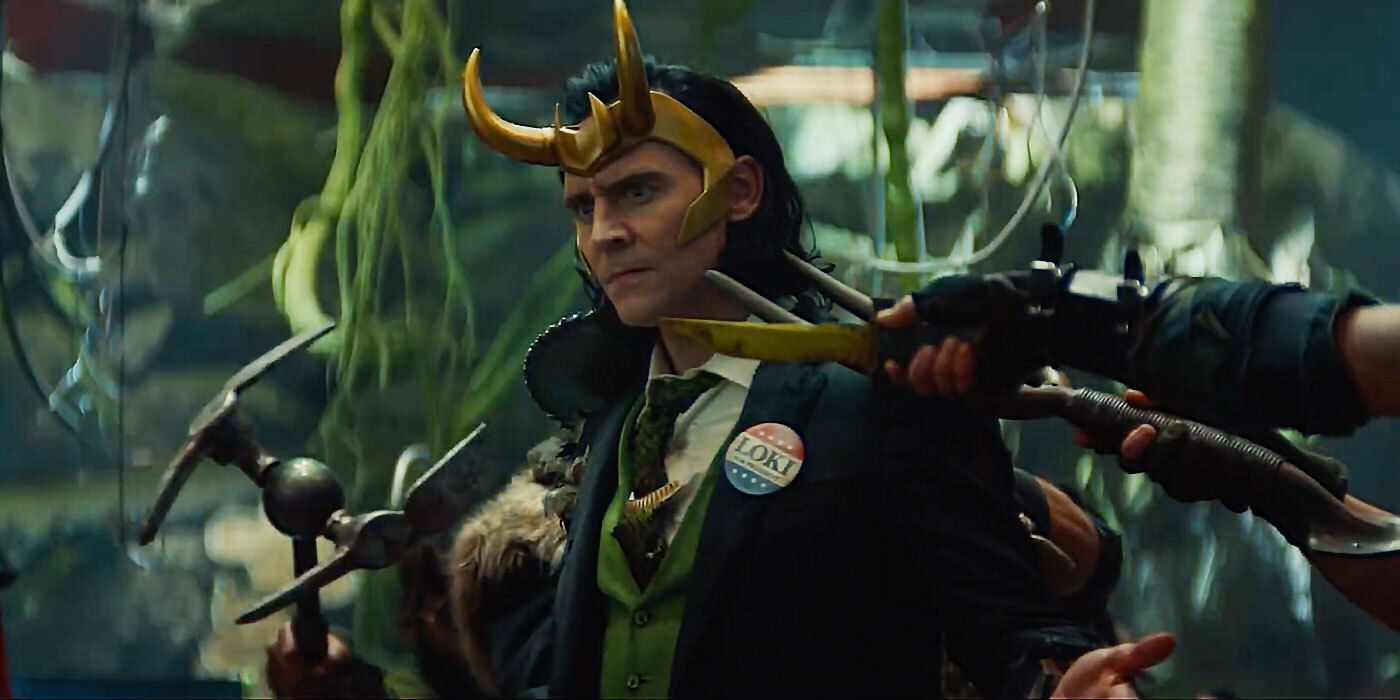
This character turn, unsurprisingly, gives Tom Hiddleston more range for him to be the best version of Loki we’ve ever seen. He gets to tap into that maliciousness we saw from the first Avengers film and the bumbling brattiness he gave the character in Thor: Ragnarokwhile bringing a new layer of weariness for the character. Hiddleston is absolutely on fire as this version of Loki. There are big emotional moments for the character in the first episode where he gets to really flex those acting chops. More than Chris Hemsworth and any other MCU star, Hiddleston might be the MCU’s greatest casting discovery to date.
What makes Hiddleston better this time around is that he has Owen Wilson to bounce off from. Wilson plays Mobius, an obscure character from the comics that works for the Time Variance Authority. Wilson is very much playing an Owen Wilson character here and I don’t mean that as a dig: Wilson’s quirks as an actor work so well against Hiddleston’s highbrow Shakespearean energy. You have Loki, whose thing is being grandiose and boisterous and then you have Mobius, who is just some dude trying to finish his 9-to-5 job. What’s also great about Mobius is that he’s one of the few in Loki’s orbit that is actually several steps ahead. This dynamic leads to some very fun interactions between the two; Loki is second fiddle next to Mobius and he can’t stand it. The two almost have a Jim-Dwight chemistry that almost seems unthinkable when you think about a character like Loki. Again, it goes back to the creators of this show finding engaging ways to keep you on board. People will adore the tandem these two have.
And then you have TVA, the most bizarre organization to make the MCU to date. Essentially, they are the timeline police. You stray from your predetermined path in the timeline and then they arrest you. The show does a fantastic job in explaining how they operate via an animated educational video akin to Jurassic Park. What intrigues me about the TVA is the larger implications the organization has for the MCU. There are some absolutely bonkers allusions to Secret Wars and Infinity Stones in the show. The TVA as the most powerful ruling order in the MCU’s plane of existence is going to lead to some crazy stuff moving forward.
Apart from being immensely powerful, what really makes the TVA such a bizarre organization is the way the whole thing is packaged. The set design is so striking; a mix between retro 70’s analog and old school sci-fi. Every nook and cranny of the TVA feels very lived-in. Every single thing about the set feels like the polar opposite from what we got in TheFalcon and the Winter Soldier, where they literally had to use the same set over and over again. The people that inhabit the TVA rival those that live in Sakaar; just a bunch of totally lovable weirdos that steal each scene they’re in.
Visually, it’s the first Marvel Disney+ show to actually look truly cinematic. That’s not to say the two Marvel shows that came before this were visually bad. The VFX shots of those shows were astounding and even surpass some of the biggest movies. But beyond those expensive sequences, there are a chunk of scenes in Wandavision and, especially, TheFalcon and the Winter Soldier that fall short from looking like a movie. As great as Sam’s big monologue was in the finale, that whole moment looked like an episode of Jessica Jones. Loki is the first one of the bunch to feel like a movie.
If WandaVisionwas Marvel’s attempt at doing an experimental sitcom and TheFalcon and the Winter Soldiera return to their blockbuster form, Loki is them taking a stab at a Fincher-esque investigative crime thriller. You’ve probably heard of the premise by now: someone is causing all these problems in the sacred timeline and the TVA needs Loki’s help to hunt them down. The show gets the spirit of investigative thrillers correct. It’s eerie and atmospheric at times. The investigative aspect feels very engaging. It’s not quite a whodunnit as the show is quick to give away who they’re after but the hows and whats within the confines of the TVA’s crazy world is what makes it interesting.
The only thing I’m mixed on is how some of the mechanics of time travel are presented. Like Endgame, it’s simplified enough for you to buy it at face value until you actually start thinking of the nuances. Some of it will eat at audiences if they don’t ever clarify it. But the fact that the show is taking big swings in doing their own twist with time travel is pretty cool. The introduction of the Time Keepers results in the prevalent theme of predestination and fate; whether or not we’re actually in control of our decisions or if some cabal of time gods have it all planned out. It’s nothing we haven’t seen but when applied to a character like Loki, it becomes way more interesting to explore. The stuff they seed for his arc is gonna have some crazy payoffs by the time the finale hits.
Having seen only two episodes, it’s too early to definitively say where Lokistands among the Marvel shows. But if the rest of the season keeps up with what Episode 1 and 2 does, we might have the best one yet. Loki may not ever rule Midgard or Asgard but he may be poised to rule the Disney+ platform if all goes well.
It’s easy to forget that the Marvel brand isn’t as monolithic as we want it to be. It’s an enterprise that’s asymmetrical as they can come, with gear and chains that function unevenly and whose inner metrics are widely disparate from each other. The Marvel films may be Hollywood’s biggest commercial success for several years in a row, but Marvel Comics still struggles to keep their books selling. The Avengers brand is beloved worldwide, but a video game starring these billion characters was received coldly by the gaming market last year. Despite being in the same lucrative sandbox, Marvel Television and Marvel Animation have somewhat struggled to consistently churn out quality stuff that rivaled the famous films. It’s not always smooth sailing for some of the Marvel folk living in the era of Marvel domination.
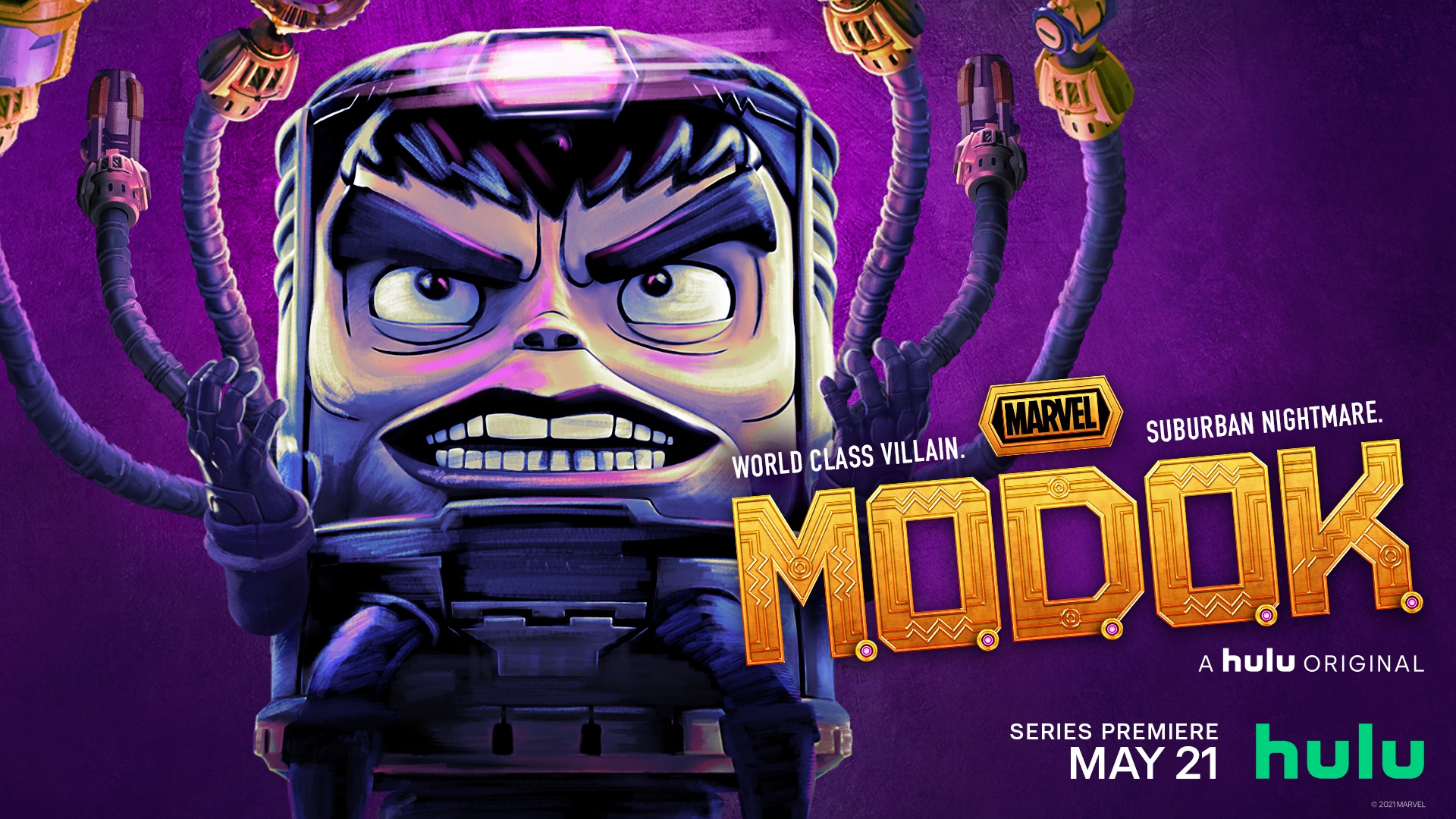
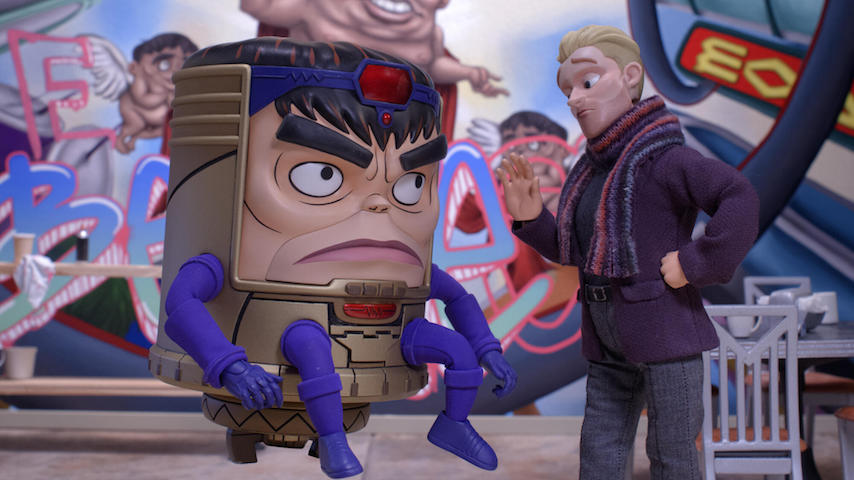
This brings us to MODOK, an upcoming show from the underdog divisions that truly stands out in a Marvel era dominated and dictated by the Marvel Cinematic Universe. The show absolutely rules, which coming from someone who has spoken ill things about the output from Marvel Television multiple times on record, is saying something. Granted, a lot of the stuff that frustrated me with Marvel TV was rooted in their less-is-more/grounded approach to what should be imaginative genre storytelling. MODOKis absolutely untethered from all that nonsense. A boisterous explosion of everything that makes the Marvel Universe truly fun.
Despite growing up in the era where Adult Swim blew up, I never really got into its network programming. It might have been too eccentric for my normie teenage self at the time. So, Seth McFarlane’s work is what I leaned towards for my adult humor. Seeing a Marvel property go the way of Robot Chicken, a self-referential, parodying, manic, stop-motion bonanza is a totally novel thing for the normie in me and I dig it because it works so damn well with a character like MODOK. This wouldn’t work elsewhere with, say, a property like Squadron Supreme.
MODOKis one of the most absurd characters in the Marvel universe. That the character has had a staying power this long in the lore, while his equally wacky cohorts such as Paste Pot Pete or Big Wheel disappear into obscurity, is practically a miracle. In the comics, MODOK is this mad scientist who mutates himself into this big-headed glob of a being. He’s a primary figure in the evil scientific alliance AIM and has gone on to fight the likes of Hulk and the Avengers. So he’s a heavy-hitter as far as being a looming big bad in the Marvel Universe.
The show takes this premise and totally craps on it in the best way possible. It’s clear how Patton Oswald and Jordan Blum are aware of how ludicrous MODOK is given the lengths they go to just to crank it up to 11. The first episode sets up the idea that this floating head, who has a day job trying to destroy the planet and fighting Earth’s Mightiest Heroes, has a home life he needs to attend to nightly. He has a human wife and son, and a daughter who looks exactly like him for no good reason. On top of all that, they have the flamboyant Super Adaptoid living with them, who they treat as the Meg Griffin of the family. And that’s just the tip of the iceberg.
I cannot count the times I laughed hard at the stuff they explore in the episodes. There’s an episode about MODOK wanting to time travel to a Third Eye Blind concert to appease his wife. In another one, MODOK dumps his trash via a portal on Asgard. Hell, there is even an episode that showcases some of the most Z-list villains planning to steal Captain America’s shield. All those things, of course, cascade into the dumbest antics a supervillain can get themselves into
This kind of self-awareness is key to a premise like this. Playing it straight is absolutely the wrong way to go. This is actually a gripe I have with the Avengersgame that treats MODOK with the utmost seriousness. As great as that final boss fight is, there’s just something drab about a poker-faced take on the character. The man is a maniacal head that floats on a toilet and has T-rex arms. I don’t wanna see what that would feel like in a plausible reality. I wanna see MODOK deal with the true threat of not being able to stand up when he falls on his round back like a turtle.
So if you’re precious and uppity about the sanctity of your comics, everything that makes MODOK great might be a dealbreaker for you. This show doesn’t hold back. It’ll poke fun at everything; from its own characters to the source material. But that doesn’t mean the show thinks comics stink. There’s a reverence to the way the show is irreverent towards the trove of inspiration it draws from. It truly feels like a love letter to comics and it stems from Oswalt and Blum’s adoration for it. Sure, it craps on so much of it but it’s really done in an endearing way that’s never mean-spirited about the material or the people who love it.
Easily the most evident way of expressing their admiration for the source material is the buffet of character cameos they pull from their disposal. Seriously, this show is like Super Smash Bros. but for characters that were left behind in the bargain bin of Marvel’s canon. And that’s not a bad thing at all. If anything, it’s an incredible showcase of just how rich Marvel’s villain roster is. There are bonkers cameos from characters that you didn’t even know existed in the canon. The fact that MODOK actually puts these characters in the forefront for people to enjoy is something to commend. Where else will I see Master Pandemonium host his own talk show?
The show wonderfully offsets all the craziness with some surprisingly real human character arcs. Never did I expect to be moved by the marital problems of a floating head or a child coping through a divorce but here we are. It’s incredible how the show manages to hone in on a lot of understated character work while treating its world with little to no regard. There are moments of tenderness in the show that make the experience. Doesn’t matter if it is MODOK doing his best to make sure his son doesn’t end up on the loser’s side of life like he is, or when he wrestles between his family’s happiness and his conflicting sense of purpose.
A lot of the character work is done justice by a murderer’s row of voice talent. Oswalt is pitch-perfect as MODOK that it almost seems criminal to cast someone else in a live-action iteration. There’s a moment in the season where the show hilariously and brilliantly alludes to this too. MODOK’s family is voiced fabulously. Melissa Fumero of Brooklyn Nine-Ninefame plays his daughter, who by virtue of his gene in her, is the queen bee of her high school. She is fantastic here and goes against the Amy Santiago-type by being a mean yet lovable heel for once.
Aimee Garcia is MODOK’s wife, Jodie, who’s somewhat of a Martha Stewart retail personality in the story. I’m in awe at the mileage they got from the character. She’s in many ways the center of the season. Garcia really gets to shine by being the heart of the story and sometimes, an antagonist to her husband. Ben Schwartz plays their son Lou, who reminds me of Steve Smith from American Dad. He’s that eccentric lovable nerd that can never follow in the evil footsteps of his supervillain dad. Schwartz emanates the spirit of Jean Ralphio playing Lou Tarleton and it’s a very welcome thing to hear.
There exists a through-line in MODOK in the form of two sinister subplots brewing within the shadows cast by the titular character’s charming stupidity. The subplots are mostly just okay. To me, it’s the weakest link of the entire season. It’s not flat-out terrible as it starts with a lot of intrigues and ties a lot of seemingly disparate plots together nicely. But as the season moves along, it gets buried in all the funnier elements of the series that by the time the subplots start falling into place, it almost feels too late. It certainly doesn’t help that the timing of when these subplots pay off in the season are sequenced oddly. But who am I kidding? None of those weak links matter in a show that works as smoothly as MODOK. Like the megalomaniacal narcissist he is, the show revels in its strengths maniacally in the face of all its faults and is all the better for it. I’ve never had this much appreciation for a Marvel TV joint since Daredevil ended. The show is without a question, the best thing they’ve done since 2015.
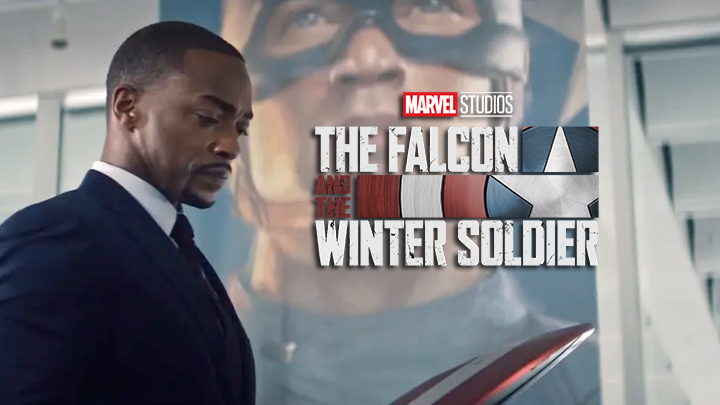
The Falcon and The Winter Soldier wastes no time in centralizing the idea of legacy and the burden it brings; that Steve Rogers and his shield are impossible to live up to. Within the show’s first minute, we already know the burden Sam Wilson feels by simply holding the physical symbol of Cap’s legacy. Even for Bucky Barnes, it’s an issue of legacy. Compared to Steve’s, Bucky’s legacy on the world is as harrowing as it comes. His sins as the Winter Soldier continually creep up on Bucky in his nightmares and it’s up to him on how he makes up for his legacy.
The world hasn’t moved on from the Blip. In fact, the Blip has complicated things in unexpected ways. Instead of fixing the world back to what it was before the Snap, the Blip has only upended the status-quo of the last 5 years of the MCU. Perspectives have changed; an organization called the Flag Smashers wants a pre-Blip status quo for the world. One without borders or governments. Down to the minutiae, laws have changed: Sam Wilson can’t get a loan for his sister because everything went under for 5 years. Fans who’ve been yearning to see the true effects of the snap will be happy to watch this show.
This episode has yet to introduce the full ensemble. Zemo and Sharon Carter are nowhere to be found in this episode so it’s mostly relegated to just the titular duo. However, we do get to meet a new sidekick in the form of Joaquin Torres, played by Danny Ramirez. Comic fans will recognize Torres as Sam Wilson’s successor to the Falcon mantle in the comics . Torres, an intelligence officer in the MCU, is Falcon’s man-in-the-chair. Ramirez plays him with a Hardy Boys-charm that a lot of fans will like.
The episode’s strengths are in these character-heavy moments and it’s up to Anthony Mackie and Sebastian Stan to bring life into these moments that could be otherwise dull if mishandled poorly but man, do these two bring it. The beauty of these long-form stories is that they allow so much room for depth for each character. In this first episode alone, we see sides of Sam and Bucky that we’ve never seen before. Whether it’s Sam going to Louisiana to reconnect with family or Bucky having lunch with a friend, it’s all character gold. Just like how Wandavision humanized Vision by having him go on social calls with the neighborhood watch, TheFalcon and The Winter Soldier brilliantly gives us lovable human moments with these titular characters. Who knew superheroes in their downtime could be so great to watch?
I’ve always felt that Stan always had the short end of the string when it came to sharing the screen with Chris Evans and Anthony Mackie at the same time and understandably so. Evans’ presence alone lights up a scene with his stoic gravitas while Mackie oozes charisma and charm. It’s almost inevitable to get upstaged by those two. Stan, for the most part, never got to do much in the shadow of the larger stories of the MCU and the intrinsic likability of his scene partners.
So as far as first episode performances go, I think Sebastian Stan gives a more noteworthy performance here. He brings a freshened sense of excitement to the role, despite inhabiting it for a decade now. Stan finally gets to have fun with the character and gives him range. There are inevitable moments of darkness for Bucky but also surprising moments of happiness and Stan deftly shifts between the two.
And of course, you have the action. Raving about Marvel Studios’ action feels trite so I’ll keep it to a minimum. Right from the get-go, they serve up an action sequence that’s on par with the helicarrier third act of Captain America: The Winter Soldier. There’s an awe-inspiring cinematic precision as to how they’ve managed to pull this off on television.
Henry Jackman’s score here really stood out for me and can only expect to be blown away in upcoming episodes. As a huge fan of what Jackman did for Captain America: The Winter Soldier and Captain America: Civil War, hearing him revisit some of his motifs from those two films but in a new context is chilling. If he brings back more themes from the last two Cap films, I’ll be beyond happy.
Without going much into spoilers, there are parts of this episode that feel clunky. There are premises and beats that don’t feel as polished as the rest of the episode’s high-quality aspects. Some moments have a bit of tonal whiplash wherein the subtext is meant to be serious and somber but the execution makes it seem unintentionally comedic. I have a lot of questions about Bucky’s road to redemption, which in concept is super intriguing, but in execution feels safe at the moment. Granted, there are 5 episodes left that could change these nitpicks of mine but as it currently stands, the episode flaws made it feel like a mixed bag as soon as I finished watching.
Overall, this show is gonna be one hell of a ride and the first episode is clearly just a taste of it. In retrospect, WandaVision being the first out of the gate feels very beneficial for TheFalcon and The Winter Soldier. After all the discussion WandaVision‘s mystery box generated, the outrage it garnered from its twists and turns, and heartwarming emotions that it elicited from fans, The Falcon and The Winter Soldier feels like the ideal follow-up. It’s a safe return to form in many ways but it’s also one that fans might need after all the Mephisto craziness. This is Marvel returning to what it does best: fist-pumping entertainment with a dose of depth.
To say that WandaVision’s sitcom trappings are merely a gimmick to bring something new to the smorgasbord of superhero fare is a disservice to what it actually does. There’s an actual sincerity to the way WandaVision is designed. A profound appreciation for what the American sitcom has meant to pop culture and to the intricate world the MCU has built. Under the guise of the shows of old, Wandavisioncelebrates all that came before it and what will come in a way that hasn’t been done before. The show is a representation of the MCU’s future.
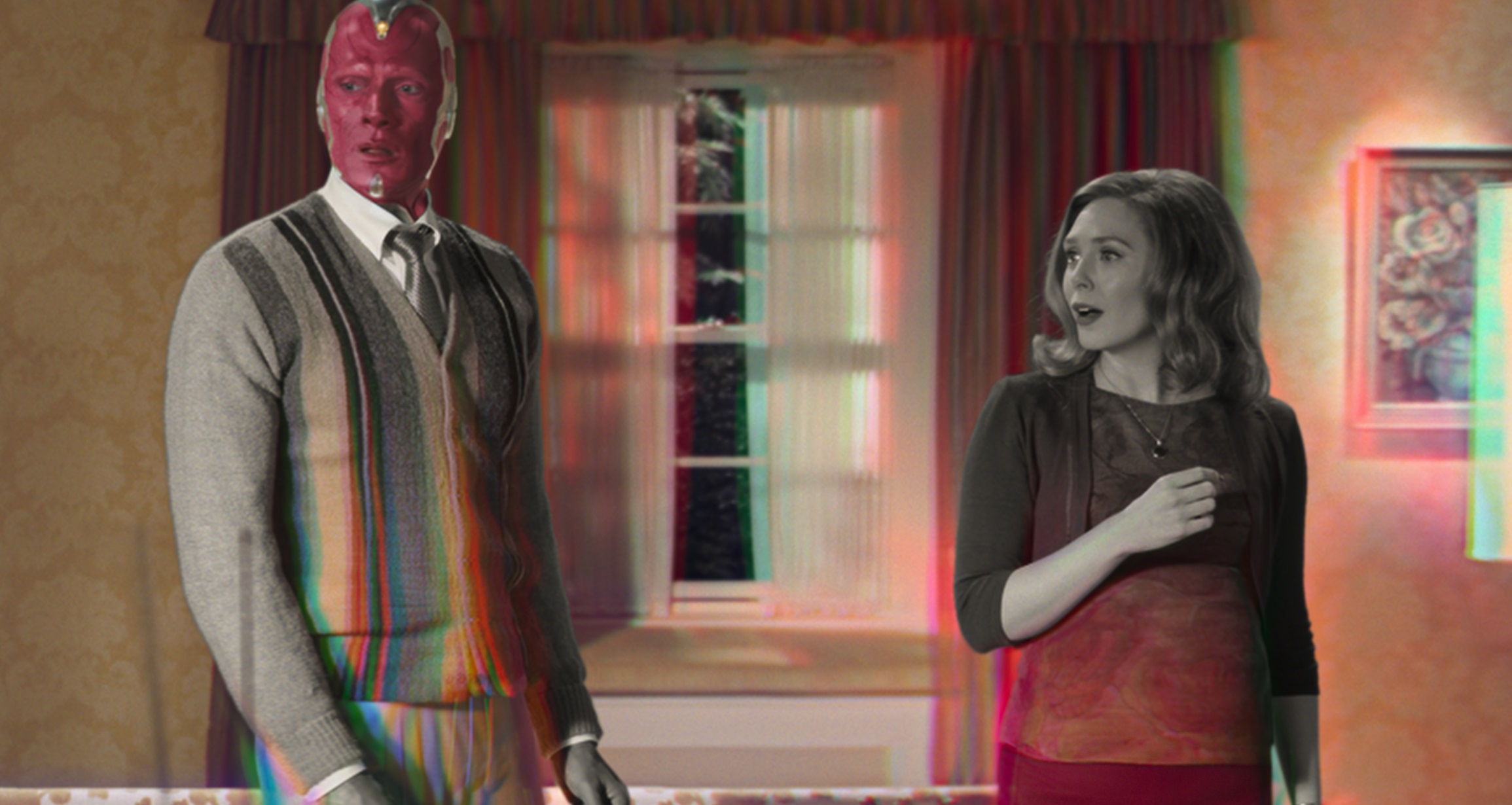
In true comic fashion, the show pretty much throws you right in the middle of this idyllic town of Westview with little to no exposition as to why Vision and Wanda are living in their own Truman Show. The vignettes that make up each episode provide a glimpse at the happy day-to-day life these two Avengers have made for themselves. Life has been good for the Visions since we last saw them; their romance is flourishing; they just moved into this great neighborhood, and the people around them are welcoming. But all good things must come to a slow and painful end. For the Visions, it begins with them noticing the many glitches in the matrix and the proverbial red pill they have yet to take is the mystery box of the show.
As bleak as that premise sounds, the show is surprisingly fun. The absurdity of two superheroes trying their dandiest to carry on with a normal life is at the forefront here which allows for fine situational comedy. Wanda struggles to make dinner while Vision tries to join the neighborhood watch. There’s honestly nothing more to ask for in a show like this.
It’s honestly hard to pinpoint what doesn’t work in WandaVision. The complexity of the premise might be inaccessible to newcomers who have no idea who these characters are, to begin with. At the same time, the show’s quirky format provides autonomy from all its overwhelming world-building needle drops. The singular day-to-day adventures Wanda and Vision go through to fit in their neighborhood of Westview work perfectly without any exposition. Each decade they adapt is its own thing with its own set of threads. These threads don’t necessarily carry over to the next episode. There’s almost no semblance of a larger story arc with the exception of the needle drops at the end of each episode. Even the character arcs are left vague to service the mystery of what the hell exactly they’re building up to.
Having the arcs shrouded in a mystery box, in addition to the surrealist nature of the show, allows for Wanda and Vision to be completely different characters from their previous appearances. It’s a very unusual way to develop these characters but it also gives stars Elizabeth Olsen and Paul Bettany carte blanche to play it however they want. And boy, do they really have their fun with it.
For me, Bettany is, by far, the MVP of this show. He grounds the show’s sitcom pastiche in a zany performance that is equally self-aware as it is charmingly ignorant. My condescending highbrow self certainly didn’t expect to laugh out loud at 50’s humor, but I did thanks to Vision acting like a believable buffoon. Bettany is totally hilarious in this and steals so many scenes in more ways than one.
Olsen unsurprisingly stands her ground to Bettany’s wacky performance and delivers a tour de force act of her own. While Bettany brings in some grade-A levity to the show, it’s Olsen who balances it with depth and range. She has a jaw-dropping moment in the third episode that will surely elicit some exciting reactions from fans. More than Bettany, the show asks the most out of Olsen, and will likely spotlight the full spectrum of her talents when Wanda becomes the bigger focus in the season’s latter half.
As of the first three episodes, there’s not much yet to grasp with the ensemble cast. Kathryn Hahn’s wink-wink tongue-in-cheek performance as Agnes lends itself to the seeming sinister nature of what Westview really is. She’s fun to watch and is totally hamming it up for good reason. Teyonah Parris as Monica Rambeau brings an aura of warmness to an ensemble filled with unsettling Stepford Wives characters. As a fan of her work on That 70’s Show, seeing Debra Jo Rupp channel in her inner Kitty Foreman once more, in a Marvel show no less is a blast to watch.
The way the show commits to authenticity as they navigate through the various eras of the sitcom world is impressive as hell. With a few exceptions of a few frames that look too modern and anachronistic, the shows stay true to form as to how these sitcoms actually looked and felt. It even manages to nail the cultural and social sensibilities of the past down to the ridiculous gender norms. For someone like me who finds pop culture of all eras fascinating, WandaVisionfunctions as a nice history lesson on what came before, albeit with a synthezoid and a witch.
Most MCU properties have a rewatchability thanks to the proven and tested Marvel Studios formula that perfectly marries levity, spectacle, and good old comic book fare that make their films worth watching. However, WandaVisionjust might be the property that takes the cake, as far as rewatchability goes. Kevin Feige, Jac Schaeffer, and Matt Shakman have crafted a make-believe world within a make-believe world so intricate that every detail on screen seems to have a life of its own. So much of what you see in the show feels like it means something, even though it might not. Be it the silly gags or the jokes, there’s a purpose to it. Every innocuous detail feels like an easter egg that’ll lead tinfoil-wearing fans into a rabbit hole and keep them rambling for weeks. Even the less nuanced callbacks to previous MCU moments and arcs have a heft to them as they allude not only to the MCU’s past but also to its future. It’s one of those shows where once they finally unveil the ace in their sleeve, every episode that came before will feel completely different.
WandaVision makes a truly convincing argument that the future of the MCU rests within the world of serialized television. The chilling moment where the monochromatic world of Wanda and Vision bursts into Technicolor is emblematic of this new era of the MCU that’s being ushered in front of our very eyes.
All things considered, Marvel TV lasting this long is pretty impressive. In their decade-long stint, the division has produced a slew of content, that ranged from spy shows like Agents of S.H.I.E.L.D. and Agent Carter, a surrealist fever dream like Legion, and gritty crime dramas like Daredevil and Jessica Jones. With a wide spectrum of subject matter, one can also expect a wide spectrum of results. Some of these shows ended up being duds while some became critical darlings. But when all was said and done, Marvel TV, for the most part, had something special going on for them.
Sometime last year, it was announced that Disney was dissolving the Marvel Television division as we knew it in favor of producing and streamlining new serialized content under the division’s more successful cousin, Marvel Studios aka the group that makes the movies. This sudden end for the was nothing short of bittersweet as there were a few projects still in development. This year saw the end of the series that started it all, Agents of S.H.I.E.L.D., with its seventh season and will also mark the final goodbye of Marvel Television with Helstrom, a show based on one of Marvel Comics’ premiere horror characters.
Alas, Marvel TV’s swansong is sadly, a dud, not a complete one but its flaws are more evident than its strengths.
There are great horror properties that aren’t necessarily scary but are well-written just as there are really scary ones that are contrived and awfully written. Helstrom falls in the middle of that category. It’s neither scary nor well-written. It’s a show that brands itself as a horror outing, showcasing possessions, exorcisms, and demons in its marketing material but in actuality, Helstrom itself seems scared of its own supernatural trappings as it refrains from actually giving us the scares. The trailer makes it out to be this action-packed screamfest but those moments are actually few and far in between. In an era where horror is having a resurgence on TV (Netflix’s Haunting of Hill House and Hulu’s new show Monsterland actually give some nice scares), it’s disheartening to see this show miss that mark when the comic and world it’s based is chock full of neat stuff.
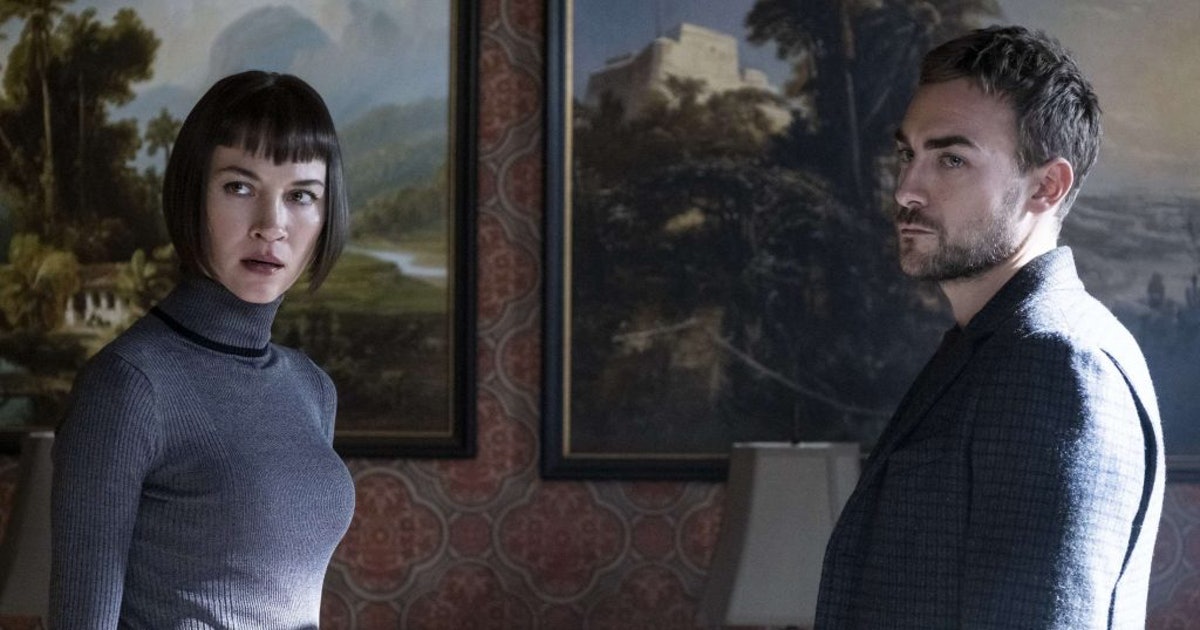
Alain Uy (Chris Yen) and Sydney Lemmon (Ana Helstrom) Credit: Bettina Strauss/Hulu
I’m a firm believer that comic books can be reinterpreted for the better in their live-action depictions just so as long as it retains the spirit of the source material and in all fairness, Helstrom stays somewhat faithful to the beats of the character’s origins. However, it’s missing one key component of the comic. In the comics, Hellstrom stories were always fun romps against the supernatural. Yes, they dabble into some dark occult stuff but it never loses its flair for making things exciting. The show is far removed from that. Its tone is dreary and takes its own world way too seriously. Visually, it’s lifeless as its colors are muted all throughout. Most importantly, the show is devoid of any excitement and fun.
The problem is that Helstrom doesn’t really get to be what it needs to be and it might be because of Marvel TV itself. Anytime a comic they’re adapting has some semblance of the supernatural and unearthly, it gets diluted to gritty realism. The first season of Iron Fist and the Defenders suffered greatly from the company’s inability to give these elements so intrinsic to the source material any justice and Helstrom suffers as well. Their depictions of the supernatural feel cheap and lackluster. A supposedly scary entity gets undercut by poor design choices. The titular character Daimon Helstrom is such a bombastic character in the comics with all kinds of powers but in the show, it gets relegated to him slightly manipulating fire. I can’t imagine what that Ghost Rider show would’ve looked like if they went through with it.
Tom Austen (Daimon Helstrom) Credit: Bettina Strauss/Hulu
Just like the Netflix shows, there’s also a good amount of wheel-spinning in this show. I don’t know what it is with Marvel TV shows in general but somehow, they’ve proven time and time again their inability to tell well-paced stories. For example, early in the season, the Helstroms come up with a plan to chase down a possessed man carrying an ancient evil relic. It’s when the show finally kicks in; where the urgency of the matter is of the utmost priority. But what happens in the actual episode? The Helstroms get bottled in a room the entire time, rendering the momentum of the subplot inert. Even more baffling is the next episode when they talk about the chase happening off-screen instead of actually showing it.
And there’s a lot of telling and not showing in Helstrom. In the comics, Daimon Hellstrom’s father is a demon and is a huge part of that entire world. Likewise in the show, they make it seem like the dad is a huge deal. They talk about him a lot, allude to the horrible stuff he’s done, set him up as this major force in the plot but it ends up being weightless for the entire half of the season because we don’t get to see what he’s capable of doing. By the end of my viewing, I was surprised at how little had progressed with the plot and how few the payoffs were in a span of several hours.
Thematically, the show has some interesting stuff to say. Just like Daredevil before it, the show tackles themes of abuse, family, religion, and faith. The Helstrom family is a really screwed up one and the show does a neat job of having the three family members deal with trauma and abuse distinctly from one another. In addition to those themes, Helstrom brings up some interesting questions about morality and necessary evils, in ways that the other Marvel TV shows haven’t explored much. The show features The Blood, a clandestine organization that puts possessed people in comas as a way to end the futile cycle of exorcisms which I thought was a nice layer of depth.
Elizabeth Marvel (Victoria Helstrom) Credit: Katie Yu/Hulu
For whatever reason, the Marvel brand has been mostly wiped clean from the show that even the iconic page flip intro is nowhere to be found which made fans question just how invested the company is in this show. So it is a bit ironic that the number one saving grace on the show is the star that happens to have Marvel as her last name, Elizabeth Marvel. Anytime Elizabeth Marvel shows up on the screen, the show gets exponentially better. Marvel brings so much weight and darkness to the character of Victoria Helstrom, a woman perpetually at war with literal demons in her head. Marvel straddles the line between sinister and tender so brilliantly; when she’s possessed, it’s genuinely unsettling; when you see her be a mom to Ana and Daimon, it’s heartwarming.
The rest of the ensemble does a bang-up job keeping an otherwise bland show watchable. Tom Austen brings a nice delicate swagger to the titular role of Daimon Helstrom though I wish the writers gave this version of the character some of the idiosyncrasies and quirks of Hellstrom in the comics just so Austen has more to do. He clearly has the chops to give a more intense and pronounced performance but the writing, unfortunately, doesn’t give room for it. Sydney Lemmon plays a fantastic foil to Austen as Daimon’s sister, Ana. Between the two siblings, Ana has the more interesting character arc and Lemmon’s icy yet tortured performance helps elevate it. Robert Wisdom, who I absolutely adored in The Wire, is Caretaker, who in the comics is like the Nick Fury of this supernatural pocket of the Marvel Universe. Wisdom plays the character with a gravitas and dignity that commands every scene he’s in.
Even with a talented ensemble cast, Helstrom is bogged down by the same things that plagued several of their shows. It’s a mishmash of neat ideas here and there but ultimately doesn’t come together in a compelling way. It isn’t outright bad like Inhumans nor is it must-watch television like Daredevil. You won’t be missing out on much if you skip this one.
Cookie Consent
We use cookies to improve your experience on our site. By using our site, you consent to cookies.
This website uses cookies
Websites store cookies to enhance functionality and personalise your experience. You can manage your preferences, but blocking some cookies may impact site performance and services.
Essential cookies enable basic functions and are necessary for the proper function of the website.
Name
Description
Duration
Cookie Preferences
This cookie is used to store the user's cookie consent preferences.
30 days
These cookies are needed for adding comments on this website.
Name
Description
Duration
comment_author_email
Used to track the user across multiple sessions.
Session
comment_author_url
Used to track the user across multiple sessions.
Session
comment_author
Used to track the user across multiple sessions.
Session
Statistics cookies collect information anonymously. This information helps us understand how visitors use our website.
Google Analytics is a powerful tool that tracks and analyzes website traffic for informed marketing decisions.
Contains information related to marketing campaigns of the user. These are shared with Google AdWords / Google Ads when the Google Ads and Google Analytics accounts are linked together.
90 days
__utma
ID used to identify users and sessions
2 years after last activity
__utmt
Used to monitor number of Google Analytics server requests
10 minutes
__utmb
Used to distinguish new sessions and visits. This cookie is set when the GA.js javascript library is loaded and there is no existing __utmb cookie. The cookie is updated every time data is sent to the Google Analytics server.
30 minutes after last activity
__utmc
Used only with old Urchin versions of Google Analytics and not with GA.js. Was used to distinguish between new sessions and visits at the end of a session.
End of session (browser)
__utmz
Contains information about the traffic source or campaign that directed user to the website. The cookie is set when the GA.js javascript is loaded and updated when data is sent to the Google Anaytics server
6 months after last activity
__utmv
Contains custom information set by the web developer via the _setCustomVar method in Google Analytics. This cookie is updated every time new data is sent to the Google Analytics server.
2 years after last activity
__utmx
Used to determine whether a user is included in an A / B or Multivariate test.
18 months
_ga
ID used to identify users
2 years
_gali
Used by Google Analytics to determine which links on a page are being clicked
30 seconds
_ga_
ID used to identify users
2 years
_gid
ID used to identify users for 24 hours after last activity
24 hours
_gat
Used to monitor number of Google Analytics server requests when using Google Tag Manager
1 minute
Marketing cookies are used to follow visitors to websites. The intention is to show ads that are relevant and engaging to the individual user.
Pinterest Tag is a web analytics service that tracks and reports website traffic.