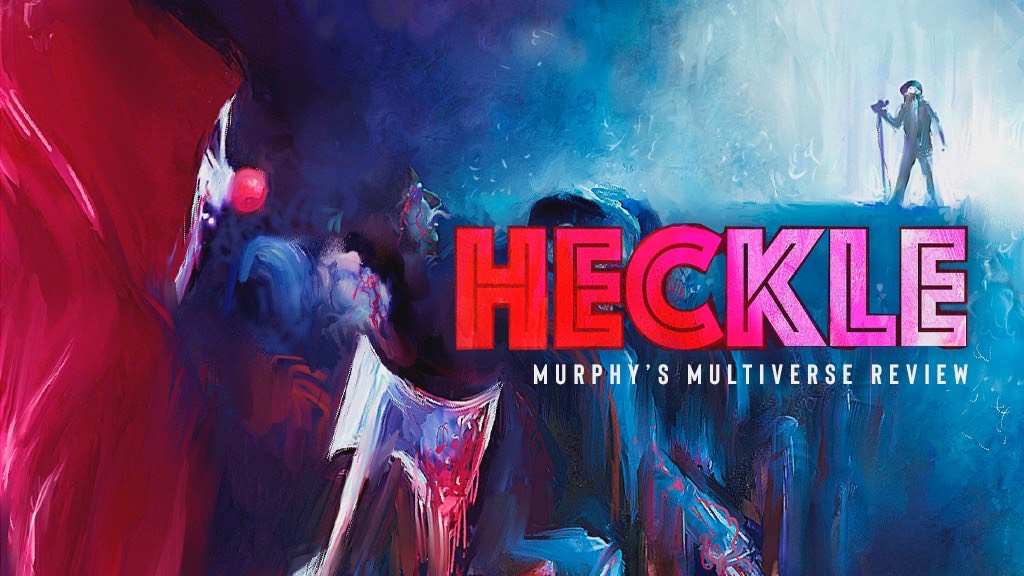
When it comes to indie horror films, some of them can be truly exciting. There’s a sense of passion that drives them, allowing these types of films to succeed in place of their small budgets. (Perfect example: The Last Possession.) Unfortunately, Heckle is not one of those films.
From the moment it begins, it’s evident that Heckle is a cold, stale film. It tries so hard to try and replicate the magic of films before it and ultimately fails. The script is so poorly conceived, and the plot just makes no sense. It’s baffling that the movie exists, and yet, it does. As a fan of horror films, I was thrilled to watch Heckle because the synopsis made it sound like a fascinating new horror tale. If only. Heckle likes to think of itself as smarter than it actually is.
The story focuses on comedian Joe Johnson. He’s supposed to be a big-time comic who is starring in a movie about Ray Kelly, a comedian he looked up to in his younger years. During his most recent show, though, he finds himself dealing with a heckler in the crowd, who makes it clear it will be the worst heckle of his life. What happens next is a bunch of absurdity that never quite makes sense. The heckler goes on to stalk him, or so it seems. It’s hard to tell what’s real and what’s not. The only thing that is certain is that Johnston is a poorly written character with a storyline that is all over the place.
The biggest issue with Heckle is that it tries too hard to be an iconic slasher flick. It tries to pull the best elements from Scream, Friday the 13th and Halloween. The issue is that it doesn’t know how to make use of these elements. Copy and pasting does not make for a good title. It makes for a poor imitation that is sure to leave a bad taste in the mouths of viewers. Even worse? The kill scenes are so poorly crafted. The sounds are off, the acting is just downright terrible and the movements are so stilted.
I wish I could say something positive about Heckle. Unfortunately, there are no redeeming qualities to this film. It feels like a rough draft that needed more time baking but was rushed into production. None of the plotlines truly receive an ending. It’s as if those involved forgot the story they were telling and forgot how to go about ending it. If you’re looking for a good indie film, try The Last Possession. Don’t waste your time on Heckle.
There are two particular jokes in Turning Red that are emblematic of the comedic brilliance of director Domee Shi and co-screenwriter Julia Cho and the confident maturity that Pixar has allowed the film to reach. The first occurs early in the film where protagonist Mei reveals her newfound disposition to her best friends. Her erratic and unpredictable transformations into a red panda have put a halt in their plans, mainly their endgame of attending the upcoming concert of the boy band of their dreams, 4*Town. With a whimpering straight face, 13-year old Mei tells her friends, “Go become women without me.” The second happens shortly after when Mei’s friend Abby shares her displeasure at not being allowed to attend the concert by her parents, “Mine called it stripper music. What’s wrong with that?”
Humor is one of the many defiant traits that comprise Turning Red’s identity. The film, in more ways than one, is akin to its protagonist Mei Lee in that both are at constant odds with their responsibilities and selves. Within the Pixar canon, Turning Red posits itself as the true rebel of the catalog; brash, anarchic, and spunky just like Mei. Pixar films have long examined complex thematics, especially with Pete Docter’s existentialist double-feature Inside Out and Soul, from a heightened fantastical perspective, oftentimes through characters resembling small children.
Soul had 22, a down-on-her-luck soul who can’t seem to find her purpose in life. Then there’s Finding Nemo’s Dory, who in her childlike naivete finds the will to find lost family in the unfathomable ocean. Turning Red departs from this mold with a 13-year old protagonist on the cusp of puberty. The film’s themes, while existentially complex in every sense of the way, are no longer just emotional concepts but physical ones as well. Faced with the overwhelming deluge of hormones, Mei begins to experience everything around her change; her body no longer feels the same, boys elicit feelings she’s never felt, and her parents no longer resonate the same way they did. Both the emotional and physical conflicts Mei and her friends experience allow the space for the filmmakers to examine them through the cultural lenses of a teenager in 2002, all without mincing words.
Domee Shi frames this semi-autobiographical tale in 2002, the cusp of 90s nostalgia and the burgeoning days of handheld tech. A child of that era, Shi uses the cultural touchstones of the era to explore how the characters behave among them. Tamagotchis, flip phones, the first wave of Nokia (or in this case, Jokia) phones, and the boyband antecedents of the era all play a key part in defining who these kids are. The songs by 4*Town – written by Billie Eilish and Finneas – are a particular standout. The duo fuses the new jack swing sound of 90s pop with the dance-pop hooks of the 2000s and the modernity of hi-fi KPOP to create a vibe perfect for this version of 2002.
Contrary to its unruly sense of humor, Turning Red does live up to the Disney brand with its profound and tender sense of heart. Central to this heart is Mei, her mother Ming, and their relationship that keeps that heart beating. Mei, like most Asian children, is weighed down by the expectation of duty and excellence from her stern mother. She’s the top of her class, diligent with extra-curricular activities, honors the family business yet every now and then, feels the urge to not be any of those. It’s only when a generational curse spanning centuries turns Mei into a red panda that those feelings are challenged. By extension, Ming’s role as the well-meaning yet faultless, absolute decision-maker in Mei’s life is also put to the test, as her own dormant trauma is unearthed. Their relationship soon becomes a tug of war between a daughter fighting for identity and a mother escaping from her trauma.
Caught in that tug-of-war are Mei’s friends, who prove to be one of Pixar’s most memorable ensembles in years. Made up of the deadpan Priya, the easygoing Miriam, and the hooligan Abby, whose frenetic wit stands out as a constant scene-stealer, the ensemble is to thank for the film’s funniest and most charming moments. Each of them brings a vibrant authenticity that holds the milieu of the early naughts together. They also not only serve as Mei’s support system but also as a tether to her identity. When the mother-and-daughter conflict comes into view, it’s the friends that are caught in the crossfire. The eventual drama that branches is not only somber but also powerful.
Turning Red nearly falls apart when the torrential family crisis threatens to be an unwieldy explosion of spectacle in its third act; reaching near-superhero levels of scope and literal scale rather than maintaining the intimacy of its earlier conflicts. But director Shi is quick to demonstrate the control she has over the material as she tempers the climax with the emotions of all the characters involved. As the set-piece grows larger, so do the themes that underpin every character’s decision. Character is never lost in the spectacle but also given a chance to shine in a way previous scenes could not. The resulting finale is one that’s not only exhilarating but also full of heart.
Both Mei and Ming are underpinned by fantastic performances from Rosalie Cheng and Sandra Oh respectively. Cheng, who was originally hired as a stand-in while the production looked for the actor they needed, gives a performance so dimensional that you’d be forgiven for thinking she was voicing her 20th animated film. Mei displays a charming yet weighty tenacity onscreen that could only ever work through the candor and earnestness Cheng yields from her voice. The ever so graceful Sandra Oh braces Cheng’s performance with a commanding warmth she engenders in Ming’s spirit. From the mere timbre of her voice, Oh envelopes each scene with a gravitas that gives the space for Cheng to be delicate and vibrant. Though the solemn gravitas eventually seethes into thunderous roaring, Oh never forgets to make it feel heartfelt.
But voice performances can only be so good as a singular element. It falls on the craftsmanship of the animators to make these performances palpable to the eye. Fortunately, Turning Red also happens to be the most expressive Pixar film to date, utilizing a spectrum of techniques derived from anime. An art form known for its stylistic excess, the film embraces the ethos of anime and uses every opportunity to be playful and experimental. Western animation sensibilities are broken frequently as facial expressions frantically contort to mischievous proportions; a star pops up in Mei’s eyes when she’s elated; her pupils shrink to a dot when startled or turn into crescent shapes; giant tears droop from her eyes in times of sadness. Because of this choice, every emote in Turning Red speaks volumes.
Meeting Turning Red‘s anime influence halfway is Pixar’s fidelity to vibrancy and richness. The film’s palette is aptly dominated by hues of red but is also counteracted by Domee Shi‘s vision of a watercolor painting rendered in full 3D. This visual aesthetic is most present during the film’s cutaway dream sequences, where vivid images of unsettling nightmarish creatures plague Mei’s dreams or hazy fantasies of 4*Town flash onscreen, and serene moments of introspection take place in the divine astral realm.
Turning Red marks Pixar’s third consecutive win in a streak of original ideas beginning with Soul and followed by Luca. While franchise installments like Lightyear and Incredibles 2 make stakeholders happy, it’s films like Turning Red that tap into the ethos that made Pixar so great all those years ago. Domee Shi and co. have crafted a film that has all the makings of a Disney classic while embodying a personality and attitude that hasn’t been seen in any of their animated films prior.
It’s not The Dark Knight: I feel like we need to get that out of the way. It isn’t flawless either, nor is it the game changer you’d expect from a director of Matt Reeves’s caliber. What it IS is a grounded take on Batman during a time period we haven’t yet explored on film, and the first two acts are brilliant in that respect. Colin Farrell is money, John Torturro is excellent, and Zoe Kravitz is downright cat-like as Selina Kyle. I love that they had Selina be Falcone’s daughter: it worked in the comics and it worked here. However, Paul Dano tries really hard to chase Heath Ledger’s performance for some parts, although he redeems himself at the end with his monologue in Arkham. Having watched it twice, it now is apparent that the Riddler’s plan was that the GCPD would arrest Wayne for being Batman, put him in Arkham with him, and then they’d be safe from the flooding. In that respect, he failed, but I had to watch it a 2nd time to figure that out so I left my first watch thinking he won. The third act was uneven, and the introduction of Barry Keoghan as the Clown Prince of Crime doesn’t do enough to save it in much the same way Sinestro’s heel turn at the end of Green Lantern didn’t save that film. The difference being the two acts work really well here, with it feeling equal parts Departed and Saw. My gripes with it are that Reeves doesn’t appear to gibe much time to Bruce Wayne (focusing the spotlight on Batman in this is either a choice or just the struggle of directing a exciting portrayal of the billionaire playboy philanthropist), and that there are literal shot for shot remakes from TDK. Namely, the shot of the sniper rifle overlooking the town square is lifted from when Bale is trying to save the Mayor and Gordon gets shot and the Riddler taking out the folks in power almost exactly like The Joker did. Also, you can’t say comic-accurate doesn’t work in this universe he’s crafting, and then have Bats inject himself with Venom. Those are my issues with it, but I give it a 4/5. The third act prevents it from being a classic, but it smokes The Dark Knight Rises and Batman Begins.
Anthony Canton III
The Batman is a film that spoke to the kid in me who read the Long Halloween. There are elements of Year one as well and those are mixed together seamlessly by Matt Reeves. Is it an incredibly long movie? Sure, but the movie’s length doesn’t take away from the story they told here. Robert Pattinson did a tremendous job playing a Batman who had no interest in being Bruce Wayne. It’s a character development that should be exciting going forward. Zoe Kravitz, Jeffrey Wright, Colin Farrell, and John Turturro all have exceptional chemistry with Batman. They really make the film sizzle throughout. Finally, Paul Dano deserves his flowers for making this version of the Riddler as scary and intelligent as possible. This movie had tension, suspense, and great nods to the comics. The most important thing this movie accomplished was it gave some runway for this Batman/Bruce Wayne to grow and not make him fully formed from the jump. I look forward to future installments with different sets of villains as they set up No Man’s Land. The Batman gets a 9.5/10 from yours truly.
Mary Maerz
Overall, I really enjoyed it. At the same time, it didn’t redefine Batman cinema for me and I’m perfectly fine if I could not ever see it again. The visuals and score, unsurprisingly could be incredible. While it was stunning at times, it kind of hit the same note at all times. It was very cohesive, but pretty monotone. For me, that’s why it felt way too long—I’m not against 3 hour movies, but I felt a bit defeated when I realized there was still another 30 minutes left. I would have brought more snacks in hindsight.
I liked the supporting cast more than I expected to, which is saying a lot because I was expecting them to be good. Robert Pattinson was great, but I have no idea how someone gets “best Batman ever” out of that. He just did not have the specific presence enough to be irreplaceable in this movie. And that is not a shot at Pattinson, but more of a comment on the script and the way this movie portrayed Bruce Wayne/Batman.
The Riddler was great in the first act, I felt like he disappeared completely in the middle, and then flopped a bit in the final act. While the build up of the character is awesome, but his end game sort of erased his “grounded serial killer” attitude and turned him into a much cornier and pretty average comic book villain. I think a lot of the nuance was lost when his motivation and final move were revealed.
Overall, I’d give it a 7.5/10. But it seems like it’s easier to talk about the negatives when I’ve heard that it was the greatest comic book movie of all time for years. It was good and extremely well-made with its cinematography and score in particular, which is a very standard take. It knew how to be dark, grungy, and delightfully uncomfortable. And it did what it did well a lot. Zoë Kravitz stood out more than anyone, and I really really enjoyed Jeffrey Wright. Like all movies, it was not perfect and not for everyone. I do not personally think it will singlehandedly change the genre, but it’s great that it adds a relatively unique vision to the conversation.
Charles Murphy
For the time being, The Batman is going to remain a riddle to me. Wonderfully acted and beautifully shot, the film left me with some questions and concerns about the future of the character. I appreciated the patience with which director Matt Reeves set up the film’s mystery; I never felt like I was bored nor that the film wasted time. That patience gave the film time to show a side of Batman that hasn’t been properly explored in live-action films and I enjoyed it. Robert Pattinson’s pensive Batman might be my favorite version of the character so far, though further viewings of the film will be necessary before I can really be sure. The film gave him some great Batman lines (the your blood or mine one was a favorite) and provided a wonderful foil in the from of Zoe Kravitz’s Selina Kyle, who certainly had an impact on the Caped Crusader. Between his “loss” to the Riddler and his time with Catwoman, Batman will be forever changed and the film ends with the hint that when we next see him, he’ll be a very different man, and that fits wonderfully with where the character is in his journey.
My concern is that, for a film that is meant to be a jumping off point for a decade worth of Batman-related content, it feels VERY narrowly-inspired. Watching this film, it’s easy to get the idea that Reeves’ model of Batman was developed by reading the works of Frank Miller and Jeph Loeb. While each of those writers brought something absolutely fascinating to the character, honing in on their takes could potentially mean forsaking some of the other things that have truly defined the character over 83 years of stories. Could Ra’s al Ghul exist in this world designed by Reeves? If not, a wealth of stories and characters that come from that corner of mythology can’t either. Could any of the more fantastical characters exist here? If not, another corner of what has defined Batman over the years can’t be explored. Reeves’ Gotham seems like a bad place with bad mob guys and dirty cops, and if that’s all it is, I don’t care to see more of it. I want to see Clayface. I want to see Robins, all of them! Those things all seem like they’d take a huge leap from where Reeves feels comfortable. Had this been a one-off and not a film meant to kickstart a whole universe of spinoffs and sequels, I think I would have enjoyed it more.
John Sabato
After three viewings of The Batman, it is everything I’ve wanted to see in a Batman film. We have a Batman that lives by his code, who is vehemently against the use of guns and killing. Pattinson embodies Batman perfectly and is the first to truly embrace the world’s greatest detective aspect of the character. Every single one of his supporting characters and antagonists are perfect and feel definitive to me. Jeffrey Wright as Gordon works incredibly well alongside Batman; Zoe Kravitz is the perfect parallel to Batman; Colin Farrell’s Penguin was hilarious. Paul Dano’s Riddler, however, was a fantastic reinvention of a character who has previously only seen quite goofy adaptions. Dano especially shined in the scene between him and Batman in Arkham. Overall, while at times I do think the film could drag a bit, and it is long, the third act really shined for me and by the end I just wanted it to keep going. The thought of having to wait so long for a sequel is killer.
Hunter Radesi
If Matt Reeves did anything right in The Batman, it was the atmosphere. There’s been a lot of comparing this film to The Dark Knight, once considered the definitive take on the character, and in this regard, Reeves blows Nolan out of the water. From the film’s opening moments, it plays with the iconography of Batman and Gotham in ways that make you fear the vigilante and his city right alongside its fictional inhabitants. It often feels like a Black Series comic come to life, teetering on the edge of brooding noir and cornball camp. A lot of the film is what I’ve always wanted to see in a Batman adaptation, with secrets of Gotham unearthed and the protagonist used as both a true detective and a force of nature. However, it’s not without its flaws. Parts of the overlong plot tend to lose their steam, and some baffling choices are made in regards to the Batman mythology. Overall, the film is a beautiful take on the character with room for improvement in an inevitable sequel.
Joseph Aberl
The Batman is a curious piece that echoes David Fincher‘s noir era of storytelling. In his second year, Robert Pattinson‘s take on Bruce Wayne is damaged and lost to his own obsession with vengeance. The film plays strongly with those emotional ties and intersects it with a strong noir mystery that keeps you on your toes throughout. The sound design is what truly grips you in, especially with some shots focusing primarily on the threat that is Batman. The use of shadows for the character in making it believable why criminals fear him is a standout moment and may be the character’s best on-screen introduction. Yet, I will say the soundtrack does tend to feel like it is on repeat at times and doesn’t truly stand out as it could’ve. A lot about this film relies on subtlety to focus on the atmosphere it creates rather than becoming a pure fan-pleasing film. Still, it may be one of the best adaptations of the comic’s version of the character and a great start into what may be a very unique franchise.
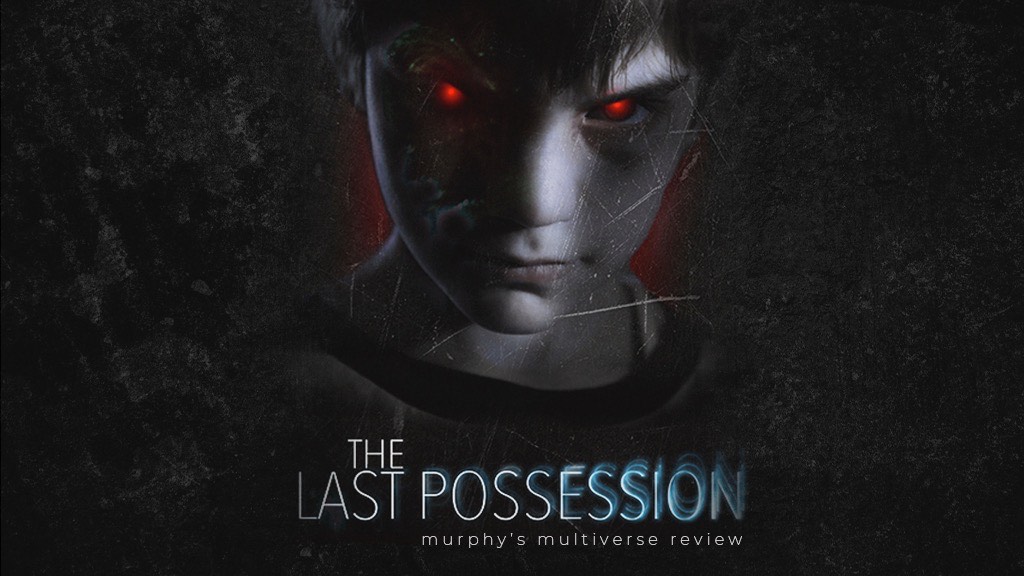
Every now and then, there manages to be that one indie horror film that surprises. The Last Possession appears to be just that; on the surface, it seems like the everyday horror, one that relies on sounds and quick glances to scare. And sure, that is true to an extent, it still manages to produce an impressive ending that is impressively terrifying. However, The Last Possession takes unexpected risks that craft an interesting horror story.
When The Last Possession begins, we meet a young family that is in the midst of moving. The two parents and their children are unpacking their boxes and moving into the house left to the husband following his father’s death. It’s the pretty standard opening for a horror flick, especially a B-horror title such as this one. There’s an uncertainty among the four family members, with the son questioning why he was left the house and the kids trying to make the new place feel like home.
The film stars Stephen Brodie as Kent, Cassie Shea Watson as his wife Stephanie and Sawyer Bell and Lourelle Jensen as their children, Jack and Gabby. The foursome are relative newbies, all with minor credits to their names, for the most part. While all manage to successfully capture the sense of a family on edge and questioning the unknown, the kids manage to be the standouts — especially Bell’s Jack.
As for the cinematography and soundtrack, both are admittedly a bit underwhelming, but they do serve their purpose in crafting the environment. It’s just that neither are memorable once the credits roll, which is a bit unfortunate. Especially as the final scene in the movie allowed for some great moments on both.
Director Dan Riddle does a good job helping to bring life to Greg Shouse‘s screenplay. This marks the first full-length feature for both, and it’s clear if given the chance, both parties can craft something magical. One can only hope Hollywood gives them more chances to tell their stories.
The Last Possession is a thrilling little horror movie that is sure to leave viewers on the edge of their seats.
When Kurt Cobain wrote “Something In The Way” in 1990, he was believed to be lamenting a period of hardship and homelessness he lived through a few years prior. Legend had it that Cobain spent those days living under one particular bridge in Seattle, dreaming of befriending animals and eating fish. Over the years, people in Cobain’s circle would refute that story, saying he hung out frequently under bridges but never actually lived under one. Cobain himself later told a biographer that the song was about his fixation of being in the gutters of life. That a song about a despondent fantasy would eventually bookend the album that would catapult Cobain into one of the most financially successful musicians in the world is not without irony. That director Matt Reeves would go on to use this song as his entry point to craft a Bruce Wayne so desperate to be in the muck and grime of Gotham is of no coincidence.
Robert Pattinson first introduces his reclusive rock star edition of Bruce Wayne through a series of diary entries. Vivid images of Gotham in Halloween flash on the screen as Bruce Wayne broodingly walks through its filthy streets, monologuing about the damage the city has inflicted on itself. Pattinson’s intro as Bruce Wayne is rooted in such curt nihilism that audiences would be forgiven for thinking he was reading aloud Rorschach’s journal. No stranger to the most despicable of characters, Pattinson fashions a Bruce Wayne that loathes being Bruce Wayne day in and day out. His take on the fabled playboy millionaire is the coldest the franchise has seen yet; it is distant and unwelcoming, a far cry from Ben Affleck’s hedonistic Adonis. The performance speaks to the isolation Wayne wears in his sleeve daily but can oftentimes linger for too long. Even with an interpretation as sincere as Pattinson’s, there’s a lot to be desired from this version of Bruce Wayne, as the actor forgoes a lot of the character’s touchstones.
When Bruce Wayne sees the Bat-signal lights up the rainy sky, Reeves, cinematographer Greig Frasier, and composer Michael Giacchino pull into focus the most cinematic Gotham in the franchise’s history. Giacchino’s doom-laden crescendos make every shadow in every alley and street corner feel abyssal. The heat from Gotham’s pavements and the rain that falls on it create hazes that glimmer from the fading neon lights of its establishments. Frasier captures every bit of beauty nestled in the filth that every frame could be a postcard. It’s a Gotham whose atmosphere is so inviting and texturally rich that it feels inhabited by all kinds of Batman characters antithetical to the realism Reeves keeps insisting on. This Gotham isn’t by way of Michael Mann’sHeat. It’s Spielbergian, a masterfully crafted world bolstered by a trifecta of direction, photography, and scoring. A world that’s full of mysteries, secrets, and beings waiting to be found.
The refrain of reactions from those who have viewed the film in advance proclaim The Batman to be one audiences have never seen. While that rings true in a certain regard, the film revisits ideas and influences prior films have covered. The Batman is indebted to Bat-authors Frank Miller and Jeph Loeb, whose work served as the foundation for the Nolan films. Matt Reeves contends that his story isn’t an origin story despite the text heavily featuring a Batman fresh on the job and the death of the Waynes as the thematic and narrative centerpiece. Year One and The Long Halloween seem to be all but permanently ingrained in these early-days, utilitarian live-action depictions of Batman and so by design, Gotham’s mobsters and police department play key roles once more in this.
Novel to this Batman film is its focus on the character’s hardboiled detective roots. From the film’s opening sequences alone, Reeves firmly makes his statement that his Batman is a noir thriller. Like any capable noir film, The Batman bides its time – almost to a fault – in unraveling a mystery and sees Batman and Jim Gordon devote most of their screen time gathering clues, deciphering evidence, interrogating people, and, occasionally, busting skulls. Gadgetry and intuition coalesce into highly watchable scenes of intrigue as layers of the Gotham underworld are peeled. However, even Reeve’s vision of a laser-focused and meticulous detective mystery loses its step thanks to a finale that collapses from the density of the material.
The Batman’s finale sees the pursuit to capture the elusive Riddler vanish, like a thief into the night, to make way for a spectacle of calamity that almost feels conceived through executive meddling. The set-piece primarily functions in the plot as an adrenaline shot to its lethargic pacing to give it some much-needed urgency. Previously absentee players are jammed into the sequence in order to broaden the stakes. While the set-piece allows Reeve the space to frame his own iconic Batman action moments, it’s an unwieldy finale that’s unfaithful to the film’s own ethos. Considering it comes abruptly after nearly 3 hours of patient sleuthing, it feels unwarranted. Perhaps this was Reeves’ best way of compromising some of his vision to accommodate high-flying action expected in these kinds of films. Regardless, it causes the film to stumble the landing.
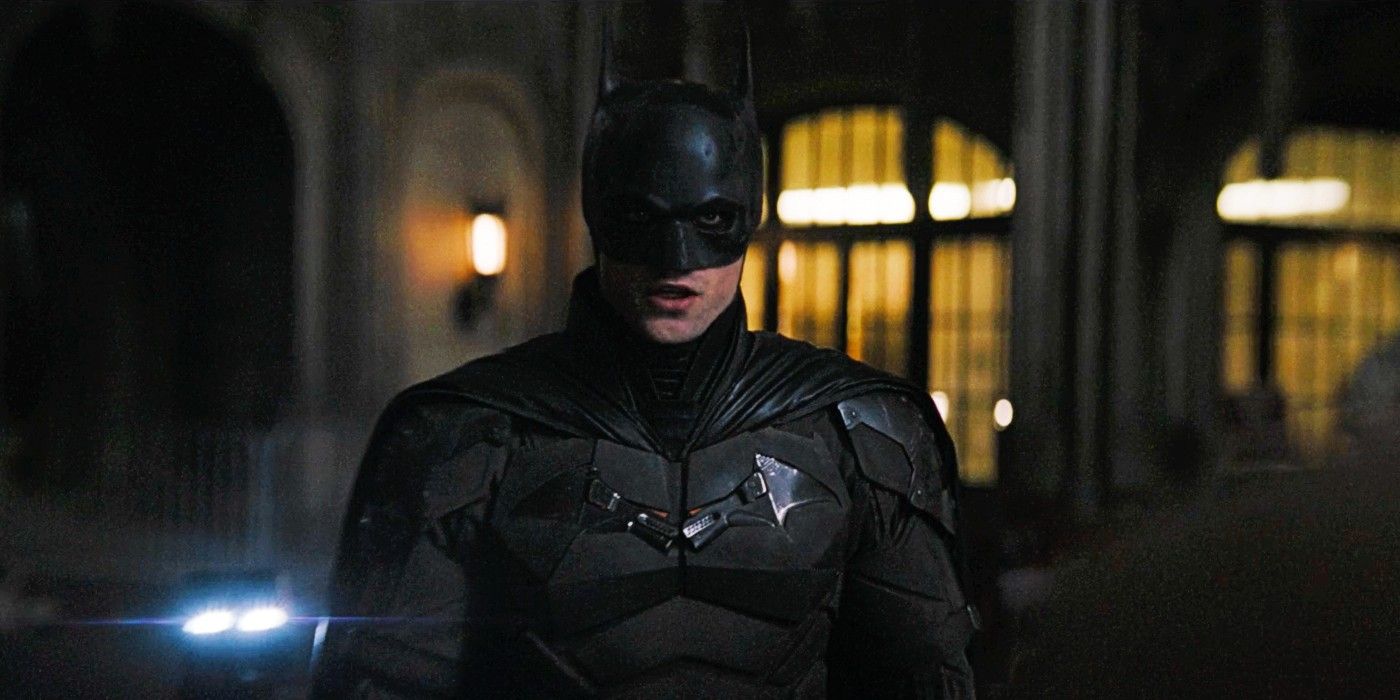
For the handful of flaws The Batman has – such as a car chase that’s almost unwatchable and a Paul Dano that’s kept off-screen – it makes up for with a cast assembled out of a painstaking vision that begins with Pattinson’s Batman. Pattinson does little to discern the man from the cowl, so the distant Bruce Wayne is one and the same as the vigilante. Fortunately, the coldness Pattinson distills into his Bruce Wayne results in a Batman whose mere stillness in the shadows invokes fear and dread. From this stillness, Pattinson derives a spectrum of emotions ranging from seething rage to deep melancholy. The days are too early to declare Pattinson as the best Batman yet but he nonetheless makes an impressionable mark. His costume, at the very least, is the best one yet.
Opposite Pattinson is the strongest Catwoman put to screen. Zoe Kravitz as Selina Kyle is mosaic; angry, discontented yet loving and nurturing. Much credit can be thrown at Bat-writer Tom King, who revitalized the Bruce-Selina romance in a way the comic hasn’t seen in years and whose influence is evident in the film, but it’s Kravitz who puts in the work. Kravtiz delivers a sultry and tempting performance that never feels gratuitous even during her displays of passion. That her chemistry with Pattinson is so alchemic is a testament to the emotion she wields at ease onscreen.
There’s a lot to be said about The Batman’s fidelity, or lack thereof, to the whimsical nature of the source material. Paul Dano’s Riddler, as much as it is a blatant co-opting of the Zodiac killer, surprisingly stays true to the theatrics of the comic version. Reeves even gives us a Riddler that uses convoluted death traps on his victims, which we sadly don’t get to see. Dano even goes so far as to adopt the often gleeful and sardonic twitchiness of the character. The Batman’s screenplay, unfortunately, relegates Riddler to news splices and corny live streams, rarely giving Dano the space to display these flourishes, let alone be physically present. In the few moments Dano shows up, however, he gives Riddler a wariness that’s as contemptible as it is playful.
Lastly, an unhinged Colin Farrell and the always-resolute Jeffrey Wright round up the principal ensemble as Penguin and Jim Gordon respectively. Farrell essentially disappears in the role, thanks to incredible prosthetics and makeup, which allows him to give the Penguin an unfounded scumminess and despicability that is highly entertaining. Jeffrey Wright’s Gordon, on the other hand, finally gets to be the ally Gary Oldman’s Gordon never was. Wright’s Gordon is stern but never callous. He understands the necessary evil of Batman but also of its pitfalls. Like Dano, Wright doesn’t quite get the space he needs to explore the character but he nonetheless gives Gordon an optimistic determination that works in tandem with Pattinson’s cynicism. The dynamic between Batman and Gordon doesn’t quite reach Riggs-and-Murtaugh levels of charm but there’s an unquestionable buddy-cop energy beneath it.
Once more, the Bat-franchise continues to be a fruitful proving ground for auteurs. The increasingly formulaic early days of Batman manages to take on a new form through Matt Reeves’ sheer will and vision. The Batman falls shy of topping the narrative and emotional highs of The Dark Knight but manages to paint a lasting image of Batman, Catwoman, Riddler, and Gotham that the world has yet to lay its eyes on. Let this be the Batman of a new generation.
Following The Dark Knight, which is arguably one of the greatest comic book films, was always going to be an unenviable task for Christopher Nolan and his team. That the conclusion of the trilogy had to be almost entirely repurposed after the tragedy of Heath Ledger‘s death meant that his original premise for Batman’s three-film arc was never going to be completed. In that respect, The Dark Knight Rises feels like a movie that didn’t really know what story it wanted to tell, and suffered as a result.
We begin with the canonization of Harvey Dent as a hero by the Gotham City Police Department after his death trying to stop Batman, which we know is a lie given the events of the previous film. Harvey was the Joker’s ace in the hole, and he was meant to bring Gotham crumbling down. In Rises, we see Gary Oldman‘s Commissioner Gordon desperately to make things right. His role is perfectly summarized in the line “I have to save Dent” from the previous entry; manic depression and all. Sadly, The Dark Knight Rises really doesn’t do his arc justice. His role is seemingly reduced by quite a bit and is cast to the side for other characters.
Speaking of, we meet Anne Hathaway‘s take on Selina Kyle doing what she does best, trying to rob Bruce Wayne. He easily tracks her down to start their dysfunctional relationship from the comics. However, putting aside the missed opportunity that this Selina Kyle is never presented as Carmine Falcone’s daughter, Anne plays her like a socialist who wants the wealthy class to get what’s coming to her. It’s a very weird turn if you compare it to her character in the comics. While I get that directors update and adapt characters as they see fit, Nolan still kept recognizable elements in his last two entries. This time around d, it just doesn’t work as well as it could’ve, and I can’t help but wonder if she wasn’t even meant to be part of this story.
Let’s turn our attention to the real villain in the story: how it wasted Marian Cotillard as Talia Al Ghul. The reveal is supposed to act as a gut punch but is telegraphed throughout the entire film. Furthermore, she’s never really built up as a threat. Even though she managed to steal Bruce’s company from him, cut Gotham off from the rest of the world in a half-assed take on No Man’s Land, and threatened to end the entire city, I never bought that she could pull this off.
There are, however, some bright spots in the film. Tom Hardy taking on the role of Bane was an inspired choice, especially in him breaking the bat. This is a historic moment in the comics, and Hardy sells the threat that his character represents. Even with his weird accent, he is incredibly quotable to this day. He’s not angry with Bruce. This isn’t personal to him. He’s just disappointed in Bruce. Their fight in the sewers is brutal, as there’s no music playing, and all we hear are Bruce’s bones cracking. He does his best Frazier impression but Bane delivers the Ali-like beating.
Of course, we can’t forget the titular Dark Knight. Christian Bale is one of the better actors of his generation, and he carries this film more than anyone else. Yet, Nolan seems to have trouble fitting Bruce into this story. He makes him disappear from Gotham to rehab his broken back in and tries to sell us on him healing up within a short span of time to return to Gotham. Keep in mind, he has no assets at this point in the film: it’s why he had to sell his company to Talia Al Ghul. Even with those restrictions, he still offers a cunning performance.
This time around, he does get a sidekick in the form of Joseph Gordon-Levitt‘s character. Yes, he has a name but they make it a point to call him Robin later on and he was clearly being set up to be a version of Nightwing. However, the pain he feels when describing how the Wayne Foundation deserted the less fortunate and how betrayed he was when Gordon lied still hit hard. He, also, isn’t jaded by what he’s seen and still believes that Gotham can be saved. It would’ve been exciting to see Nolan try to crack a film starring a rookie Nightwing living in the shadow of Batman.
If there is one thing the film nailed better than the previous entry is in its action choreography. The police taking on the League of Shadows is filmed beautifully, and the modified Batwing scenes fighting the repurposed Batmobiles are a blast. With most of the finale’s action shot in the daytime– quite a departure from the two previous entries–you really get to see every punch.
When I watched this in theatres 10 years ago, I tweeted “Nolan did it.” At the time I meant killing Batman. I’m still of the belief that Alfred was imagining everything and nothing more in that Italian Cafe. I didn’t think Warner Bros. would let him kill one of the most iconic DC heroes, but Nolan had the cache to really do as he pleases with the character. While rewatching the film for this review, I find myself annoyed at some of the choices he made. He sadly didn’t end the trilogy on a high note all of us hoped for. It’s still the best Batman trilogy, but something tells me Matt Reeves might have something to say about that soon.
Much like the spoken lines of the film, The Dark Knight is the film we deserve, but without the “not the one we need right now“. It is without a doubt that the Batman franchise has seen better days. What was once one of the front runners in superhero films with Christopher Nolan and Christian Bale‘s take on the character, has mostly gone down in quality since one of the greatest superhero trilogies wrapped up with The Dark Knight Rises. His next two appearances, Batman v Superman: Dawn of Justice and the Justice League were panned by critics. Not only was The Dark Knight the movie we deserved from the franchise, but also an inspiration for the movie we need right now. One to restore Batman as one of the best superhero properties in media.
The Dark Knight is largely considered one of the best Batman movies of all time. Thinking back to watching the trilogy for the first time, I remember watching The Dark Knight most out of the films. The dynamic between the Joker and Batman is a match made in heaven. Not only does Heath Ledger remain as my favorite iteration of the infamous villain – even if not comically accurate – but his ability to so easily bounce off of Christian Bale‘s Batman is one of those dream pairings in modern media. The two actors act out the relationship between these opposites amazingly. Batman is portrayed as the morally aligned superhero that does not care about fame and only cares about the people of Gotham. Joker, on the other hand, is the perfect portrayal of “some men just want to watch the world burn”.
This dynamic between the hero and villain carries this movie. Not to say the rest of the film is bad, the movie basically perfected the modern superhero genre. However, when you have such a standout part of a movie, it’s hard not to accidentally overlook the rest of the film’s strengths. That being said, not all of the movie has aged well 14 years later. The plot still stands firm, the cinematography is still amazing, yet the combat, however, stood out to me in my recent rewatch. Once again, I do not think this is a fault of the movie, the combat was definitely ahead of its time and nothing in the film is going to be considered qualified for eternity. It was a tad jarring going back to one of the most beautifully shot superhero films and going back to stiff action scenes compared to the fanfare we see in today’s films in the genre.
Superhero films today are flashy, from acrobatic magical martial artists to colorful guns with a mix of explosion and beauty. Modern technology has progressed the abilities for moviemakers to put us into the colorful and flashy pages of a comic book. While this does make the combat of the film feel stiff nowadays, I can’t help but feel this departure from the common superhero tropes of the modern-day really makes The Dark Knight stand firm as one of the most unique superhero films. And in a good way, opposed to the unique but odd Batman Forever.
The Dark Knight is gritty, dark, and violent. The Joker in this form just couldn’t be done without this atmosphere. The man with no morals is sinister, manipulative, and even worse, fearless. This excellent villain to the already serious Batman really puts the character on his toes, I don’t think I have quite seen a hero so powerless since this film. Not even mind control in Jessica Jones and Avengers: Age of Ultron can quite compare. When powers or physical control are involved, there is a thing to break, a thing to fix.
The thing with Joker is that none of that is involved. This is a man with no powers or high-tech machines, just a desire to take down the heroes of the world and prove humanity’s flaws. This desire and his cunning makes him powerful. His insanity and his unpredictability, that is what give him power. That power makes him real, a man that could exist, one that would terrify even the best of us in the real world. That is what makes the Joker easily one of the best villains in modern media.
I didn’t have a definitive ranking of my favorite Batman films, but upon rewatching many of them leading up to The Batman releasing next month, I think it’s safe to say The Dark Knight easily tops my list. The Nolan trilogy of movies is easily the highest quality in my eyes, and this is the movie that makes the trilogy. From a perfect atmosphere to an amazing villain and hero, the film is almost perfect. Now looking back, not only is this easily my favorite DC film, but one of my favorites of all time, and that is coming from a die-hard Marvel fan. The Batman is looking like a snapback to this amazing quality, and I truly hope it leads Batman back to being in the spotlight like when The Dark Knight launched to critical and financial success more than a decade ago.
Batman Begins kicked off Christopher Nolan’s Dark Knight Trilogy, which has gone on to become an integral part of the world’s conception of not only Batman but also superhero movies in general. While debuting in 2005, Batman Begins is a far (at least 4,350 miles) cry from the last Batman flick—1997’s critical Titanic Batman & Robin. While Batman Begins no longer feels like anything particularly special, there is no doubt that it ushered in an era where superhero movies are taken seriously, both by critics and broad audiences.
The production value of the film is off the charts. Seventeen years later, it still feels natural to watch and does not struggle too much with outdated visuals or storytelling. Helmed by 11-time Academy Award winner and acclaimed director Christopher Nolan, it is obvious that the film’s baseline quality was one of the most important characteristics of Batman Begins. This next paragraph is about to be obnoxious, but it makes a point.
The movie stars Academy Award winner Christian Bale as the titular Batman, Academy Award winner Michael Caine as Alfred, Academy Award winner Gary Oldman as Commissioner Gordon, Academy Award nominee Liam Neeson as the villain as Ra’s al Ghul, Golden Globe nominee and the guy with the super intense eyes Cillian Murphy as Scarecrow, and Academy Award winner and global treasure Morgan Freeman as Lucius Fox. Batman Begins is scored by Academy Award winner and legend Hans Zimmer, and the Batsuit was even designed by Academy Award-winning costume designer Lindy Hemming. These likely only scratch the surface of the level of talent brought in for Batman Begins and The Dark Knight Trilogy.
Aside from the output quality, the story comes across quite differently than most—if not all—superhero movies to come before the film. The focus is on Bruce Wayne himself. His own personal demons and battles drive the narrative rather than fantastical, caricaturized, and shallow shiny-costumed heroes or villains. Rather than the adversary being campy or corny villains taken straight out of a classic comic book, Batman’s fight is ultimately against the manifestations of long-lasting systemic crime in Gotham City. There is an element of realism in Batman Begins that frankly did not exist before in the cinematic genre. The film takes its time—albeit a lot of time—to try and explain Bruce and his origin like a fully-established character. We are not just given the Bat. We have to earn the Bat.
Batman Begins is certainly not perfect. Watching it now, it can be rather dull and boring at times. While systemic crime is the real culprit, a somewhat messy mixture of Ra’s al Ghul, Scarecrow, and Carmine Falcone make up the individual villains. Because each is diluted, none have the presence of an actually foreboding villain, but the combination and realism influence gives the movie more of its well-rounded and structurally-solid qualities. One thing that the movie provides that was surprisingly refreshing upon re-watch is the steady building of Batman’s arsenal. As far as previous Batman movies are concerned, Batman already existed and had his awe-inspiring collection of gadgets, gear, and Batmobiles. Here, watching it all play out with genuine attempts at describing how Batman’s stuff works is nice.
At the end of the day, Batman Begins feels now like an overtly middle-of-the-road, standard high-quality superhero movie. With its level of realism, it honestly simply feels like a “not bad” general action film. Still, the fact that the quality of Batman Begins is now something ordinary to talk about in the genre is something taken for granted now. As another reminder, Batman & Robin was released only eight years before Batman Begins. Now, the internet goes insane over a 4-hour, black-and-white director’s cut of a superhero film fans felt let down by, and perfectly OK Eternals is absolutely slammed for each and every potential weakness because it touted itself as being both “cinema” and a superhero movie. That type of discussion only exists because of the legacy and influence of The Dark Knight Trilogy, which in turn came into existence with Batman Begins.
The fourth and final film of what was originally the Michael Keaton-led Batman franchise is famous for being a disaster. Twenty-five years later, the 1997 Batman & Robin is still looked at as one of the worst – if not the worst – superhero movies of all time. Countless things are wrong with humanity, but this might take the cake. Batman & Robin is, quite possibly, one of the greatest films the genre has ever produced and easily one of the most enjoyable things one could possibly do on a Wednesday night after a bottle of wine. I have no problem comparing it to The Godfather or Citizen Kane, maybe because I haven’t seen them. But I can say for certain that Batman & Robin is a cinematic masterpiece for anyone with taste.
Batman & Robin doesn’t mess around – it is about Batman & Robin. George Clooney’s Bruce Wayne alongside Chris O’Donnell’selderly Dick Grayson is a masterclass in the exploration of complex character relationships. From the moment the Batman & Robin logos form a bond in the opening credits, the movie screams “two’s a party, but three’s a crowd.” It is incredibly weird and uncomfortable that the two of them spend most of the movie fighting over Uma Thurman’s Poison Ivy, especially considering Robin is supposed to be…a kid? Realistically, that man looks 57-years-old, so this secondhand embarrassment of a dynamic is a little less creepy. Not really. But this nails-on-chalkboard-adjacent feeling is one of the many unique experiences on the emotional tapestry that is Batman & Robin.
Otherwise, Dick spends the film in either adolescent angst or midlife crisis demanding respect from the man who brought him straight home after witnessing the deaths of his entire family to throw him in a suit with detailed nipples and give him a moped instead of Batmobile. To be fair, considering he could be 74-years-old, it is hard to blame him for being angry that he is treated like a child. But still, much of his motivation to stray from Bruce revolves around their shared interest in being erotically murdered by Poison Ivy without consent. Is there any better way to show that two men can have an emotionally close and healthy relationship than to bond over the downfall of an attractive evil woman? No.
Past that, whatever train wreck Poison Ivy was is better left mostly unacknowledged, among others (Bane). The real villain of Batman & Robin – the future governor of the State of California when it was filming – is, of course, Arnold Schwarzenegger’s Mr. Freeze. There is so much to say about the guy, but it’s pretty simple: he is great. He looks amazing – even if his personal traveling hockey team is less impressive – he only speaks in ice pun so that you don’t forget he has ice powers, and his background motivation is relatively fleshed out (his wife is floating in a tube). Mr. Freeze (and Poison Ivy as well to be fair) has global-destruction-level ambitions. It is not entirely clear why someone trying to reverse climate change on the entire planet has such a Gotham fixation, or why the New Jersey National Guard never gets involved when the City is constantly overrun with overindulgent mass murder with no defense but squabbling homoerotic father-son rubber-suited bird people.
At a certain point, you realize that Alicia Silverstone’s Batgirl/Barbara Gordon is also in the movie. She is not necessary. None of this is strictly necessary, but anyone watching Batman & Robin is just trying to be involved in a Mr. Freeze/Poison Ivy/62-year-old Robin plot smoothie. Frankly, no one cares if she breaks out of a mansion to go street racing or soul-crushingly guesses passwords to top-secret information given to her by Alfred: “ALFRED”. She also ruins the “three’s a crowd” analogy because the moral of the story is apparently that three makes a happy Bat Family, but getting into “keeping it in the family” is maybe too much right now.
Batman & Robin does give a touching ode to Michael Gough’s Alfred, the only consistent part of the four-movie franchise. Gough is basically the only person who was willing to see Batman all the way to the end. Even when you said, why is Batman fighting penguins? Gough was there. Even when you said hey that’s not Michael Keaton .. or Val Kilmer! Gough was there. Even when you said why is Robin 47-years-old? Gough was there.
I know what you’re thinking. Why am I reading this review at all? More importantly, how has this gone on so long without mentioning how Batman & Robin sparks more joy than Marie Kondo could even dream of? If you cannot enjoy nature or tents, or fires, or nights, then yes, Batman & Robin – the campiest piece of media that has ever been produced – is probably extremely painful. I wouldn’t know, because even though I’m normally not the biggest fan of camp, I have never laughed so hard in my life as I did while watching this movie, and it is the most fun I’ve had with a movie in a long time. When I said this movie was for people with taste, I meant that anyone who can laugh alongside this movie is in for the time of their life.
Every single frame of Batman & Robin is cornier than 300 dad jokes combined. It is entirely consistent, and it has no crisis of identity. Everything matches. The sets match the costumes which match the characters which match the dialogue and on and on. There is no way in Mr. Freeze’s frozen hell that it is unintentional. The dialogue and delivery throughout the film are also the worst and corniest you can possibly come by. You have to work hard to stay at O’Donnell’s impressive level of convincing the audience this is the worst acting they have ever seen.
The only tragedy of Batman & Robin is that it can’t be summarized coherently. It just absolutely makes no sense but in the best way. Poison Ivy dressed as a gorilla does a sexy dance 20 feet in the air at a benefit where costumed Batman and Robin are acting as props to a crowded auction that they intentionally lured a mass murderer (the sexy gorilla) to. The action level in this movie compared to its predecessors is off the charts. The Dynamic Duo flies around in ways that make Olympics gymnastics look like walking. At one point, they surf the air. Not much to add to that. Robin is 49-years-old, and he owns it. There are gender-neutral but extremely aggressive closeups of Bat people putting on their suits. I would say you can’t make this stuff up, but clearly, someone already did. And for that we give thanks.
True, director Joel Schumacher has indeed publicly apologized for how bad Batman & Robin is. And listen, if you want high-quality cinema, character development, storytelling, dialogue, or logical thinking, look elsewhere. This is not for you. It will probably always be a mysterious and unhygienic-looking cocktail of joy, but it is pure joy if you have a taste. Were the 1990s hard on Batman? Sure. But Batman has his 56-year-old Robin by his side and if that doesn’t make you smile, nothing will.
Of the countless adaptations to come out of the Batman mythos, Batman Forever has always been the hardest one to pin down. The film, released to financial success and critical failure in 1995, never really managed to obtain a solid identity. While Tim Burton‘s prior films were clear in their aspirations of a darker tone, and franchise follow-up Batman & Robin was infamously committed to being a real-life cartoon, Joel Schumacher‘s first venture into superhero movie making was a little less defined.
As a result, the movie has become somewhat of a “forgotten installment” in Batman’s cinematic history. Not as silly as its sequel, but still a far cry from the graphic material of its predecessors. It’s likely that this is the reason many have failed to remember the crowning achievement of Forever, rising to claim a title that has yet to be truly challenged. It can be argued that the film does indeed have an identity and one that makes it very special. To this day, there has never been a hornier Batman movie.
Yes, I have seen Batman Returns. I am very aware of the tension Michelle Pfeiffer brought to the table and the sparkling chemistry she shared with Michael Keaton‘s Bruce Wayne. Trust me when I say, after back-to-back viewings of both films, that Forever earns this honor just a little bit more. Before I get to dive into why it should be clarified that I actually think Val Kilmer‘s one-and-only romp in the Bat-suit is an all-around much better film than it gets credit for.
It seems audiences found it fairly easy to dismiss the project when it came on the heels of the excellent Burton installments, flagging it as a waste of time and moving on rather quickly. However, this ousting does not take into consideration any of the reasons the movie is how it is. After the wildly adult themes and imagery of Returns, Warner Bros. wanted a threequel a little closer in tone to the campy adventures of Adam West‘s Caped Crusader and a little further in tone from the Creepshow vibes of Danny DeVito‘s child-murdering, potato-sack wearing Penguin. Conflictingly, the studio also still wanted the movie to be in line with the world established by the previous entries.
Honestly, with these goals in mind, Schumacher no sort of nails it. Forever is the perfect mix between West and Burton, with goofy surrealistic villains and over-the-top character archetypes stirred into the established pot of gothic neon gravitas brewed by the first two films. Despite Chris O’Donnell’s Dick Grayson mostly being the worst character on screen at all times, his scenes with Kilmer surprisingly make for some of the more earnest Bruce Wayne content caught on camera.
Though often a bit on the nose, Forever takes its look into the psyche of Wayne seriously, giving fans both sides of his coin in equal measure. Speaking of which, Tommy LeeJones‘ Two-Face and Jim Carrey‘s Riddler are maybe better antagonists than you remember. They’re not really threatening, and both are basically just new skins for the Joker, but it is immensely comical to watch them chew up screen time. The laughs don’t always come when the script might have intended, but they will come.
The emotional crux of the film is where we re-enter horny territory. Again, this is a movie that hopes to explore the duality of Bruce Wayne and the Bat. The title itself comes from a line in the film in which Wayne declares that he’s accepted his demons and chosen to be “Batman forever“. It’s just the way the story decides it will demonstrate this is questionable at best, or not to be questioned at all, depending on your configuration.
Bruce is forced to confront the longevity of his double life when he meets Dr. Chase Meridian, played by AMC spokesperson Nicole Kidman, and realizes how badly he wants to get laid. The problem is that, while Dr. Meridian also wants this, she is far more interested in the mystique of Batman than any amount of charm or money Wayne can throw at her. What comes of this is an enthralling cat-and-mouse game of two people with deeply rooted psychological issues and massive libidos. I’m no professional, and I can’t diagnose why this is true, but something about this conflict is far raunchier than anything Batman and Catwoman are able to muster up in the preceding entry.
Literally every single scene Kidman is in, features her trying to seduce Batman, or to a lesser extent, Bruce Wayne. All of them except for when she becomes a damsel in distress; an unfortunate consequence of being a movie made anytime prior to the last five years. It doesn’t stop there, either, as several of the other characters get in on the fun before credits roll. A not-so-keen eye will notice that Carrey wears tighter clothing each time he’s on the screen. He also becomes less aware of personal space and a lot more mindful of how attractive everyone else is, something he comments on frequently.
This is another spot where I should stop and remind the reader that I do not think this is a bad attribute. In fact, it feels pretty at home in the context of the vibe. Even the typically staunch Jones has populated his elaborate lair with sexual energy. Although the moral ramifications of his keeping two mistresses, each scantily dressed to represent one side of his personality, probably should be debated. I digress, it furthers my point.
Batman Forever just captures certain erotic magic that no other comic book film has come close to matching. Both the title character and his youthful sidekick are adorned in stiff costumes, with chiseled abs and nipples added for flavor. It’s worth noting the latter detail would be more questionable if the teenager wasn’t played by a 25-year-old man. Batman & Robin tries to bring the energy back with Uma Thurman’s Poison Ivy, but a lack of chemistry or wanton desire prevents any attempt from hitting home. Matt Reeves’ The Batman is making a strong case for itself as a contender, with certified heartthrobs Robert Pattinson and Zoe Kravitz producing steam through the screen, but it remains to be seen if they can conquer the mountain ahead of them. At the very least, until March 4th, Kilmer will remain the most indisputably aroused Batman.
Cookie Consent
We use cookies to improve your experience on our site. By using our site, you consent to cookies.
This website uses cookies
Websites store cookies to enhance functionality and personalise your experience. You can manage your preferences, but blocking some cookies may impact site performance and services.
Essential cookies enable basic functions and are necessary for the proper function of the website.
Name
Description
Duration
Cookie Preferences
This cookie is used to store the user's cookie consent preferences.
30 days
These cookies are needed for adding comments on this website.
Name
Description
Duration
comment_author_email
Used to track the user across multiple sessions.
Session
comment_author_url
Used to track the user across multiple sessions.
Session
comment_author
Used to track the user across multiple sessions.
Session
Statistics cookies collect information anonymously. This information helps us understand how visitors use our website.
Google Analytics is a powerful tool that tracks and analyzes website traffic for informed marketing decisions.
Contains information related to marketing campaigns of the user. These are shared with Google AdWords / Google Ads when the Google Ads and Google Analytics accounts are linked together.
90 days
__utma
ID used to identify users and sessions
2 years after last activity
__utmt
Used to monitor number of Google Analytics server requests
10 minutes
__utmb
Used to distinguish new sessions and visits. This cookie is set when the GA.js javascript library is loaded and there is no existing __utmb cookie. The cookie is updated every time data is sent to the Google Analytics server.
30 minutes after last activity
__utmc
Used only with old Urchin versions of Google Analytics and not with GA.js. Was used to distinguish between new sessions and visits at the end of a session.
End of session (browser)
__utmz
Contains information about the traffic source or campaign that directed user to the website. The cookie is set when the GA.js javascript is loaded and updated when data is sent to the Google Anaytics server
6 months after last activity
__utmv
Contains custom information set by the web developer via the _setCustomVar method in Google Analytics. This cookie is updated every time new data is sent to the Google Analytics server.
2 years after last activity
__utmx
Used to determine whether a user is included in an A / B or Multivariate test.
18 months
_ga
ID used to identify users
2 years
_gali
Used by Google Analytics to determine which links on a page are being clicked
30 seconds
_ga_
ID used to identify users
2 years
_gid
ID used to identify users for 24 hours after last activity
24 hours
_gat
Used to monitor number of Google Analytics server requests when using Google Tag Manager
1 minute
Marketing cookies are used to follow visitors to websites. The intention is to show ads that are relevant and engaging to the individual user.
Pinterest Tag is a web analytics service that tracks and reports website traffic.