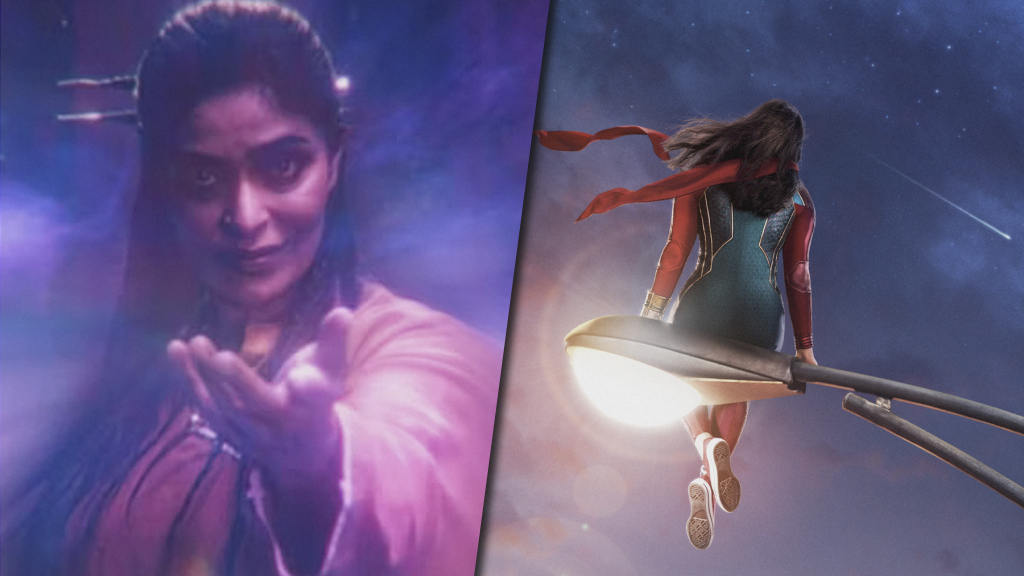
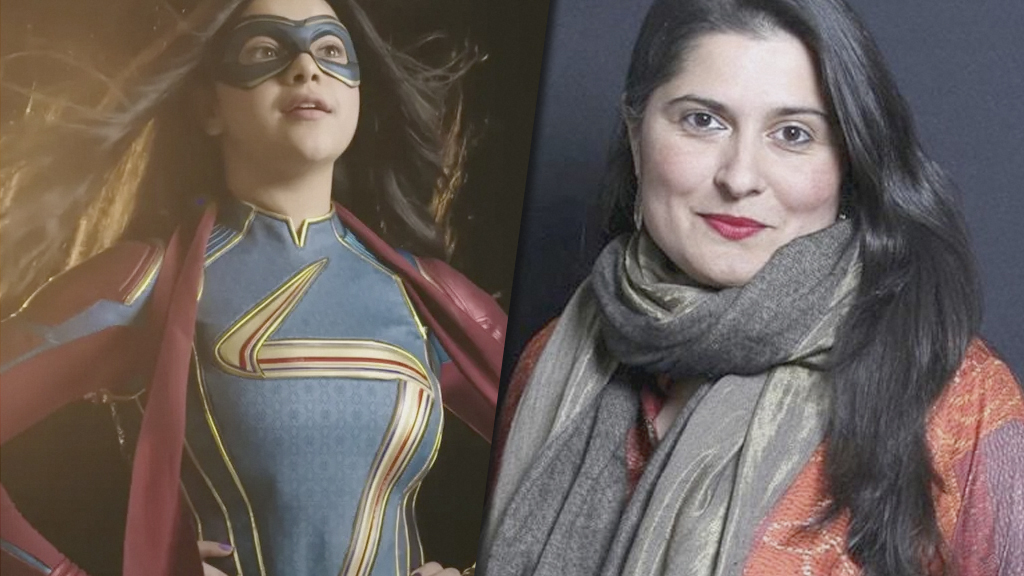
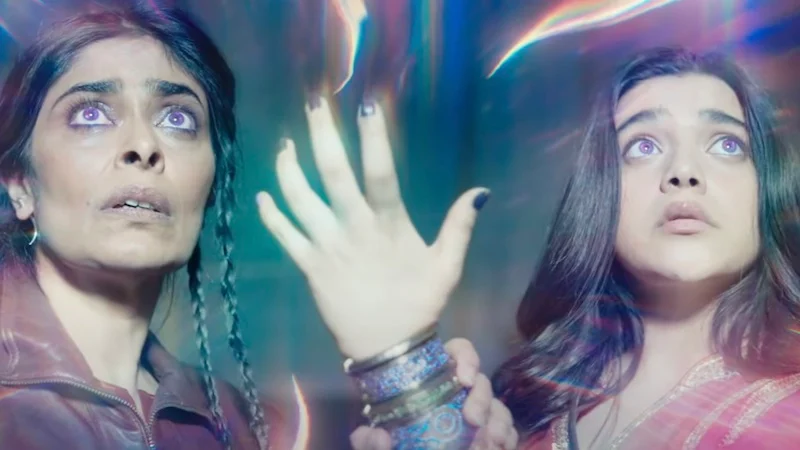
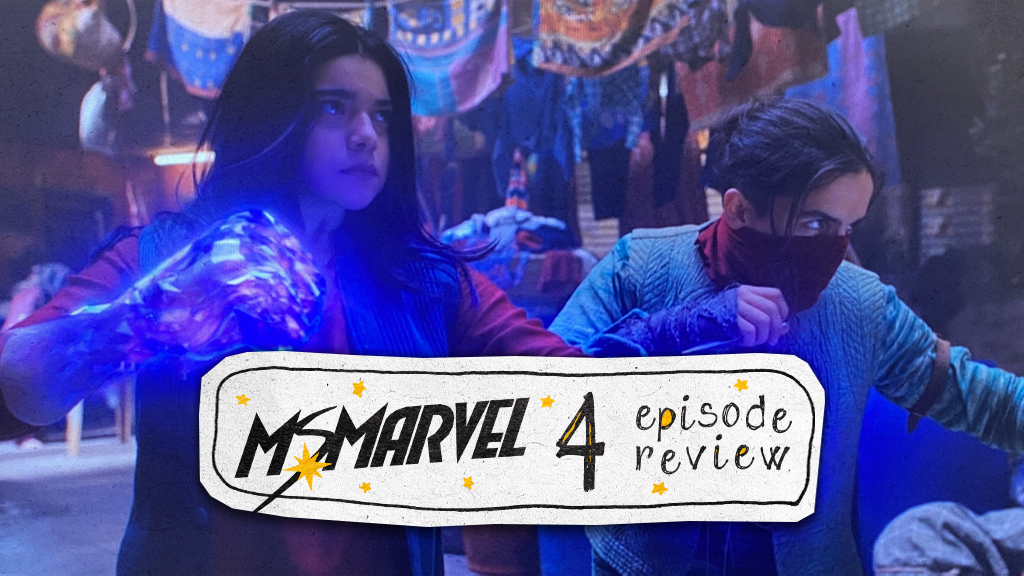
Ms. Marvel ended episode 4 on quite a cliffhanger. After being attacked by the Clandestine, Kamala Khan finds herself in another time. Not just at any time, but during the Partition when her great-grandmother was separated from her family like many others. It left us with many questions, such as if this was just another vision or if Kamala actually traveling through time. Well, director Sharmeen Obaid-Chinoy offered some insight into how they brought the sequence to life and talk about that twist ending.
You know, telling the story of The Partition comes with great responsibility. And I, in Episode 4 at the end, when she walks on the platform, I took hundreds of photographs from 1947. And I worked with the crew and the cast to recreate frames from real photographs. So when she walks onto that train, walks onto the platform, the conversation she’s hearing and the way people are being carried and the props, everything comes out of a real photograph.
Sharmeen Obaid-Chinoy
It definitely sounds like they put a lot of work into bringing this sequence faithfully to life, which makes sense given its historical importance for the generations that lived through it. Obaid-Chinoy also gave some insight into what Kamala’s role is in this sequence.
So that Kamala Khan is bearing witness to history. She’s not a superhero at that moment. She’s literally catching these frenetic conversations. And I think that when you make it personal when you make it about people leaving their homes, then anyone watching anywhere in the world would find a connection to it.
Sharmeen Obaid-Chinoy
There’s definitely something interesting about the fact that she’s not only hearing the stories but also witnessing their events. Once again, the Disney+ Marvel series is promising an emotional rollercoaster of a fifth episode though it’ll be interesting how it leads into the final episode and what the future has in store for the Clandestine. Ms. Marvel is shaping to be one of Marvel Studios’ strongest showings and it’ll be exciting to see how they wrap up the project.
Episodes 4 and 5 of Marvel Studios latest Disney Plus streaming series, Ms. Marvel, were directed by Sharmeen Obaid-Chinoy, a veteran filmmaker with 20 years of experience. And while Obaid-Chinoy, who has won 7 Emmy and 2 Academy Awards for her documentary work, has plenty of time behind the camera, she is brand new to the Marvel Cinematic Universe.
Born in Pakistan, Obaid-Chinoy now plays a large role in bringing Kamala Khan, Marvel’s first Muslim superhero, to the screen from the pages of Marvel Comics. In an exclusive interview, the director explained why she wanted to be part of the creative team that brought Ms. Marvel to life.
I think Kamala Khan changes the way we see superheroes. And I think the world is ready to embrace the fact that superheroes come in all shapes and forms and sizes. And that, in falling in love with the Khan family, in falling in love with Kamala Khan, you open yourself up to these experiences, to this culture, to this way of life, to this food and this music and these fabrics and sort of the richness of the texture of what it is to be an immigrant in America and to find your voice. I think she does this wonderful job of doing that.
Sharmeen Obaid-Chinoy
Through 4 episodes, it’s safe to say that Obaid-Chinoy and the rest of the Ms. Marvel team have succeeded in making fans fall in love with Kamala, her family and their story as the series is among the most-well reviewed projects Marvel Studios has put out to date. The character is already beloved by fans, who are already anticipating star Iman Vellani‘s next appearance in 2023’s The Marvels, and it’s safe to assume she’s going to play a large part in the future of the MCU.
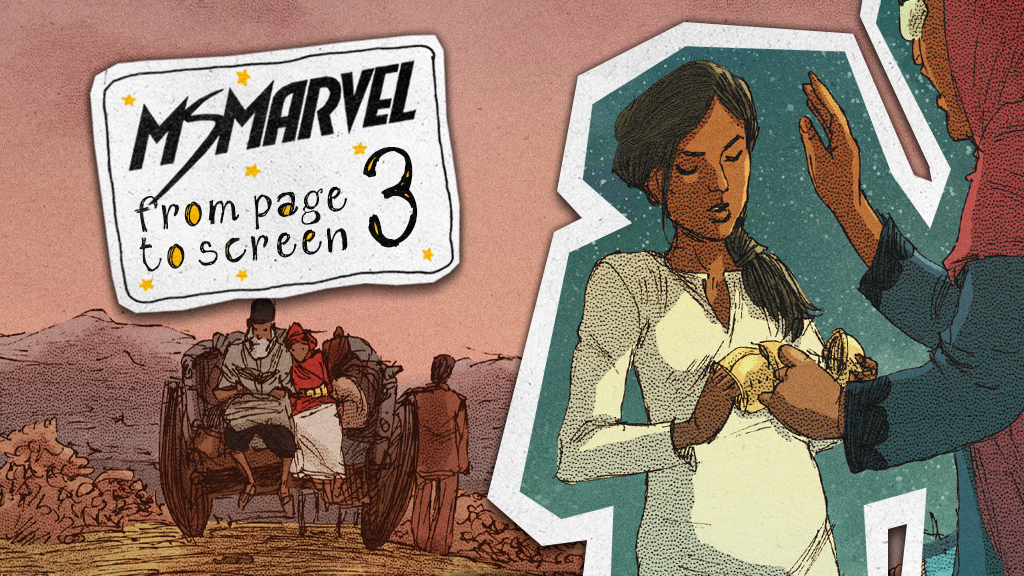
Episode 4 of Ms. Marvel, “Seeing Red”, ended on a very TV-esque cliffhanger that saw Kamala Khan witnessing the events of the 1947 Partition, which divided the British-occupied Indian subcontinent into India and Pakistan, displacing 10 to 20 million people amidst terrible and unprecedented violence that took the lives of as many as 2 million.
The Partition has served as a key point in the story of Ms. Marvel so far as it’s part of the story of Kamala’s great-grandmother, Aisha, the character around whom the central mystery of the 6-part series continues to revolve. Whether Kamala traveled through time to 1947 in Episode 4, or if she’s part of a more immersive vision than the ones she’s previously had is unclear. What is clear, however, is that what she saw on the train platform, and what she’ll see in next week’s episode, will connect her to Aisha in a way that passed down stories from her family never could.
In an exclusive interview with Sharmeen Obaid-Chinoy, the director of episodes 4 and 5 of Ms. Marvel, Charles Murphy asked about the emotional final scene.
Kamala is bringing audiences into something that is rarely visualized on screen, which is the 1947 Partition. And in that moment that she’s walking on the platform, she is not a superhero. She is bearing witness to this monumental period in history that carries such a generational trauma. I took hundreds of photographs from 1947 and recreated that on that platform to be able to tell that story.
Sharmeen Obaid-Chinoy
Obaid-Chinoy went on to explain how the details of the scene, specifically the conversations among those on the platforms, were part of an escalation of emotions that ended in the chilling final shot that showed millions of people chaotically scrambling, leaving friends and family behind.
I wanted Kamala to be catching-to be listening into-these frenetic conversations that were taking place as people were leaving their homes. So she’s almost listening to snippets of conversations and each conversation makes you realize what it meant for those people to leave their homes and to leave relationships and to leave their family members. In the case of the father and the son, he was too old to travel and he was sending his son. This little girl thinks that her mom and her will no longer have a place on the train because it’s so packed. These two friends who are hugging, who’ll never see each other again. And so as she was walking through and she was looking, the anguish of the families was reflecting on her face as she was listening. So I think that by making it deeply personal and making it about families and them leaving their homes, anybody…it was transcending cultures and boundaries. Anybody who’s had to leave home or who’s experienced refugees could…it touched them in some way.
Sharmeen Obaid-Chinoy
In closing, Obaid-Chinoy touched on how important it was that the audience slowly realize the scale of the historical moment and how the camera work in the scene put audiences right into the midst of the frenzy.
And the scale of it was so important, so to make her climb up on that train and to pull the camera back for you to realize that millions of people left their homes. You realize that when the camera pulls back, you see people just jumping onto the train and that frenetic energy…that is exactly how it was in 1947.
Sharmeen Obaid-Chinoy
Of course, the full extent of Kamala’s experience with Partition, and the mechanics of how she finds herself there, are still a mystery but given Marvel Studios’ track record of using the fifth episode of their streaming series to wrap up the ongoing mysteries of the series, fans will likely learn considerably more next week.
Ms. Marvel was a surprising project, as it was seemingly going to release last year. It was hinted at arriving before Hawkeye and we even got a first glimpse at the project during Disney’s Investors Day. Suddenly, the project was postponed and there were hints at quite a few reshoots were ordered for the project. The Direct got a chance to sit down with director Sharmeen Obaid-Chinoy, who offered a little insight into why they needed the reshoots.
At first, she seemingly hints that only “a few pickups” were necessary, especially when it came to tying together the story for the season. Ms. Marvel feels the most “episodic” of all of Marvel Studios’ six-hour drama series and it definitely has one of its most interesting over-arching arcs on her heritage and how it connects with her newly gained powers.
I think that we went back and did some pickup shoots in which we were tying the story in together, and making sure that there was a sort of cohesive storyline that ran through. And I think that each, you know, sort of, with each one of the episodes, when you sort of complete the series, you go back and you just think about all of the other things that you could have brought in and done that. So we did a few pickups here and that
Sharmeen Obaid-Chinoy
She also highlights that a big part that influenced its developments was the fact that they had quite a few crowd shots planned, which were affected by the pandemic. As such, they couldn’t shoot on locations, especially as they had to travel from country to country, which took up a bit more time.
I think it was the pandemic. To be honest, I think that the pandemic was so cyclical, that every time we thought it was coming to an end, it would re-emerge its sort of ugly head. And I think that there are some very big scenes in Ms. Marvel and that require, you know, hundreds and hundreds of extras and that are shot on location, and they’re outdoors. And, you know, there is international travel and, and I think that putting a six-part series that is shot in multiple countries with diverse crews and multiple characters in a pandemic requires time.
Sharmeen Obaid-Chinoy
The Direct theorizes on why exactly this project was delayed as far back as it was, but we’ve seen the restrictions international travel had on Falcon and The Winter Soldier earlier on that may have acted as a lesson for them while tackling a series that is directly tied to its cultural heritage. So, they may have decided to prioritize the reshoots rather than rush it out. Something we may see with many more projects moving forward.
Part of what has made Ms. Marvel so enjoyable over the past four weeks is the genuine mystery that weaves throughout each episode and keeps viewers on their toes. It all stems from the fact that Kamala Khan does not appear to bring her Inhuman ties to the live-action Marvel Cinematic Universe. So, the source of her powers has left both casual viewers and comic book experts scratching their heads as to where the series is taking the beloved character. Even by the end of Episode 4, fans still aren’t entirely clear as to what’s happening. But we first looked at Kamala’s potential connection to the Quantum Realm and time travel after the series premiere, and more evidence of this theory just keeps rolling in.
Numerous aspects of Ms. Marvel could lean in this direction. A major theory suggests that the bangle that activated her powers is, in fact, a quantum band, which derives its powers from the Quantum Realm. There were hints of time travel via Kamala’s visions, and it could be important to remember that her comic powers operated based on constant time-traveling on a molecular level.
What we now know about Kamala’s origins and family history in Ms. Marvel is that her great-grandmother, Aisha, was a “Clandestine” or “Djinn.” While the “Djinn” designation turned out to be more of a red herring based on what we learned in Episode 4, we also know that the Clandestines come from the Noor Dimension, which is separated from the main reality by a veil of energy. Najma and her gang want Kamala to break through that veil, but it has been made clear that if she were to do so, the Noor Dimension would overtake and destroy Kamala’s reality.
We do not know much about the Noor Dimension other than that supernatural beings, identified in the past as “Djinn”, came from it and that Clandestines and the Red Daggers can sense the Noor energy that Kamala draws from the other dimension. In the MCU, we know about a few realms. Asgard is a great example, and it is even referenced in Episode 4 to help explain the Noor Dimension. Another “realm” we have heard of is the Quantum Realm, which is certainly creeping in as a major player in the future of the MCU.
As we know from Avengers: Endgame, the Quantum Realm, and quantum energy were the backbones of time travel. What Episode 4 possibly re-emphasizes is Kamala’s connection to time travel. By the end of Episode 4, Kamala seems very much in the 1940s in India after her bangle was attacked and went haywire. While it is not entirely clear yet whether she is actually, physically present there, the ending shots of the episode certainly made it easy to make that conclusion. Obviously, Episode 5 will keep her in that space for the purpose of explaining and resolving Aisha’s mysterious storyline, which is profoundly connected to the exact period Kamala is now in.
Still worth noting, Ms. Marvel has had quite the number of Ant-Man references. Obviously, Scott Lang and Hank Pym are the characters most associated with the Quantum Realm, and we next expect to see Ant-Man in Ant-Man and the Wasp: Quantumania. “Quantumania” alone should set the expectations for how important the Quantum Realm will be, but that film will also star the time-travelling villain Kang the Conquerer. Following Loki, the Kang Easter egg in Moon Knight, and Phase 4’s focus on the multiverse, Kang is very much set up to potentially be the next MCU saga’s Big Bad.
Overall, there’s enough evidence to form the theory that Kamala is utilizing some of the same general concepts that we have already been introduced to in the MCU. If the Noor Dimension is actually the Quantum Realm, that major piece of the universe would be served by being better developed in Ms. Marvel. It also could make Kamala’s story more interesting than if the Noor Dimension was a completely original concept that gets limited to her origin story and not much else. Obviously, there is more nuance to why Kamala or Aisha can utilize the bangle while others, like the Clandestines, cannot. We will likely learn virtually all of this information in the next episode, as all MCU DIsney+ series love spending the majority of their penultimate episodes resolving every mystery or question, and ultimately setting the hero up for the final battle fully embracing their identity.
The first four episodes of Ms. Marvel are now streaming on Disney+.
The fourth episode of Ms. Marvel just dropped and brought with it quite a lot of Kamala’s heritage and family history; not to mention some quality action sequences and Marvel Cinematic Universe world-building. But apart from the gradual exploration of what the series has dubbed the Noor Dimension, Ms. Marvel also debuted a connection to a future MCU project. In fact, it looks like a potentially major element of She-Hulk: Attorney At Law has had the foundation laid for it.
While the Department of Damage Control’s presence has faded since the first two Ms. Marvel episodes, their role in the story has carried on in a more subtle way. At the end of Episode 3, the DODC took the Clandestines into custody after the wedding fight. In Episode 4, we see the follow-up to that, as the Clandestine escape being brought into the DODC Supermax Prison. While we do not see any main area of the prison, we do see a shot of the outside of it. As it turns out, the DODC Supermax was the prison complex seen in the She-Hulk trailer.
By showing up in multiple projects, the Supermax has essentially been established as being a significant element in the MCU. While we got a taste of the Raft in Captain America: Civil War, that high-security prison has not been used since. The fact that the Supermax is run by the DODC is important for a few reasons. First, it means that, unlike the Raft, there is nothing secretive about it—it appears to be on land and is extremely visible and accessible.
Second, it means that the DODC is likely here to stay as an ongoing source of law enforcement and a thorn in the sides of superpowered people. This confirms the message in the second episode of Ms. Marvel that Damage Control is on a mission to target and incarcerate enhanced people. To what extent is unclear—surely some supers are allowed to operate, but we may find out more in She-Hulk.
Jennifer Walters, aka She-Hulk, is an attorney who specializes in superhuman law. We know from the She-Hulk trailer that she will deal with people like Emil Blonsky, otherwise known as Abomination. While we do not know for sure where Blonksy is being held, the DODC Supermax is now the top candidate. Practicing superhuman law requires either representing or suing superhumans. A great place to find clients or targets, then, would be a building where a bunch of superhumans is being held prisoner for alleged crimes.
So what do we know about the DODC Supermax Prison so far? Not a lot, aside from the fact that it is operated by the DODC. We can assume some relatively high-profile people, like Abomination, are there. If it is a sort of catch-all prison like it seems to be, a wide variety of supervillains should pass through. Despite being a Supermax prison, it clearly has terrible security. The Clandestine essentially walked out of that place. Plus, it is almost a given that prison breaks will pop up at least every now and again.
The first four episodes of Ms. Marvel are now streaming on Disney+.
While Ms. Marvel still has to stick the landing in its final two episodes—something that Marvel Cinematic Universe shows tend to struggle with—its Episode 4 was yet another triumph for Kamala Khan’s series. In fact, it manages to follow the MCU series template for four episodes, but yet surpasses all expectations set by previous Disney+ installments. Ultimately, the conclusion, so far, on Ms. Marvel is that from inception to execution it is the highest quality MCU series to date. And it is not particularly close.
While the mystery of Kamala’s origin continues in Episode 4, it is still developing in more interesting ways in each episode. Quickly, we learn that there is much more depth and nuance to the “Djinn” classification we were introduced to in the previous episode, and we get a hint that the Noor connection may have stronger connections to the more traditional super-aspects of the MCU. What that connection actually is remains the driving energy of the series, and Ms. Marvel expertly stretches the reveal out much like Kamala can stretch out her own hard light energy.
But one of the most delightfully perplexing aspects of Ms. Marvel is uncovering why exactly this is so well played out. While many substantive aspects of Ms. Marvel are certainly unique from other MCU entries, the actual structure of the series is not. For example, virtually every MCU series has a major cliff-hanging plot twist-type ending to its fourth episode. In WandavIsion’s Episode 4, Wanda’s sentience in the Hex is formally revealed. In Loki, the titular character wakes up to different variants of himself at the end of time. In Moon Knight, Marc Spector is killed and is awakened in what appears to be a mental asylum. Here, in Ms. Marvel, Kamala seems to have been somewhat transported to the past, as she finds herself engulfed in the scene of the last train to Karachi the night her great-grandmother Aisha disappeared.
So while this sort of ending was not a true surprise—and the structure of the penultimate episode can likely similarly be guessed to an extent—Ms. Marvel executes it on an absurdly impressive level. The final shots are breathtaking and rely mostly on a realistic reimagining of the past rather than supernatural, magical, or fantastical elements. While the knowledge of Partition and Kamala’s family history has been known to this extent since the second episode, Episode 4 fully opened the door for what Kamala’s very human origin means to the character, and frankly, the world at large. Even Kamala is completely at a loss for words at the tragedy, suffering, and pain she sees around her.
Much of the beauty of the series’ focus on Kamala’s mysterious origin is the fact that, as emphasized and written in stone in this episode, Kamala’s origin is as much intertwined with traditional reality as it is with whatever inter-dimensional tie-in is. All superheroes carry the weight and strengths of their non-super past, but Ms. Marvel is unique in truly expressing that Kamala’s foundation is in her family and its history. The bangle is certainly the most important force in her superpowers, but it is every bit as important to Kamala’s character as is her relationship with her mother, her mother’s relationship with her mother, and whatever happened to Aisha during Partition.
In the midst of the incredibly rich storyline, even the action sequences of Episode 4 stand out. In particular, the extended chase scene could without a doubt be plopped into a feature film as is and no one would question it. While often in MCU series, even Ms. Marvel, action is rushed and sparing, this scene proved that that is a choice and not a necessity for these shows.
So, to go back to the earlier question of whyMs. Marvel seems to be ahead of the curve, there are numerous unique things that the show brings to the table. But it would not be fair to say that the series radically upended the Disney+ MCU model. Not everyone will personally prefer the series over all others, and no one has to. But at the end of the day, in all truthfulness, Ms. Marvel has been written and executed with such quality that it truly stands out. On no level is that an attack on other MCU shows, either—Ms. Marvelis simply that good.
In episode 3 of Ms. Marvel, “Destined”, Kamala finds out more about her heritage and how the power inside of her works. After rescuing her from Damage Control at the end of the second episode, Kamran’s mom, Najma, fills Kamala about the true nature of her great-grandma, Aisha, who is a Djinn from the Noor Dimension. Najma and Aisha believed that a pair of bangles, one of which Kamala now wears, could return them and their exiled family back home. Najma and her family, the Clandestine, seem harmless and and to only want Kamala’s help in using the bangle to open a portal to the Noor Dimension.
While Kamala learns the truth about her heritage and asks Bruno to help her send the Clandestine home, her brother’s wedding takes center stage. Unfortunately, it turns out that Najma isn’t so trustworthy after all and quickly decides to make Kamala try to send them home, despite a warning from Bruno that it might be very dangerous. After being warned by Kamran that the Clandestine are on their way and that everyone at the wedding is in danger, Kamala pulls the fire alarm, essentially ruining the wedding. She does this to save everyone from getting hurt but it only hurts her relationship with her family. Kamala survives a fight with the Clandestine, which is interrupted when Damage Control shows us and takes them into custody. When she returns home, she is too afraid to tell her family that she is Night Light. At the very end of the episode, her Nani calls Kamala and says that she needs to come to Karachi right away. Nani insists this because she saw the same vision of a train that Kamala saw during her fight with Najma.
Why her Nani sees the same vision as her is pretty self-explanatory. She probably has the same powers as Kamala and the bangle is connected to them both. Kamala’s mom probably also has this power but she is hiding it from Kamala, just the same way she hid the bangle at first. If her mom does have the same power then we can assume that she has the same visions as well.
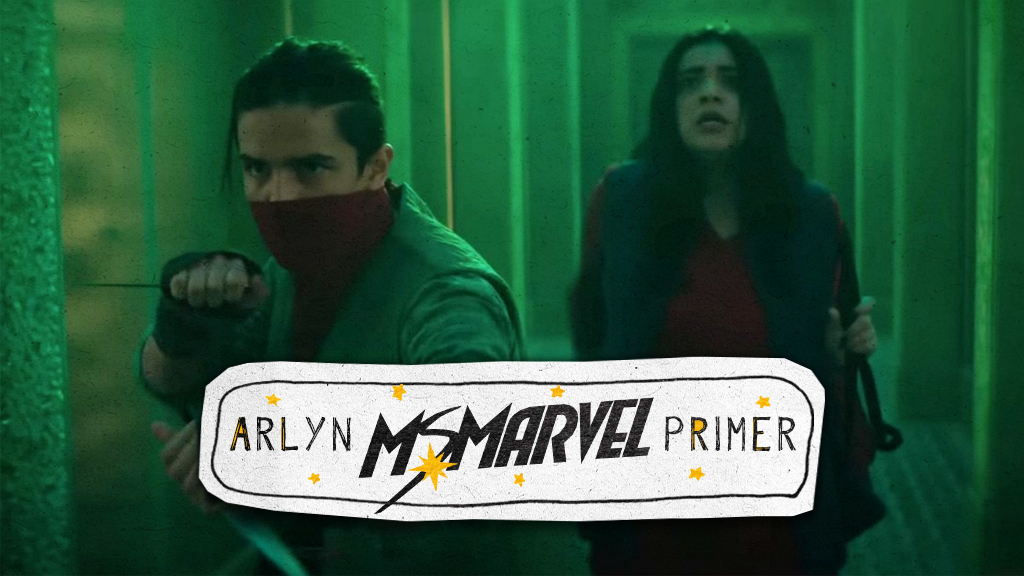
Arlyn’s Assumptions
In this next episode, I know that Kamala goes to Karachi. In order to get there, Kamala must tell her mom about everything that has happened, including her powers and the visions she is seeing. Either that, or she’s going to be sneaking out for one heck of a trip! It’s also going to be interesting to hear another side of Aisha’s story, this time from someone who seems like a little less of a villain than Najma. Will their stories match up? Almost definitely not, so I’m thinking this episode will reveal the truth about Aisha, the Clandestine and Kamala’s heritage.
The next episode of Ms. Marvel will stream on Disney+ tomorrow!
The beginning of Episode 3, titled “Destined”, brought forth a lot of information supposedly explaining much of Kamala’s origin and background. Najma, Kamran’s mother and the woman Kamala had visions of, tells Kamala that she and Kamala’s great-grandmother Aishia were not human. Specifically, Najma claims that she and some others she appears to live with are actually Djinn, who were exiled from their home Noor dimension. She states that they are called many names, including Clandestines.
The explanation of who Djinn are that we get in Episode 3 of Ms. Marvel is pretty sparing. Kamala’s dad reads Bruno’s research, which says that Djinn are mythological beings of pre-Islamic folklore, sometimes referred to as genies. We also know from references throughout the series that Djinn seem to be viewed as demons to the superstitious, including Kamala.
Marvel Studios’ Ms. Marvel Episode 3
Marvel Studios’ Ms. Marvel Episode 3
There are still a lot of questions about the group, but they appear to be a patchwork group of loosely-related Djinn who live together. It is unclear if anyone is closely related other than Kamran and his mother, but there is a clear theme of family and belonging within the Clandestines which Najma uses to manipulate Kamala.
ClanDestine in the Comics
ClanDestine #1 (2008)
The Clandestines of Ms. Marvel are clearly influenced by the ClanDestine comics, although ClanDestine seems to provide minimal inspiration rather than being directly adapted into live-action. In the comics, ClanDestine is a large, kind of odd family comprised of the progeny of Adam Destine and a being named Elayath. All of their children inherited superhuman abilities of some kind. Adam himself is immortal and many of the children are decades or centuries apart in age.
The family primarily sought to operate in secret rather than identifying themselves as super-powered beings or superheroes, though certain members try to follow this path. ClanDestine stories in the comics are driven by family conflict, such as when Adam killed his son Victor because he believed he had become evil.
ClanDestine #5 (1994)
ClanDestine #5 (1994)
ClanDestine #5 (1994)
The clear connection that the makers of Ms. Marvel made to ClanDestine is that the matriarch, Elayath, is a Djinn. Adam freed her from a wizard that had trapped her in a jewel around 1200 A.D. In return, she granted him his immortality and invulnerability.
Why Would Ms. Marvel Adapt ClanDestine?
ClanDestine #12 (1995)
The comics’ ClanDestines and Ms. Marvel’s Clandestines seem extremely different in history, nature, and group members. The connection between the two seems to boil down simply to the name and the Djinn aspect. Even so, how the two groups incorporate Djinn is entirely different, as ClanDestine is a family descended from a single Djinn, whereas the Clandestines in the show appear to all be a type of being, known as Djinn, from another dimension.
Why would Marvel make this connection between an extremely obscure group from the comics and a very different group in live-action? It all likely comes down to the series attempting to give Kamala’s background and origin the same type of explanation as her Inhuman heritage in the comics. Everything in the series suggests that Marvel Studios wants to mimic Kamala’s comic story without invoking Inhumans. So, in Ms. Marvel, the Clandestines are a family-like group of super-powered, or at least mystical, beings that Kamala is related to in some way, similar to her relationship to Inhumans in the comics.
Ms. Marvel #7 (2014)
That connection is relatively obvious, but the series clearly wanted that familial theme to be tied to Kamala’s religious and cultural heritage. This leads, of course, to using beings of pre-Islamic folklore, Djinn, as an option to explain why Kamala is more than human. There is very little comic basis for this, but ClanDestine happens to already contain those essential elements of Kamala’s story in Ms. Marvel.
Marvel Studios’ Ms. Marvel Episode 3
To be fair, Najma’s explanation of the Clandestines should be taken with a grain of salt given the fact that she is a clear villain and there is not much evidence yet to back up her claims. Still, Ms. Marvel certainly made a bold creative choice in adapting ClanDestine from the comics to build Kamala’s Khan’s story.
The first three episodes of Ms. Marvel are now streaming on Disney+.
Ms. Marvel has been quite the standout in the Marvel Cinematic Universe. Not only does it offer a window into the life of Muslim-Americans with the touch that many have wanted from these kinds of stories, but also one of the visual standouts in the franchise. While the series may be the most down-to-earth for the franchise, Ms. Marvel‘s sound mixer Chris Giles teases the final episodes as “dynamic” in an interview with The Direct.
In the interview, he especially highlights how the later episodes will be “touching on things that a lot of Westerners may not even be aware” of and it may offer a culturally relevant backstory that we haven’t seen yet in the MCU.
The standout ones will be, somewhere in my mind, for me, will be later in the series. Because we start touching on things that a lot of Westerners may not even be aware of existing. Maybe if you follow the canon of Ms. Marvel and a few other things, you might be able to kind of piece it together and figure some of this out. But I’m fascinated that there are some stories that are going to be told through this medium. And it’s kind of to me, it’s backstories, it’s sort of things that help develop these characters.
Chris Giles
He also goes on to highlight how this new series format offers a way to further explore the origin stories of the characters and continues to tease that “some really, really cool things coming” our way in the Disney+ series.
Because, you know, Marvel gets critiqued a lot for, oh, there’s no character development, oh, it’s just flashing and banging and blowing things up, and this and that. Especially these episodic streaming projects, they’re able to flesh out a lot of backstories. So, whenever you do greet them on the big screen, you’re like, oh, I was able to read up on such and so, this is why they are at, you know, an adversary to this other person that I thought was a good person or bad guy, or whatever the case is. No, there are some really, really cool things coming.
Chris Giles
What stood out in the interview is that he also teases a “dynamic differently” direction as the backstory is further explored. The last episode already offered us a glimpse into a very surprising new direction with Ms. Marvel’s origin and we may get a better look as more puzzle pieces fall into place moving foward.
I can’t say. When they start building more of the backstory, it gets more dynamic differently than I think a lot of MCU things have typically. So, if nothing else, because it’s different. It stands out in my mind. I hope it translates to the audience because we can perceive it one way, because we’ve read the scripts we’ve been through the process. And we can applaud our ways all the way to release. But, until the audience sees it, you have no idea if it registers, or if it speaks to people. Mostly because the demographics that it serves are what speak to me the most. If nothing else, the more youthful audience.
Chris Giles
It definitely sounds like Ms. Marvel may continue to evolve and if it hits the landing, could find its place among the top of the Marvel Studios’ offerings on Disney+ so far. It has the most “weekly” feeling, unlike some of the other dramas that have a more “six-hour film” approach. So, it’s going to be exciting to see how the story comes together.
We use cookies to improve your experience on our site. By using our site, you consent to cookies.
This website uses cookies
Websites store cookies to enhance functionality and personalise your experience. You can manage your preferences, but blocking some cookies may impact site performance and services.
Essential cookies enable basic functions and are necessary for the proper function of the website.
Name
Description
Duration
Cookie Preferences
This cookie is used to store the user's cookie consent preferences.
30 days
These cookies are needed for adding comments on this website.
Name
Description
Duration
comment_author_email
Used to track the user across multiple sessions.
Session
comment_author_url
Used to track the user across multiple sessions.
Session
comment_author
Used to track the user across multiple sessions.
Session
Statistics cookies collect information anonymously. This information helps us understand how visitors use our website.
Google Analytics is a powerful tool that tracks and analyzes website traffic for informed marketing decisions.
Contains information related to marketing campaigns of the user. These are shared with Google AdWords / Google Ads when the Google Ads and Google Analytics accounts are linked together.
90 days
__utma
ID used to identify users and sessions
2 years after last activity
__utmt
Used to monitor number of Google Analytics server requests
10 minutes
__utmb
Used to distinguish new sessions and visits. This cookie is set when the GA.js javascript library is loaded and there is no existing __utmb cookie. The cookie is updated every time data is sent to the Google Analytics server.
30 minutes after last activity
__utmc
Used only with old Urchin versions of Google Analytics and not with GA.js. Was used to distinguish between new sessions and visits at the end of a session.
End of session (browser)
__utmz
Contains information about the traffic source or campaign that directed user to the website. The cookie is set when the GA.js javascript is loaded and updated when data is sent to the Google Anaytics server
6 months after last activity
__utmv
Contains custom information set by the web developer via the _setCustomVar method in Google Analytics. This cookie is updated every time new data is sent to the Google Analytics server.
2 years after last activity
__utmx
Used to determine whether a user is included in an A / B or Multivariate test.
18 months
_ga
ID used to identify users
2 years
_gali
Used by Google Analytics to determine which links on a page are being clicked
30 seconds
_ga_
ID used to identify users
2 years
_gid
ID used to identify users for 24 hours after last activity
24 hours
_gat
Used to monitor number of Google Analytics server requests when using Google Tag Manager
1 minute
Marketing cookies are used to follow visitors to websites. The intention is to show ads that are relevant and engaging to the individual user.
Pinterest Tag is a web analytics service that tracks and reports website traffic.